
2 layers23 × 120 mm

 BrijModi/ESP32-Quadcopter-FlightController1
Open-source ESP32-based flight controller for quadcopters, featuring sensor fusion, nested PID control, motor mixing, real-time Wi-Fi PID tuning, and a custom KiCad PCB with support for GPS and FPV modules.
Drone Flight Controller is an open-source printed circuit board by BrijModi, from the BrijModi/ESP32-Quadcopter-FlightController repository on GitHub, published under the MIT licence. It is a 2-layer board of 53.4 × 68.4 mm with 21 parts on 41 nets, routed with 126 tracks and 8 vias.
It is built around the MPU-6050. Its parts include 11 connectors, 2 capacitors, 2 ICs, 1 resistor and 1 diode. It belongs with the robots and motor control and radio and wireless boards and the ESP32 boards of this library.
Open-source ESP32-based flight controller for quadcopters, featuring sensor fusion, nested PID control, motor mixing, real-time Wi-Fi PID tuning, and a custom KiCad PCB with support for GPS and FPV modules.
This project is a fully custom ESP32-based quadcopter flight controller, built from scratch to provide complete hardware and firmware flexibility.
Unlike commercial closed-source flight controllers, this system allows direct modification of IMU handling, PID algorithms, motor mixing, and communication layers—making it ideal for learning, research, and UAV experimentation.
The controller runs an 83 Hz control loop, uses a complementary filter for real-time roll/pitch estimation, and stabilizes the quadcopter using nested PID loops (Angle + Rate).
A built-in Wi-Fi interface enables on-the-fly PID tuning and telemetry, eliminating the need to reflash firmware between adjustments.
This repository includes the complete firmware, custom KiCad PCB design, calibration and testing utilities, project media, and a comprehensive technical report documenting the system design and implementation.
Firmware/
Main_Firmware/ – Main ESP32-based quadcopter flight controller firmwareTesting_Calibration/ – Calibration, testing, and Wi-Fi PID tuning utilitiesHardware/
Drone Flight Controller/ – Complete KiCad project (schematic, PCB layout, and project files)FC Gerber.zip – PCB manufacturing (Gerber) filesPCB View.pdf – PCB layout overviewSchematic.pdf – Flight controller circuit schematicMedia/
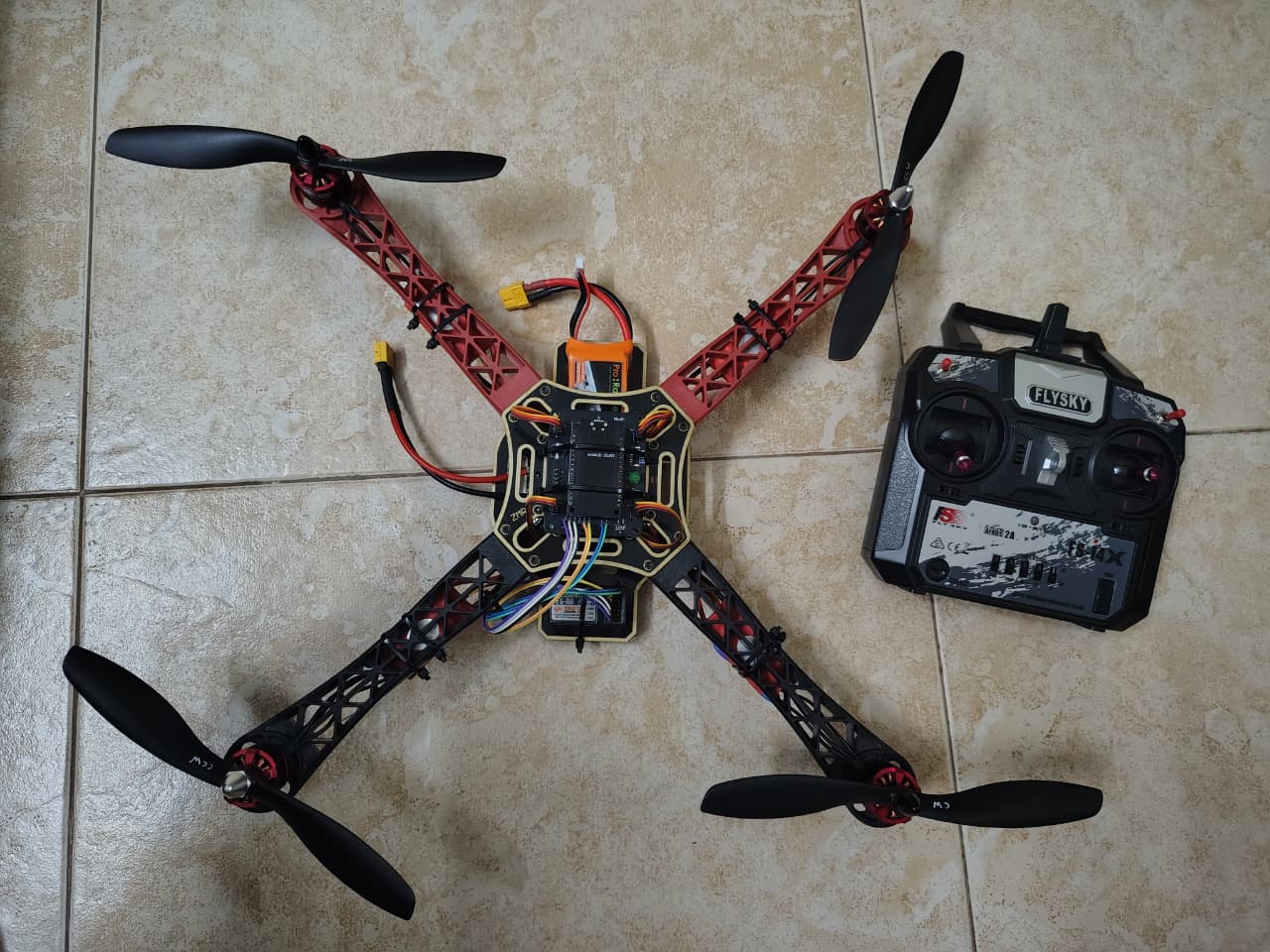
Drone/ – Drone assembly, flight controller, and hardware imagesTest Flight and Calibration/ – Flight test videos, calibration recordings, and PID response graphTechnical Report.pdf – Comprehensive technical documentation covering hardware design, firmware architecture, implementation, and testing
Wire – I²C communicationESP32Servo – ESC PWM controlWiFi – Wireless communicationAsyncTCP – Asynchronous TCP networkingESPAsyncWebServer – Web-based PID tuning dashboardSPIFFS – Web dashboard file storageFollow the steps below to configure and fly the quadcopter for the first time.
Firmware/Testing_Calibration/Receiver_PWM_Testing/ to verify proper receiver operation.Firmware/Testing_Calibration/ESC_Calibration/ and calibrate all ESCs.Firmware/Testing_Calibration/IMU_Calibration/.Firmware/Testing_Calibration/PID_Tuning_Webserver/.Firmware/Main_Firmware/Flight_Controller_v2/Flight_Controller_v2.ino.| Qty | Value | Footprint | References |
|---|---|---|---|
| 4 | MountingHole | MountingHole:MountingHole_3.2mm_M3 | H1, H2, H3, H4 |
| 2 | 470uf, 25v | Capacitor_SMD:CP_Elec_6.3x7.7 | C1, C2 |
| 1 | 220 / 330 | Resistor_THT:R_Axial_DIN0207_L6.3mm_D2.5mm_P7.62mm_Horizontal | R1 |
| 1 | Batt | Connector_PinHeader_2.54mm:PinHeader_1x02_P2.54mm_Vertical | J9 |
| 1 | Camera | Connector_JST:JST_XH_S3B-XH-A_1x03_P2.50mm_Horizontal | J7 |
| 1 | ESC1 | Connector_PinHeader_2.54mm:PinHeader_1x03_P2.54mm_Vertical | J2 |
| 1 | ESC2 | Connector_PinHeader_2.54mm:PinHeader_1x03_P2.54mm_Vertical | J3 |
| 1 | ESC3 | Connector_PinHeader_2.54mm:PinHeader_1x03_P2.54mm_Vertical | J4 |
| 1 | ESC4 | Connector_PinHeader_2.54mm:PinHeader_1x03_P2.54mm_Vertical | J5 |
| 1 | ESP32 DEV Board | ESP32 Devkit v1:MODULE_ESP32_DEVKIT_V1 | U1 |
| 1 | GPS / Compass | Connector_PinHeader_2.54mm:PinHeader_1x04_P2.54mm_Vertical | J11 |
| 1 | LED | LED_THT:LED_D5.0mm | D1 |
| 1 | MPU-6050 | Connector_PinHeader_2.54mm:PinHeader_1x08_P2.54mm_Vertical | U2 |
| 1 | Pressure Sensor | Connector_PinHeader_2.54mm:PinHeader_1x07_P2.54mm_Vertical | J10 |
| 1 | Receiver Channels | Connector_PinHeader_2.54mm:PinHeader_1x06_P2.54mm_Vertical | J6 |
| 1 | Receiver Power | Connector_PinHeader_2.54mm:PinHeader_1x02_P2.54mm_Vertical | J1 |
| 1 | VTX | Connector_JST:JST_GH_SM06B-GHS-TB_1x06-1MP_P1.25mm_Horizontal | J8 |
It measures 53.4 × 68.4 mm and has 2 copper layers, 1.6 mm thick.
21 parts, built around the MPU-6050. The full list of its parts is on this page, with links to each part's symbol and footprint where PCBKit's library has them.
From the BrijModi/ESP32-Quadcopter-FlightController repository on GitHub, at the commit this page was made from: the board is Hardware/Drone Flight Controller/Drone Flight Controller.kicad_pcb and its schematic Hardware/Drone Flight Controller/Drone Flight Controller.kicad_sch. PCBKit opens the board in the browser, with nothing to install.
Its repository publishes it under the MIT licence: you may reuse it on that licence's terms (keep the author's notice, and for a copyleft licence share your changes alike).

ZhuYanzhen1/MM32_CLion
本项目是全国大学生智能车竞赛GDUT 2022年极速越野组的项目文件。采用了LQR控制器和多速率卡尔曼融合算法,并在单片机上实现。This project is the project document for the GDUT 2022 Extreme Off-Road Category of the National Student Intelligent Vehicle Competition.


victorhook/asac-fc
asac fc is an rp2040 based flight controller made for FPV drone flying


pms67/PModlet
PMOD PCB with USB-to-UART converter and IMU (MPU-6050, I2C) for FPGAs.