4 layers45 × 89 mm
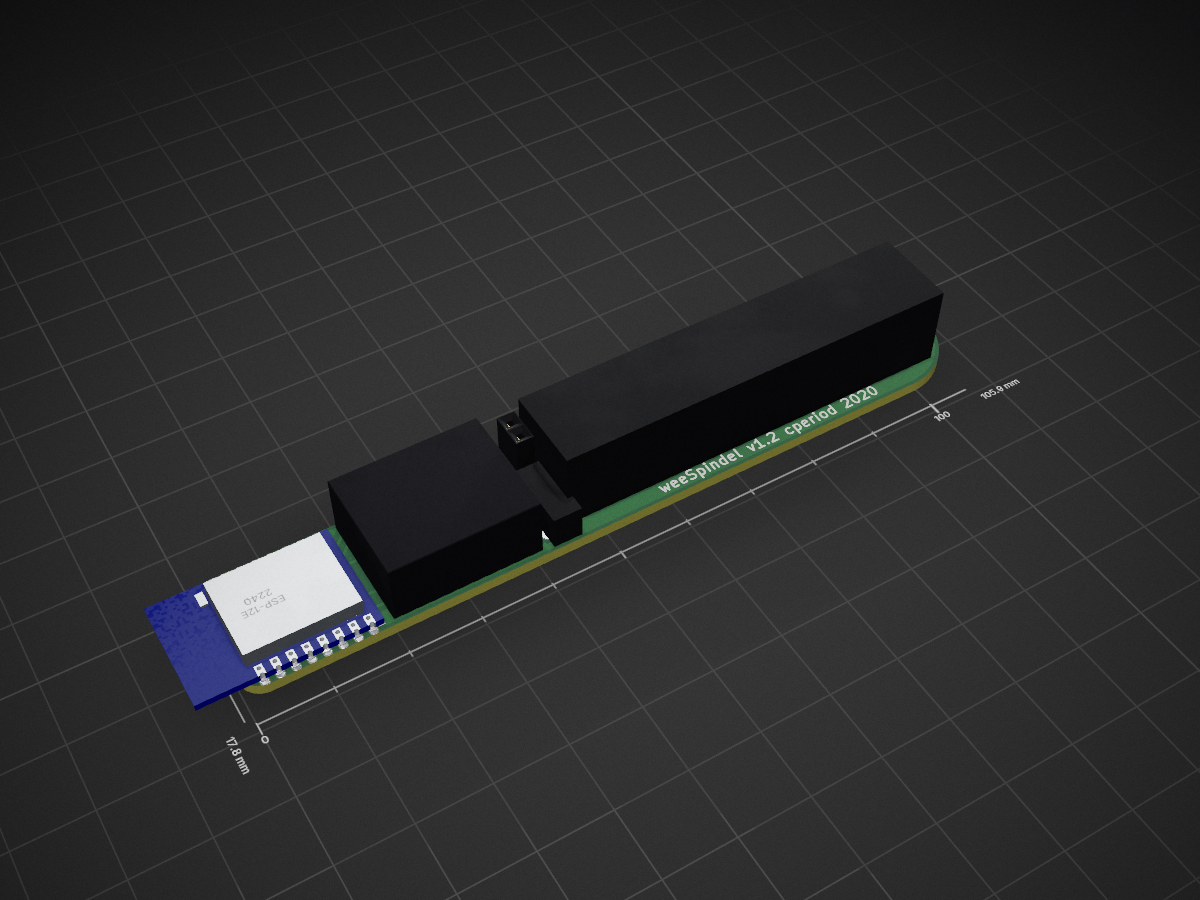
 c-/weeSpindel17
Smaller, simpler version of the iSpindel. NOTE: Work-in-progress
WeeSpindel is an open-source printed circuit board by c-, from the c-/weeSpindel repository on GitHub. It is a 2-layer board of 98.5 × 17.8 mm with 22 parts on 20 nets, routed with 121 tracks and 15 vias.
It is built around the ESP-12E, HT7733SA and MPU-6050. Its parts include 7 capacitors, 7 resistors, 3 ICs, 1 connector and 1 switch. It belongs with the ESP8266 boards of this library.


I like the idea of the iSpindel, but I wanted something smaller; ideally, something which I could use in my glass carboys. This contraint means I need to get it into a tube with an outside diameter of approximately 25mm.

I've also been trying to get away from Li-ion as a power source and stick to simple NiMH rechargeables. Using ESP-NOW as a communications protocol makes a single NiMH cell with a boost converter a realistic option. However, it turns out that a 25mm tube containing a AA NiMH cell doesn't have the necessary buoyancy to actually float, much less tilt, so I've been forced to switch to an AAA cell. In a nod to practicality, I've also included the option to use a 10440 (AAA-size) Li-ion cell with a conventional LDO regulator, which seems far more stable at this point.
Stripping out all the bits of the iSpindel that I can't use or don't need, I'm left with an ESP-12 module, the MPU-6050 module, the power circuitry, assorted passives, and a single battery cell. Even the DS18B20 temperature sensor is dropped in favour of the MPU-6050. Programming the ESP is handled by either removing it (I mount mine on pin headers) or some sort of TBD pogo pin jig.
weeSpindel is running a stripped down firmware which transmits reports using an ESP-NOW broadcast rather than WiFi. ESP-NOW allows for low-overhead transmission, which reduces the wake-read-send-sleep cycle to approximately 100-120ms (we only bother with five samples from the MPU, which honestly might even be excessive). A ESP-NOW-to-MQTT (ESP32 with an W5500 ethernet module) gateway makes the sensor results available in Home Assistant, etc. Configurability is... minimal.
Note that we don't bother with something like a MOSFET to cut power to the MPU module; between it and the (on my board, at least) Torex XC6204 LDO it'll use maybe 5uA during sleep. We do remove the LED in the usual fashion.
The prototype is done on a PCB mill, and that naturally limits what sort of component footprints I can comfortably get away with. Future design using a manufactured PCB opens up a few possibilities.
Lose the MPU-6050 module and put the chip directly on the board.
The failure mode of the HT7733SA boost regulator when the voltage drops too low (under 1.2v with a AAA NiMH cell) is to go into a approx 200mA battery draining loop. This is bad. In extreme cases, it'll reverse-charge the NiMH cell. The fix for this would be to change to a boost regulator with under-voltage lockout (UVLO). Something like the TPS61097 should do the trick.
I'd love to get a USB controller onboard for programming. Probably the CH340E.
| Qty | Value | Footprint | References |
|---|---|---|---|
| 3 | 100nF | Capacitor_SMD:C_0805_2012Metric_Pad1.15x1.40mm_HandSolder | C1, C6, C7 |
| 3 | 10K | Resistor_SMD:R_0805_2012Metric_Pad1.15x1.40mm_HandSolder | R4, R6, R7 |
| 3 | 10uF | Capacitor_SMD:C_0805_2012Metric_Pad1.15x1.40mm_HandSolder | C2, C3, C4 |
| 1 | 100uF | Capacitor_Tantalum_SMD:CP_EIA-3528-12_Kemet-T_Pad1.50x2.35mm_HandSolder | C5 |
| 1 | 10uH | Inductor_SMD:L_Coilcraft_XxL4040 | L1 |
| 1 | 1K | Resistor_SMD:R_1206_3216Metric_Pad1.42x1.75mm_HandSolder | R3 |
| 1 | 1M | Resistor_SMD:R_0805_2012Metric_Pad1.15x1.40mm_HandSolder | R1 |
| 1 | 330K | Resistor_SMD:R_0805_2012Metric_Pad1.15x1.40mm_HandSolder | R2 |
| 1 | 47K | Resistor_SMD:R_0805_2012Metric_Pad1.15x1.40mm_HandSolder | R5 |
| 1 | Cal | CPB:Socket_Strip_Straight_1x02_Oval_Pitch2.54mm | JP1 |
| 1 | ESP-12E | CPB:ESP-12Emin | U1 |
| 1 | HT7733SA | Package_TO_SOT_SMD:SOT-23-5 | U2 |
| 1 | MCP1700-3302E_SOT23 | Package_TO_SOT_SMD:SOT-23 | U3 |
| 1 | MPU-6050 | CPB:MPU-6050 Breakout I2C | J1 |
| 1 | NiMH | CPB:Battery_Springs_AAA | BT1 |
| 1 | POWER | CPB:SPST Switch 9mmx3.5mm C223839 | SW1 |
It measures 98.5 × 17.8 mm and has 2 copper layers, 1.6 mm thick.
22 parts, built around the ESP-12E, HT7733SA and MPU-6050. The full list of its parts is on this page, with links to each part's symbol and footprint where PCBKit's library has them.
From the c-/weeSpindel repository on GitHub, at the commit this page was made from: the board is weeSpindel.kicad_pcb. PCBKit opens the board in the browser, with nothing to install.
Its repository states no licence, so its author keeps all rights: ask c- before reusing the design.

UtilitechAS/amsreader-firmware
ESP8266 and ESP32 compatible firmware to read, interpret and publish data to MQTT from smart electrical meters, both DLMS and DSMR is supported


skorokithakis/tiny-ESP8266-breakout
A very small and basic ESP8266 breakout board

mcbittech/souliss-smart-thermostat-WiFi
ESP8266 WiFi Smart Thermostat based on Souliss IoT Framework

girst/hardpass-passwordmanager-mirror-of-git.gir.st
https://git.gir.st/hardpass.git - Seldomly Updated Mirror: Hardpass is a Raspberry Pi Zero based hardware password manager, using passwordstore.org.

MakerMeik/Window-Sensor
Here you will find all the files you need to build an ESP8266-based window sensor whose battery will last for several years. Have a look at my video on Youtube: https://youtu.be/vxbuO1zWo3w
