
4 layers25.4 × 58.5 mm
Shrike lite
vicharak-in/shrike
Low cost microcontroller + FPGA board for makers , hobbyist and student for endless possibility.
60 parts537GPL-2.0

 vicharak-in/shrike537
Low cost microcontroller + FPGA board for makers , hobbyist and student for endless possibility.
Shrike lite is an open-source printed circuit board by vicharak-in, from the vicharak-in/shrike repository on GitHub, published under the GPL-2.0 licence. It is a 4-layer board of 25.4 × 58.5 mm with 60 parts on 71 nets, routed with 557 tracks and 110 vias.
It is built around the RP2040. Its parts include 21 capacitors, 14 resistors, 5 ICs, 5 connectors and 3 diodes. It belongs with the microcontroller boards and fPGA and programmable logic boards and the ESP32, RP2040, RP2350 and FPGA and CPLD boards of this library.
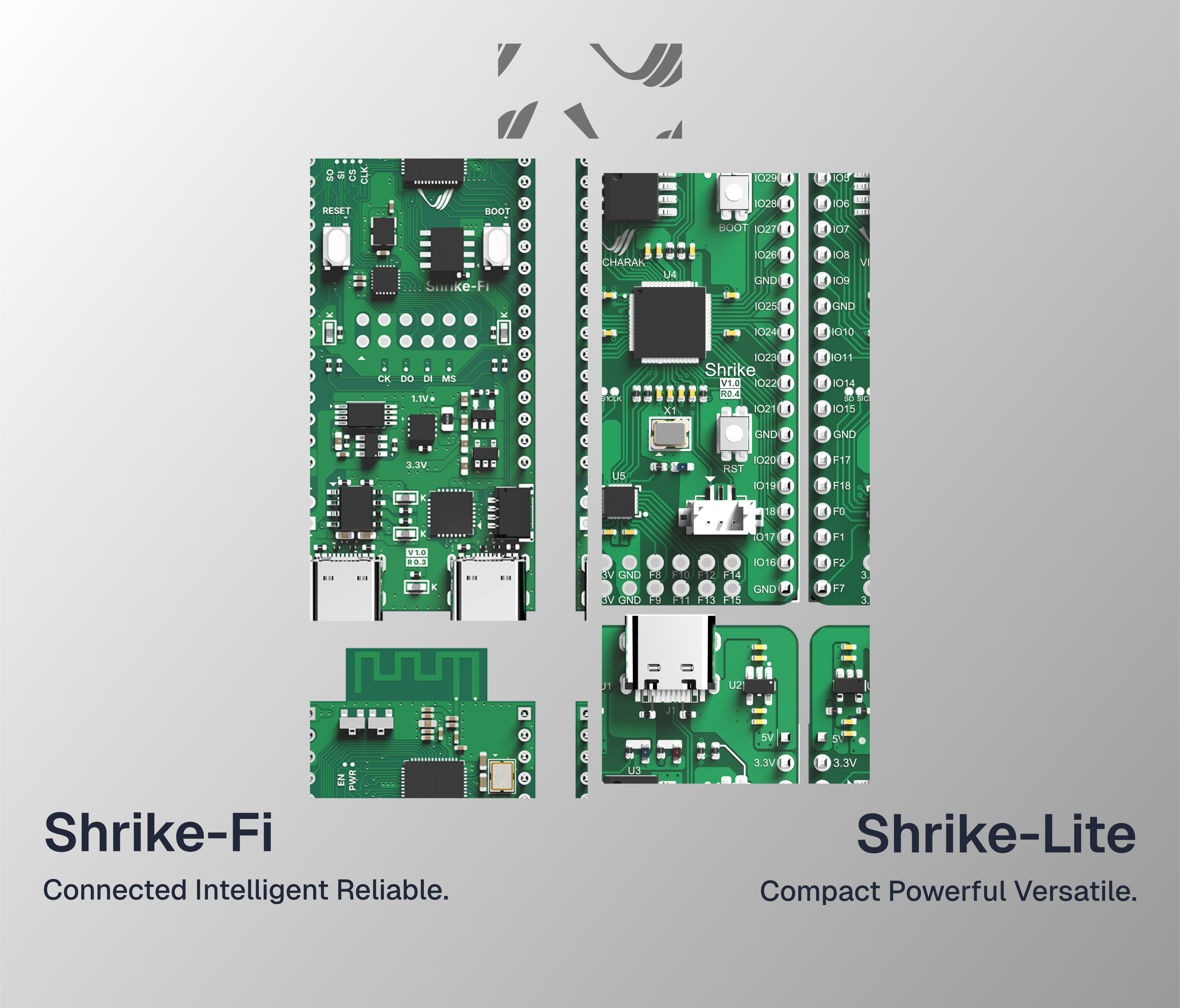
Shrike is a family of low cost affordable FPGA development board along with a host microcontroller. Currently the family features these two members -:
And a lot version under development.
We usually work on very complex FPGA-based projects built around Vaaman and its upcoming series. However, Shrike is a passion project at Vicharak, driven by our love for engineering across both embedded microcontrollers and FPGAs.
Our goal is to make FPGAs accessible to everyone by offering robust toolchains, high-quality hardware, and strong ecosystem support. We’re committed to keeping the hardware prices extremely low, and every piece of software for Shrike will be completely open-source.
We at vicharak have kept in mind need of a learner, maker and a hobbyist while designing this art. This dev board will be your stepping stone in the field of FPGA, reconfigurable and heterogenous computing.
We invite contributors from all over the world to join us in this mission. Together, let’s make FPGA technology truly accessible to all.
Shrike-lite the RP2040 version of the family is available at our store for worldwide shipping and the Shrike RP2350 version will be available on the crowdsupply soon. You can follow the links below to get both.
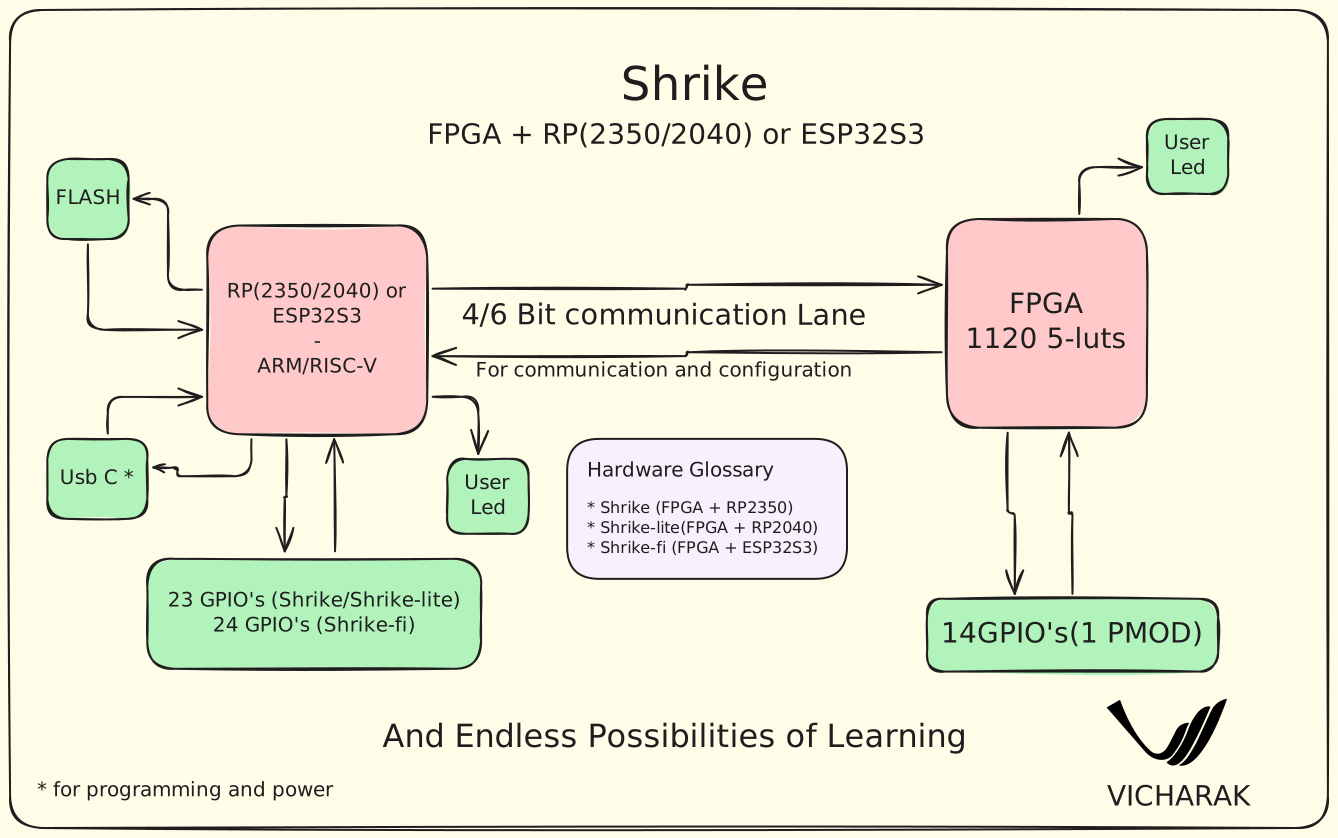
| Feature | Shrike | Shrike-lite | Shrike-fi |
|---|---|---|---|
| FPGA | 1120 × 5-input LUTs | 1120 × 5-input LUTs | 1120 × 5-input LUTs |
| MCU | RP2350 | RP2040 | ESP32-S3 |
| PMOD Compatible Connector | ✅ | ✅ | ✅ |
| Breadboard Compatible | ✅ | ✅ | ✅ |
| FPGA ↔ MCU IO Interface | ✅ | ✅ | ✅ |
| Flash (QSPI) | 4 MB | 4 MB | 8 MB |
| User LEDs | 2 | 2 | 2 |
| USB Type-C (Power & Programming) | ✅ | ✅ | ✅ |
| WiFi | ❌ | ❌ | ✅ |
| BLE | ❌ | ❌ | ✅ |
| Optional Add-on Features | |||
| PSRAM (QSPI) ( Optional ) | ❌ | ❌ | Upto 8 MB |
| BMS On Board ( Optional ) | ❌ | ❌ | ✅ |
The optional add on for the Shrike-fi are not soldered in the base version , board version with these part soldered will be launched at later date. However you can solder them yourself in the base version as well read more here.
Want to see what people have built with Shrike , or show off your own build?
Check out shrike_projects.
The examples/ folder here is focused on teaching , one
concept per example. Built something cool with your Shrike? Add it to the
projects repo , creative scope is unlimited.
Not sure which repo your contribution belongs in? See the classification criteria.





We are building a ecosystem for learners , makers and hobbyist around shrike and the projects that will follow in future, thus we request you contribution in the same. Join our communities across all the platforms, pitch and showcase your ideas with Shrike.
Thank You
Your contribution to the Shrike project are always welcome. To contribute fork the project test your changes and create a PR. Few things in to keep in mind for better contribution. Please read the Contribution Guide to know them.
You can contribute the project's and example's that you have designed on Shrike or any utils that you might have designed.
We also have live bounty from time to time check it here
This project’s software is licensed under the GNU General Public License v2.0 (GPL-2.0). See the LICENSEfor details.
This project’s hardware designs (HDL/RTL, schematics, PCB files, constraints, etc.) are licensed under the CERN Open Hardware License v1.2. See LICENSE_HW for details.
| Qty | Value | Footprint | References |
|---|---|---|---|
| 17 | SLG47910:CAP_0402 | C2, C4, C6, C7, C10, C11, C12, C13, C14, C15, C16, C17, C18, C19, C20, C21 +1 | |
| 13 | SLG47910:RESC0402 | R2, R3, R4, R5, R6, R7, R8, R9, R10, R11, R12, R13, R14 | |
| 5 | SLG47910:TP | 2, CLK, CS, SI, SO | |
| 4 | 100nF 10V | Shrike:CAPC0603 | C1, C3, C5, C8 |
| 3 | , , | ||
| 2 | SLG47910:LED_0603 | D2, D3 | |
| 2 | Header 19X1_2.54MM | SLG47910:HEADER_19X1_2.54 | J2, J4 |
| 2 | SW PUSHBUTTON | SLG47910:SW_MICRO PUSH BUTTON 4 PAD | SW1, SW2 |
| 1 | CUSTOM PCB:TYPE-C | J1 | |
| 1 | SLG47910:QFN24 3X3 | U5 | |
| 1 | SLG47910:CRYSTAL_3225 | X1 | |
| 1 | SLG47910:SOT25-5 | U2 | |
| 1 | SLG47910:SOT23-5 | U1 | |
| 1 | SLG47910:SOIC-8_208MIL | U3 | |
| 1 | DNP | SLG47910:6X2 HEADER 2.54MM | J3 |
| 1 | LED1 | SLG47910:LED_0603 | D1 |
| 1 | RES_0402_5 | SLG47910:RESC0402 | R1 |
| 1 | RP2040 | SLG47910:QFN-56 7X7 | U4 |
| 1 | TP | SLG47910:TP | GND1 |
| 1 | XUNPU WAFER-SH1.0-3PLB | SLG47910:XUNPU WAFER-SH1.0-3PLB | J5 |
vicharak-in/shrike
Low cost microcontroller + FPGA board for makers , hobbyist and student for endless possibility.


Fr4nkFletcher/ESP32-Marauder-Cheap-Yellow-Display
ESP32Marauder Cheap Yellow Display


shanteacontrols/OpenDeck
A platform for building interactive control and sensing devices using MIDI and OSC built with Zephyr RTOS.


polpo/picogus
Emulation of ISA sound cards and CD-ROM on Raspberry Pi Pico (GUS, SB/Adlib, MPU-401, Tandy, CMS, Panasonic CD-ROM) with USB mouse/joystick support

It measures 25.4 × 58.5 mm and has 4 copper layers, 1.58 mm thick.
60 parts, built around the RP2040. The full list of its parts is on this page, with links to each part's symbol and footprint where PCBKit's library has them.
From the vicharak-in/shrike repository on GitHub, at the commit this page was made from: the board is hardware/shrike-lite/kicad/v1_r0.4/Shrike-lite.kicad_pcb and its schematic hardware/shrike-lite/kicad/v1_r0.4/FPGA.kicad_sch. PCBKit opens the board in the browser, with nothing to install.
Its repository publishes it under the GPL-2.0 licence: you may reuse it on that licence's terms (keep the author's notice, and for a copyleft licence share your changes alike).