
4 layers132.2 × 188.4 mm
SparkFun IoT Node LoRaWAN panelized
sparkfun/SparkFun_IoT_Node_LoRaWAN
Hardware Repository for the SparkFun IoT Node - LoRaWAN Development board
971 parts

 sparkfun/SparkFun_IoT_Node_LoRaWAN
Hardware Repository for the SparkFun IoT Node - LoRaWAN Development board
SparkFun IoT Node LoRaWAN is an open-source printed circuit board by sparkfun, from the sparkfun/SparkFun_IoT_Node_LoRaWAN repository on GitHub. It is a 4-layer board of 59 × 79.5 mm with 242 parts on 134 nets, routed with 959 tracks and 280 vias.
It is built around the CH340C, APS6404L-3SQR-ZR and DT1042-04SO, with the BAT20J and DMG2305UX among its other parts. Its parts include 31 capacitors, 28 resistors, 7 connectors, 4 switches and 3 diodes. It belongs with the radio and wireless and home automation and IoT boards of this library.


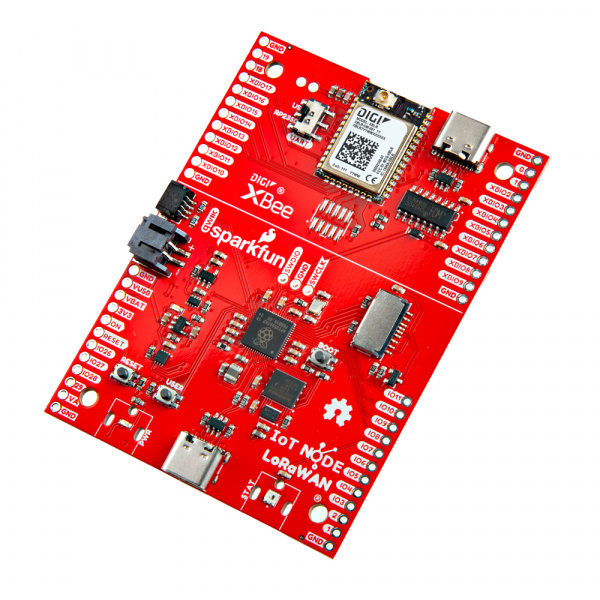
SparkFun IoT Node - LoRaWAN (WRL-26060)

The SparkFun IoT Node – LoRaWAN development board brings an entirely new level of usability to the often convoluted and configuration-intensive effort to set up a LoRaWAN™-based IoT Device. Combining the ease of LoRaWAN™ setup and configuration delivered by the Digi X-ON™ system with the rapid prototyping provided by the SparkFun Qwiic ecosystem, the SparkFun IoT Node – LoRaWAN development board accelerates IoT end-node creation and deployment.
Out of the Box
With the integration of Digi X-ON™ technology, the SparkFun IoT Node – LoRaWAN board allows the creation and deployment of a LoRaWAN™ IoT sensor in minutes.
The SparkFun IoT Node – LoRaWAN board is shipped with firmware installed that Digi HX15 Gateway for LoRaWAN automatically connects to Digi X-ON, detects an attached sensor, and posts data to the X-ON cloud. Configured via a serial console connection, this application allows rapid evaluation and creation of a LoRaWAN™ IoT device.
The pre-installed application is also open source and readily available, enabling rapid customization if desired.
Firmware Development
The firmware development for the SparkFun IoT Node – LoRaWAN board is performed primarily in the Arduino environment and enabled by an Arduino XBee® LR library from Digi. Combining the easy LoRaWAN™ access provided by the Digi library with the wide range of Qwiic sensors available from SparkFun, the possibilities of potential LoRaWAN™ IoT sensors are endless.
Additionally, the pre-installed application is open source and readily available, enabling rapid customization if desired.
Hardware
At the heart of the IoT Node – LoRaWAN board is the RP2350 microprocessor from Raspberry Pi, supporting many development environments, including Arduino, micropython, and the Raspberry Pi pico SDK. Besides the capabilities the RP2350 provides, we’ve kitted out the processer with all the goodies your project might require:
The Digi XBee® LR module for LoRaWAN module is directly connected to a serial port of the RP2350, allowing direct control and access to the LoRaWAN™ module via a development library provided by Digi.
The XBee® LR for LoRaWAN™ module is the latest LoRaWAN™ module from Digi, delivering unmatched operational performance and onboarding simplicity. The Digi XBee® LR uses LoRa™ modulation for Non-Line-of-Sight (NLOS) two-way communications for long-range and high-noise RF environments. Since each module is pre-activated on Digi's X-ON™ cloud platform, automated connection and two-way device management are a breeze.
This product is open source!
Please review the LICENSE.md file for license information.
If you have any questions or concerns on licensing, please contact technical support on our SparkFun forums.
Distributed as-is; no warranty is given.
| Qty | Value | Footprint | References |
|---|---|---|---|
| 17 | 0.1uF | SparkFun-Capacitor:C_0603_1608Metric | C1, C3, C6, C7, C8, C10, C11, C12, C13, C17, C18, C19, C21, C27, C30, C31 +1 |
| 10 | 1.0mm | SparkFun-Connector:TestPoint-1.0mm | TP1, TP2, TP3, TP4, TP5, TP6, TP7, TP8, TP9, TP10 |
| 10 | 10k | SparkFun-Resistor:R_0603_1608Metric | R8, R9, R10, R14, R18, R22, R23, R24, R25, R28 |
| 9 | G*** | kibuzzard-6691B276 | kibuzzard-6691B276, kibuzzard-6691B276, kibuzzard-6691B276, kibuzzard-6691B276, kibuzzard-6691B276, kibuzzard-6691B276, kibuzzard-6691B276, kibuzzard-6691B276, kibuzzard-6691B276 |
| 7 | G*** | kibuzzard-6691B3A2 | kibuzzard-6691B3A2, kibuzzard-6691B3A2, kibuzzard-6691B3A2, kibuzzard-6691B3A2, kibuzzard-6691B3A2, kibuzzard-6691B3A2, kibuzzard-6691B3A2 |
| 5 | 2.2uF | SparkFun-Capacitor:C_0603_1608Metric | C4, C24, C25, C28, C29 |
| 5 | 5.1k | SparkFun-Resistor:R_0603_1608Metric | R3, R4, R11, R12, R13 |
| 4 | 10uF | SparkFun-Capacitor:C_0603_1608Metric | C14, C15, C20, C26 |
| 4 | Conn_01x10 | SparkFun-Connector:1x12 | J5, J6, J7, J8 |
| 4 | Fiducial_0.5mm | SparkFun-Aesthetic:Fiducial_0.5mm_Mask1mm | FID1, FID2, FID3, FID4 |
| 4 | Standoff | SparkFun-Hardware:Standoff | ST1, ST2, ST3, ST4 |
| 3 | 100k | SparkFun-Resistor:R_0603_1608Metric | R15, R16, R17 |
| 3 | 2.2k | SparkFun-Resistor:R_0603_1608Metric | R21, R26, R27 |
| 3 | SMD_4.6x2.8mm_h2.5mm | SparkFun-Switch:Push_SMD_4.6x2.8mm_h2.5mm | SW2, SW3, SW4 |
| 2 | 1.0uF | SparkFun-Capacitor:C_0603_1608Metric | C16, C22 |
| 2 | 15pF | SparkFun-Capacitor:C_0603_1608Metric | C2, C5 |
| 2 | 1k | SparkFun-Resistor:R_0603_1608Metric | R2, R7 |
| 2 | 27 | SparkFun-Resistor:R_0603_1608Metric | R5, R6 |
| 2 | 4.7k | SparkFun-Resistor:R_0603_1608Metric | R19, R20 |
| 2 | DT1042-04SO | SparkFun-Semiconductor-Standard:SOT23-6 | D1, D3 |
| 2 | G*** | kibuzzard-6691B7BF | kibuzzard-6691B7BF, kibuzzard-6691B7BF |
| 2 | G*** | kibuzzard-6691B7AB | kibuzzard-6691B7AB, kibuzzard-6691B7AB |
| 2 | USB_C_Receptacle | SparkFun-Connector:USB-C_16 | J1, J3 |
| 1 | 10 | SparkFun-Resistor:R_0603_1608Metric | R1 |
| 1 | 10pF | SparkFun-Capacitor:C_0603_1608Metric | C23 |
| 1 | 12MHz | SparkFun-Clock:Crystal_SMD_2.5x2.0mm | Y1 |
| 1 | 4.7uH | SparkFun-Coil:1008_2520Metric | L1 |
| 1 | APS6404L-3SQR-ZR | SparkFun-Semiconductor-Standard:USON-8_3x2mm-SkinnyCenterPad | U3 |
| 1 | BAT20J | SparkFun-Semiconductor-Standard:SOD-323 | D2 |
| 1 | CH340C | SparkFun-Semiconductor-Standard:SO-16 | U5 |
| 1 | CHG | SparkFun-Jumper:Jumper_2_NC_Trace | JP5 |
| 1 | Conn_01x03 | SparkFun-Connector:1x03 | J2 |
| 1 | DMG2305UX | SparkFun-Semiconductor-Standard:SOT23-3 | Q1 |
| 1 | DPDT_Slide_SMD_7.2x3.5mm | SparkFun-Switch:Slide_DPDT_SMD_7.2x3.5mm | SW1 |
| 1 | G*** | kibuzzard-671A9C38 | kibuzzard-671A9C38 |
| 1 | G*** | kibuzzard-66999523 | kibuzzard-66999523 |
| 1 | G*** | kibuzzard-6691B6AB | kibuzzard-6691B6AB |
| 1 | G*** | kibuzzard-6691B763 | kibuzzard-6691B763 |
| 1 | G*** | kibuzzard-669E97C2 | kibuzzard-669E97C2 |
| 1 | G*** | kibuzzard-6691B4CC | kibuzzard-6691B4CC |
| 1 | G*** | kibuzzard-6691B952 | kibuzzard-6691B952 |
| 1 | G*** | kibuzzard-6691B931 | kibuzzard-6691B931 |
| 1 | G*** | kibuzzard-671A9BE0 | kibuzzard-671A9BE0 |
| 1 | G*** | kibuzzard-669EA04A | kibuzzard-669EA04A |
| 1 | G*** | kibuzzard-6691B926 | kibuzzard-6691B926 |
| 1 | G*** | kibuzzard-669EA026 | kibuzzard-669EA026 |
| 1 | G*** | kibuzzard-669EA03D | kibuzzard-669EA03D |
| 1 | G*** | kibuzzard-6691B72F | kibuzzard-6691B72F |
| 1 | G*** | kibuzzard-669E9793 | kibuzzard-669E9793 |
| 1 | G*** | kibuzzard-669E9784 | kibuzzard-669E9784 |
| 1 | G*** | kibuzzard-671A9CA4 | kibuzzard-671A9CA4 |
| 1 | G*** | kibuzzard-6691B623 | kibuzzard-6691B623 |
| 1 | G*** | kibuzzard-669E9F62 | kibuzzard-669E9F62 |
| 1 | G*** | kibuzzard-669EC8FA | kibuzzard-669EC8FA |
| 1 | G*** | kibuzzard-669E97D3 | kibuzzard-669E97D3 |
| 1 | G*** | kibuzzard-669E97CF | kibuzzard-669E97CF |
| 1 | G*** | kibuzzard-6691B62F | kibuzzard-6691B62F |
| 1 | G*** | kibuzzard-6691B48E | kibuzzard-6691B48E |
| 1 | G*** | kibuzzard-6691B3E7 | kibuzzard-6691B3E7 |
| 1 | G*** | kibuzzard-6691B750 | kibuzzard-6691B750 |
| 1 | G*** | kibuzzard-6691B62B | kibuzzard-6691B62B |
| 1 | G*** | kibuzzard-671A9B96 | kibuzzard-671A9B96 |
| 1 | G*** | kibuzzard-6691B3F5 | kibuzzard-6691B3F5 |
| 1 | G*** | kibuzzard-6691B6B0 | kibuzzard-6691B6B0 |
| 1 | G*** | kibuzzard-6691B3CB | kibuzzard-6691B3CB |
| 1 | G*** | kibuzzard-6691B419 | kibuzzard-6691B419 |
| 1 | G*** | kibuzzard-6691B44C | kibuzzard-6691B44C |
| 1 | G*** | kibuzzard-669EA654 | kibuzzard-669EA654 |
| 1 | G*** | kibuzzard-6691B440 | kibuzzard-6691B440 |
| 1 | G*** | kibuzzard-671A9C1E | kibuzzard-671A9C1E |
| 1 | G*** | kibuzzard-669E9F4F | kibuzzard-669E9F4F |
| 1 | G*** | kibuzzard-669E97D7 | kibuzzard-669E97D7 |
| 1 | G*** | kibuzzard-6691B649 | kibuzzard-6691B649 |
| 1 | G*** | kibuzzard-6691B637 | kibuzzard-6691B637 |
| 1 | G*** | kibuzzard-6691B6A6 | kibuzzard-6691B6A6 |
| 1 | G*** | kibuzzard-6691B448 | kibuzzard-6691B448 |
| 1 | G*** | kibuzzard-671A9C32 | kibuzzard-671A9C32 |
| 1 | G*** | kibuzzard-6691B43C | kibuzzard-6691B43C |
| 1 | G*** | kibuzzard-6691B472 | kibuzzard-6691B472 |
| 1 | G*** | kibuzzard-669ED447 | kibuzzard-669ED447 |
The 163 most common of 242 parts.
sparkfun/SparkFun_IoT_Node_LoRaWAN
Hardware Repository for the SparkFun IoT Node - LoRaWAN Development board

sparkfun/SparkFun_XRP_Controller
Controller Board repository for the XRP Kit.

embeddedos-org/eCAD-Hardware-Products
Hardware designs + EE docs + Board datasheets of Multiple products

sparkfun/SparkFun_GNSSDO
The SparkFun GNSS Disciplined Oscillator (GNSSDO / GNSSDO+) is a precision time and frequency reference based on the Septentrio mosaic-T GNSS receiver.

sparkfun/SparkFun_GNSS_DAN-F10N
A USB evaluation board for the dual L1/L5 frequency DAN-F10N GNSS receiver.

sparkfun/SparkFun_UM980_Triband_GNSS_RTK_Breakout
Documentation and hardware repository for the SparkFun Triband GNSS RTK Breakout, featuring the UM980 high precision GNSS/RTK module from Unicore Communications

sparkfun/SparkFun_u-blox_NEO-F10N
Documentation and hardware files for the low cost SparkFun GNSS L1/L5 Breakout - NEO-F10N.


SolderedElectronics/Soldered-Inkplate-10-hardware-design
Hardware design, BOM, gerbers and 3D files for Soldered-Inkplate-10 designed by Soldered Electronics.
It measures 59 × 79.5 mm and has 4 copper layers, 1.65 mm thick.
242 parts, built around the CH340C, APS6404L-3SQR-ZR, DT1042-04SO and BAT20J. The full list of its parts is on this page, with links to each part's symbol and footprint where PCBKit's library has them.
From the sparkfun/SparkFun_IoT_Node_LoRaWAN repository on GitHub, at the commit this page was made from: the board is Hardware/SparkFun_IoT_Node_LoRaWAN.kicad_pcb and its schematic Hardware/SparkFun_IoT_Node_LoRaWAN.kicad_sch. PCBKit opens the board in the browser, with nothing to install.
Its repository states no licence, so its author keeps all rights: ask sparkfun before reusing the design.