
2 layers192.4 × 50 mm

Open Source Remote - Hardware
Omote is an open-source printed circuit board by OMOTE-Community, from the OMOTE-Community/OMOTE-Hardware repository on GitHub, published under the GPL-3.0 licence. It is a 2-layer board of 192.4 × 50 mm with 187 parts on 137 nets, routed with 1,285 tracks and 324 vias.
It is built around the CH340C, ESP32-S3-WROOM-1-N16R8 and AP2112K-3.3, with the DW01A, MAX17048G+T10 and TCA8418RTW among its other parts. Its parts include 44 resistors, 28 capacitors, 25 switches, 16 diodes and 12 ICs. It belongs with the radio and wireless boards and the ESP32 boards of this library.


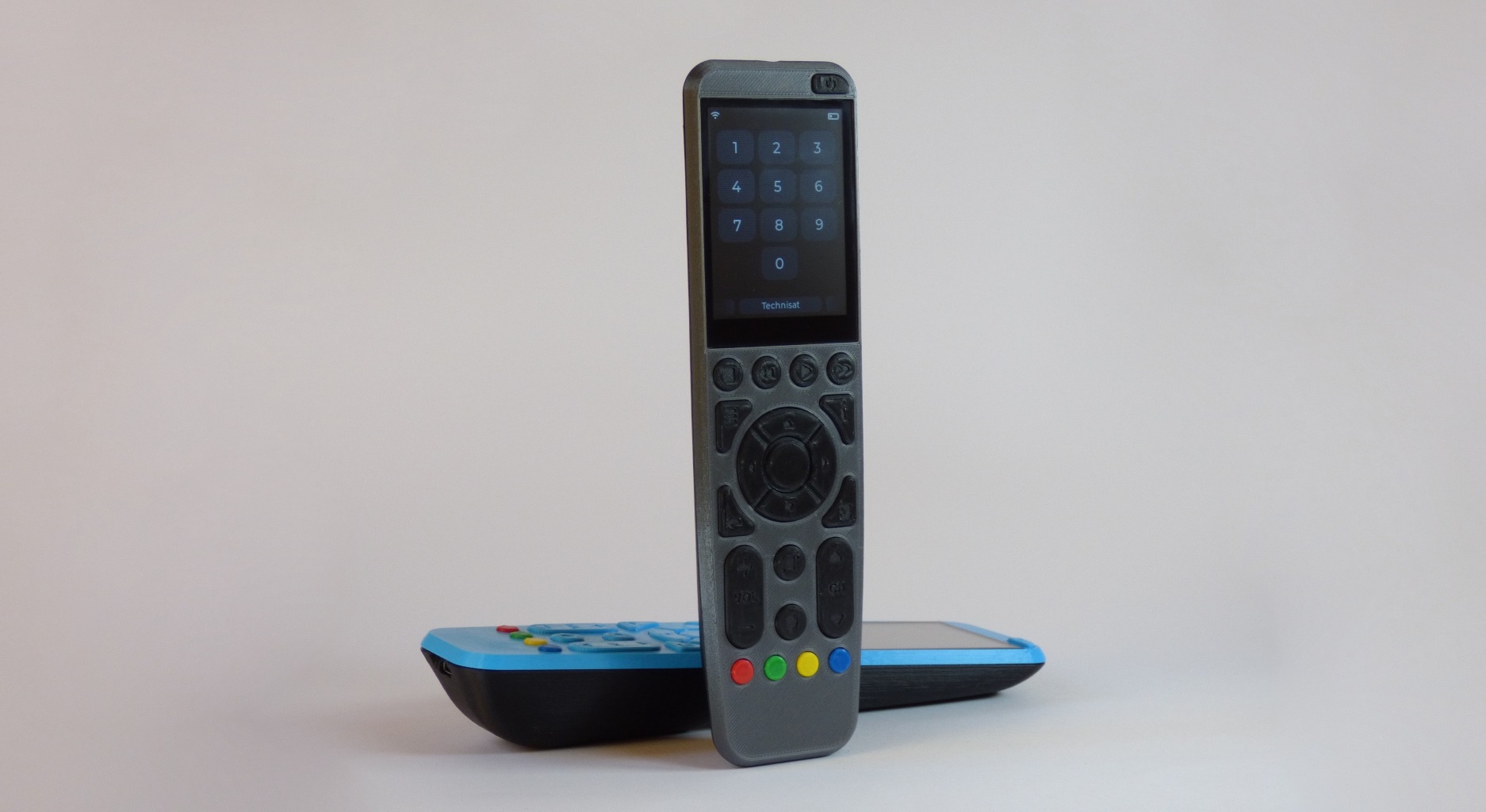
OMOTE is an ESP32 based open source universal remote. Its capacitive 2.8” touchscreen provides an intuitive and snappy user interface for switching devices and settings. No hub or docking station is required as the remote features infrared, Wi-Fi and Bluetooth connectivity. With its well optimized power consumption, OMOTE can run for months on a charge. And since the design files are open source, you can fully customize them to your devices and needs.
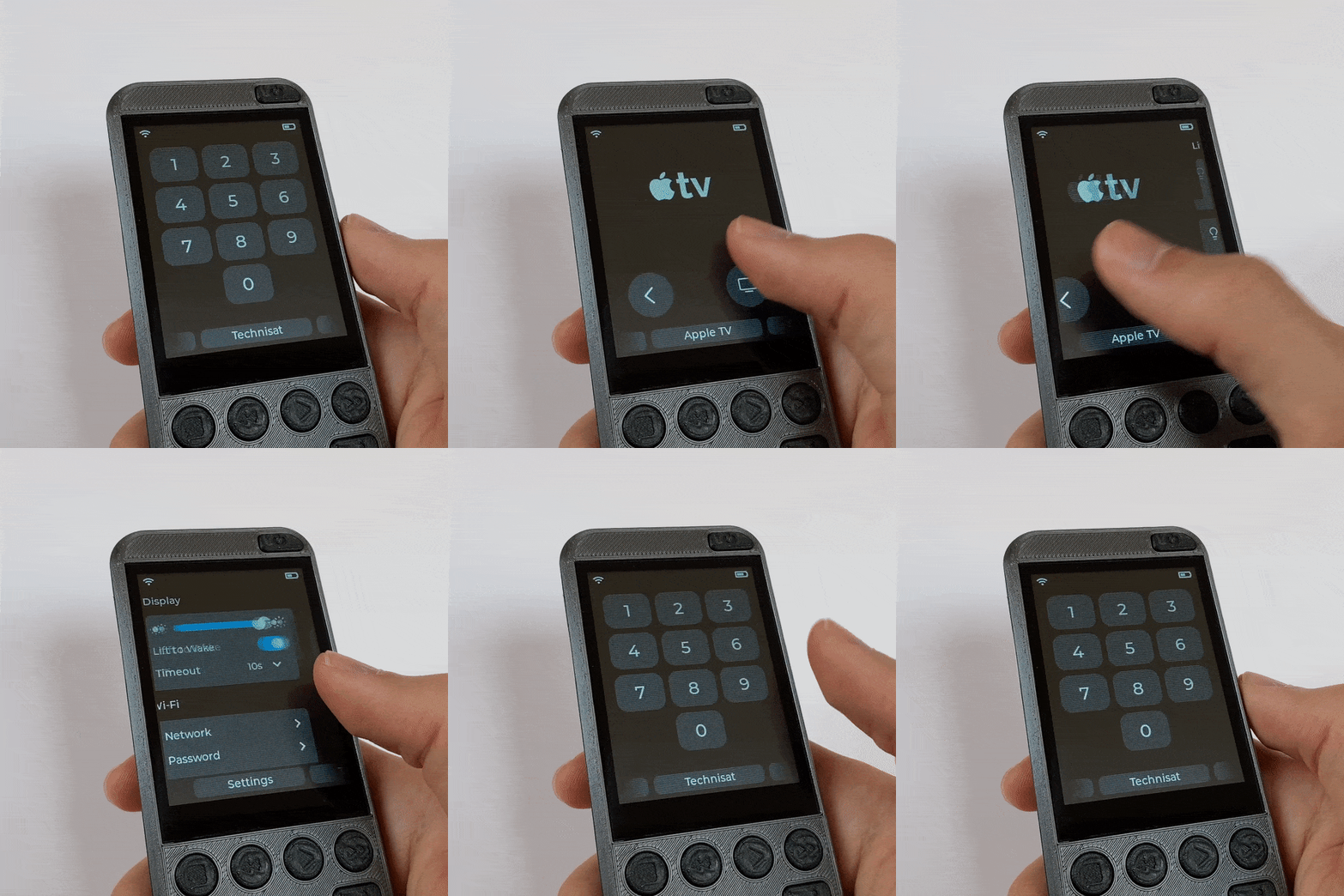
The hardware for OMOTE is designed to be easily replicated, using 3D-printed parts, a 2-layer PCB and commonly available components. The mechanical and PCB design can be considered mostly complete. Still, there might be areas for improvement, for example the IR range could be further optimized.
The central component of OMOTE is its PCB. If you want to build the PCB yourself, you will need SMT-reflow tools like a hot plate or a hot-air station. The 2-layered board and a solder paste stencil can be ordered from any PCB manufacturer using the KiCad files. Manufacturers like OSHPARK or Aisler will accept these files directly. For JLCPCB or PCBWay, you can use their plugin to export the optimized Gerber files. A zip archive with theses Gerber files is also included in this repository. You can also choose to order assembled PCBs from JLCPCB using the instructions in the Wiki.
The electrical components can be sourced from LCSC, but most of them should be available from the usual suppliers like Digikey or Mouser as well. You can check out the BOM for all the necessary components.
The project uses a 2000mAh Li-Ion battery with a JST-PHR-2 connector. Any 3.7V Li-Ion battery that fits into the 50x34x10mm dimensions should work alright. From rev 4 on, the board includes battery protection features agains overcurrent and undervoltage. It cannot hurt to use a battery with integrated protection anyway (usually visible as a small PCB under Kapton tape between the battery cables).
The 2.8" capacitive touchscreen can be sourced from Adafruit (2770). If you look for the part number CH280QV10-CT, you can also buy this display directly from the manufacturer via Alibaba. Shipping from China is expensive, so this only makes sense if you order multiple displays. In general, the cost for a single OMOTE is quite high. Please join the Discord server and then check out the buy-sell page to see if you can share the cost of the PCBs and components with others.
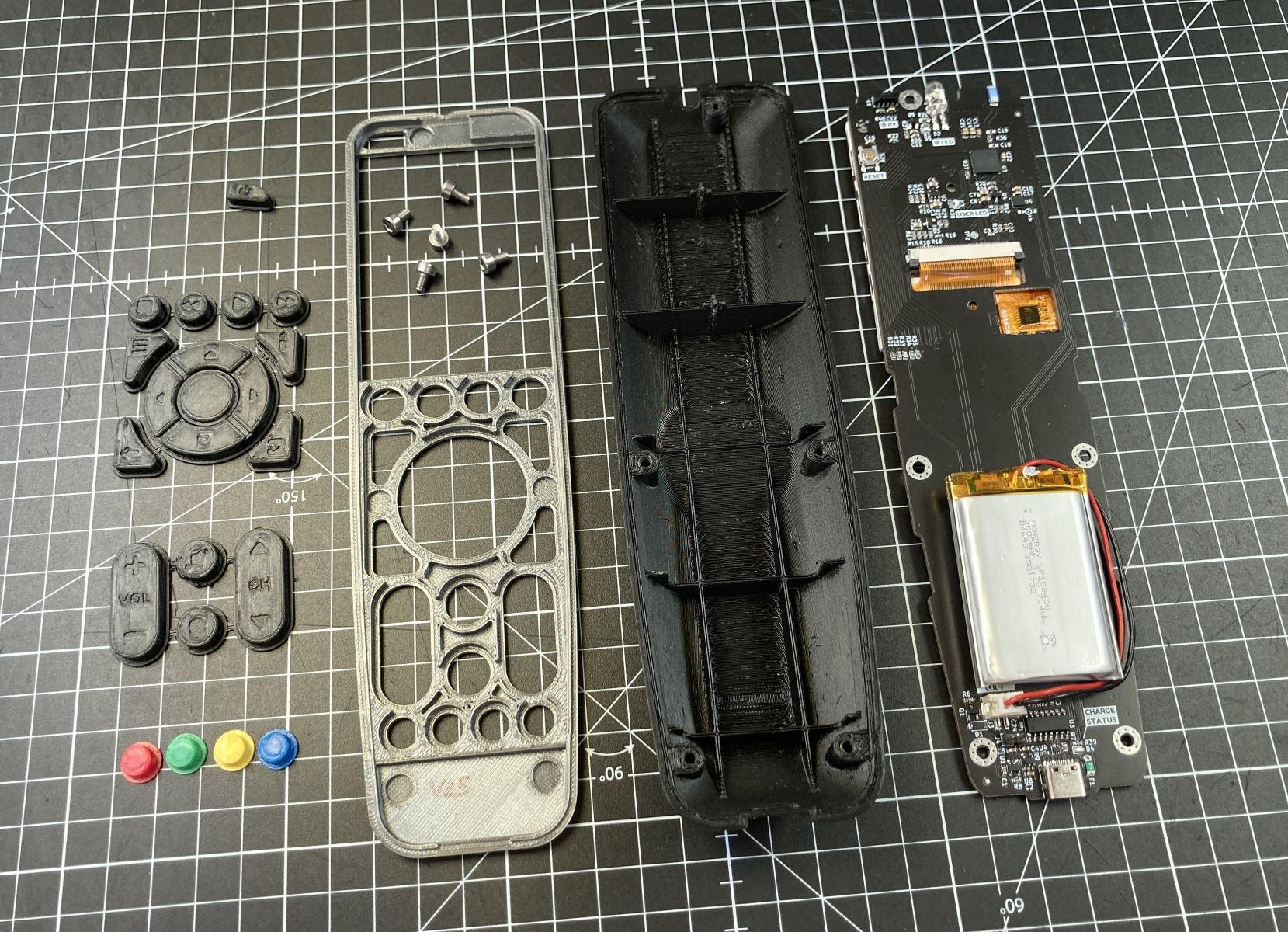
The housing and buttons can be printed using PLA or PETG. The parts from the project photos were sliced with PrusaSlicer with a layer height of 0.25mm and printed using ColorFabb PETG. It is important that the case part is printed with its flat side towards the print bed using lots of support structures. If your printer is well calibrated, the cover plate will snap onto the case.
The firmware is available at OMOTE ESP32 Firmware
If you have a suggestion for an improvement, please fork the repo and create a pull request. You can also simply open an issue or for more general feature requests, head over to the discussions.
Distributed under the GPL v3 License. See LICENSE for more information.

Join the OMOTE Discord: https://discord.gg/5PnYFAsKsG
Maximilian Kern - kernm.de
Project Page on Hackaday.io: https://hackaday.io/project/191752-omote-diy-universal-remote
| Qty | Value | Footprint | References |
|---|---|---|---|
| 25 | TL3342F160QG | Button_Switch_SMD:SW_SPST_TL3342 | S1, S2, S10, S11, S12, S13, S14, S15, S16, S17, S18, S19, S20, S22, S23, S24 +9 |
| 23 | TestPoint | TestPoint:TestPoint_Pad_D1.5mm | TP1, TP2, TP10, TP11, TP12, TP13, TP14, TP15, TP16, TP17, TP18, TP19, TP20, TP21, TP22, TP23 +7 |
| 15 | 2k2 | Resistor_SMD:R_0603_1608Metric | R1, R5, R23, R31, R32, R33, R34, R35, R38, R39, R40, R41, R42, R43, R44 |
| 14 | LED | LED_SMD:LED_0603_1608Metric | D3, D4, D5, D6, D7, D8, D9, D10, D11, D12, D13, D14, D15, D16 |
| 13 | 10k | Resistor_SMD:R_0603_1608Metric | R6, R10, R13, R14, R19, R20, R22, R24, R25, R26, R30, R36, R37 |
| 13 | 10uF | Capacitor_SMD:C_0805_2012Metric | C3, C5, C6, C7, C8, C11, C13, C14, C16, C18, C21, C25, C28 |
| 11 | 100nF | Capacitor_SMD:C_0603_1608Metric | C1, C9, C10, C12, C17, C20, C22, C23, C24, C26, C29 |
| 5 | 1k | Resistor_SMD:R_0603_1608Metric | R2, R3, R27, R28, R29 |
| 5 | DMG2301L | Package_TO_SOT_SMD:SOT-23 | Q1, Q3, Q4, Q5, Q7 |
| 4 | 10 | Resistor_SMD:R_0603_1608Metric | R15, R16, R17, R18 |
| 4 | 1uF | Capacitor_SMD:C_0603_1608Metric | C2, C4, C15, C27 |
| 4 | Fiducial | Fiducial:Fiducial_1mm_Mask2mm | FID1, FID2, FID3, FID4 |
| 4 | MountingHole | MountingHole:MountingHole_3.2mm_M3_Pad_Via | H1, H2, H3, H5 |
| 3 | 4k7 | Resistor_SMD:R_0603_1608Metric | R8, R11, R12 |
| 2 | 5.1k | Resistor_SMD:R_0603_1608Metric | R7, R9 |
| 2 | LOGO | LOGO | G***, G*** |
| 2 | MountingHole | MountingHole:MountingHole_2.5mm | H6, H7 |
| 1 | 100 | Resistor_SMD:R_0603_1608Metric | R4 |
| 1 | 2.54x2 Header | Connector_PinHeader_2.54mm:PinHeader_1x02_P2.54mm_Vertical | J4 |
| 1 | 3R3 | Resistor_SMD:R_0805_2012Metric | R21 |
| 1 | 500mA | Fuse:Fuse_1206_3216Metric_Pad1.42x1.75mm_HandSolder | F1 |
| 1 | AP2112K-3.3 | Package_TO_SOT_SMD:SOT-23-5 | U8 |
| 1 | APX803S | Package_TO_SOT_SMD:SOT-23 | U10 |
| 1 | BAT20J | Diode_SMD:D_SOD-323 | D1 |
| 1 | CH340C | Package_SO:SOIC-16_3.9x9.9mm_P1.27mm | U3 |
| 1 | Conn_01x50 | omoteLib:TFT_2.83IN_240X320_50PIN | J2 |
| 1 | DW01A | Package_TO_SOT_SMD:SOT-23-6 | U1 |
| 1 | ESP32-S3-WROOM-1-N16R8 | RF_Module:ESP32-S3-WROOM-1 | U7 |
| 1 | FS8205A | Package_TO_SOT_SMD:SOT-23-6 | Q6 |
| 1 | G*** | kibuzzard-644014FA | kibuzzard-644014FA |
| 1 | G*** | kibuzzard-643EE5B9 | kibuzzard-643EE5B9 |
| 1 | G*** | kibuzzard-643EE46C | kibuzzard-643EE46C |
| 1 | G*** | kibuzzard-643EE8B3 | kibuzzard-643EE8B3 |
| 1 | G*** | kibuzzard-64A91C1C | kibuzzard-64A91C1C |
| 1 | G*** | kibuzzard-64A91BF0 | kibuzzard-64A91BF0 |
| 1 | G*** | kibuzzard-63D97EAF | kibuzzard-63D97EAF |
| 1 | G*** | kibuzzard-643EE600 | kibuzzard-643EE600 |
| 1 | G*** | kibuzzard-64A91C24 | kibuzzard-64A91C24 |
| 1 | JST_PH_B2B-PH | omoteLib:JST_PH_B2B-PH-SM4-TB_1x02-1MP_P2.00mm_Vertical | J3 |
| 1 | LIS3DHTR | omoteLib:XDCR_LIS3DHTR | U5 |
| 1 | MAX17048G | Package_DFN_QFN:TDFN-8-1EP_2x2mm_P0.5mm_EP0.8x1.2mm | U9 |
| 1 | MBT3904DW1 | Package_TO_SOT_SMD:SOT-363_SC-70-6 | Q2 |
| 1 | Micro_SD_Card | omoteLib:MicroSD Slot TF-01A | J5 |
| 1 | MountingHole | MountingHole:MountingHole_3.2mm_M3 | H4 |
| 1 | SFH4547 | omoteLib:LED_5mm_Side_Mount | D2 |
| 1 | TCA8418 | Package_DFN_QFN:HVQFN-24-1EP_4x4mm_P0.5mm_EP2.5x2.5mm | U12 |
| 1 | TP4056 | Package_SO:Infineon_PG-DSO-8-27_3.9x4.9mm_EP2.65x3mm | U11 |
| 1 | TSSP77038 | omoteLib:Heimdall vertical | U6 |
| 1 | USBLC6-2P6 | Package_TO_SOT_SMD:SOT-666 | U4 |
| 1 | USB_C_Receptacle_USB2.0 | omoteLib:USB_C_Receptacle_HRO_TYPE-C-31-M-12 | J1 |
| 1 | XC6220B331 | Package_TO_SOT_SMD:SOT-23-5 | U2 |
The 183 most common of 187 parts.


arcticlula/Netscore
Device that keeps track of a volleyball's game score (points and sets). Ideally it should be mounted on the net, since it has a display on the front and back and buttons on the sides.


SonDinh23/EMGBand-HandBionic
Full-stack 6-ch dry-electrode sEMG wearable (ESP32/BLE, 1 kHz/ch, JSON presets) with DC removal + HPF/LPF + Kalman DSP and dual-path gesture control (Amplitude thresholds + 6-ch Radar-shape matching) + Flutter app…

aliaksei-lameyka/ENKU-Base-reader
Open enku-mainboard-r0.1.kicadpro with KiCad10.0.7. Matching PCB/root schematic and power.kicadsch, mcuio.kicadsch, epdhv.kicadsch, connectors.kicadsch are canonical.

FujiNetWIFI/fujinet-hardware
Schematics and design files for FujiNet hardware
It measures 192.4 × 50 mm and has 2 copper layers, 1.6 mm thick.
187 parts, built around the CH340C, ESP32-S3-WROOM-1-N16R8, AP2112K-3.3 and DW01A. The full list of its parts is on this page, with links to each part's symbol and footprint where PCBKit's library has them.
From the OMOTE-Community/OMOTE-Hardware repository on GitHub, at the commit this page was made from: the board is PCB/Omote.kicad_pcb and its schematic PCB/Omote.kicad_sch. PCBKit opens the board in the browser, with nothing to install.
Its repository publishes it under the GPL-3.0 licence: you may reuse it on that licence's terms (keep the author's notice, and for a copyleft licence share your changes alike).
