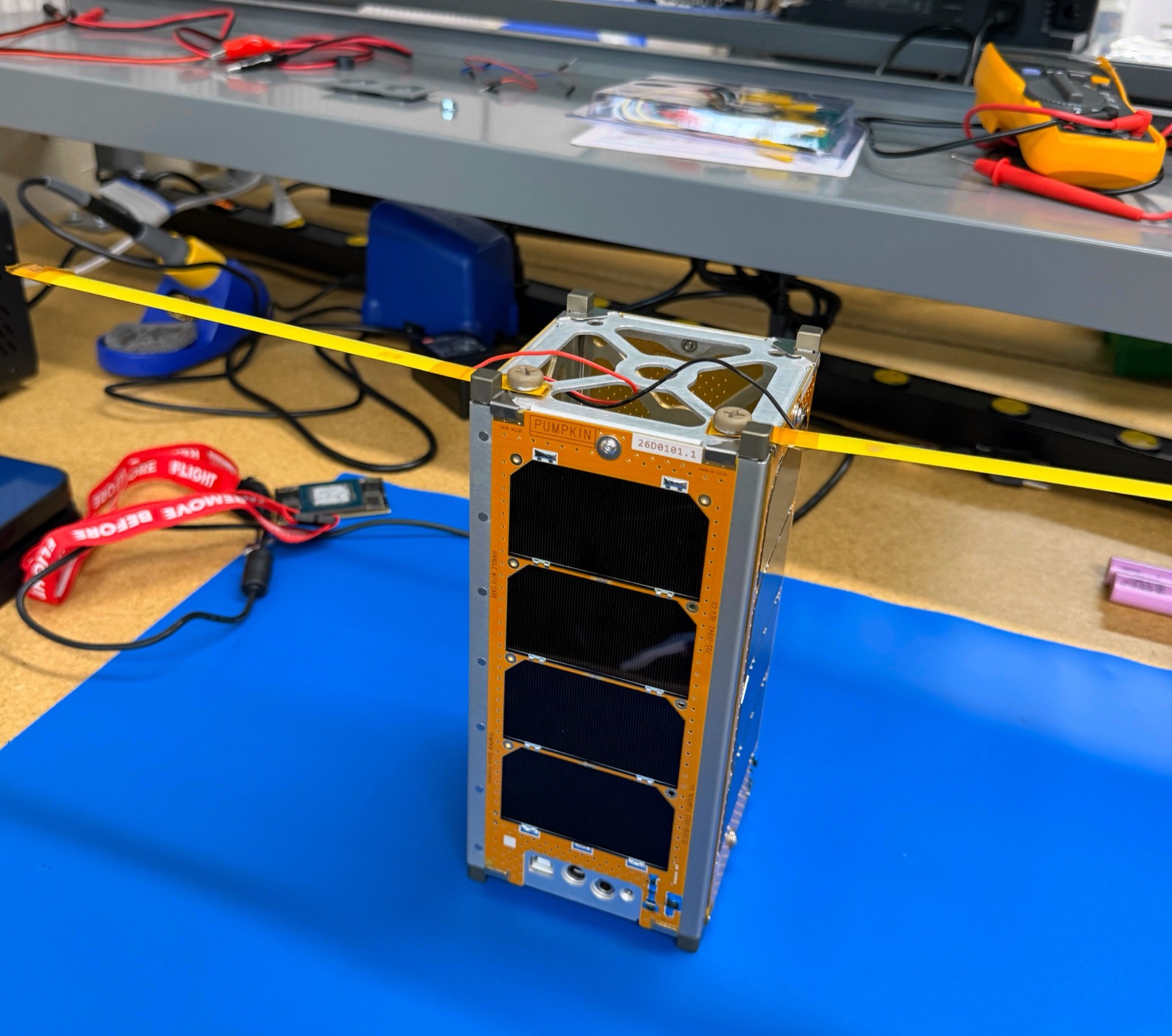
KENSAT, Edge-AI Compute in Orbit - A 2U CubeSat that runs a large language model on-orbit. A power-gated NVIDIA Jetson Orin Nano executes neural-network inference in space, and the results are downlinked over a custom UHF radio link to amateur ground stations.
KENSAT EPS v1.2 is an open-source printed circuit board by kenchangh, from the kenchangh/kensat repository on GitHub. It is a 4-layer board of 95.9 × 90.2 mm with 218 parts on 235 nets, routed with 961 tracks and 1,058 vias.
It is built around the TPS62130ARGTR, BQ24650RVAR and LM74700QDBVTQ1, with the CSD16406Q3, HY2120-CB and MY-18650-02 among its other parts. Its parts include 65 resistors, 64 capacitors, 21 diodes, 14 ICs and 14 transistors. It belongs with the radio and wireless and computers and single-board computers boards of this library.
A 2U CubeSat that runs a large language model on-orbit. A power-gated NVIDIA
Jetson Orin Nano executes neural-network inference in space, and the results
are downlinked over a custom UHF radio link to amateur ground stations.
KENSAT's mission is to demonstrate autonomous AI compute on a small
satellite — taking a GPU-class accelerator and a quantized LLM out of the
data center and running them inside the tight power, thermal, and reliability
envelope of a 2U CubeSat. The on-board computer wakes the Jetson only when
needed, runs an inference within a measured energy budget, and frames the
output for downlink. Everything else in the spacecraft — the flight software,
the UHF radio and its RF matching networks, the power system, and the
antenna-deployment hardware — exists to get that compute on orbit, keep it
alive, and get its results to the ground.
Why it's hard. Edge AI in orbit means treating a multi-watt accelerator as
a scheduled, fault-tolerant load: powering it from a battery-backed bus only
in defined windows, dissipating its heat passively in vacuum, recovering it if
it hangs, and surviving the brownouts and resets that come with switching that
much current on a small satellite. KENSAT is built end to end around that
problem.
Mission profile: a 520 km sun-synchronous orbit, operating UHF amateur
radio at 437.08 MHz for beaconing, telemetry downlink, and command uplink.
Telemetry — including downlinked inference results — is intentionally
unencrypted so amateur operators worldwide can receive and decode it.
Radio link (for receiving stations)
KENSAT beacons openly on the UHF amateur band — no encryption, no keys.
Anyone with a 70 cm receiver and a G3RUH-capable TNC (Direwolf, gr-satellites,
SatNOGS) can decode it.
Beacon / downlink frequency
437.080 MHz
Transmitter
Mode U — GFSK 1k2 AX.25 G3RUH
Modulation
GFSK
Baud
1200
Framing
AX.25 UI, NRZI + G3RUH
Source callsign
KO6IKZ
Beacon interval
~10 s
Status
active
Encryption
none — telemetry is open by design
Everything in the info field is plain ASCII. Frames are identified by their
first token:
Frame
Carries
BCN
Housekeeping beacon: cumulative sequence number, boot count, reset cause, uptime, body rates, uplink frames received
LLM
One per on-orbit inference: Jetson temperatures and peaks, power, RAM, model-load and inference times, result CRC-32, and how many text frames to expect
TXT
The text the on-board LLM generated, as numbered chunks — s= result, c=<k>/<m> chunk, h= CRC-32 of the whole result
ACK
Acknowledgement of a received telecommand
A result is sent one chunk per beacon cycle and the whole set twice, because
the link has no ARQ. To reassemble: group by s=, order by c=, concatenate,
and check h= (standard CRC-32). ground-station/llm_downlink.py does this
for you, from live decoder output or a saved log.
Command uplink is a short authenticated ASCII telecommand (Si4463 native
framing, CRC-16) that can inhibit the transmitter, ping the spacecraft, uplink
a prompt of up to 256 characters for the LLM in a single frame (which starts
the inference), or run a library prompt. Formats, verbs and the
reasoning behind them are in
firmware/obc/README.md.
Decoders, the result reassembler and an end-to-end test harness live in
ground-station.
Boards interconnect over the 104-pin CubeSat Kit Bus. The PIC24 is the
always-on flight computer; it talks to the EPS over I²C, drives the Si4463
radio over SPI, controls and exchanges data with the Jetson over UART, and
fires the antenna-deployment burn wires over GPIO.
See docs/system-architecture.md for the full
spec: pinouts, bus map, operational modes, deployment state machine, power
budget, and thermal analysis.
Architecture spec, radio guide, Jetson startup, debug notes
Engineering highlights
An LLM running in orbit. The payload is an NVIDIA Jetson Orin Nano running
a quantized TinyLlama model under llama.cpp. The always-on PIC24 keeps it
powered down, then — on schedule or command — switches on its rail through a
high-side load switch, waits for the Jetson to boot and signal READY over
UART, dispatches a prompt, collects the generated text, powers the Jetson back
off, and queues the result for downlink. The whole cycle is bounded by a
measured per-inference energy budget so a single run can't drain the pack.
Prompts come either from a library pre-loaded on the payload — so the mission
produces results with no uplink at all — or from the ground, uplinked as a
single 256-byte prompt field that the OBC runs as soon as it arrives.
(docs/system-architecture.md §6.2, jetson/)
Treating a GPU as a spacecraft load. Running multi-watt edge compute on a
2U bus is a systems problem: the EPS sizes a battery-backed rail and a
hardware watchdog around the Jetson's draw, the OBC power-gates it and can
recover a hung payload by cutting power, and the design accounts for
dissipating its heat passively in vacuum, where there's no convection.
(docs/system-architecture.md §8.1)
Fault-tolerant by construction. Both the inference cycle and the antenna
burn-wire release are one-shot, flash-persisted state machines that survive
the brownouts and resets that come with switching large currents: attempt
counts are written before energizing, success flags only after completion,
and the RF-silence hold fails safe toward staying quiet.
(details)
A complete UHF link to get results down. TX / RX / antenna matching
networks were designed with a custom scikit-rf grid-search optimizer that
models PCB traces as CPWG transmission lines (elliptic-integral method) and
snaps to real LCSC part values, then validated on an ADALM-Pluto SDR loopback
bench (gain sweep, harmonics, insertion loss). Inference output is framed as
AX.25 and downlinked openly. (radio/rf-design)
Signal-integrity-aware bus design. The Si4463 SPI bus crosses two
board-to-board connectors; the design derates the clock and adds series
termination accordingly. (docs/spi-debug-notes.md)
OBC firmware depends on proprietary vendor SDKs (Pumpkin CubeSat Kit BSP,
Salvo RTOS) that are not redistributed here. See
firmware/obc/BUILD.md.
Radio firmware builds with arduino-cli for the ESP32-S3.
RF design / ground-station tools are Python; see the requirements.txt
in each directory.
License
Original work in this repository is released under the MIT License.
Proprietary vendor SDKs the firmware builds against are not included and are
not covered by that license — see the LICENSE file and
firmware/obc/BUILD.md.
KENSAT — UHF amateur satellite, 437.08 MHz. Telemetry is open and unencrypted
by design, in the tradition of the amateur radio community.
KENSAT, Edge-AI Compute in Orbit - A 2U CubeSat that runs a large language model on-orbit. A power-gated NVIDIA Jetson Orin Nano executes neural-network inference in space, and the results are downlinked over a custom…
Hestia is a space-ready heater & temperature measurement system developed by Mawson Rovers in Sydney. Its first mission will demonstrate a novel UTS heatsink design, aboard the Waratah Seed cubesat mission.
184 parts3MIT
Questions
How big is the KENSAT EPS v1.2 PCB?
It measures 95.9 × 90.2 mm and has 4 copper layers, 1.6 mm thick.
What parts does the KENSAT EPS v1.2 use?
218 parts, built around the TPS62130ARGTR, BQ24650RVAR, LM74700QDBVTQ1 and CSD16406Q3. The full list of its parts is on this page, with links to each part's symbol and footprint where PCBKit's library has them.
Where can I download the KENSAT EPS v1.2 KiCad files?
From the kenchangh/kensat repository on GitHub, at the commit this page was made from: the board is eps/hardware/KENSAT_EPS_v1.2.kicad_pcb and its schematic burnwire/hardware/burnwire.kicad_sch. PCBKit opens the board in the browser, with nothing to install.
Can I use the KENSAT EPS v1.2 design in my own project?
Its repository states no licence, so its author keeps all rights: ask kenchangh before reusing the design.