
2 layers50 × 53 mm
Picoquorum key
jmcpheron/pico-quorum
Several people, several keys, one Safe. Hardware approvals for Safe multisig wallets.
71 partsMIT

Several people, several keys, one Safe. Hardware approvals for Safe multisig wallets.
Mono is an open-source printed circuit board by jmcpheron, from the jmcpheron/pico-quorum repository on GitHub, published under the MIT licence. It is a 2-layer board of 40 × 89.5 mm with 89 parts on 90 nets, routed with 732 tracks and 312 vias.
It is built around the RP2350A, CH343P and W25Q128JVSIQ, with the ATECC608C-SSHDA-T, USBLC6-2SC6 and LDL1117S33R among its other parts. Its parts include 29 capacitors, 20 resistors, 10 ICs, 3 connectors and 3 switches. It belongs with the RP2350 boards of this library.


Several people, several keys, one Safe.
Hardware approvals for Safe multisig wallets.













Picoquorum is a small console that is one owner of a Safe. Each signer holds a plug-in key with a secure element inside. The console shows what a transaction does on its own screen, works out the Safe transaction hash itself, and asks the key to sign only after you have seen every page and held the green Sign button. Reject is red and easy.
The same console also runs in your browser, with your own passkey as its key. That version is one short folder you can read, check against this README, and sign from on your own computer.
A pico quorum is a small group that agrees before anything moves: a family's savings, a club's treasury, a two-person company, a project's release keys. Two of three. Three of five. Too small for a custody desk, too important for one laptop. Picoquorum gives each person in that group the same small box and their own key, and makes every approval a deliberate thing you do with your hands.
Experimental. Early design. Use a testnet first, and only small amounts on mainnet. The Safe's threshold is the real control: always keep owners on the Safe that are not this console.
The key is a secure element on a small board you plug in. Its P-256 private key is generated inside the chip, never leaves it, and never exists as a seed phrase. There is nothing to write down, photograph or phish. The chip has no command that reads a private key out, it is locked after provisioning, and the console asks it to sign only a hash the console worked out itself.
Each key owns the Safe through Safe's audited passkey signer
(firmware/webauthn.py), with the same owner address on every chain. The
contracts it relies on were checked onchain on Base and Ethereum.
The USB-C key, in production now. key-c P2 is the key as a part you can hold: an ATECC608C behind a USB-C receptacle on a 16 × 36 mm board, with an ESD array between the connector and the chip.
| parts side | back |
|---|---|
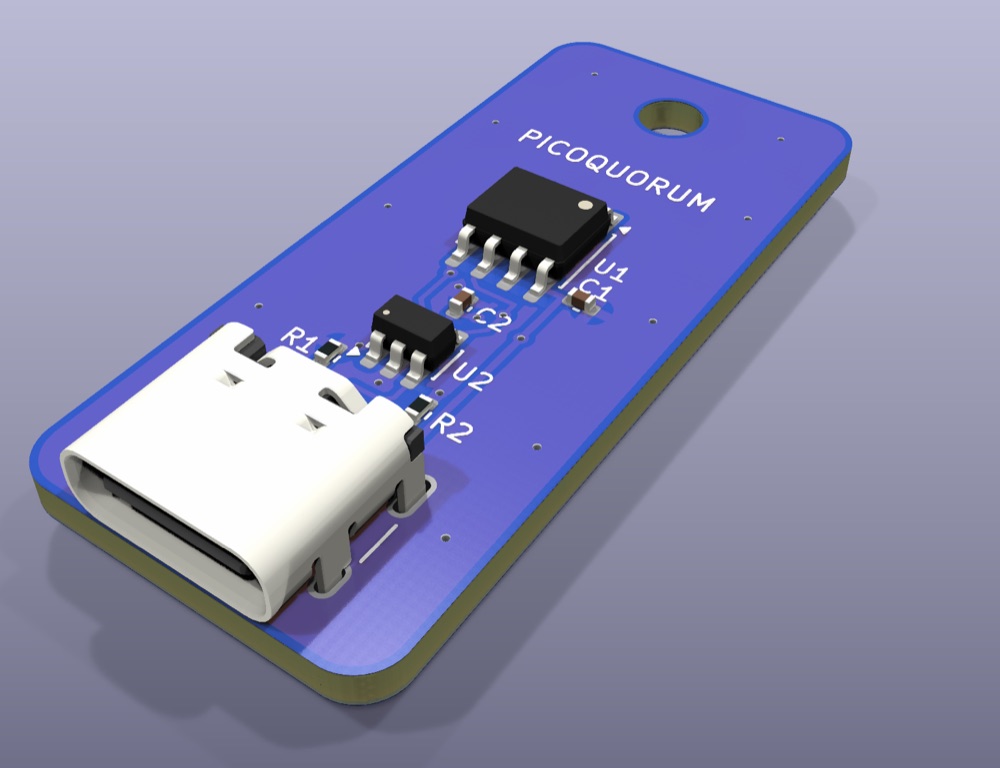 | 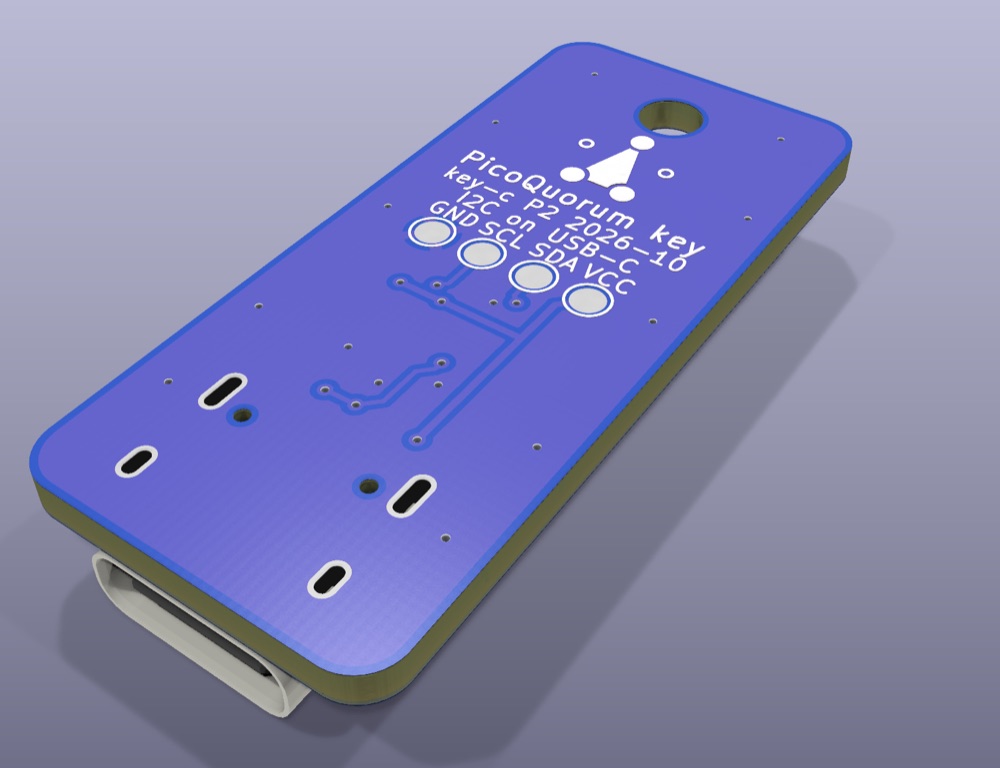 |
Until it arrives, the dev console's key is an Infineon OPTIGA Trust M or an ATECC608 breakout. The
other key designs (card edge, pogo pads) are in hardware/key-pcb/.
How a chip is locked: docs/LOCKING.md and docs/TRUSTM.md.
What a sealed key can't protect you from: docs/SECURITY.md.
The console is a Raspberry Pi Pico 2 W with a 240 × 240 screen and a few buttons, running a small amount of MicroPython you can read. It doesn't take anyone's word for a transaction: not your laptop's, not your browser's, not Safe{Wallet}'s, and not the transaction service's.
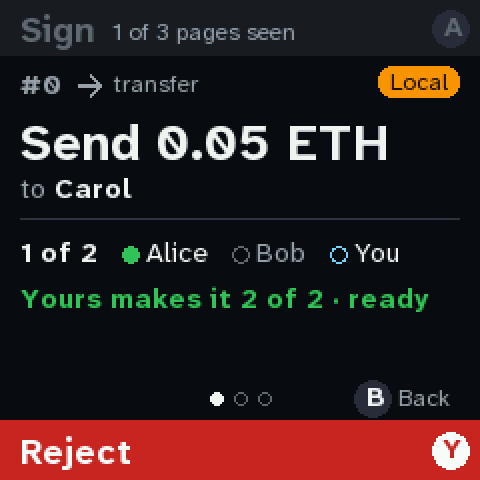 | 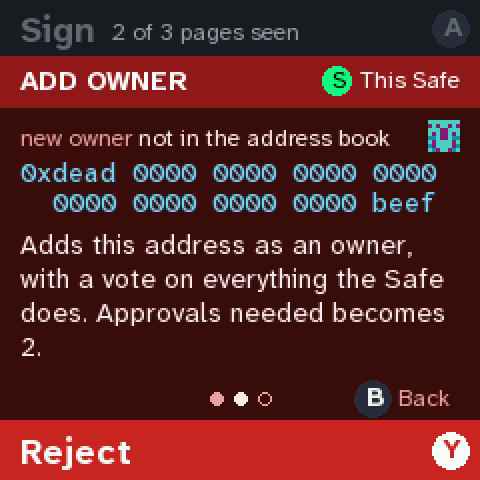 | 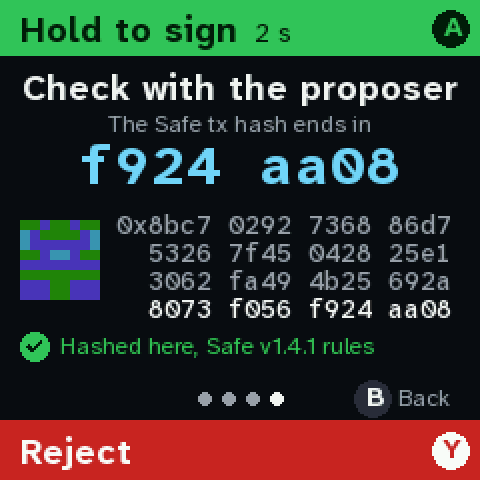 | 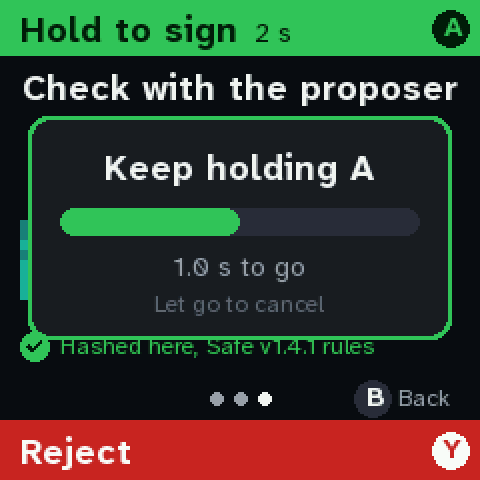 |
| Plain language. What it does, who it pays, who has signed. | Red pages. Owners, thresholds, anything that can't be undone. | A verify code. To check with the proposer. | Hold to sign. Two seconds on a guarded button. |
That independence is the point. A second check is only worth something if it fails differently from the first: different hardware, different code, a different network path, a different person looking at it. More screens: docs/quorum-ui.
Picoquorum is never the whole wallet. It is one owner among several, and it is built to sit next to the others: a hardware wallet, a passkey, Safe{Wallet} in a browser, another Picoquorum in another house. The project's own Safe is planned around one rule (docs/GOVERNANCE.md), and we suggest it for yours: no technology, and no person, holds a threshold's worth of keys.
The console page runs the console's firmware, file for file, on MicroPython for WebAssembly, with your passkey (Touch ID, Windows Hello, a phone, a security key) as its key. It is one folder, it loads nothing from the rest of the site, and it can reach only Safe's transaction service: its Content-Security-Policy says so, and the browser enforces it.
| in the folder | |
|---|---|
firmware/ | the console image a Pico runs, as plain files: about 11,000 lines of MicroPython |
shims/ | Python in place of the Pico's hardware: about 630 lines |
console.js, worker.js, web/, core/ | the page: about 1,100 lines of JavaScript |
vendor/micropython/ | MicroPython 1.26 for WebAssembly, pinned by its hash: the one part built elsewhere |
That is short enough to read, and you can check it without trusting the site that sent it:
SHA256SUMS lists every file: fetch them, then sha256sum -c SHA256SUMS. There
is no build step; these are the files that run.firmware/, hashed with sha256sum in a one-line loop, gives the
console's release fingerprint in the build table: the same one a
Pico running that release shows on its Device screen.cd emu && npm ci && node build.mjs writes the same bytes. CI checks that on every
push, and a check from outside compares what Pages serves with the source every six hours.python3 -m http.server in the folder and open localhost:8000. A
passkey belongs to the site that made it, so one made on your copy can be asked to sign by your
copy and never by a later version of the site. Its owner address works on a Safe like any other.The commands: docs/guide/BROWSER.md. The screen is still drawn by your computer, and the passkey's prompt never shows the transaction, so the hardware console is the stronger owner: keep passkey owners below the threshold.
tools/quorum e2e runs a whole approval with the emulator against a
Safe 1.4.1 on an Anvil fork of Base (details).python3 test-vectors/run.py runs every vector in
test-vectors/, including real mainnet Safe transactions, on CPython; CI runs
them on MicroPython 1.26 too.Every firmware image has a release fingerprint: one SHA-256 over its source files
(docs/releases). A console shows its blockie and first 8 hex digits on the
Device screen; the console page shows the same picture for the same files, and its firmware/
folder hashes to it with sha256sum (how); the
app's Releases page lists each release's. The badges above and this table name the source in this commit, so you can hold a
console up to the README:
| image | release fingerprint | |
|---|---|---|
 | console | 1eebbf43e652aa289b9495c5dc66a7878e00a54e2f4c9bd2fbc4934a382bc033 |
 | ceremony | b023b563b115e06aa9250c192d3c22fa1e07107a50e41ea9462649564e6f7aea |
 | brand | 4fb1d81abf7c37040f02c0d110f9423db2202626df3c7a4a8330c3cb7a718670 |
 | dual | 27b254630a065e6c7dc811374a5d2837dee3486b7cd1cc761c546a3758bb9b0d |
How a release is trusted (docs/RELEASES.md):
fw-<version>, checked against
.github/allowed_signers before anything is built.Picoquorum is built in public. docs/STATUS.md is the one page for what exists today: the name (picoquorum.eth) and the domains, every Safe and key with its address, the contracts the console relies on, and what's next.
The test ladder tracks each chain:
The design and the open questions are in the kickoff, and the project Safe's plan
in GOVERNANCE.md. Dated notes and photos, mistakes included, are in
buildlog/.
| path | what |
|---|---|
firmware/ | the console in MicroPython: quorum.py and quorum_ui.py (the console), safe_tx.py (the Safe hash), decode.py, txservice.py, webauthn.py, the chip drivers trustm.py and atecc.py |
hardware/ | key-pcb/ (the keys, key-c among them), wiring/ (Build 1, perfboard, breadboard, on an ESP32), bom/ |
docs/ | everything to read (index), and the site GitHub Pages serves: the front page, app/, console/, brand/ |
web/ | the app's source; npm run build writes docs/app/ |
emu/ | the console in a browser: MicroPython in WebAssembly and a virtual secure element. build.mjs writes the console page (docs/console/); tools/emu adds an editor and the case in 3D, for development |
test-vectors/ | Safe transactions with known-correct hashes, and the suites CI runs |
tools/ | quorum (Safes on a fork and on chain), fw (build and push images), emu, usb, release, releases/, brand/, keypcb, wiring, wiring-esp32 |
contracts/ | Picoquorum's own contracts, when there are any; today each key owns a Safe through Safe's passkey signer |
buildlog/ | dated notes and photos |
The name, the mark and the colours: docs/BRAND.md. tools/brand/lockup.py draws the
logo at the top of this page.
Picoquorum exists because of picowallet by Austin Griffith. picowallet proved that a Raspberry Pi Pico can drive a secure element from MicroPython, rebuild an EIP-712 digest on the device, show it on its own screen, and sign with a key that never leaves the chip, all on mainnet. Picoquorum began as a fork of it and is still built on it:
Each of those files says so on its first line, under Austin's MIT license. Fixes to the drivers go back upstream (docs/UPSTREAM-TRACKING.md). Everything else this project uses is credited in NOTICE.
Picoquorum runs on Raspberry Pi Pico 2 W. It is not affiliated with Raspberry Pi or Safe.
| license | |
|---|---|
Code and firmware: firmware/, emu/, web/, tools/, test-vectors/, the built site | MIT |
Hardware: hardware/ (the key boards, wiring, parts lists) | CERN-OHL-W-2.0 |
| Docs, the build log, photos and screenshots | CC BY-SA 4.0 |
| The name Picoquorum and its mark | not licensed: TRADEMARK.md |
Hardware made from these sources must show where the source is (hardware/README.md). Third-party parts and their licenses are in NOTICE.
| Qty | Value | Footprint | References |
|---|---|---|---|
| 9 | 100n | Capacitor_SMD:C_0402_1005Metric | C9, C17, C21, C22, C23, C25, C26, C27, C28 |
| 9 | 100n | mono:RPi_C_0402 | C4, C5, C6, C7, C8, C10, C12, C13, C14 |
| 6 | 4.7k | Resistor_SMD:R_0402_1005Metric | R6, R7, R11, R17, R18, R20 |
| 4 | M2 | MountingHole:MountingHole_2.2mm_M2 | H1, H2, H3, H4 |
| 3 | 1k | Resistor_SMD:R_0402_1005Metric | R3, R10, R12 |
| 3 | 1u | Capacitor_SMD:C_0402_1005Metric | C20, C24, C29 |
| 3 | Fiducial | Fiducial:Fiducial_1mm_Mask2mm | FID1, FID2, FID3 |
| 2 | 100R | Resistor_SMD:R_0402_1005Metric | R15, R16 |
| 2 | 10k | Resistor_SMD:R_0402_1005Metric | R9, R19 |
| 2 | 15p | mono:RPi_C_0402 | C15, C16 |
| 2 | 27R | mono:RPi_R_0402 | R13, R14 |
| 2 | 4.7u | mono:RPi_C_0402_wide | C1, C2 |
| 2 | 4.7u | mono:RPi_C_0402 | C3, C11 |
| 2 | 5.1k | Resistor_SMD:R_0402_1005Metric | R4, R5 |
| 2 | ATECC608C-SSHDA-T | Package_SO:SOIC-8_3.9x4.9mm_P1.27mm | U5, U8 |
| 2 | GND | TestPoint:TestPoint_Pad_D1.5mm | TP2, TP9 |
| 2 | USBLC6-2SC6 | Package_TO_SOT_SMD:SOT-23-6 | U2, U10 |
| 1 | 1.14in 240x135 | LCD_1.14in_240x135_on_tape | LCD1 |
| 1 | 10u | Capacitor_SMD:C_0805_2012Metric | C19 |
| 1 | 12MHz | mono:RPi_Crystal_SMD_3225-4Pin_3.2x2.5mm | Y1 |
| 1 | 150R | Resistor_SMD:R_0603_1608Metric | R8 |
| 1 | 1k | mono:RPi_R_0402 | R2 |
| 1 | 3.3uH | mono:RPi_L_Abracon_AOTA-B201610 | L1 |
| 1 | 33R | mono:RPi_R_0402 | R1 |
| 1 | 3V3 | TestPoint:TestPoint_Pad_D1.5mm | TP5 |
| 1 | 4.7u | Capacitor_SMD:C_0402_1005Metric | C18 |
| 1 | AO3401A | Package_TO_SOT_SMD:SOT-23 | Q1 |
| 1 | AP22653W6-7 | Package_TO_SOT_SMD:SOT-23-6 | U9 |
| 1 | BOOT | TestPoint:TestPoint_Pad_D1.5mm | TP6 |
| 1 | CH343P | Package_DFN_QFN:WCH_QFN-16-1EP_3x3mm_P0.5mm_EP1.8x1.8mm | U4 |
| 1 | D+ | TestPoint:TestPoint_Pad_D1.5mm | TP7 |
| 1 | D- | TestPoint:TestPoint_Pad_D1.5mm | TP8 |
| 1 | D0 | Button_Switch_SMD:SW_Push_1P1T_XKB_TS-1187A | SW1 |
| 1 | D1 | Button_Switch_SMD:SW_Push_1P1T_XKB_TS-1187A | SW2 |
| 1 | D2 | Button_Switch_SMD:SW_Push_1P1T_XKB_TS-1187A | SW3 |
| 1 | ESD5Z5V0 | Diode_SMD:D_SOD-523 | D2 |
| 1 | KEY2 | Connector_PinHeader_2.54mm:PinHeader_1x05_P2.54mm_Vertical | J4 |
| 1 | LDL1117S33R | Package_TO_SOT_SMD:SOT-223-3_TabPin2 | U3 |
| 1 | PANEL | mono:FPC_ZIF_8P_P0.5mm_HDGC_0.5K-HX-8PWB | J2 |
| 1 | PicoQuorum_Mark | picoquorum:PicoQuorum_Mark | LOGO1 |
| 1 | RED | LED_SMD:LED_0603_1608Metric | D1 |
| 1 | RP2350A | mono:RPi_RP2350A_QFN-60_7x7mm_P0.4mm_ThermalVias | U1 |
| 1 | RUN | TestPoint:TestPoint_Pad_D1.5mm | TP4 |
| 1 | S8050 | Package_TO_SOT_SMD:SOT-23 | Q2 |
| 1 | SLS32AIA010MH | Package_SON:Microchip_USON-10-1EP_3x3mm_P0.5mm_EP1.8x2.5mm | U7 |
| 1 | SWCLK | TestPoint:TestPoint_Pad_D1.5mm | TP1 |
| 1 | SWDIO | TestPoint:TestPoint_Pad_D1.5mm | TP3 |
| 1 | USB-C | Connector_USB:USB_C_Receptacle_HRO_TYPE-C-31-M-12 | J1 |
| 1 | W25Q128JVSIQ | Package_SO:SOIC-8_5.3x5.3mm_P1.27mm | U6 |
jmcpheron/pico-quorum
Several people, several keys, one Safe. Hardware approvals for Safe multisig wallets.

jmcpheron/pico-quorum
Several people, several keys, one Safe. Hardware approvals for Safe multisig wallets.

jmcpheron/pico-quorum
Several people, several keys, one Safe. Hardware approvals for Safe multisig wallets.

jmcpheron/pico-quorum
Several people, several keys, one Safe. Hardware approvals for Safe multisig wallets.

jmcpheron/pico-quorum
Several people, several keys, one Safe. Hardware approvals for Safe multisig wallets.

jmcpheron/pico-quorum
Several people, several keys, one Safe. Hardware approvals for Safe multisig wallets.

jmcpheron/pico-quorum
Several people, several keys, one Safe. Hardware approvals for Safe multisig wallets.

jmcpheron/pico-quorum
Several people, several keys, one Safe. Hardware approvals for Safe multisig wallets.

jmcpheron/pico-quorum
Several people, several keys, one Safe. Hardware approvals for Safe multisig wallets.

jmcpheron/pico-quorum
Several people, several keys, one Safe. Hardware approvals for Safe multisig wallets.

jmcpheron/pico-quorum
Several people, several keys, one Safe. Hardware approvals for Safe multisig wallets.

jmcpheron/pico-quorum
Several people, several keys, one Safe. Hardware approvals for Safe multisig wallets.


sequoia-hope/ultraroute
PCB autorouting experiments around copperroute: route jobs, leaderboards, board morphing

FujiNetWIFI/fujinet-hardware
Schematics and design files for FujiNet hardware

Jotrorox/minicontrol
RP2354A + 868 MHz LoRa (Ai-Thinker Ra-01SH) USB-C controller board, designed in KiCad 10.

MeesCode/gameboy-pcb
custom gameboy-esque pcb running an stm32 and my own tiny game engine

hazy2go/gb-link-usb
Game Boy (DMG) link port to USB-C PC adapter: printer emulation, PC link, online link play. Sister project of the WiFi Game Boy cart.

ratmuds/spark
The PCB files for this project. The gerber and other PCBA files are in the production folder.

embeddedos-org/eCAD-Hardware-Products
Hardware designs + EE docs + Board datasheets of Multiple products
It measures 40 × 89.5 mm and has 2 copper layers, 1.6 mm thick.
89 parts, built around the RP2350A, CH343P, W25Q128JVSIQ and ATECC608C-SSHDA-T. The full list of its parts is on this page, with links to each part's symbol and footprint where PCBKit's library has them.
From the jmcpheron/pico-quorum repository on GitHub, at the commit this page was made from: the board is hardware/mono/mono/mono.kicad_pcb and its schematic hardware/console-a/console-a/console-a.kicad_sch. PCBKit opens the board in the browser, with nothing to install.
Its repository publishes it under the MIT licence: you may reuse it on that licence's terms (keep the author's notice, and for a copyleft licence share your changes alike).