
2 layers32 × 32 mm
MCP251863Breakout
jlpoltrack/CAN-Breakouts
CAN and CAN FD breakout boards: SimpleCANBreakout, SimpleCANBreakoutMicro, MCP251863Breakout (KiCad 10)
30 partsMIT

 jlpoltrack/CAN-Breakouts
CAN and CAN FD breakout boards: SimpleCANBreakout, SimpleCANBreakoutMicro, MCP251863Breakout (KiCad 10)
SimpleCANBreakoutMicro is an open-source printed circuit board by jlpoltrack, from the jlpoltrack/CAN-Breakouts repository on GitHub, published under the MIT licence. It is a 2-layer board of 20 × 15 mm with 16 parts on 9 nets, routed with 73 tracks and 57 vias.
It is built around the SN65HVD230D. Its parts include 6 capacitors, 2 ICs, 2 connectors and 1 resistor. It belongs with the interfaces and adapters boards of this library.
A tiny CAN transceiver breakout. It converts a microcontroller's logic-level CAN TX/RX to a CAN bus on a JST-GH connector, with an onboard 3.3 V regulator and optional 120 Ω termination.
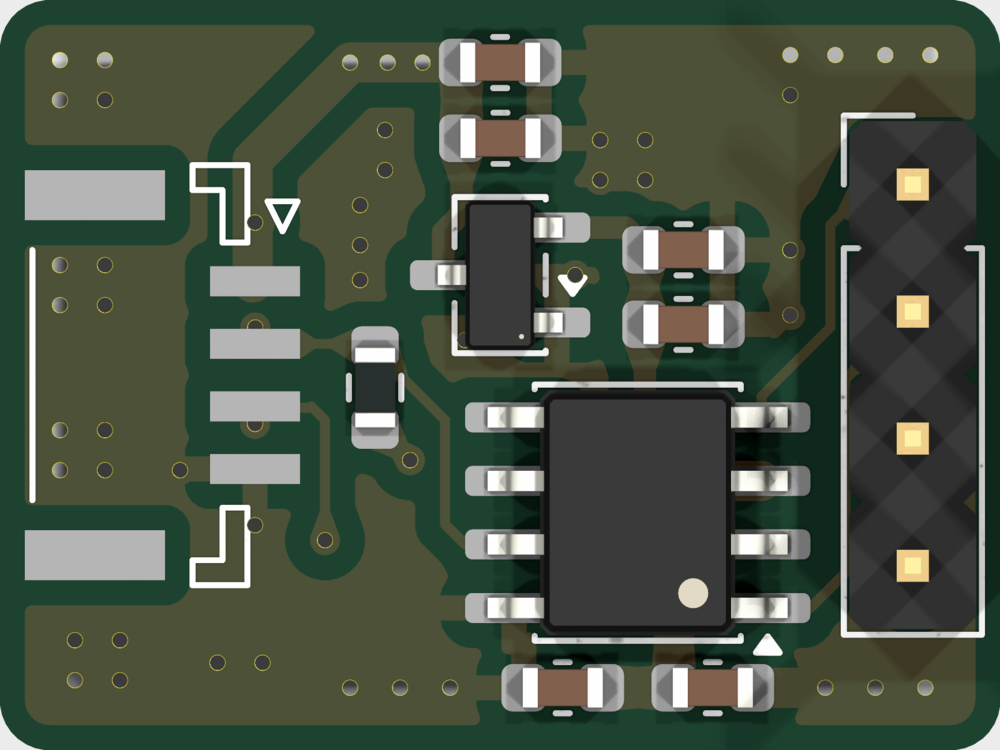
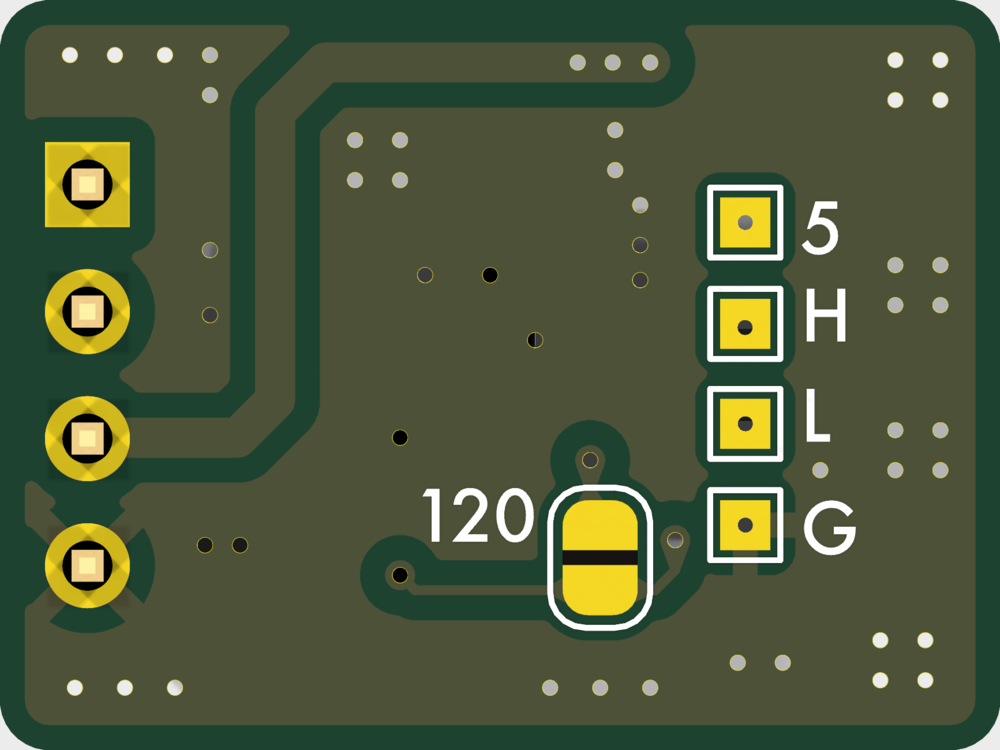
Designed in KiCad 10. See SimpleCANBreakout for a larger version with solder pads and an AMS1117 regulator.
J1 — MCU side (1×4 pin header, 2.54 mm)
| Pin | Signal |
|---|---|
| 1 | CAN RX |
| 2 | CAN TX |
| 3 | +5V |
| 4 | GND |
J2 — CAN bus (JST-GH 4-pin, SM04B-GHS-TB)
| Pin | Signal |
|---|---|
| 1 | +5V |
| 2 | CANH |
| 3 | CANL |
| 4 | GND |
The +5V pins on J1 and J2 are connected, so the board can be powered from either side. CAN TX/RX are 3.3 V logic.
Bridge JP1 (bottom side) to connect the 120 Ω resistor across CANH/CANL. Do this only if the board sits at an end of the bus.
| Ref | Value | Package | LCSC |
|---|---|---|---|
| U3 | SN65HVD230 | SOIC-8 | C12084 |
| U2 | XC6206 3.3 V | SOT-23-3 | C5446 |
| C1, C4, C5 | 1 µF | 0603 | |
| C2, C3, C6 | 100 nF | 0603 | |
| R1 | 120 Ω | 0603 | |
| J1 | 1×4 header | 2.54 mm | |
| J2 | JST-GH 4-pin | SM04B-GHS-TB | C189895 |
SimpleCANBreakoutMicro.kicad_sch / .kicad_pcb / .kicad_pro — KiCad projectSimpleCANBreakoutMicro.pdf — schematicproduction/ — fabrication outputs generated with the Fabrication Toolkit plugin: Gerbers and drill files (SimpleCANBreakoutMicro.zip), BOM, and pick-and-place positions, ready for JLCPCB| Qty | Value | Footprint | References |
|---|---|---|---|
| 4 | TestPoint | TestPoint:TestPoint_Pad_1.0x1.0mm | TP1, TP2, TP3, TP4 |
| 3 | 100n | Capacitor_SMD:C_0603_1608Metric | C2, C3, C6 |
| 3 | 1u | Capacitor_SMD:C_0603_1608Metric | C1, C4, C5 |
| 1 | 120 | Resistor_SMD:R_0603_1608Metric | R1 |
| 1 | Conn_01x04_Pin | Connector_PinHeader_2.54mm:PinHeader_1x04_P2.54mm_Vertical | J1 |
| 1 | Conn_01x04_Pin | Connectors_JST:JST_GH_SM04B-GHS-TB_04x1.25mm_Angled | J2 |
| 1 | SN65HVD230 | Package_SO:SOIC-8_3.9x4.9mm_P1.27mm | U3 |
| 1 | SolderJumper_2_Open | Jumper:SolderJumper-2_P1.3mm_Open_RoundedPad1.0x1.5mm | JP1 |
| 1 | XC6206PxxxMR | Package_TO_SOT_SMD:SOT-23-3 | U2 |
jlpoltrack/CAN-Breakouts
CAN and CAN FD breakout boards: SimpleCANBreakout, SimpleCANBreakoutMicro, MCP251863Breakout (KiCad 10)

jlpoltrack/CAN-Breakouts
CAN and CAN FD breakout boards: SimpleCANBreakout, SimpleCANBreakoutMicro, MCP251863Breakout (KiCad 10)

menloresearch/asimov-1
v1 of Asimov, an open-source humanoid robot

tenderlove/initial-v
It's a BMW shifter converted to a Bluetooth Keyboard that you use with Vim


hirakuni45/RX
Renesas RX Microcontroller, C++ framework, Library, Sample

henrikssn/TurboCAN
This is the official repository for the TurboCAN controller board, designed specifically for the Voron AfterBurner toolhead but can also be used on similar toolheads using NEMA17 steppers.

VIPQualityPost/lemon-pepper-stepper
simplefoc all-in-one 50W hybrid stepper + bldc driver

luftaquila/monolith
DIY wireless real-time datalogging platform for Student Formula and Baja.
It measures 20 × 15 mm and has 2 copper layers, 1.6 mm thick.
16 parts, built around the SN65HVD230D. The full list of its parts is on this page, with links to each part's symbol and footprint where PCBKit's library has them.
From the jlpoltrack/CAN-Breakouts repository on GitHub, at the commit this page was made from: the board is SimpleCANBreakoutMicro/SimpleCANBreakoutMicro.kicad_pcb and its schematic MCP251863Breakout/MCP251863Breakout.kicad_sch. PCBKit opens the board in the browser, with nothing to install.
Its repository publishes it under the MIT licence: you may reuse it on that licence's terms (keep the author's notice, and for a copyleft licence share your changes alike).