4 layers85 × 55 mm
Device
jayis1/hacker-devices
Full-cycle hardware designs for security research devices — each device is a subfolder with its own README, schematics, PCB layout, and software stack
29 parts2

 jayis1/hacker-devices2
Full-cycle hardware designs for security research devices — each device is a subfolder with its own README, schematics, PCB layout, and software stack
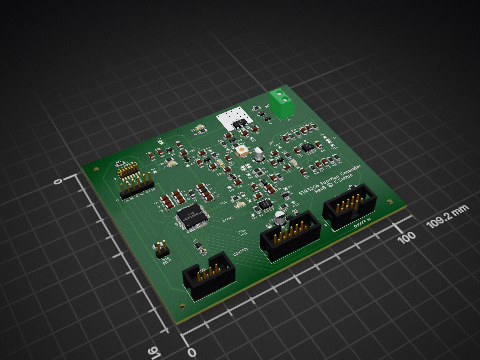
Device is an open-source printed circuit board by jayis1, from the jayis1/hacker-devices repository on GitHub. It is a 4-layer board of 110 × 75 mm with 8 parts on 23 nets, routed with 13 tracks and 0 vias.
It is built around the STM32G474RET6 and ADS131M04IPW. Its parts include 4 ICs, 3 connectors and 1 switch. It belongs with the STM32 boards of this library.


A collection of fully open-source hardware designs for legitimate security research and pentesting. Every device is complete end-to-end: engineering docs, KiCad schematics & PCB layouts, production C/Python firmware, and React Native companion apps. Build it, flash it, run the app, start researching.
No half-finished reference designs. Each device folder contains the full stack:
| Category | Files | Description |
|---|---|---|
| Engineering Docs | phase1_conceptual_architecture.md → phase4_software_stack.md | 4-phase design process: requirements, BOM & netlists, PCB layout rules, software stack |
| KiCad Schematics | kicad/*.kicad_pro, *.kicad_sch, *.kicad_pcb | Full schematic with real component symbols, net labels, power flags, and board outline with placed footprints |
| C/Python Firmware | firmware/main.c, registers.h, board.h, drivers/, Makefile | Production-quality MCU firmware — init code, drivers with DMA, USB descriptors, wire protocol |
| React Native App | app/App.js, screens/, components/, utils/protocol.js, package.json | Companion mobile app for device control, configuration, real-time status, and data capture |
Every device follows a rigorous 4-phase process:
| Phase | Document | Contents |
|---|---|---|
| Phase 1 | phase1_conceptual_architecture.md | Purpose, performance targets, constraints, block diagram, bus topology, power domains |
| Phase 2 | phase2_component_selection_schematics.md | BOM with real part numbers, pinouts/MUX tables, decoupling networks, netlists, impedance matching |
| Phase 3 | phase3_pcb_blueprints_layout.md | PCB stackup, routing rules, length matching, via strategy, thermal management, DFM notes |
| Phase 4 | phase4_software_stack.md | MMIO/register defs, clock & GPIO init (production C), critical device driver, device tree, bootloader |
| # | Device | Status | Description |
|---|---|---|---|
| 1 | wifi-pentest-dongle/ | ✅ Complete | 802.11ax monitor/inject, deauth, PMKID capture |
| 2 | rf-transceiver-tool/ | ✅ Complete | Sub-GHz + 2.4GHz multi-protocol (CC1101 + nRF24) |
| 3 | badusb-injector | ⏳ Queued | HID emulation payload injector, multi-profile |
| 4 | nfc-rfid-cloner | ⏳ Queued | 13.56MHz + 125kHz, Mifare/EM4100 |
| 5 | network-tap-mitm | ⏳ Queued | 2× GbE transparent bridge, packet capture |
| 6 | can-bus-analyzer | ⏳ Queued | OBD-II + CAN-FD, automotive pentest |
| 7 | sdr-keyfob-replay | ⏳ Queued | 433/315MHz keyfob capture & replay |
| 8 | ble-sniffer-spoofer | ⏳ Queued | nRF52, advertisement inject, GATT fuzz |
| 9 | imsi-catcher-detector | ⏳ Queued | LTE/4G SDR analysis |
| 10 | biometric-bypass-toolkit | ⏳ Queued | Fingerprint emulation, RFID clone for access control |
| Component | License |
|---|---|
| Hardware design (KiCad) | CERN-OHL-S v2 |
| C firmware & drivers | GPL-2.0 |
| Python tools & scripts | MIT |
| React Native companion apps | MIT |
| Qty | Value | Footprint | References |
|---|---|---|---|
| 1 | ADS131M04 | Package_SO:TSSOP-20_4.4x6.5mm_P0.65mm | U6 |
| 1 | DALI CTRL | TerminalBlock_Phoenix:TerminalBlock_Phoenix_MKDS-1,5-2_1x02_P5.00mm_Horizontal | J1 |
| 1 | DALI GEAR | TerminalBlock_Phoenix:TerminalBlock_Phoenix_MKDS-1,5-2_1x02_P5.00mm_Horizontal | J2 |
| 1 | ISO7721 CTRL | Package_SO:SOIC-8_3.9x4.9mm_P1.27mm | U4 |
| 1 | ISO7721 GEAR | Package_SO:SOIC-8_3.9x4.9mm_P1.27mm | U5 |
| 1 | NC FAILSAFE BYPASS | Relay_SMD:Relay_DPDT_Omron_G6K-2F-Y | K1 |
| 1 | STM32G474RET6 | Package_QFP:LQFP-64_10x10mm_P0.5mm | U1 |
| 1 | USB-C | Connector_USB:USB_C_Receptacle_GCT_USB4105-xx-A_16P_TopMnt_Horizontal | J3 |
It measures 110 × 75 mm and has 4 copper layers, 1.6 mm thick.
8 parts, built around the STM32G474RET6 and ADS131M04IPW. The full list of its parts is on this page, with links to each part's symbol and footprint where PCBKit's library has them.
From the jayis1/hacker-devices repository on GitHub, at the commit this page was made from: the board is dali-sentinel/kicad/device.kicad_pcb. PCBKit opens the board in the browser, with nothing to install.
Its repository states no licence, so its author keeps all rights: ask jayis1 before reusing the design.
jayis1/hacker-devices
Full-cycle hardware designs for security research devices — each device is a subfolder with its own README, schematics, PCB layout, and software stack

jayis1/hacker-devices
Full-cycle hardware designs for security research devices — each device is a subfolder with its own README, schematics, PCB layout, and software stack

jayis1/hacker-devices
Full-cycle hardware designs for security research devices — each device is a subfolder with its own README, schematics, PCB layout, and software stack

jayis1/hacker-devices
Full-cycle hardware designs for security research devices — each device is a subfolder with its own README, schematics, PCB layout, and software stack

jayis1/hacker-devices
Full-cycle hardware designs for security research devices — each device is a subfolder with its own README, schematics, PCB layout, and software stack

jayis1/hacker-devices
Full-cycle hardware designs for security research devices — each device is a subfolder with its own README, schematics, PCB layout, and software stack

jayis1/hacker-devices
Full-cycle hardware designs for security research devices — each device is a subfolder with its own README, schematics, PCB layout, and software stack

jayis1/hacker-devices
Full-cycle hardware designs for security research devices — each device is a subfolder with its own README, schematics, PCB layout, and software stack

jayis1/hacker-devices
Full-cycle hardware designs for security research devices — each device is a subfolder with its own README, schematics, PCB layout, and software stack

jayis1/hacker-devices
Full-cycle hardware designs for security research devices — each device is a subfolder with its own README, schematics, PCB layout, and software stack

jayis1/hacker-devices
Full-cycle hardware designs for security research devices — each device is a subfolder with its own README, schematics, PCB layout, and software stack

jayis1/hacker-devices
Full-cycle hardware designs for security research devices — each device is a subfolder with its own README, schematics, PCB layout, and software stack

skunkforce/b091_2-4channel_24bit_ADC_ADS131M02-4
to pull the submodules before opening the project with kicad.


jayis1/hardware-design-lab
Full-cycle hardware device designs — each device in its own subfolder with architecture, schematics, PCB layout, and software stack


NicholasKorth/BedCooler
A dual-zone heating and cooling controller for a bed: a 6-layer KiCad board with an STM32G474 real-time controller and a Raspberry Pi Compute Module 5 host.
cracked-machine/FunctionGeneratorCortexM4_HW
A function generator powered by ARM Cortex M4

6thSense-dev/mocap-glove
Magnetic MoCap glove firmware, tracking diagnostics and local hand visualizer