Skip to the content
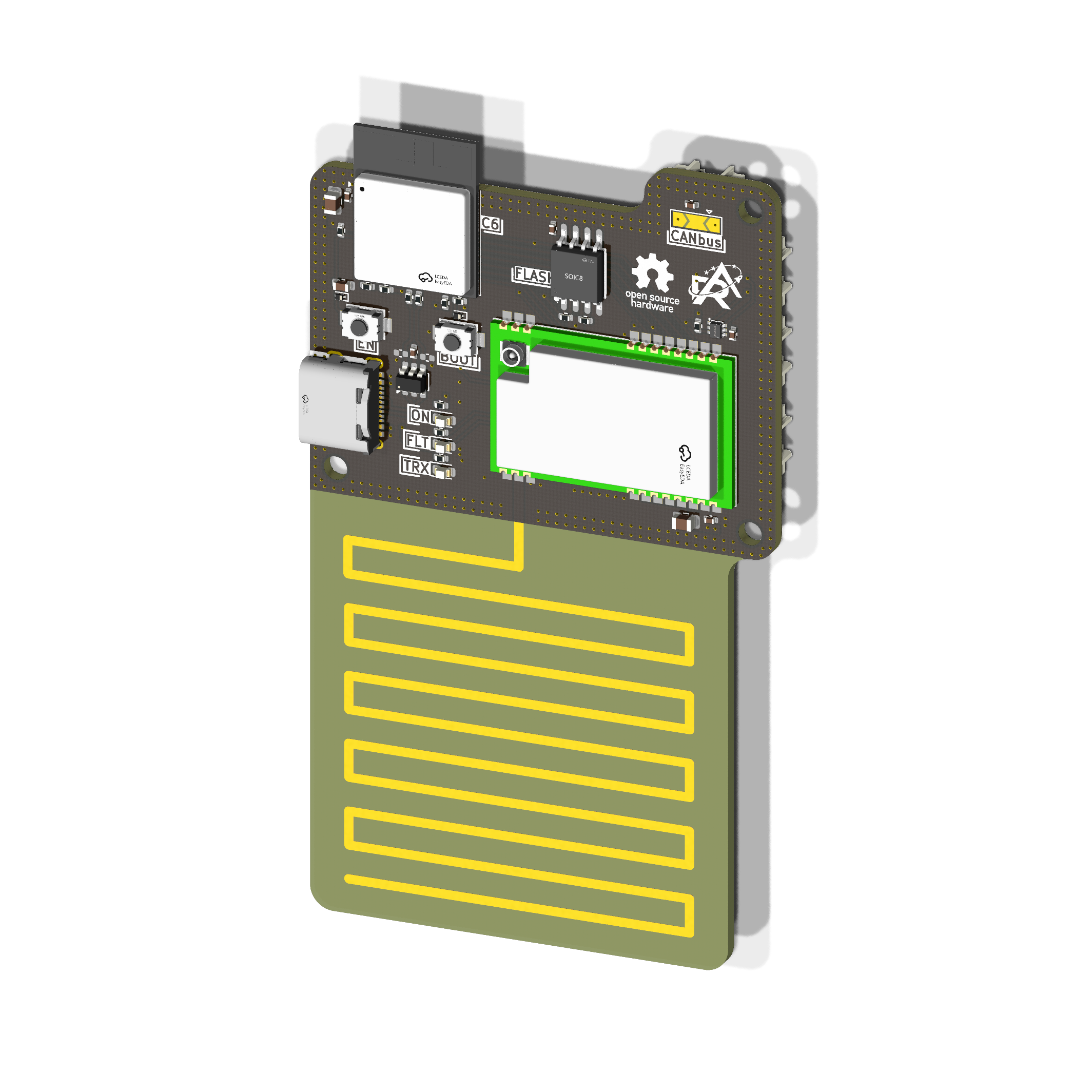
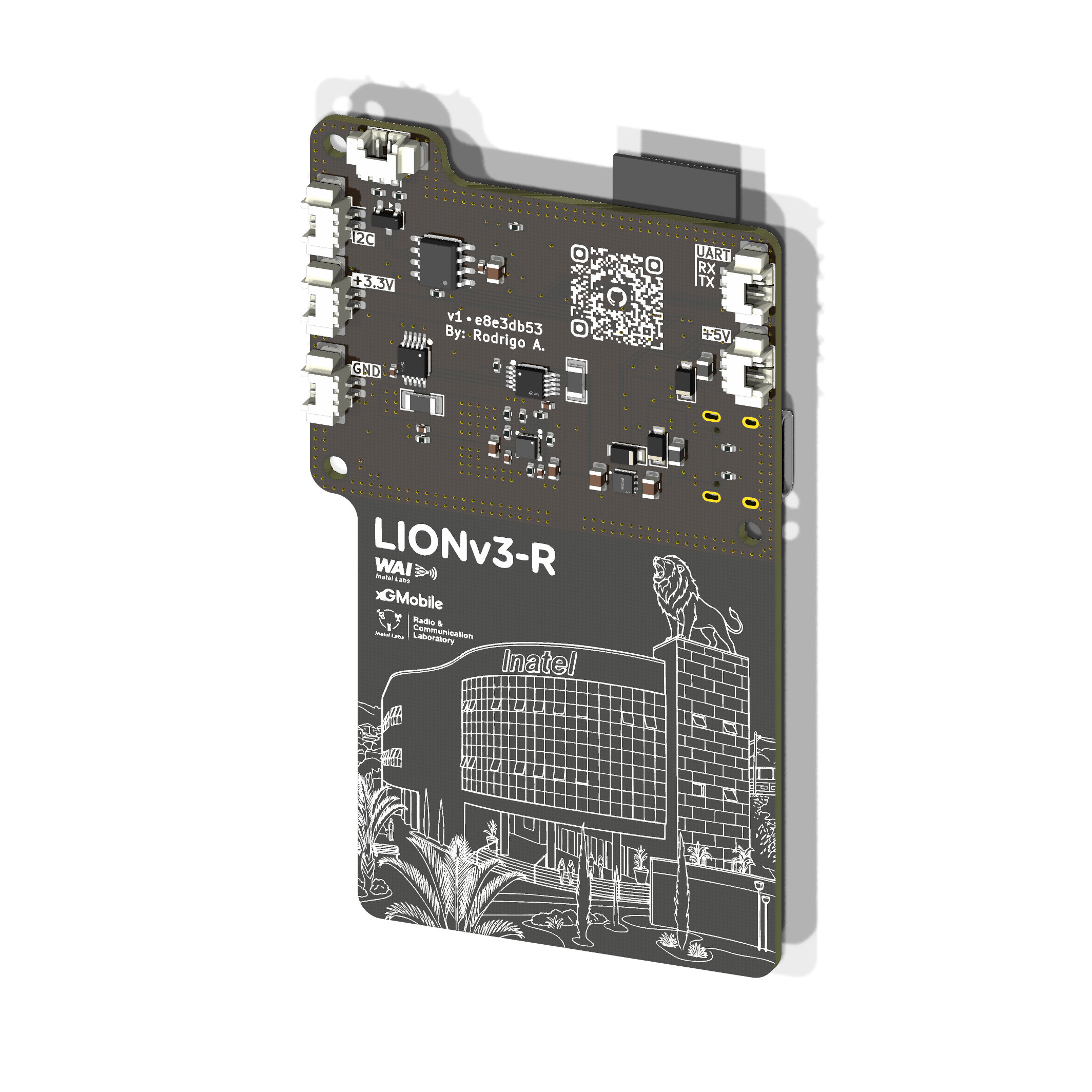
4 layers50.1 × 85.2 mmLIONv3, the printed circuit board in 3D

The LIONv3-R is an IoT and Direct-to-Satellite board powered by the ESP32-C6, combining local Wi-Fi, Zigbee, and Thread networks with high-density LR-FHSS connectivity for scalable global tracking and telemetry.

Size
50.1 × 85.2 mm
Copper layers
4
Thickness
1.6 mm
Parts
89
Nets
72
Pads
325
Tracks, vias
324, 467
Pours
16
Routed
Yes
KiCad
KiCad 10.0 (file 20260206)
Created
12 Aug 2026
Updated
30 Sep 2026

Overview

LIONv3 is an open-source printed circuit board by RodrigoCAndrade, from the RodrigoCAndrade/LIONv3-R repository on GitHub. It is a 4-layer board of 50.1 × 85.2 mm with 89 parts on 72 nets, routed with 324 tracks and 467 vias.

It is built around the E80-900M2213S, ESP32-C6-MINI-1-N4 and TCAN3414DRB, with the INA226AIDGSR, TMP112AIDRLR(UMW) and TLV76733DRVR among its other parts. Its parts include 29 resistors, 22 capacitors, 20 ICs, 6 diodes and 2 switches. It belongs with the radio and wireless and home automation and IoT boards and the ESP32 and RISC-V boards of this library.

Main components

12

README

README.md
Rodrigo Andrade Logo

LIONv3-R Module

Status GitHub Release GitHub Issues GitHub Pull Requests GitHub Contributors


Overview

The LIONv3-R is an IoT and Direct-to-Satellite (DtS) board built around the ESP32-C6, with 16 MB of external flash and local connectivity over Wi-Fi, Zigbee and Thread. Its radio supports LR-FHSS alongside conventional LoRa, enabling reliable uplinks to satellites or terrestrial gateways from remote sites, at device densities conventional LoRa cannot sustain. By bridging local wireless networks with satellite reach, the LIONv3-R is a complete, scalable hardware platform for telemetry, global asset tracking and remote sensing.

Repository Organization

  • docs: Systems engineering, datasheets, requirements (SRD), and interface control (ICD).
  • hardware: Native KiCad project, schematics, and manufacturing files.
  • mechanics: 3D models, technical drawings, and physical integration constraints.
  • software: Embedded firmware and support testing scripts.

Releases

RenderHardware RevisionStatusLatest ReleaseDateDatasheetBOMManufacturing Info
board renderLIONv3-R🚧 Development- [blocked]18-08-2026PDF [blocked]-Gerber [blocked]

Contributing

We welcome contributions to this project! To ensure a smooth collaboration and maintain our engineering standards, please review our Contribution Guidelines before opening any issues, modifying the hardware design, or submitting pull requests.

References

This board was developed from scratch, but draws on the earlier LIONv1 and LIONv2 designed by Diego Anestor Coutinho and Arielli Ajudarte. The v3 introduces several improvements:

  • Dedicated low-power MCU on board
  • LR-FHSS support and a more capable LoRa transceiver, covering both sub-GHz and S-band
  • External flash for store-and-forward applications
  • More efficient antenna
  • More compact form factor

License

This project utilizes a dual-licensing approach to maximize flexibility and adoption:

  • Hardware: The hardware designs and schematics are licensed under the permissive CERN-OHL-P-2.0 open-hardware license. You are entirely free to use, modify, distribute, and commercialize the design without any copyleft obligations to share your derived works under the same terms.
  • Software: All embedded firmware and utility scripts are licensed under the MIT License. You are free to use, modify, and distribute the code without restriction, provided the original copyright notice and permission notice are included.

Acknowledgments

This work was carried out at the National Institute of Telecommunications (Inatel) with the support of three research laboratories. The EMBRAPII Inatel Competence Center for 5G and 6G Networks (xGMobile) supported this project through its Talent Development Program (PFT xGMobile), alongside the Radio & Communication Laboratory (RadioCom Lab) and the Wireless and Artificial Intelligence Laboratory (WAI Lab). Many thanks to the researchers and staff of all three laboratories for their help and for the infrastructure that made the LIONv3-R possible.

Funding

Built with ❤️ by Rodrigo de Carvalho Andrade
Parts

89
QtyValueFootprintReferences
1110kResistor_SMD:R_0402_1005MetricR1, R4, R5, R11, R13, R14, R15, R16, R21, R22, R27
9100nFCapacitor_SMD:C_0402_1005MetricC2, C4, C7, C8, C10, C11, C12, C19, C21
6HC-1_25-2PWTLIONv3-Footprints:CONN-SMD_2P-P1.25-HC-1.25-2PWTU1, U2, U5, U18, U19, U20
422uFCapacitor_SMD:C_0805_2012MetricC1, C9, C15, C16
31uFCapacitor_SMD:C_0603_1608MetricC3, C13, C14
34.7kResistor_SMD:R_0402_1005MetricR2, R3, R7
3LOGOLOGOG***, G***, G***
3MountingHole_PadMountingHole:MountingHole_2.5mmH1, H2, H3
3PMEG2010ERDiode_SMD:Nexperia_CFP3_SOD-123WD3, D4, D5
20Resistor_SMD:R_0402_1005MetricR6, R8
2120Resistor_SMD:R_0402_1005MetricR17, R20
25.1kResistor_SMD:R_0402_1005MetricR9, R10
250mLIONv3-Footprints:R1206R12, R26
259Resistor_SMD:R_0402_1005MetricR28, R29
2BLM21PG221SN1DInductor_SMD:L_0805_2012MetricFB1, FB2
2DNPCapacitor_SMD:C_0402_1005MetricC5, C6
2ESD9B3.3ST5GDiode_SMD:D_SOD-923D1, D2
2INA226AIDGSRLIONv3-Footprints:MSOP-10_L3.0-W3.0-P0.50-LS5.0-BLU9, U17
110uFCapacitor_SMD:C_0805_2012MetricC20
115kResistor_SMD:R_0402_1005MetricR19
12.2nFCapacitor_SMD:C_0402_1005MetricC18
13.32kResistor_SMD:R_0402_1005MetricR25
13.3nFCapacitor_SMD:C_0402_1005MetricC17
134.8kResistor_SMD:R_0402_1005MetricR23
14.7nFCapacitor_SMD:C_0402_1005MetricC22
1430Resistor_SMD:R_0402_1005MetricR24
160.4kResistor_SMD:R_0402_1005MetricR18
1BOOTLIONv3-Footprints:KEY-SMD_L3.9-W3.0-LS5.0SW2
1E80-900M2213SLIONv3-Footprints:WIFIM-SMD_22P-L26.0-W16.0-P1.27-TLU10
1ESP32-C6-MINI-1-N4RF_Module:ESP32-C6-MINI-1U3
1RESETLIONv3-Footprints:KEY-SMD_L3.9-W3.0-LS5.0SW1
1SolderJumper_3_OpenJumper:SolderJumper-3_P2.0mm_Open_TrianglePad1.0x1.5mmJP1
1TCAN3414DRLIONv3-Footprints:SOIC-8_L4.9-W3.9-P1.27-LS6.0-BLU21
1TI ESD752DBZRPackage_TO_SOT_SMD:SOT-23-3D6
1TLV76733DRVRLIONv3-Footprints:WSON-6_L2.0-W2.0-P0.65-TL-EPU15
1TMP112AIDRLRLIONv3-Footprints:SOT-563_L1.6-W1.2-P0.50-LS1.6-BRU6
1TPS259474ARPWRLIONv3-Footprints:VQFN-10_L2.0-W2.0-P0.45-TLU14
1TYPE-C_16PIN_2MD(073)LIONv3-Footprints:USB-C-SMD_TYPE-C-16PIN-2MD-073U8
1USBLC6-2SC6Package_TO_SOT_SMD:SOT-23-6U7
1W25Q16JVSSIQTRLIONv3-Footprints:SOIC-8_L5.3-W5.3-P1.27-LS8.0-BLU11
1XL-1608SURC-06LIONv3-Footprints:LED0603-RD_REDU16
1XL-1608UBC-04LIONv3-Footprints:LED0603-RD_BLUEU12
1XL-1608UGC-04LIONv3-Footprints:LED0603-RD_GREENU13

The 88 most common of 89 parts.

Similar boards

  • 4 layers50.2 × 40.2 mmLIONv3, the printed circuit board in 3D

    LIONv3

    RodrigoCAndrade/LIONv3-Mini

    The LIONv3-Mini is an IoT and Direct-to-Satellite board powered by the ESP32-C6, combining local Wi-Fi, Zigbee, and Thread networks with high-density LR-FHSS connectivity for scalable global tracking and telemetry.

    88 parts2
  • 4 layers90.2 × 95.9 mmTET, the printed circuit board in 3D

    TET

    ICDT-Inatel-Cubesat-Design-Team/TET-Module

    A reliable 1U CubeSat TT&C subsystem featuring an STM32L4 MCU, LoRa radio for long-range communication, CAN Bus, and TMR SPI Flash for critical space applications.

    87 parts5CERN-OHL-W-2.0
  • 2 layers101.4 × 69.4 mmPanel, the printed circuit board in 3D

    Panel

    4project-co-il/PlugAndPlay-SAMD21

    Plug-n-Play SAMD21 Development Board

    85 partsMIT
  • 2 layers48.2 × 49.8 mmEEG amp, the printed circuit board in 3D

    EEG amp

    hackclub/OnBoard

    💡 Join 1,000 teenagers and make your first PCB with a $100 grant!

    31 parts915
  • 4 layers60 × 53.7 mmOptical flow, the printed circuit board in 3D

    Optical flow

    SSL-A-Team/electrical

    circuit board design files, gerbers, and circuit analysis

    55 parts6MIT
  • 4 layers155 × 103 mmMEMLNaut 0 3, the printed circuit board in 3D

    MEMLNaut 0 3

    MusicallyEmbodiedML/MEMLNaut

    138 parts6
  • 4 layers19.9 × 90.4 mmELI2040c, the printed circuit board in 3D

    ELI2040c

    Emute-Lab-Instruments/ELI2040

    62 parts
  • 4 layers55 × 55 mmAI Pocket, the printed circuit board in 3D

    AI Pocket

    zycero/AiPocket-Kicad-ESP32-P4-seconde

    164 parts1

Questions

How big is the LIONv3 PCB?

It measures 50.1 × 85.2 mm and has 4 copper layers, 1.6 mm thick.

What parts does the LIONv3 use?

89 parts, built around the E80-900M2213S, ESP32-C6-MINI-1-N4, TCAN3414DRB and INA226AIDGSR. The full list of its parts is on this page, with links to each part's symbol and footprint where PCBKit's library has them.

Where can I download the LIONv3 KiCad files?

From the RodrigoCAndrade/LIONv3-R repository on GitHub, at the commit this page was made from: the board is hardware/LIONv3/LIONv3.kicad_pcb and its schematic hardware/LIONv3/CANbus.kicad_sch. PCBKit opens the board in the browser, with nothing to install.

Can I use the LIONv3 design in my own project?

Its repository states no licence, so its author keeps all rights: ask RodrigoCAndrade before reusing the design.