Skip to the content
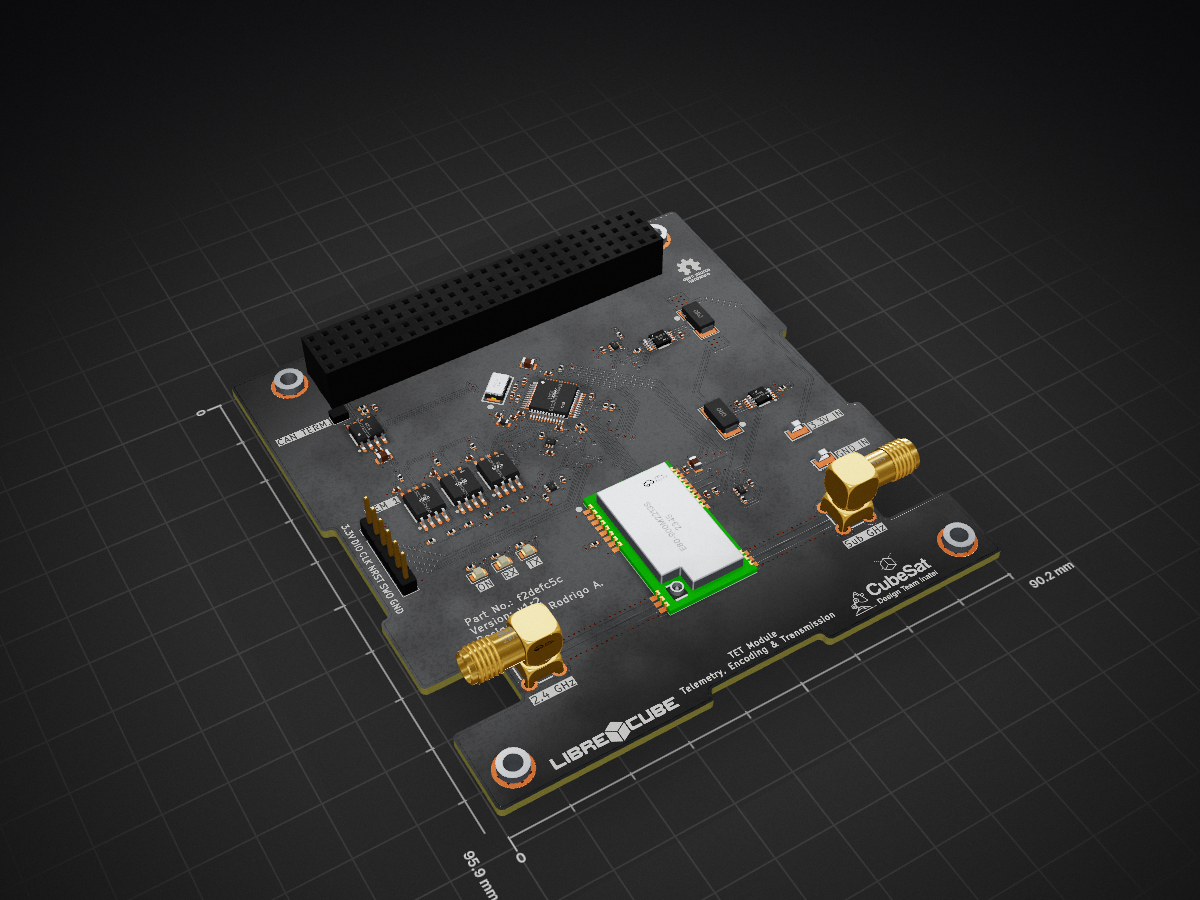
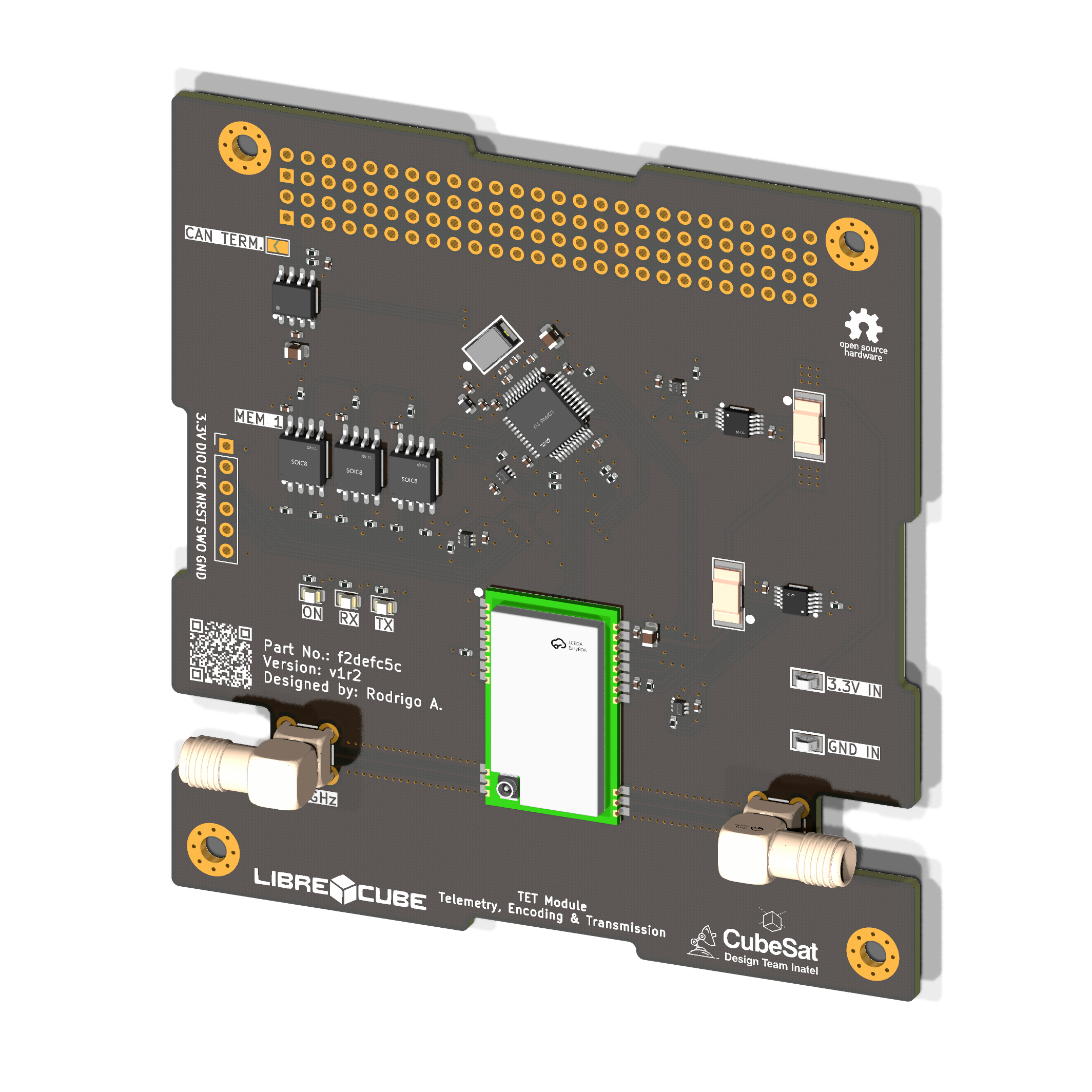
4 layers90.2 × 95.9 mmTET, the printed circuit board in 3D

A reliable 1U CubeSat TT&C subsystem featuring an STM32L4 MCU, LoRa radio for long-range communication, CAN Bus, and TMR SPI Flash for critical space applications.

Size
90.2 × 95.9 mm
Copper layers
4
Thickness
1.6 mm
Parts
87
Nets
154
Pads
426
Tracks, vias
761, 221
Pours
518
Routed
Yes
KiCad
KiCad 10.0 (file 20260206)
Created
3 May 2026
Updated
28 Sep 2026

Overview

TET is an open-source printed circuit board by ICDT-Inatel-Cubesat-Design-Team, from the ICDT-Inatel-Cubesat-Design-Team/TET-Module repository on GitHub, published under the CERN-OHL-W-2.0 licence. It is a 4-layer board of 90.2 × 95.9 mm with 87 parts on 154 nets, routed with 761 tracks and 221 vias.

It is built around the STM32L431CCT6, E80-900M2213S and TCAN3414DRB, with the TMP112AIDRLR(UMW), W25Q128JVSIQ TR and INA226AIDGSR among its other parts. Its parts include 29 resistors, 26 capacitors, 17 ICs, 3 diodes and 1 connector. It belongs with the radio and wireless boards and the STM32 boards of this library.

Main components

6

README

README.md
ICDT Logo

TET Module

Static Badge [blocked] GitHub Release GitHub Issues or Pull Requests GitHub Issues or Pull Requests GitHub contributors

Overview • Repository Organization • Releases • References • License

Overview

This project involves the development of the TET (Telemetry, Encoding & Transmission) module tailored for a 1U CubeSat platform. The system is engineered to handle TT&C (Tracking, Telemetry, and Command) capabilities, providing long-range telemetry and low-power wireless communication based on the Semtech LR1121 RF transceiver architecture and an STM32L431 microcontroller.

Technical Parameters

  • RF Architecture: E80-900M2213S (LR1121)
  • Supported Bands: Dual-band operation (915 MHz and 2.4 GHz)
  • Modulation Schemes: LoRa, GFSK, FLRC, and LR-FHSS.
  • RF Interfaces: Dedicated SMA/IPEX outputs for external antennas
  • External Interfaces: SPI, GPIO, and CAN bus (via TCAN3414).
  • Power Input: 3 independent 5 V input channels from the EPS (via PC/104)
  • Power Regulation: Independent, regulated low-noise 3.3 V rail.
  • Onboard Sensors: INA226 (current and voltage monitoring) and TMP112 (temperature monitoring and thermal alerts via I2C).
  • Storage: 3 external SPI flash memories configured with TMR (Triple Modular Redundancy) for telemetry buffering and data storage.

Repository Organization

  • docs: Technical documentation and datasheets.
  • hardware: Core hardware files.
    • 3D: 3D models (.step).
    • Fabrication: BOM and Gerber files for JLCPCB manufacturing.
    • PCB: KiCad schematics and layout design.
  • firmware: Examples of firmware implementation.

Releases

RenderBoard NameStatusLatest ReleaseDateDatasheetBOMOrdering Info
renderTET Module v1🧪 Testingv1r209-06-2026YesGERBER (JLCPCB)

References

This project was inspired by the TTC and TTC2 modules from SpaceLab UFSC, and the Build a CubeSat project. Thank you to both for making your work open-source, and a special thanks to the Build a CubeSat community for their support.

Missions Associated with this Project

License

This project is licensed under the permissive, weakly-reciprocal CERN-OHL-W-2.0 open-hardware license. You are free to modify and distribute these files, provided downstream hardware design modifications remain under the same terms.

Parts

87
QtyValueFootprintReferences
17100nFCapacitor_SMD:C_0402_1005MetricC1, C2, C14, C19, C20, C22, C23, C24, C25, C26, C27, C30, C31, C32, C33, C40 +1
1410kResistor_SMD:R_0402_1005MetricR1, R26, R27, R28, R30, R31, R34, R35, R36, R37, R38, R39, R40, R45
84.7kResistor_SMD:R_0402_1005MetricR6, R8, R29, R33, R41, R42, R43, R44
4MountingHole_PadMountingHole:MountingHole_3.2mm_M3_Pad_ViaH3, H4, H5, H6
4TMP112AIDRLRTET-Footprints:SOT-563_L1.6-W1.2-P0.50-LS1.6-BRU4, U6, U17, U19
3W25Q128JVSIQTRTET-Footprints:SOIC-8_L5.3-W5.3-P1.27-LS8.0-BLU12, U13, U16
210uFCapacitor_SMD:C_0805_2012MetricC29, C34
21uFCapacitor_SMD:C_0402_1005MetricC36, C37
220pFCapacitor_SMD:C_0402_1005MetricC38, C39
22mTET-Footprints:RES-SMD_L6.3-W3.1-1R7, R32
25015TET-Footprints:TEST-SMD_L2.7-W1.0U1, U2
260.4Resistor_SMD:R_0402_1005MetricR3, R4
2INA226AIDGSRTET-Footprints:MSOP-10_L3.0-W3.0-P0.50-LS5.0-BLU3, U21
2PC/104 ConnectorTET-Footprints:PinHeader_2x26_P2.54mm_VerticalH1, H2
2SMATET-Footprints:SMA-TH_SMA-KWE_C7498154U11, U15
1100Resistor_SMD:R_0402_1005MetricR5
110nFCapacitor_SMD:C_0402_1005MetricC35
1120RInductor_SMD:L_0603_1608MetricFB2
1200Resistor_SMD:R_0402_1005MetricR2
122uFCapacitor_SMD:C_0805_2012MetricC21
1270Resistor_SMD:R_0402_1005MetricR10
14.7 nFCapacitor_SMD:C_0402_1005MetricC8
18 MHzTET-Footprints:CRYSTAL-SMD_L5.0-W3.2U8
1E80-900M2213STET-Footprints:WIFIM-SMD_22P-L26.0-W16.0-P1.27-TLU14
1Jumper_2_OpenJumper:SolderJumper-2_P1.3mm_Open_TrianglePad1.0x1.5mmJP1
1LOGOTET-Footprints:LibreCube_logo_22.4mmG***
1LOGOLOGOG***
1Logo_Open_Hardware_SmallSymbol:OSHW-Logo_5.7x6mm_SilkScreenREF1
1ON_LEDLED_SMD:LED_0805_2012MetricD6
1RX_LEDLED_SMD:LED_0805_2012MetricD5
1STM32L431CCT6TET-Footprints:LQFP-48_L7.0-W7.0-P0.50-LS9.0-BLU20
1SWDConnector_PinHeader_2.54mm:PinHeader_1x06_P2.54mm_VerticalJ1
1TCAN3414DRTET-Footprints:SOIC-8_L4.9-W3.9-P1.27-LS6.0-BLU5
1TX_LEDLED_SMD:LED_0805_2012MetricD4

Similar boards

  • 4 layers50.1 × 85.2 mmLIONv3, the printed circuit board in 3D

    LIONv3

    RodrigoCAndrade/LIONv3-R

    The LIONv3-R is an IoT and Direct-to-Satellite board powered by the ESP32-C6, combining local Wi-Fi, Zigbee, and Thread networks with high-density LR-FHSS connectivity for scalable global tracking and telemetry.

    89 parts4
  • 4 layers50.2 × 40.2 mmLIONv3, the printed circuit board in 3D

    LIONv3

    RodrigoCAndrade/LIONv3-Mini

    The LIONv3-Mini is an IoT and Direct-to-Satellite board powered by the ESP32-C6, combining local Wi-Fi, Zigbee, and Thread networks with high-density LR-FHSS connectivity for scalable global tracking and telemetry.

    88 parts2
  • 2 layers68.9 × 51.8 mmE80-900M2213S SE050 Breakout, the printed circuit board in 3D

    E80-900M2213S SE050 Breakout

    cvaldess/E80-900M2213S_SE050_Breakout

    Breakout board for the Ebyte E80-X00M221XS (LR1121/LR2021 dual-band LoRa) with an NXP SE050 secure element — KiCad 10

    18 partsGPL-3.0
  • 6 layers240 × 207 mmEHNS -, the printed circuit board in 3D

    EHNS -

    HW9711/EHNS_-

    EHNS硬件

    665 parts
  • 2 layers50.8 × 88.9 mmBusiness card pcb, the printed circuit board in 3D

    Business card pcb

    josephattalla/business-card-pcb

    A low power stm32 driven pcb business card powered by a coin cell battery featuring an 8x8 LED matrix controllable by the stm32.

    84 parts
  • 2 layers120 × 100 mmEnvSensor, the printed circuit board in 3D

    EnvSensor

    jakubprzybytek/Environmental-Sensors

    90 parts1
  • 4 layers76 × 64 mmEWP Control, the printed circuit board in 3D

    EWP Control

    haum2002/EWP-Control

    SmartCoolingv2.1 menggabungkan firmware SmartCooling dengan reka bentuk EWP Controller ini. RP2350B kekal sebagai pengawal keselamatan dan actuator kritikal, manakala ESP32-S3 mengurus UI, Wi-Fi, BLE, diagnostik dan…

    93 parts
  • 4 layers110 × 75 mmMainBoard nonRJ45, the printed circuit board in 3D

    MainBoard nonRJ45

    Gold-Rush-Robotics/pcb_2024

    A repository to store work done on PCBs for the 2024 season

    85 parts1MIT

Questions

How big is the TET PCB?

It measures 90.2 × 95.9 mm and has 4 copper layers, 1.6 mm thick.

What parts does the TET use?

87 parts, built around the STM32L431CCT6, E80-900M2213S, TCAN3414DRB and TMP112AIDRLR(UMW). The full list of its parts is on this page, with links to each part's symbol and footprint where PCBKit's library has them.

Where can I download the TET KiCad files?

From the ICDT-Inatel-Cubesat-Design-Team/TET-Module repository on GitHub, at the commit this page was made from: the board is hardware/PCB/TET.kicad_pcb and its schematic hardware/PCB/TET-Power-Supply.kicad_sch. PCBKit opens the board in the browser, with nothing to install.

Can I use the TET design in my own project?

Its repository publishes it under the CERN-OHL-W-2.0 licence: you may reuse it on that licence's terms (keep the author's notice, and for a copyleft licence share your changes alike).