2 layers120 × 120 mm
 MartinChauveliere/Arduino_Nano
Replication d'un arduino nano
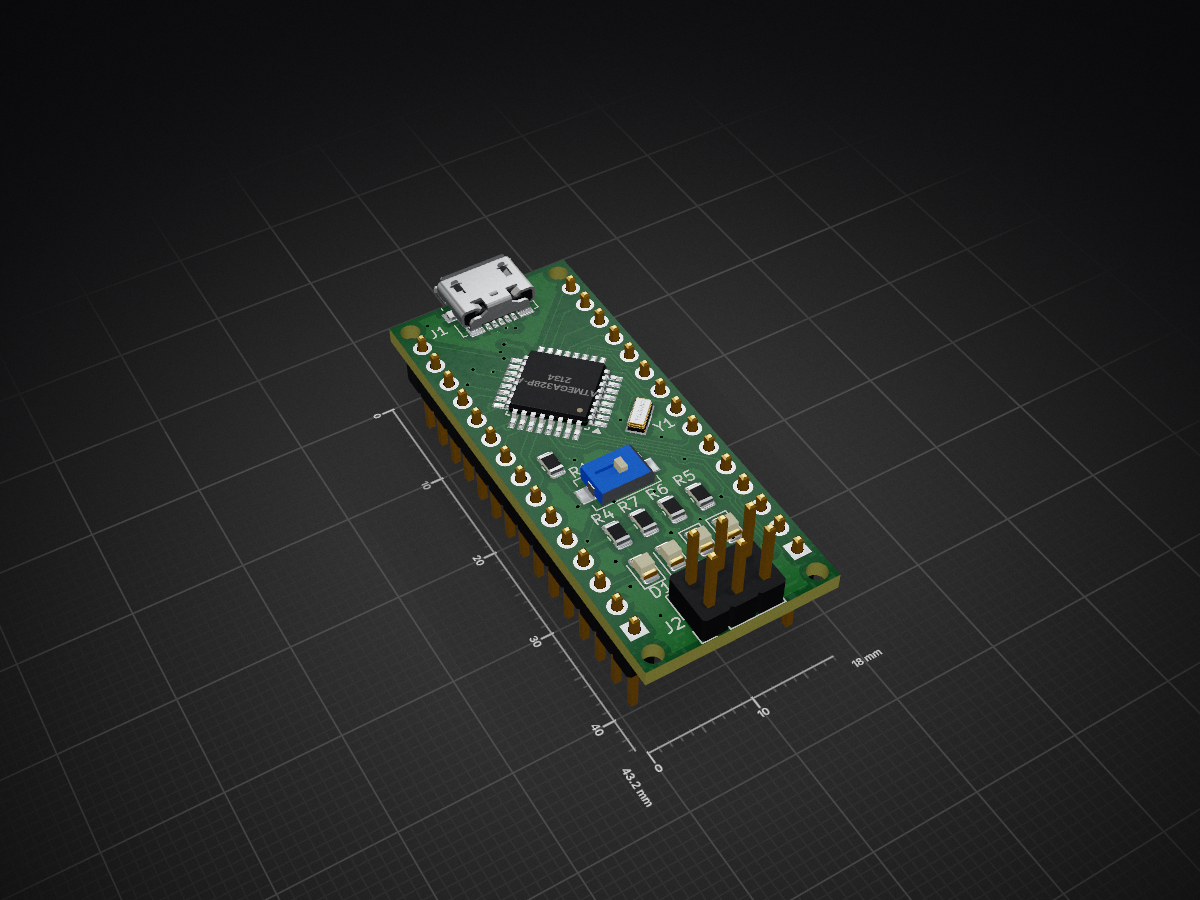
Arduino Nano is an open-source printed circuit board by MartinChauveliere, from the MartinChauveliere/Arduino_Nano repository on GitHub. It is a 2-layer board of 18 × 43.2 mm with 32 parts on 53 nets, routed with 472 tracks and 50 vias.
It is built around the ATMEGA328P-AU, FT232RL and LM1117MP-5.0. Its parts include 10 capacitors, 7 resistors, 5 diodes, 4 connectors and 3 ICs. It belongs with the AVR (ATmega, ATtiny) boards of this library.


| Qty | Value | Footprint | References |
|---|---|---|---|
| 8 | C | Capacitor_SMD:C_0805_2012Metric | C1, C2, C3, C4, C6, C7, C8, C11 |
| 7 | R | Resistor_SMD:R_0805_2012Metric | R1, R2, R3, R4, R5, R6, R7 |
| 2 | C_Polarized | Capacitor_SMD:C_0805_2012Metric | C5, C9 |
| 2 | Conn_01x15 | Connector_PinHeader_2.54mm:PinHeader_1x15_P2.54mm_Vertical | J3, J4 |
| 1 | ATmega328P-A | Package_QFP:TQFP-32_7x7mm_P0.8mm | U1 |
| 1 | AVR-ISP-6 | Connector_PinHeader_2.54mm:PinHeader_2x03_P2.54mm_Vertical | J2 |
| 1 | Crystal | Crystal:Crystal_SMD_3215-2Pin_3.2x1.5mm | Y1 |
| 1 | D_Schottky | Diode_SMD:D_SMA | D4 |
| 1 | FT232RL | Package_SO:SSOP-28_5.3x10.2mm_P0.65mm | U2 |
| 1 | LED_Built_In | LED_SMD:LED_0805_2012Metric | D1 |
| 1 | LED_RX | LED_SMD:LED_0805_2012Metric | D2 |
| 1 | LED_TX | LED_SMD:LED_0805_2012Metric | D3 |
| 1 | LED_Tension | LED_SMD:LED_0805_2012Metric | D5 |
| 1 | LM1117MP-5.0 | Package_TO_SOT_SMD:SOT-223-3_TabPin2 | U3 |
| 1 | Polyfuse | Fuse:Fuse_1812_4532Metric | F1 |
| 1 | SW_Push | Button_Switch_SMD:SW_SPST_EVQPE1 | SW1 |
| 1 | USB_B_Micro | Connector_USB:USB_Micro-B_Molex_47346-0001 | J1 |

riteshh27/arduino-nano-clone
KiCad project for an Arduino Nano clone (ATmega328P + FT232RL USB-serial)


Hirusha785/arduino-nano-kicad-design
⚙️ Arduino Nano-compatible development board designed in KiCad for the Mastering KiCad Specialization final project. Includes schematic, PCB layout, 3D renders, BOM, and fabrication-ready files for manufacturing. 🚀📐

MaheshChowdaryDamuluri/Arduino-Nano-Project
Welcome to the official repository for the Custom Arduino Nano Hardware Clone project. This repository houses the full programmatic schematic blueprints, advanced multi-layer stackup routing configurations, and…

Rehmanchaudhary/custom-pcb-design
Custom Arduino Nano–compatible board — full schematic and PCB design in KiCad, physically etched and soldered

sebastiansebs/Arduino-Nano-from-Scratch
Custom-designed microcontroller development board based on the ATmega328P-M. The board integrates a USB-to-serial converter for programming and UART/SPI communication with comprehensive pin headers for flexible…
It measures 18 × 43.2 mm and has 2 copper layers, 1.6 mm thick.
32 parts, built around the ATMEGA328P-AU, FT232RL and LM1117MP-5.0. The full list of its parts is on this page, with links to each part's symbol and footprint where PCBKit's library has them.
From the MartinChauveliere/Arduino_Nano repository on GitHub, at the commit this page was made from: the board is Arduino_Nano.kicad_pcb and its schematic Arduino_Nano.kicad_sch. PCBKit opens the board in the browser, with nothing to install.
Its repository states no licence, so its author keeps all rights: ask MartinChauveliere before reusing the design.