
2 layers40 × 30 mm
 Lowcost-Radiosonde-Research-Project/MetSensorSuiteEmbeddedFirmware
This is the source code that runs on the Sensor Suite pico which handles reading from sensors, calculating needed products and building data packets
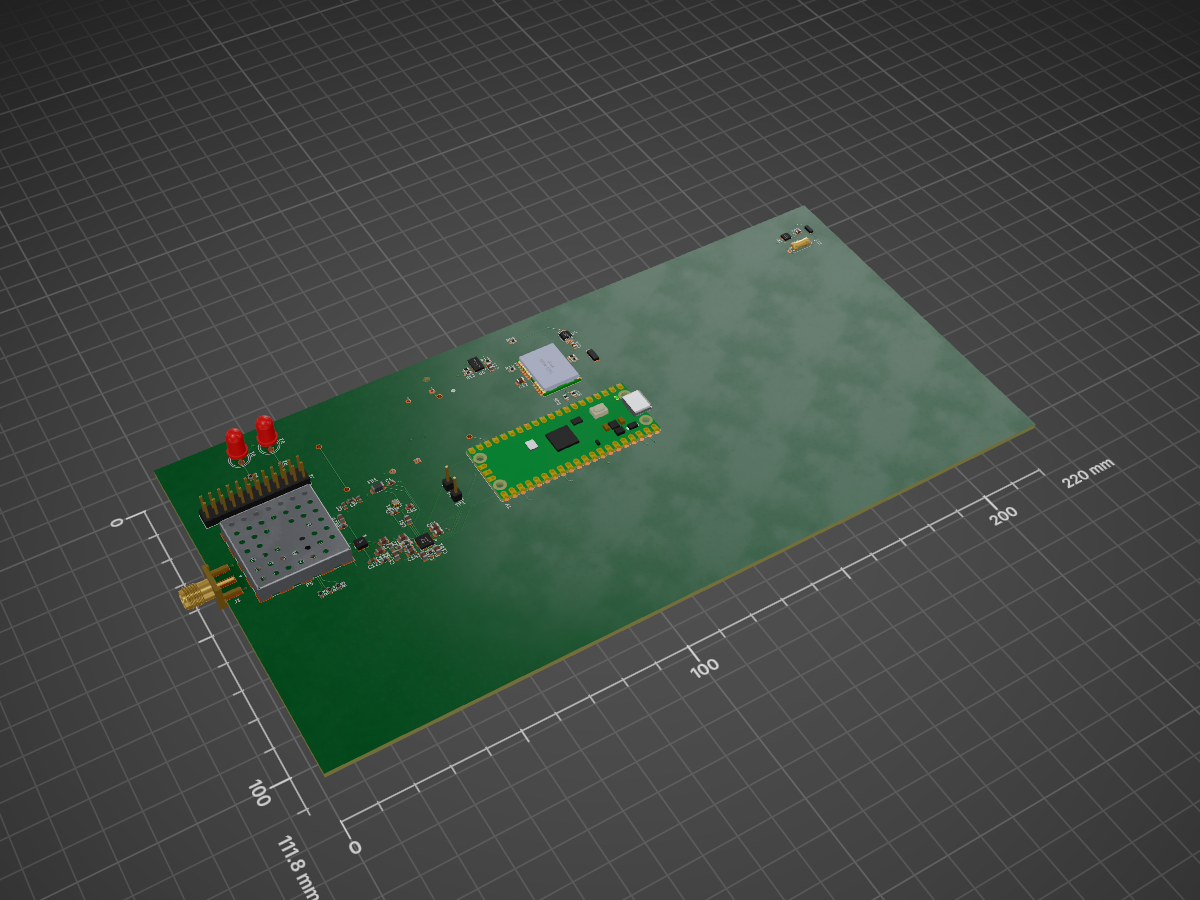
MetSensorSuiteEmbeddedFirmware is an open-source printed circuit board by Lowcost-Radiosonde-Research-Project, from the Lowcost-Radiosonde-Research-Project/MetSensorSuiteEmbeddedFirmware repository on GitHub, published under the BSD-3-Clause licence. It is a 4-layer board of 220 × 111.8 mm with 91 parts on 91 nets, routed with 383 tracks and 30 vias.
It is built around the CC1101RGP, NEO-M9N-00B and ADS1115IDGS, with the BME280, LM2596S-3.3 and MS5611-01BA03 among its other parts. Its parts include 36 capacitors, 19 resistors, 12 inductors, 8 ICs and 4 connectors. It belongs with the RP2040 and RP2350 boards of this library.






Status as of latest revision. Every module now has a real implementation - BMI330's carries a significant caveat (see below and its module docstring) since its register map is unverified.
| File | Status | Notes |
|---|---|---|
config.py | Real | All pins/addresses/constants in one place. Several TODOs remain. |
packet.py | Real | Fixed-width binary record format (PACKET_FORMAT = "<I15fBBBB", 68 bytes). |
bme280.py | Real | Full Bosch compensation formulas, forced-mode reads. I2C bus 1. |
rtd_ads1115.py | Real | Ratiometric RTD read + Callendar-Van Dusen (T >= 0 C only). I2C bus 1. |
ms5611.py | Real | PROM calibration + 1st/2nd-order temp/pressure compensation. I2C bus 2. |
bmi330.py | Unverified | Register map guessed from the related BMI323; may not function as intended - see caveat below. I2C bus 2. |
gps_neo_m9n.py | Real | NMEA GGA parsing: lat/lon/alt/num_sats/UTC time. |
sd_logger.py | Real | Mounts SD, appends packet.pack_record() output, periodic flush. |
imet_packet.py | Real | Builds the 38-byte iMet-1-RSB GPS+PTU-enhanced downlink frame + CRC-16. |
link_uart.py | Real | Frames and sends one 38-byte iMet frame per cycle to the RF Pico over UART. |
main.py | Real | Two I2C buses, SD log + iMet frame to RF Pico link, per-sensor fault isolation. |
Every sensor module exposes init_<name>(i2c, addr) returning an
object with a read() method, and main.py wraps each init in
try/except (OSError, ValueError) and each read in try/except OSError (the only error read() can raise) so one bad/missing sensor
doesn't take down the loop or the log - it just logs NAN for that field
and a [WARN] line to the console.
I2C1*): ADS1115 (RTD) + BME280I2C2*): MS5611 + BMI330GPS_UART_*): NEO-M9N GPSLINK_UART_*): outbound link to the RF Pico, one framed
38-byte iMet-1-RSB frame per cycle (see imet_packet.py /
link_uart.py)SD_*): SD cardAll pin numbers above are placeholders pending the Tuesday wiring
session - see the TODOs in config.py.
bmi330.py is written against the BMI323's register map (a related
Bosch part) because verified BMI330-specific register documentation
wasn't available when this was written. The register addresses,
ACC_CONF/GYR_CONF bitfield values, and full-scale range assumptions are
all unverified guesses. The driver may run without raising any error
and still return meaningless numbers.
On Tuesday, init_bmi330() will print whatever it reads from the
assumed CHIP_ID register (0x00) as a diagnostic - note that value down.
If accel/gyro readings look like noise, sit constant, or are far
outside physical range (accelerometer magnitude should be close to 1g
at rest), the register map guess is wrong and bmi330.py needs
revisiting against real BMI330 documentation (Bosch's BMI3 Sensor API
repo is the best starting point once it covers BMI330). This isn't
blocking for Wednesday - BMI330 isn't part of that test.
packet.FIELD_NAMES prefixes every field with the sensor that owns it
(bme280_*, ms5611_*, rtd_*, bmi330_*, gps_*). BMI330 fields
are in milli-g / milli-deg/s (_mg / _mdps) rather than g / deg-per-s
The GPS record has gps_num_sats plus gps_hour/gps_minute/
gps_second (UTC time of fix), but no fix-type field - gps.read()
returns a 7-tuple (lat, lon, alt, num_sats, hour, minute, second).
Position/altitude are NAN and the satellite/time fields are
NO_DATA_U8 until a checksum-valid GGA sentence with a non-zero fix
quality has been parsed. If you want fix-quality (e.g. for
SondeHub-style reporting) added too, that's a small change to
packet.py (one more B field) and gps_neo_m9n.py's _parse_gga().
Each cycle, after the SD record is written, main.py builds a
separate 38-byte frame via imet_packet.pack_frame() - a GPS Data
Packet (PKT_ID=0x02, 18 bytes) immediately followed by a PTU
(enhanced) Data Packet (PKT_ID=0x04, 20 bytes), each with its own
CRC-16, matching InterMet's "Appendix A - Binary Radiosonde Packet
Definition" as decoded by imet1rsb. This frame - not the packet.py
record - is what gets sent over link_uart to the RF Pico for AFSK
modulation; packet.py stays SD-only.
Current sensor -> iMet field mapping (set in main.py, easy to
change - it's just which record[...] value is passed to which
imet_packet keyword argument):
| iMet field | Source | Notes |
|---|---|---|
| GPS lat/lon/alt/num_sats/hour/min/sec | gps_* record fields | real NMEA GGA parsing; NAN/NO_DATA until a fix is acquired |
| P (pressure) | ms5611_pressure_hpa | TODO: confirm vs. BME280 as the primary pressure source |
| T (primary temp) | bme280_temp_c | |
| U (humidity) | bme280_humidity_pct | |
| Vbat | hardcoded NAN | TODO: no battery-voltage sensing exists yet (new ADC channel) |
| Tint (internal temp) | bme280_temp_c | TODO: currently duplicates T - confirm intent |
| Tpr (probe temp) | rtd_temp_c | |
| Tu (aux temp) | hardcoded NAN | TODO: no mapping defined - InterMet's intended use of this field is unclear |
All of the NAN/sentinel placeholders above pack safely (verified in
imet_packet.py's _scaled_*/_encode_altitude helpers - they map
NAN to the field's "no data" value rather than raising), so the frame
is well-formed even with everything still stubbed.
sdcard.py onto the board. Easiest path in
Thonny/REPL: import mip; mip.install("sdcard"). This is the
standard MicroPython SD-over-SPI block driver - sd_logger.py
imports it as sdcard.config.py for the TODO items - nothing blocks you from
reading the code now, but these are the values you'll set Tuesday.config.py pin numbers for both I2C buses, SPI (SD), GPS
UART, the RF Pico link UART, and REGULATOR_EN_PIN (LM2596 3.3V
rail enable) to match actual wiring.RTD_MUX / REF_MUX (which ADS1115 differential pair is
the RTD vs. the reference resistor) and ADS1115_GAIN (PGA
setting), based on the RTD interface board.MS5611_I2C_ADDR and BMI330_I2C_ADDR once those boards
are wired. MS5611 and GPS now have real drivers, so a wrong
address will surface as [WARN] ... init failed from
_safe_init rather than silently logging NaN.[INFO] BMI330 CHIP_ID register read as 0x.. line at startup and sanity-check accel/gyro readings
against the caveat above - this driver's register map is a
guess.main.py. With only BME280 + RTD wired, expect [WARN]
lines at startup for MS5611/BMI330/GPS init or SD mount (if not
present) - that's expected, the loop should keep running and
print live T/P/RH/RTD values once per second.The console line each cycle:
t= 12345ms T= 23.45C P=1006.32hPa RH= 45.2% RTD= 23.10Cgives a live sanity check that BME280 and RTD agree roughly with each
other and with ambient conditions. The SD card (if mounted) accumulates
PACKET_SIZE-byte (68-byte) binary records in /sd/metlog.bin - decode
with packet.unpack_record() in a small post-processing script, reading
PACKET_SIZE bytes at a time.
bmi330.py's module docstring before trusting any IMU data.link_uart.py now sends a 38-byte iMet frame instead of the
65-byte packet.py record - see "iMet-1-RSB downlink frame" above
for the sensor mapping and its open TODOs (Vbat sensing, GPS UTC
time, P/Tint/Tu assignment).imet_packet.py matches the field layout and CRC algorithm from
imet1rsb.c's source, but hasn't been cross-checked byte-for-byte
against a compiled run of that decoder yet. Worth doing once there's
a spare moment - compile imet1rsb.c, feed it a known frame, and
confirm its crc16() agrees with imet_packet.crc16().link_uart's frame format
(sync bytes + length + checksum) doesn't exist yet - that's firmware
for the other board, out of scope here, but the frame format is
documented at the top of link_uart.py so it can be matched.main.py currently runs everything on a single core via a simple
fixed-interval loop. If SD writes, link UART sends, or sensor reads
start causing timing jitter once everything is real, revisit
splitting acquisition and logging across the two cores with
_thread.| Qty | Value | Footprint | References |
|---|---|---|---|
| 7 | 100nF | Capacitor_SMD:C_0805_2012Metric | C41, C51, C91, C111, C141, C151, C181 |
| 6 | 4.7k | Resistor_SMD:R_0603_1608Metric | R07, R08, R12, R13, R15, R16 |
| 4 | 10K | Resistor_SMD:R_0603_1608Metric | R3, R04, R4, R5 |
| 3 | 0.1 uF | Capacitor_SMD:C_0805_2012Metric | C11, C12, C46 |
| 3 | 12pF | Capacitor_SMD:C_0603_1608Metric | C22, C52, C81 |
| 3 | 47pF | Capacitor_SMD:C_0603_1608Metric | C21, C26, C123 |
| 2 | 1.5pF | Capacitor_SMD:C_0805_2012Metric | C122, C131 |
| 2 | 10 uF | Capacitor_SMD:C_0603_1608Metric | C01, C02 |
| 2 | 10k | Resistor_SMD:R_0603_1608Metric | R11, R14 |
| 2 | 12nH | Inductor_SMD:L_0603_1608Metric | L121, L131 |
| 2 | 15pF | Capacitor_SMD:C_0603_1608Metric | C101, C132 |
| 2 | 18nH | Inductor_SMD:L_0603_1608Metric | L122, L132 |
| 2 | 1uF | Capacitor_SMD:C_0603_1608Metric | C1, C30 |
| 2 | 330 | Resistor_SMD:R_0603_1608Metric | R1, R2 |
| 2 | TestPoint | Connector_PinHeader_2.54mm:PinHeader_1x01_P2.54mm_Vertical | TP1, TP2 |
| 1 | 0.8pF | Capacitor_SMD:C_0805_2012Metric | C125 |
| 1 | 1.5nH | Inductor_SMD:L_1206_3216Metric | L130 |
| 1 | 1.9pF | Capacitor_SMD:C_0603_1608Metric | C121 |
| 1 | 10 | Resistor_SMD:R_0603_1608Metric | R161 |
| 1 | 100pF | Capacitor_SMD:C_0805_2012Metric | C124 |
| 1 | 1079 | footprints:1079_KEY | B41 |
| 1 | 10K OHM 0.1% 0.4W AXIAL | Resistor_THT:R_Axial_DIN0207_L6.3mm_D2.5mm_P7.62mm_Horizontal | R05 |
| 1 | 10nH | Inductor_SMD:L_0603_1608Metric | L25 |
| 1 | 10uF | Capacitor_SMD:C_0603_1608Metric | C2 |
| 1 | 11nH | Inductor_SMD:L_0603_1608Metric | L2 |
| 1 | 180 uF | Capacitor_SMD:CP_Elec_8x6.7 | C44 |
| 1 | 1N5820 | Diode_THT:D_A-405_P7.62mm_Horizontal | D41 |
| 1 | 1nF | Capacitor_SMD:C_0805_2012Metric | C27 |
| 1 | 2.9nH | Inductor_SMD:L_0402_1005Metric | L23 |
| 1 | 220pF | Capacitor_SMD:C_0603_1608Metric | C3 |
| 1 | 22nH | Inductor_SMD:L_0603_1608Metric | L21 |
| 1 | 26.000 MHz | Crystal:Crystal_SMD_2016-4Pin_2.0x1.6mm | X1 |
| 1 | 27pF | Capacitor_SMD:C_0805_2012Metric | C161 |
| 1 | 3.3k | Resistor_SMD:R_0603_1608Metric | R141 |
| 1 | 3.3pF | Capacitor_SMD:C_0805_2012Metric | C24 |
| 1 | 33 uH | Inductor_SMD:L_Bourns-SRN8040_8x8.15mm | L43 |
| 1 | 330/35 uF/V | Capacitor_SMD:CP_Elec_10x10 | C45 |
| 1 | 47 | Resistor_SMD:R_0603_1608Metric | R151 |
| 1 | 56K | Resistor_SMD:R_0603_1608Metric | R171 |
| 1 | 7.5nH | Inductor_SMD:L_0603_1608Metric | L22 |
| 1 | 7.5pF | Capacitor_SMD:C_1206_3216Metric | C25 |
| 1 | 9.1nH | Inductor_SMD:L_0402_1005Metric | L24 |
| 1 | ADS1115IDGS | Package_SO:TSSOP-10_3x3mm_P0.5mm | U4 |
| 1 | B39921B3588U410 | B39921B3588U410:B39162B3522U410_TDK-L | U3 |
| 1 | BME280 | Package_LGA:Bosch_LGA-8_2.5x2.5mm_P0.65mm_ClockwisePinNumbering | U5 |
| 1 | BMI-S-205-C | RF_Shielding:Laird_Technologies_BMI-S-203-F_26.21x26.21mm | P5 |
| 1 | Blue LED | LED_THT:LED_D5.0mm | D2 |
| 1 | CC1101 | Package_DFN_QFN:Texas_RGP0020H_VQFN-20-1EP_4x4mm_P0.5mm_EP2.4x2.4mm_ThermalVias | U1 |
| 1 | CC1190 | CC1190RGVT:RGV0016A | U2 |
| 1 | DNP | Capacitor_SMD:C_1206_3216Metric | C28 |
| 1 | FerriteBead | Inductor_SMD:L_1206_3216Metric | FB1 |
| 1 | LM2596S-3.3 | Package_TO_SOT_SMD:TO-263-5_TabPin3 | U8 |
| 1 | MS5611-01BA | Package_LGA:LGA-8_3x5mm_P1.25mm | U6 |
| 1 | Micro_SD_Card_Det1 | Connector_Card:microSD_HC_Molex_104031-0811 | J4 |
| 1 | NEO-M9N | RF_GPS:ublox_NEO | U7 |
| 1 | PPG102JA | footprints:PPG102JA | RT1 |
| 1 | RaspberryPi_Pico2 | Module:RaspberryPi_Pico_Common_SMD | A1 |
| 1 | Red LED | LED_THT:LED_D5.0mm | D1 |
| 1 | SMA | Connector_Coaxial:SMA_Molex_73251-1153_EdgeMount_Horizontal | J1 |
| 1 | SW_SPST | Button_Switch_THT:SW_DIP_SPSTx01_Slide_9.78x4.72mm_W7.62mm_P2.54mm | SW41 |
| 1 | Test Header | Connector_PinHeader_2.54mm:PinHeader_2x12_P2.54mm_Vertical | J2 |
| 1 | W3011 | footprints:XDCR_W3011 | AE1 |

sneakylizard123-4/CC1101_Module
A simple breakout-style radio module for long-range sub-GHz link without designing an RF front end from scratch.

zeodotdev/zeo-boards
ESP32-S3 development board with onboard BME280 (temperature, humidity, pressure) and LSM6DS3 (6-axis IMU) sensors. This repo contains the designs, ESP-IDF firmware, and a Python plotter for visualization.

iamdarshg/drone-arm
Reworked cheaper, maybe faster but less redundant drone controller.


vito-pp/FlightComputer-SRAD-2026
HW and SW documentation of a Student Researched And Developed (SRAD) flight computer in charge of telemetry for ITBA's rocketry team 2026


It measures 220 × 111.8 mm and has 4 copper layers, 1.6 mm thick.
91 parts, built around the CC1101RGP, NEO-M9N-00B, ADS1115IDGS and BME280. The full list of its parts is on this page, with links to each part's symbol and footprint where PCBKit's library has them.
From the Lowcost-Radiosonde-Research-Project/MetSensorSuiteEmbeddedFirmware repository on GitHub, at the commit this page was made from: the board is hardware/hardware.kicad_pcb and its schematic hardware/I2C0.kicad_sch. PCBKit opens the board in the browser, with nothing to install.
Its repository publishes it under the BSD-3-Clause licence: you may reuse it on that licence's terms (keep the author's notice, and for a copyleft licence share your changes alike).