2 layers89 × 44 mm

 WYVERN2742/Peanut1
Pinenut-01S BL602 Motherboard
Peanut dev is an open-source printed circuit board by WYVERN2742, from the WYVERN2742/Peanut repository on GitHub. It is a 2-layer board of 92 × 44 mm with 54 parts on 61 nets, routed with 463 tracks and 62 vias.
It is built around the HDC2010YPAR, LTR-303ALS-01 and LWP040-PSGLC-S, with the PCF8574APWR and BNO085 among its other parts. Its parts include 17 capacitors, 13 resistors, 8 ICs, 6 switches and 3 connectors. It belongs with the home automation and IoT and computers and single-board computers boards and the RISC-V boards of this library.


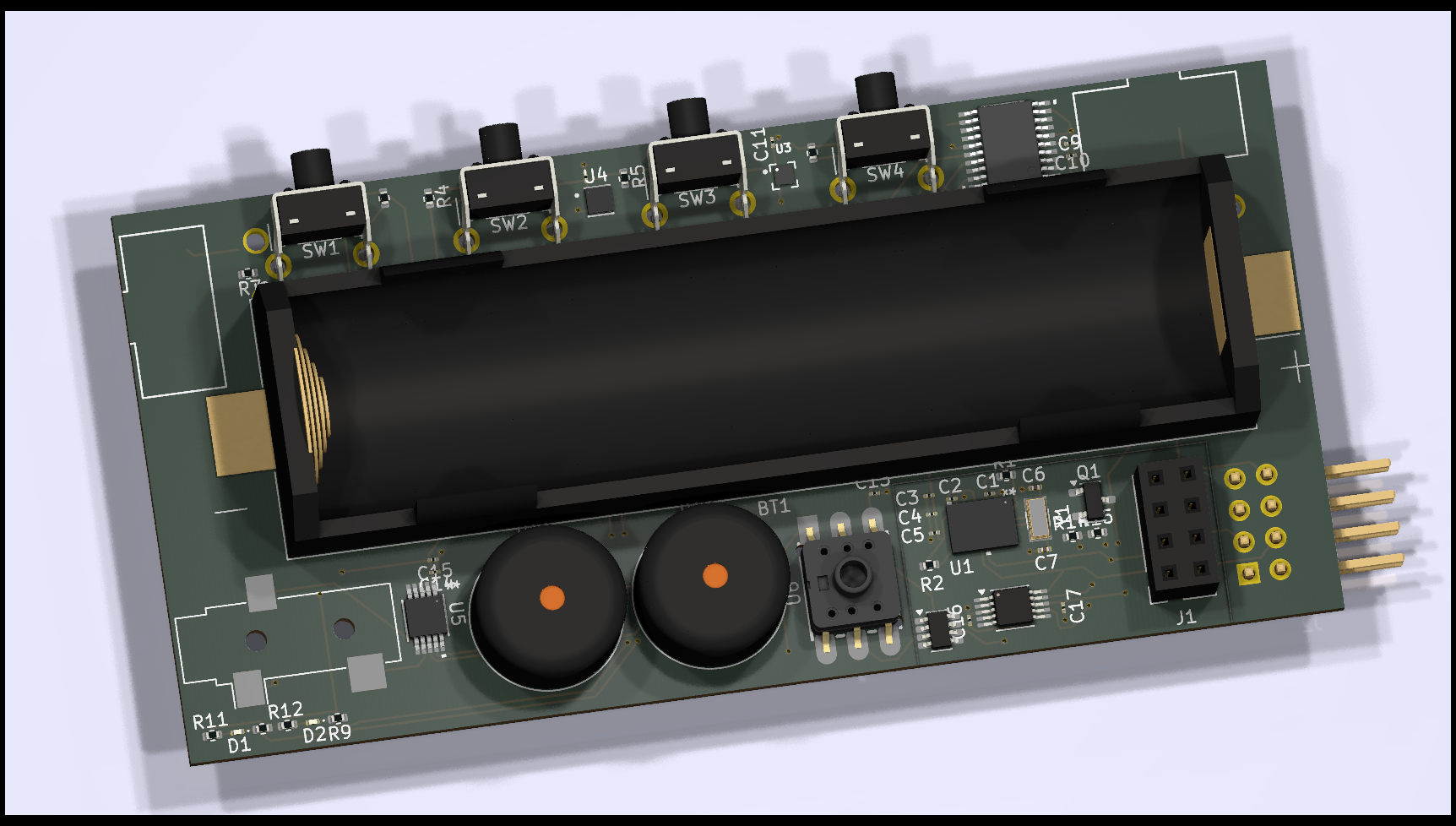
The Peanut is a motherboard for the PINE64 Pinenut Model-01S BL602 Wifi/BLE5 Module.
It aims to offer a very large suite of sensors, including Motion, Humidity, Temperature, Ambient Light, and Pressure. While also providing some LEDs and buttons for interaction, with audio output and buzzers for the classic electronic bleeps. It's entirely powered by a single LiFePO4 battery, allowing for easy charging and a compact size.
A prime design point is to also provide capability for extensions; such as solar charging, motor powering, or literally anything else you can imagine.
[!WARNING] This is a hobby project and our first exploration into creating a custom PCB from scratch. Mistakes are Guarenteed!
[!NOTE] Component list is subject to change; especially before Rev 1.0
Take a look at the up-to-date table
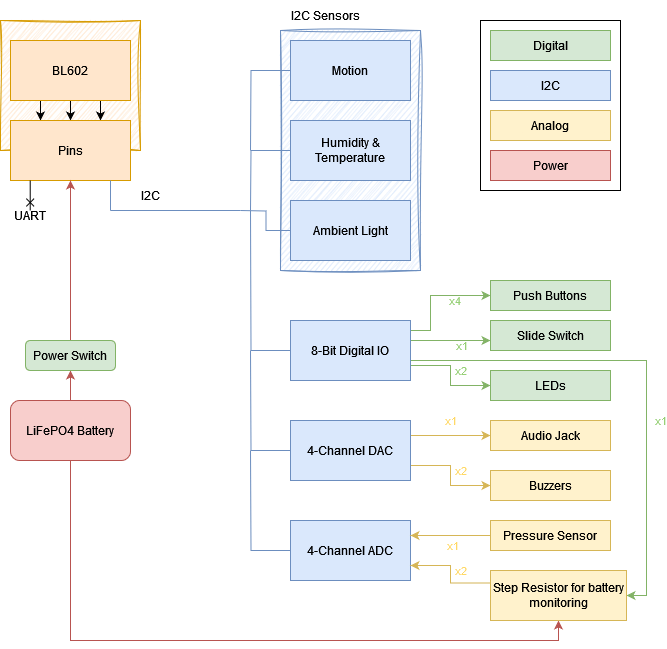
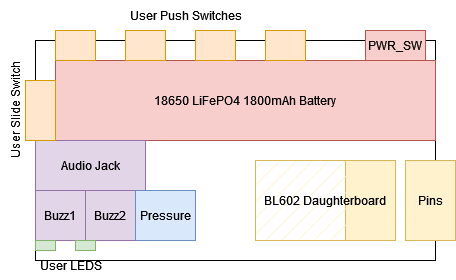
User goals and considerations; along with some misc ideas/wants
| Qty | Value | Footprint | References |
|---|---|---|---|
| 9 | 1uF | Capacitor_SMD:C_0402_1005Metric | C1, C3, C4, C5, C8, C9, C10, C11, C13 |
| 7 | 100k | Resistor_SMD:R_0402_1005Metric | R3, R4, R5, R6, R7, R9, R10 |
| 4 | 0.1uF | Capacitor_SMD:C_0402_1005Metric | C14, C15, C16, C17 |
| 4 | Push_Button | Button_Switch_THT:SW_Tactile_SPST_Angled_PTS645Vx58-2LFS | SW1, SW2, SW3, SW4 |
| 3 | 2.2k | Resistor_SMD:R_0402_1005Metric | R2, R11, R12 |
| 2 | 22pF | Capacitor_SMD:C_0402_1005Metric | C6, C7 |
| 2 | Buzzer | Buzzer_Beeper:Buzzer_12x9.5RM7.6 | BZ1, BZ2 |
| 2 | R | Resistor_SMD:R_0402_1005Metric | R14, R15 |
| 2 | Slide Switch | Peanut:SW-TH_SK12D07VG4 | SW5, SW6 |
| 1 | 100nF | Capacitor_SMD:C_0402_1005Metric | C2 |
| 1 | 10k | Resistor_SMD:R_0402_1005Metric | R1 |
| 1 | 1uf | Capacitor_SMD:C_0402_1005Metric | C12 |
| 1 | 3.3V | Battery:BatteryHolder_Keystone_1042_1x18650 | BT1 |
| 1 | ADS1015IDGSR | Package_SO:VSSOP-10_3x3mm_P0.5mm | U7 |
| 1 | AudioPlug3 | Connector_Audio:Jack_3.5mm_CUI_SJ-3523-SMT_Horizontal | J3 |
| 1 | BNO085 | Peanut:LGA28_5.2X3.8_CEV | U1 |
| 1 | Conn_02x04_Odd_Even | Connector_PinSocket_2.54mm:PinSocket_2x04_P2.54mm_Vertical | J1 |
| 1 | Conn_02x04_Odd_Even | Peanut:PinHeader_2x04_P2.54mm_Horizontal_Flipped | J2 |
| 1 | Crystal_32.768kHz | Crystal:Crystal_SMD_3215-2Pin_3.2x1.5mm | Y1 |
| 1 | GRN | LED_SMD:LED_0201_0603Metric | D2 |
| 1 | HDC2010YPAR | Peanut:HDC2010YPAR | U3 |
| 1 | INA350ABSIDDFR | Package_TO_SOT_SMD:TSOT-23-8 | U8 |
| 1 | LTR-303ALS-01 | Peanut:LTR-308ALS-01_LTO | U4 |
| 1 | LWP040-PSGLC-S | Peanut:SOP-4_L7.0-W7.0-P2.54-LS10.3-TL-CW_LWP040-PSGLC-S | U6 |
| 1 | MCP4728T-E/UN | Peanut:MSOP10_MC_MCH | U5 |
| 1 | PCF8574APWR | Peanut:PW20 | U2 |
| 1 | Q_NPN_BEC | Package_TO_SOT_SMD:SOT-23-3 | Q1 |
| 1 | RED | LED_SMD:LED_0201_0603Metric | D1 |


The-Wrench/Smart-watch-PCB-esp32s3
a smart watch making use of HDSP-2000 alphanumeric displays and an esp32s3 with an RTC/c


punkfab/pcb-corpus
235 real KiCad boards from open-source hardware repositories, prepared as a placement and routing benchmark

AlexD717/HA-Sensor-Node
Sensor node featuring a temperature, humidity, and mmWave sensor


openenergymonitor/emonTH3
Hardware for the emonTH3 temperature, humidity, and pulse sensing node
It measures 92 × 44 mm and has 2 copper layers, 1.6 mm thick.
54 parts, built around the HDC2010YPAR, LTR-303ALS-01, LWP040-PSGLC-S and PCF8574APWR. The full list of its parts is on this page, with links to each part's symbol and footprint where PCBKit's library has them.
From the WYVERN2742/Peanut repository on GitHub, at the commit this page was made from: the board is Hardware/Peanut-dev.kicad_pcb and its schematic Hardware/DigitalMuxer.kicad_sch. PCBKit opens the board in the browser, with nothing to install.
Its repository states no licence, so its author keeps all rights: ask WYVERN2742 before reusing the design.