


2 layers132.3 × 94.9 mm

 tcarmelveilleux/MoonClock
A Raspberry Pi Pico-based Analog + Digital Lunar Clock
MoonClock is an open-source printed circuit board by tcarmelveilleux, from the tcarmelveilleux/MoonClock repository on GitHub, published under the MIT licence. It is a 2-layer board of 50 × 80 mm with 32 parts on 39 nets, routed with 439 tracks and 83 vias.
It is built around the RP2040-ZERO, CR2032 and ECS-.327-6-17X-C-TR. Its parts include 12 resistors, 7 connectors, 5 capacitors, 4 ICs and 1 crystal. It belongs with the lEDs and displays boards and the RP2040 boards of this library.

A unique analog and digital clock that displays the current phase of the moon and the number of hours of darkness available for astronomical observation in the evening.
tcv_astro module, specifically developed for this project using algorithms from astronomical literature (primarily "Astronomical Algorithms" by Jean Meeus).tcv_astro CircuitPython module (containing astronomical calculation functions).
tcv_astro ModuleThis project features a custom-built CircuitPython module, tcv_astro, which handles the necessary astronomical calculations. It implements algorithms described in Jean Meeus's "Astronomical Algorithms.":
This module computes:
Instructions for building and setting up your own MoonClock will be provided in future updates. This will include details on:
Contributions to this project are welcome! If you have ideas for improvements, bug fixes, or new features, please feel free to open an issue or submit a pull request.
MIT license, see the LICENSE file.
| Qty | Value | Footprint | References |
|---|---|---|---|
| 8 | R_US | Resistor_SMD:R_0805_2012Metric_Pad1.20x1.40mm_HandSolder | R2, R3, R4, R8, R9, R10, R11, R12 |
| 3 | 100n | Capacitor_SMD:C_0805_2012Metric_Pad1.18x1.45mm_HandSolder | C1, C4, C5 |
| 3 | 10k | Resistor_SMD:R_0805_2012Metric_Pad1.20x1.40mm_HandSolder | R5, R6, R7 |
| 3 | Screw_Terminal_01x04 | TerminalBlock_Phoenix:TerminalBlock_Phoenix_MKDS-1,5-4-5.08_1x04_P5.08mm_Horizontal | J3, J4, J5 |
| 2 | 6p | Capacitor_SMD:C_0603_1608Metric_Pad1.08x0.95mm_HandSolder | C2, C3 |
| 2 | Conn_01x04 | Connector_PinHeader_2.54mm:PinHeader_1x04_P2.54mm_Vertical | J2, J6 |
| 2 | SolderJumper_2_Open | Jumper:SolderJumper-2_P1.3mm_Open_RoundedPad1.0x1.5mm | JP1, JP2 |
| 1 | 10K | Potentiometer_THT:Potentiometer_Bourns_3296W_Vertical | R1 |
| 1 | CR2032 | moonclock:BAT_BS-7 | BT1 |
| 1 | Conn_01x05 | Connector_PinHeader_2.54mm:PinHeader_1x05_P2.54mm_Vertical | J7 |
| 1 | Conn_01x06 | Connector_PinHeader_2.54mm:PinHeader_1x06_P2.54mm_Vertical | J1 |
| 1 | ECS-.327-6-17X-C-TR | moonclock:XTAL_ECS-.327-6-17X-C-TR | Y1 |
| 1 | MCP47FVB22-E/ST | Package_SO:TSSOP-8_4.4x3mm_P0.65mm | U3 |
| 1 | MCP6002-xSN | Package_SO:SOIC-8_3.9x4.9mm_P1.27mm | U2 |
| 1 | MCP7940N-xSN | Package_SO:SOIC-8_3.9x4.9mm_P1.27mm | U4 |
| 1 | RP2040-Zero | moonclock:RP2040-Zero | U1 |


beekeeb/zerosprey42
Zerosprey42 Keyboard is a wired, beginner friendly, choc hotswap, MonoBlockSplit (Unibody), column-staggered, DIY mechanical keyboard.


ravinrabbid/DonCon2040
RP2040 based firmware and hardware for DIY Taiko no Tatsujin Drum Controllers
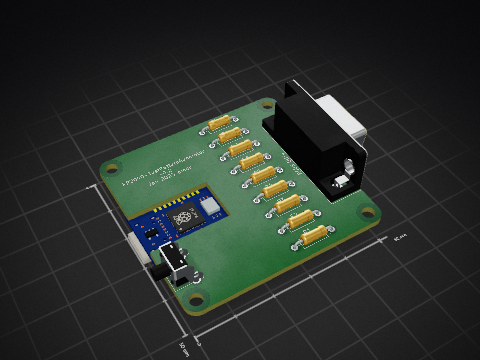
nmur/RP2040-TestPatternGenerator
A simple test pattern generator running on the RP2040 microcontroller

ChrisChrisLoLo/bunchiez40
A pocket keyboard that makes use of mouse switches to achieve a miniscule size

It measures 50 × 80 mm and has 2 copper layers, 1.6 mm thick.
32 parts, built around the RP2040-ZERO, CR2032 and ECS-.327-6-17X-C-TR. The full list of its parts is on this page, with links to each part's symbol and footprint where PCBKit's library has them.
From the tcarmelveilleux/MoonClock repository on GitHub, at the commit this page was made from: the board is Schematics/moonclock/moonclock.kicad_pcb and its schematic Schematics/moonclock/moonclock.kicad_sch. PCBKit opens the board in the browser, with nothing to install.
Its repository publishes it under the MIT licence: you may reuse it on that licence's terms (keep the author's notice, and for a copyleft licence share your changes alike).