2 layers101 × 76 mm

 slimmpylk/Skoll_Ultra
a custom outdoor and endurance-sports smartwatch.
Sportwatch revA is an open-source printed circuit board by slimmpylk, from the slimmpylk/Skoll_Ultra repository on GitHub. It is an 8-layer board with 184 parts on 358 nets, routed with 14 tracks and 24 vias.
It is built around the MAX-F10S-00B, NRF7002-QFAA-R7 and BMM350, with the BMP585, EMMC64G-TB9F-06011 and OPT4001DTSR among its other parts. Its parts include 90 capacitors, 55 resistors, 17 ICs, 8 inductors and 3 crystals. It belongs with the wearables boards of this library.


An open, from-scratch outdoor and endurance smartwatch: custom electronics, PCB design, mechanical packaging and, later, embedded firmware.
In Norse mythology, Sköll is the wolf who chases the sun across the sky, never stopping. His twin brother Hati chases the moon. The name fits a watch built for long days outside: the design target is 30 hours of GNSS tracking with heart rate, enough for an ultramarathon from sunrise to well past sunset.
This is a personal engineering project. I design the system at component and PCB level instead of building on a ready-made smartwatch module, and I own every engineering decision: architecture, part selection, power budget, mechanical packaging and verification.
Current phase: Rev-A hardware. Schematics for both boards are drafted in KiCad and a schematic verification pass is under way. The mechanical closure study has validated a 36 x 33 mm D-cut battery inside a 50.7 mm case; the battery source is still open. Firmware starts at hardware bring-up.
| Rev-A target | |
|---|---|
| Case | Round, 51 mm, titanium caseback, CNC midcase |
| Thickness | ≤ 16.5 mm nominal |
| Battery life | ≥ 30 h with GPS + Galileo at 1 Hz and optical heart rate |
| Display | 1.43" round AMOLED with touch |
| Buttons | 5 mechanical pushers |
| Charging | Two-pin contacts through the caseback, inside the seal |
Rev-A is a working prototype, not a product. It is allowed to be thicker than a commercial watch; Rev-B can shrink it once Rev-A is proven.
Two boards: MAIN (processor, radios, display, power, motion sensors) and REAR (optical heart rate and skin temperature against the wrist), connected by a 24-position FPC.
| Subsystem | Part |
|---|---|
| Application processor + BLE | Ambiq Apollo510B |
| Power management + charger | Nordic nPM1300 |
| GNSS (L1 + L5) | u-blox MAX-F10S |
| Wi-Fi 6 | Nordic nRF7002 |
| Display | ZC-A1D43W-046, 1.43" AMOLED (CO5300 driver, CHSC6417 touch) |
| Storage | Kingston eMMC |
| IMU | ST LSM6DSV16X |
| Magnetometer | Bosch BMM350 |
| Barometer | Bosch BMP585 |
| Ambient light | TI OPT4001 |
| Haptics | TI DRV2625 + Vybronics VLV041035L LRA |
| Optical heart rate (REAR) | 2 x MAX86141, OSRAM SFH 7018A emitter, SFH 2703 photodiodes |
| Skin temperature (REAR) | MAX30208 |
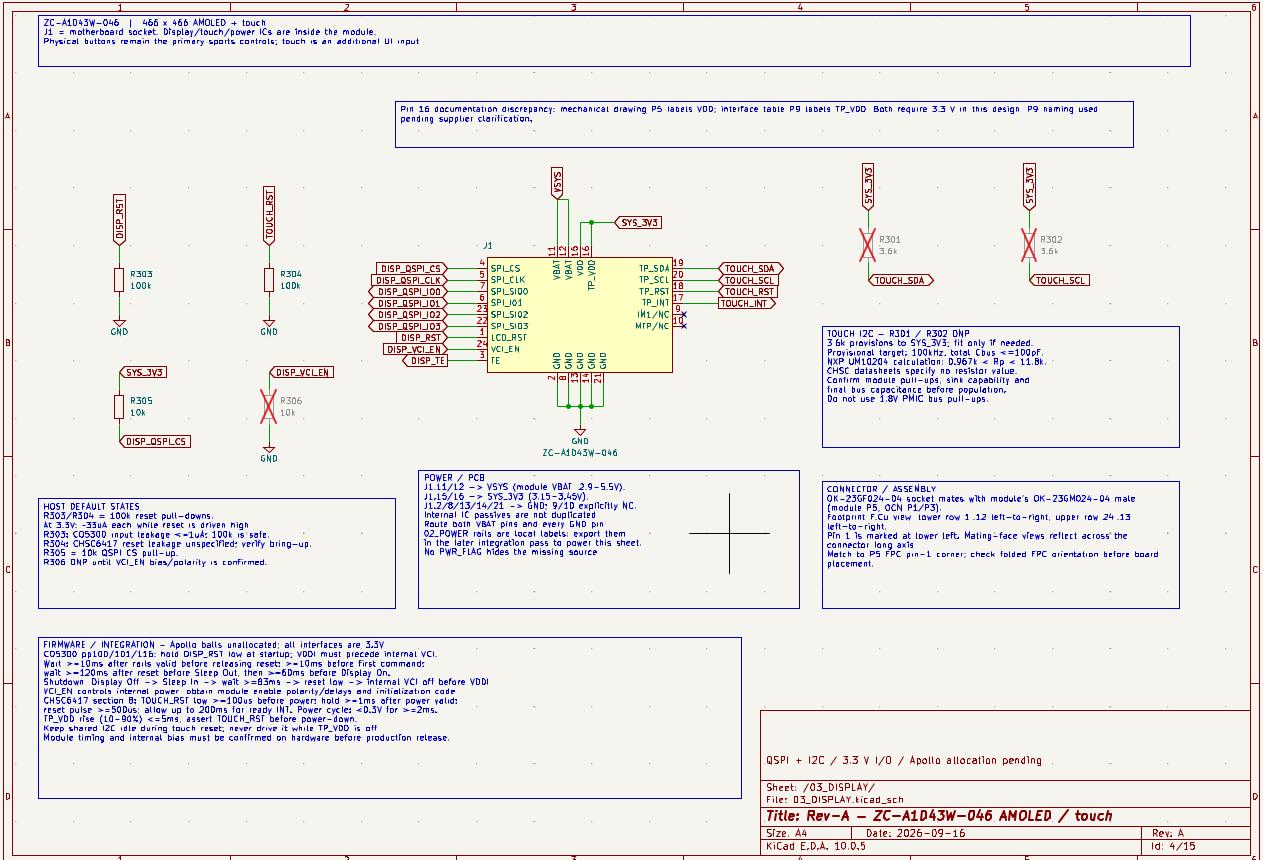
Schematic excerpt of the display interface: QSPI, I²C touch controller, power rails and reset/enable circuitry.
A watch is a packaging problem first. Before PCB layout, I built a parametric model of the whole stack (display, MAIN board, battery, REAR board, caseback) to check that everything fits with real tolerances, battery swelling and assembly clearances.
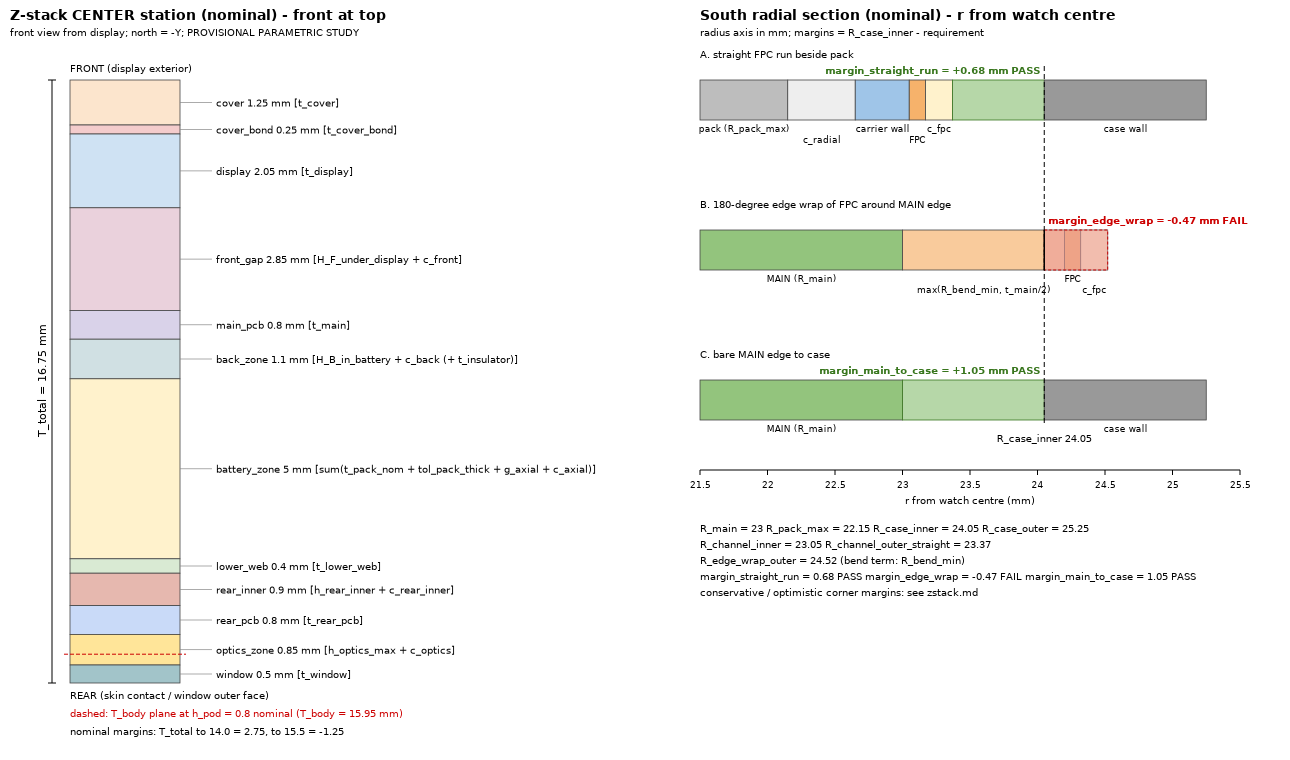
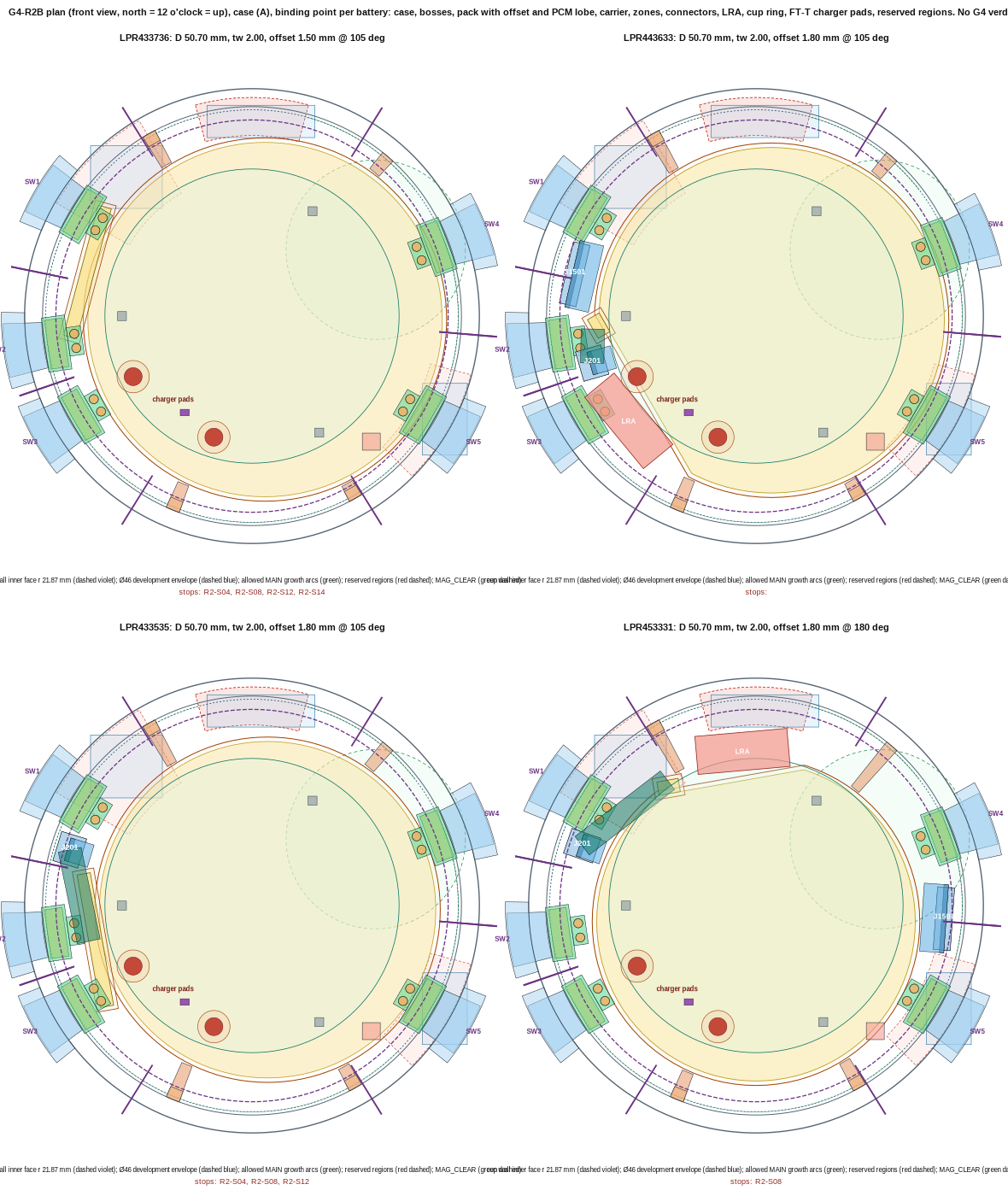
Some of the decisions this forced:
| Battery | Estimated GNSS workout time |
|---|---|
| 425 mAh | ~23 h |
| 475 mAh | ~26 h |
| 540 mAh | ~30 h |
| 585 mAh | ~32 h |
Estimates for GPS + Galileo at 1 Hz with heart rate, at room temperature. Cold reduces usable capacity.
├── sportwatch_revA.kicad_pro / .kicad_sch / .kicad_pcb   MAIN board
├── 01_APOLLO510B ... 14_RF.kicad_sch                     MAIN hierarchical sheets
├── rear_sensor/                                         REAR board (PPG + skin temperature)
├── libraries/                                           custom symbols and footprints
├── design/mechanical/generated/                         packaging drawings
├── design/placement/                                    MAIN placement plan
└── images/
Custom symbols and footprints are kept with the project, so it opens on any machine with KiCad.
Board support and drivers, power management, display and UI, GNSS, heart rate processing, activity recording, storage, BLE and Wi-Fi sync, and a test and diagnostics toolset.
I make the engineering decisions and own the result: requirements, architecture, part selection, trade-offs and sign-off. For implementation work such as packaging scripts and schematic edits, I use AI coding assistants under written specifications, with a fixed rule that no tool reviews its own output. Every result is checked by an independent review and against manufacturer datasheets before it is accepted.
TBD.
| Qty | Value | Footprint | References |
|---|---|---|---|
| 23 | 100nF | Capacitor_SMD:C_0402_1005Metric | C111, C113, C115, C120, C121, C122, C123, C124, C125, C126, C127, C213, C701, C702, C1001, C1002 +7 |
| 11 | 100k | Resistor_SMD:R_0402_1005Metric | R102, R103, R303, R304, R601, R602, R1101, R1102, R1103, R1104, R1105 |
| 10 | 47k | Resistor_SMD:R_0402_1005Metric | R203, R902, R903, R904, R905, R906, R907, R908, R909, R910 |
| 9 | 10k | Resistor_SMD:R_0402_1005Metric | R110, R201, R202, R305, R306, R701, R702, R803, R901 |
| 8 | 2.2uF | Capacitor_SMD:C_0402_1005Metric | C107, C108, C109, C112, C114, C117, C206, C609 |
| 6 | 1.0uF | Capacitor_SMD:C_0402_1005Metric | C116, C605, C610, C616, C619, C905 |
| 6 | 10uF | Capacitor_SMD:C_0603_1608Metric | C202, C203, C204, C207, C208, C214 |
| 6 | 4.7k | Resistor_SMD:R_0402_1005Metric | R104, R105, R106, R107, R801, R802 |
| 5 | 4.7uF | Capacitor_SMD:C_0603_1608Metric | C601, C602, C606, C611, C901 |
| 5 | 47nF | Capacitor_SMD:C_0402_1005Metric | C1101, C1102, C1103, C1104, C1105 |
| 4 | 4.7uF | Capacitor_SMD:C_0201_0603Metric | C101, C102, C103, C104 |
| 4 | DNP | Capacitor_SMD:C_0201_0603Metric | C1410, C1411, C1420, C1421 |
| 3 | 1uF | Capacitor_SMD:C_0402_1005Metric | C106, C201, C205 |
| 3 | 2.2k | Resistor_SMD:R_0402_1005Metric | R1001, R1002, R1004 |
| 3 | 2.2uF | Capacitor_SMD:C_0603_1608Metric | C607, C618, C903 |
| 2 | 0R | Resistor_SMD:R_0201_0603Metric | R1410, R1420 |
| 2 | 100nF | Capacitor_SMD:C_0201_0603Metric | C612, C617 |
| 2 | 2.2uH | Inductor_SMD:L_0603_1608Metric | L201, L202 |
| 2 | 22uF | Capacitor_SMD:C_0603_1608Metric | C215, C401 |
| 2 | 3.6k | Resistor_SMD:R_0402_1005Metric | R301, R302 |
| 2 | 470nF | Capacitor_SMD:C_0201_0603Metric | C604, C614 |
| 2 | 8.2pF | Capacitor_SMD:C_0201_0603Metric | C118, C119 |
| 2 | NetTie_2 | NetTie:NetTie-2_SMD_Pad0.5mm | NT201, NT202 |
| 2 | SN74AXC1T45 | Package_TO_SOT_SMD:SOT-563 | U104, U105 |
| 1 | 0R | Resistor_SMD:R_0402_1005Metric | R206 |
| 1 | 0R (Lm2 tune) | Resistor_SMD:R_0201_0603Metric | R1401 |
| 1 | 1.0pF DNP | Capacitor_SMD:C_0201_0603Metric | C1404 |
| 1 | 1.5nH | Inductor_SMD:L_0201_0603Metric | L1401 |
| 1 | 1.8nH | Inductor_SMD:L_0201_0603Metric | L1402 |
| 1 | 100pF | Capacitor_SMD:C_0201_0603Metric | C128 |
| 1 | 10M | Resistor_SMD:R_0402_1005Metric | R101 |
| 1 | 10nF | Capacitor_SMD:C_0201_0603Metric | C608 |
| 1 | 10uF | Capacitor_SMD:C_0402_1005Metric | C105 |
| 1 | 150k | Resistor_SMD:R_0402_1005Metric | R204 |
| 1 | 16.2k | Resistor_SMD:R_0402_1005Metric | R207 |
| 1 | 18pF | Capacitor_SMD:C_0201_0603Metric | C1401 |
| 1 | 1uH | sportwatch_custom:L_2016_2016Metric | L401 |
| 1 | 2.2uF | Capacitor_SMD:C_0805_2012Metric | C705 |
| 1 | 2.2uF | Capacitor_SMD:C_0201_0603Metric | C615 |
| 1 | 2.2uH | sportwatch_custom:L_2016_2016Metric | L203 |
| 1 | 2.2uH / Isat>=1A / DCR<550mR | Inductor_SMD:L_0603_1608Metric | L101 |
| 1 | 2.8pF | Capacitor_SMD:C_0201_0603Metric | C1402 |
| 1 | 200k | Resistor_SMD:R_0402_1005Metric | R108 |
| 1 | 220k | Resistor_SMD:R_0402_1005Metric | R1003 |
| 1 | 220nF | Capacitor_SMD:C_0402_1005Metric | C902 |
| 1 | 220nF | Capacitor_SMD:C_0201_0603Metric | C603 |
| 1 | 220pF | Capacitor_SMD:C_0201_0603Metric | C1405 |
| 1 | 22R initial | Resistor_SMD:R_0201_0603Metric | R111 |
| 1 | 22nF | Capacitor_SMD:C_0201_0603Metric | C613 |
| 1 | 3.2pF | Capacitor_SMD:C_0201_0603Metric | C1403 |
| 1 | 3.3uH_1A_DCR<=200mR | sportwatch_custom:L_2016_2016Metric | L601 |
| 1 | 300k | Resistor_SMD:R_0402_1005Metric | R109 |
| 1 | 36.5k | Resistor_SMD:R_0402_1005Metric | R205 |
| 1 | 4.7uF | Capacitor_SMD:C_0402_1005Metric | C110 |
| 1 | 47uF | Capacitor_SMD:C_0805_2012Metric | C402 |
| 1 | 604k 1% | Resistor_SMD:R_0402_1005Metric | R406 |
| 1 | 91k 1% | Resistor_SMD:R_0402_1005Metric | R407 |
| 1 | ABS06-32.768KHZ-6-1-T | sportwatch_custom:Crystal_SMD_ABS06_2.0x1.2mm | Y101 |
| 1 | AP510BFA-CBR | sportwatch_custom:BGA-153_5.6x5.6mm_Layout13x13_P0.4mm_Ball0.25mm_Pad0.22mm_NSMD | U101 |
| 1 | BMM350 | sportwatch_custom:BGA9_BMM350_BOS | U703 |
| 1 | BMP585 | sportwatch_custom:LGA9_BMP585_BOS | U4 |
| 1 | DRV2625YFFR | sportwatch_custom:YFF0009AHAN | U7 |
| 1 | EMMC64G-TB9F-06011 | sportwatch_custom:FBGA-153_8.0x8.5mm_Layout14x14_P0.5mm | U901 |
| 1 | GND | TestPoint:TestPoint_Pad_D1.0mm | TP1306 |
| 1 | LSM6DSV16XTR | sportwatch_custom:LGA-14L_STM | U702 |
| 1 | MAX-F10S-00B | sportwatch_custom:MAX-F10S_UBL | U8 |
| 1 | NRF7002-QFAA-R7 | sportwatch_custom:QFN48_6X6_NOR | U9 |
| 1 | NX1612SA-40M-EXS00A-CS14264 | sportwatch_custom:Crystal_1612-4Pin_1.6x1.2mm | Y1 |
| 1 | NX1612SA-48M-EXS00A-CS14265 | sportwatch_custom:Crystal_1612-4Pin_1.6x1.2mm | Y102 |
| 1 | OPT4001DTSR | sportwatch_custom:DTS0008A-MFG | U5 |
| 1 | PCA9306DCU | Package_SO:VSSOP-8_2.3x2mm_P0.5mm | U106 |
| 1 | SN74AXC8T245 | sportwatch_custom:Texas_RHL0024A | U102 |
| 1 | SYS_3V3 | TestPoint:TestPoint_Pad_D1.0mm | TP1305 |
| 1 | TC2030-CTX-NL_TARGET | Connector:Tag-Connect_TC2030-IDC-NL_2x03_P1.27mm_Vertical | J1301 |
| 1 | TPS22918DBVT | Package_TO_SOT_SMD:SOT-23-6 | U11 |
| 1 | TPS631000DRLR | Package_TO_SOT_SMD:SOT-583-8 | U401 |
| 1 | TPS63900 | Package_SON:WSON-10-1EP_2.5x2.5mm_P0.5mm_EP1.2x2mm_ThermalVias | U202 |
| 1 | TXB0101DRLR | Package_TO_SOT_SMD:SOT-563 | U103 |
| 1 | VBAT | TestPoint:TestPoint_Pad_D1.0mm | TP1301 |
| 1 | VOUT1_1V8 | TestPoint:TestPoint_Pad_D1.0mm | TP1303 |
The 180 most common of 184 parts.

Architeuthis-Flux/Doombiq
An ultra low power, energy harvesting board that lets you "run" Doom


JMET04/aicad-agent
Deterministic CAD/EDA agent plugin for 2D drawings, AutoCAD, SolidWorks, KiCad, review gates and auditable delivery.

ZeshuLiu/SX70z
SX-70 电子化机身主控 | Electronic Polaroid SX-70 Controller 基于 ESP32 的宝丽来 SX-70 相机控制模块,替换原装机头控制器。 支持自动测光曝光、B/T/手动模式、闪光灯同步、BLE+WiFi配网、OTA升级。 配备 128×32 OLED 机身控制器显示 EV 和快门速度,3D 按键交互。 Firmware: GPLv3 Hardware: CERN-OHL-S 2.0

184 parts, built around the MAX-F10S-00B, NRF7002-QFAA-R7, BMM350 and BMP585. The full list of its parts is on this page, with links to each part's symbol and footprint where PCBKit's library has them.
From the slimmpylk/Skoll_Ultra repository on GitHub, at the commit this page was made from: the board is sportwatch_revA.kicad_pcb and its schematic 01_APOLLO510B.kicad_sch. PCBKit opens the board in the browser, with nothing to install.
Its repository states no licence, so its author keeps all rights: ask slimmpylk before reusing the design.