Skip to the content
PCBKitNew board
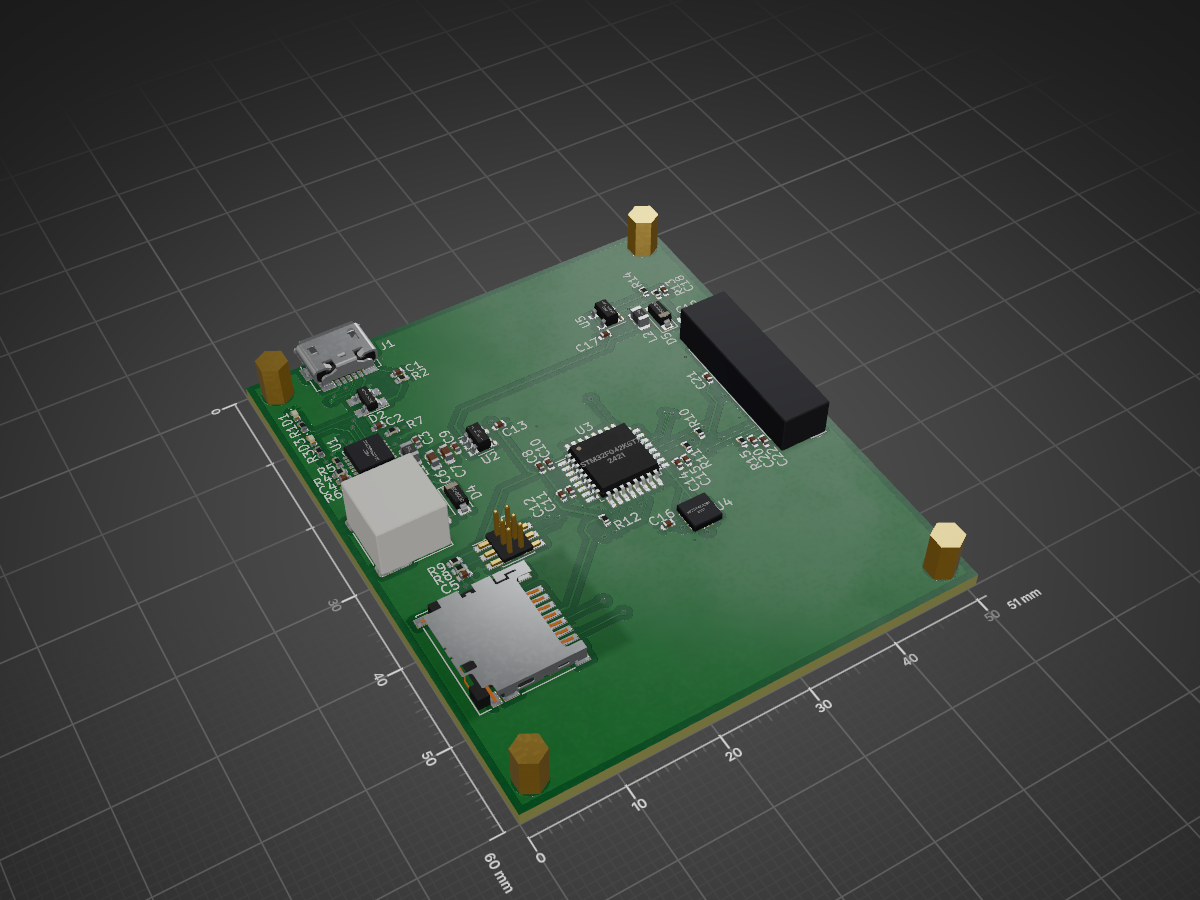
2 layers51 × 60 mmRowing Computer, the printed circuit board in 3D

Rowing Computer

set321go/OpenRow

Open Source Rowing Computer

Size
51 × 60 mm
Copper layers
2
Thickness
1.6 mm
Parts
59
Nets
76
Pads
247
Tracks, vias
415, 56
Pours
2
Routed
Yes
KiCad
KiCad 5 (file 20171130)
Created
30 Apr 2019
Updated
5 May 2019

Overview

Rowing Computer is an open-source printed circuit board by set321go, from the set321go/OpenRow repository on GitHub, published under the MIT licence. It is a 2-layer board of 51 × 60 mm with 59 parts on 76 nets, routed with 415 tracks and 56 vias.

It is built around the LM2731XMF, BQ25895RTW and LP5907MFX-3.3, with the MMA8451QR1, MBR0520 and MF-FSMF050X-2 among its other parts. Its parts include 22 capacitors, 15 resistors, 5 ICs, 5 diodes and 5 connectors. It belongs with the STM32 boards of this library.

Main components

8

README

README.md

OpenRow

A project to design an build an open source rowing computer. This project was born from the idea that I would rather throw something cheaper than a cell phone into the water, a secondary driver was how expensive existing options are given they are in effect a specialized pedometer.

Goals

  1. Hardware and software for an acceleration based rowing computer similar in functionality to a variety of apps available for phones.
  2. Speaker/Headset module integration (module provides headset functionality existing computer provides rowing data), which fits into existing headset amplifier form factor.
  3. GPS & Bluetooth
  4. Fitness platform compatability.

Secondary Goals

  1. Floats
  2. Impeller Integration

Design

This is purely a personal hobby project at some point it may make sense to use a funding platform to do a medium sized run with assembly but there are no plans for this. I have no background in EE.

Circuit

I have used kicad 5. Its free and open source, you can use whatever tools you wish but you need to ensure the files in the project remain comatible with kicad.

PCB

The current design is built to JLCPCB 2 layer design rules, I have no solution for providing multiple pcb's which would allow designs for multiple fabrictors. It is likely in the future to ease the design of RF components I will move to a 4 layer design.

Assembly

Stencil and hand assembly with a homebrew toaster oven reflow setup for prototyping and testing.

Case

3D printed - in progress

Software

In progress

Commercial Use

If you use this project commercially reference to its usage on the consumer device is desired but not required under the licensing terms.

Getting Involved

If you would like to get involved please get in touch.
Parts

59
QtyValueFootprintReferences
6100nCapacitor_SMD:C_0402_1005MetricC5, C8, C10, C14, C15, C16
510kResistor_SMD:R_0402_1005MetricR5, R6, R7, R9, R14
41uCapacitor_SMD:C_0402_1005MetricC2, C9, C13, C21
32u2Capacitor_SMD:C_0402_1005MetricC17, C20, C22
34k7Resistor_SMD:R_0402_1005MetricR10, R11, R12
210uCapacitor_SMD:C_0603_1608MetricC6, C7
2330RResistor_SMD:R_0402_1005MetricR3, R4
24n7Capacitor_SMD:C_0402_1005MetricC1, C4
1100kResistor_SMD:R_0402_1005MetricR13
110nCapacitor_SMD:C_0402_1005MetricC12
11MResistor_SMD:R_0402_1005MetricR2
11nCapacitor_SMD:C_0402_1005MetricC11
1270pCapacitor_SMD:C_0402_1005MetricC18
12u2Inductor_SMD:L_0805_2012MetricL1
133uInductor_SMD:L_0805_2012MetricL2
1390RResistor_SMD:R_0402_1005MetricR1
139RResistor_SMD:R_0402_1005MetricR8
147nCapacitor_SMD:C_0402_1005MetricC3
14u7Capacitor_SMD:C_0603_1608MetricC19
1900kResistor_SMD:R_0402_1005MetricR15
1BQ25895RTWPackage_DFN_QFN:Texas_S-PWQFN-N24_EP2.7x2.7mm_ThermalViasU1
1Conn_01x02Connector_JST:JST_PH_S2B-PH-SM4-TB_1x02-1MP_P2.00mm_HorizontalJ3
1Conn_01x31Connector_FFC-FPC:FPC_31J5
1G_LEDLED_SMD:LED_0402_1005MetricD1
1LM2731XMFPackage_TO_SOT_SMD:SOT-23-5U5
1LP5907MFX-3.3Package_TO_SOT_SMD:SOT-23-5U2
1MBR0520Diode_SMD:D_SOD-123D5
1MFFSMF050Fuse:Fuse_0402_1005MetricF1
1MMA8451QR1MMA8451QR1:QFN50P300X300X100-16NU4
1Micro_SD_CardConnector_Card:microSD_HC_Hirose_DM3D-SFJ4
1O_LEDLED_SMD:LED_0402_1005MetricD3
1PMEG6020Diode_SMD:D_SOD-123D4
1PRTR5V0U2XPackage_TO_SOT_SMD:SOT-143D2
1STM32F042K6TxPackage_QFP:LQFP-32_7x7mm_P0.8mmU3
1SWDConnector_PinHeader_1.27mm:PinHeader_2x03_P1.27mm_Vertical_SMDJ2
1USB_B_MicroConnector_USB:USB_Micro-B_Molex_47346-0001J1

The 55 most common of 59 parts.

Questions

How big is the Rowing Computer PCB?

It measures 51 × 60 mm and has 2 copper layers, 1.6 mm thick.

What parts does the Rowing Computer use?

59 parts, built around the LM2731XMF, BQ25895RTW, LP5907MFX-3.3 and MMA8451QR1. The full list of its parts is on this page, with links to each part's symbol and footprint where PCBKit's library has them.

Where can I download the Rowing Computer KiCad files?

From the set321go/OpenRow repository on GitHub, at the commit this page was made from: the board is hardware/Rowing Computer.kicad_pcb. PCBKit opens the board in the browser, with nothing to install.

Can I use the Rowing Computer design in my own project?

Its repository publishes it under the MIT licence: you may reuse it on that licence's terms (keep the author's notice, and for a copyleft licence share your changes alike).

Similar boards

  • 4 layers50.2 × 72.4 mmRaceTracker, the printed circuit board in 3D

    RaceTracker

    jonaschramm/race-tracker

    Custom PCB data logger for motorcycle racing: GPS position + IMU motion data, logged to a microSD card, with an e-Paper status display. Built around an ESP32-S3 (WiFi/BT built in) so it can also stream/sync over WiFi.

    135 parts
  • 2 layers67 × 84 mmEcp5 soc hat, the printed circuit board in 3D

    Ecp5 soc hat

    daveshah1/ecp5-hat

    SoC hat for ECP5 Versa & EVN boards

    34 parts6
  • 2 layers99.4 × 99.4 mmRP2350 80QFN minimal, the printed circuit board in 3D

    RP2350 80QFN minimal

    alvestav/alvestav-lee-thesis-project-2025

    This is the GitHub repository for the thesis project in computer and electronics engineering by Alvestav and Lee

    166 partsMIT
  • 2 layers85.6 × 54 mmPersonalPCB BC, the printed circuit board in 3D

    PersonalPCB BC

    Bumb1eris/PCB_Business_Card

    A coin cell powered PCB business card that can play snake

    73 partsMIT
  • 2 layers104.1 × 79.4 mmPSE RP2040, the printed circuit board in 3D

    PSE RP2040

    G10v4nn/PPSE_Board_Code

    134 parts
  • 4 layers35 × 50 mmTama, the printed circuit board in 3D

    Tama

    rough-rat/tama

    74 parts