
2 layers
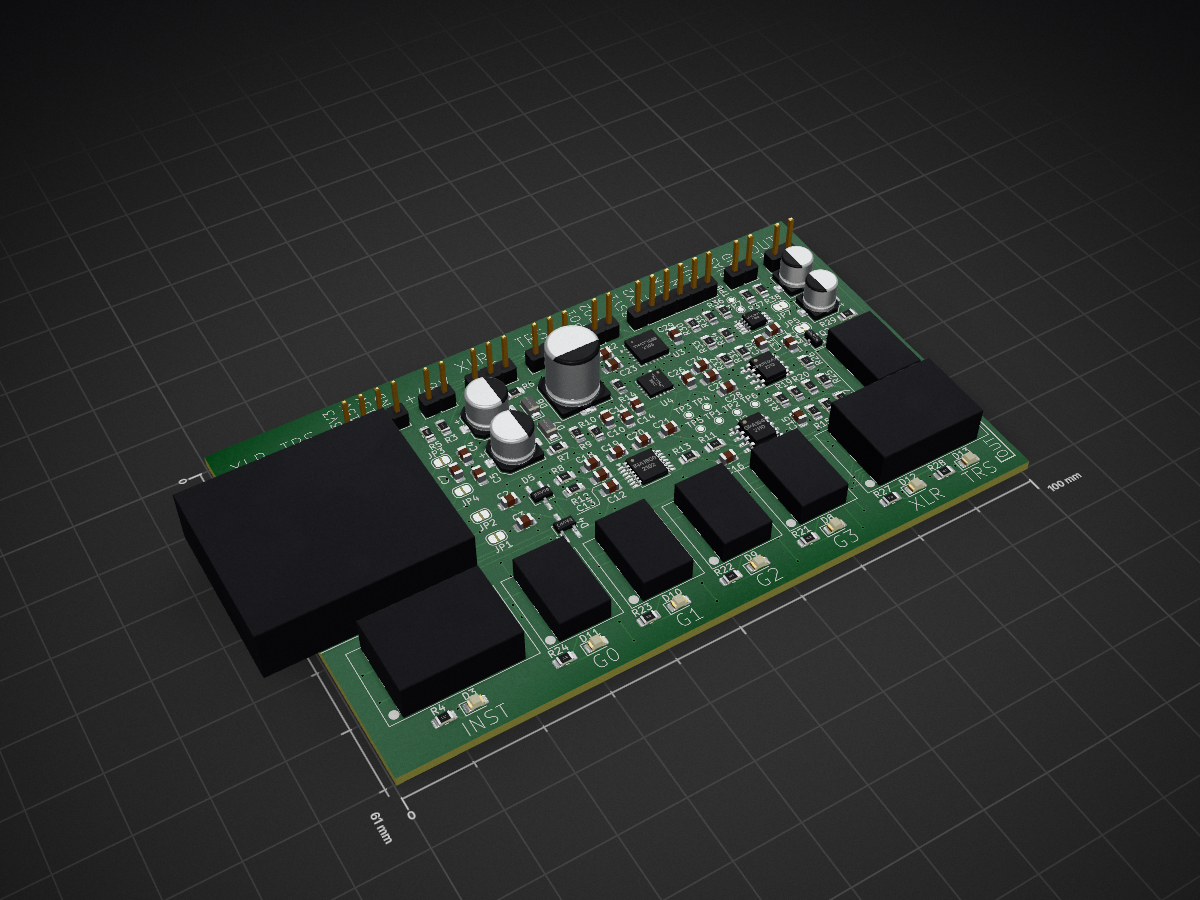
An open source audio interface
Input is an open-source printed circuit board by oliverpaddock, from the oliverpaddock/OpenMic repository on GitHub, published under the CERN-OHL-S-2.0 licence. It is a 2-layer board of 100 × 61 mm with 122 parts on 97 nets, routed with 929 tracks and 201 vias.
It is built around the INA1650IPW, OPA1637DGK and OPA1641AID, with the THAT5263, BAV99 and BSS138 among its other parts. Its parts include 38 resistors, 33 capacitors, 14 diodes, 9 connectors and 7 switches.


OpenMic is an open-source, 2-in, 2-out, usb-c audio interface.
Open source audio/music hardware is not scarce, but general-purpose open source audio interfaces for musicians are essentially non-existent. OpenMic brings repairability, transparency, and education to an overlooked corner of music hardware.
You own your hardware. All schematics, firmware, and design files are publicly accessible so you can repair it, modify it, and understand it.
If you aren't familiar with audio interfaces like the Focusrite Scarlett 2i2 or the Universal Audio Apollo Twin, they basically take analog audio - from a microphone, a guitar, a synth, etc. - and convert it into digital audio your computer can use in a DAW like Ableton, Logic, or Audacity. They also convert digital audio from your computer back into analog audio that you can hear through speakers or headphones. Interfaces also typically provide some sort of amplification or volume control on the inputs and outputs.
This is exactly what OpenMic does. Two inputs that can take microphone/line/instrument level signals, outputs for your speakers, and a headphone jack. Plus a few other features like phantom power that are listed in more detail in the Features section.
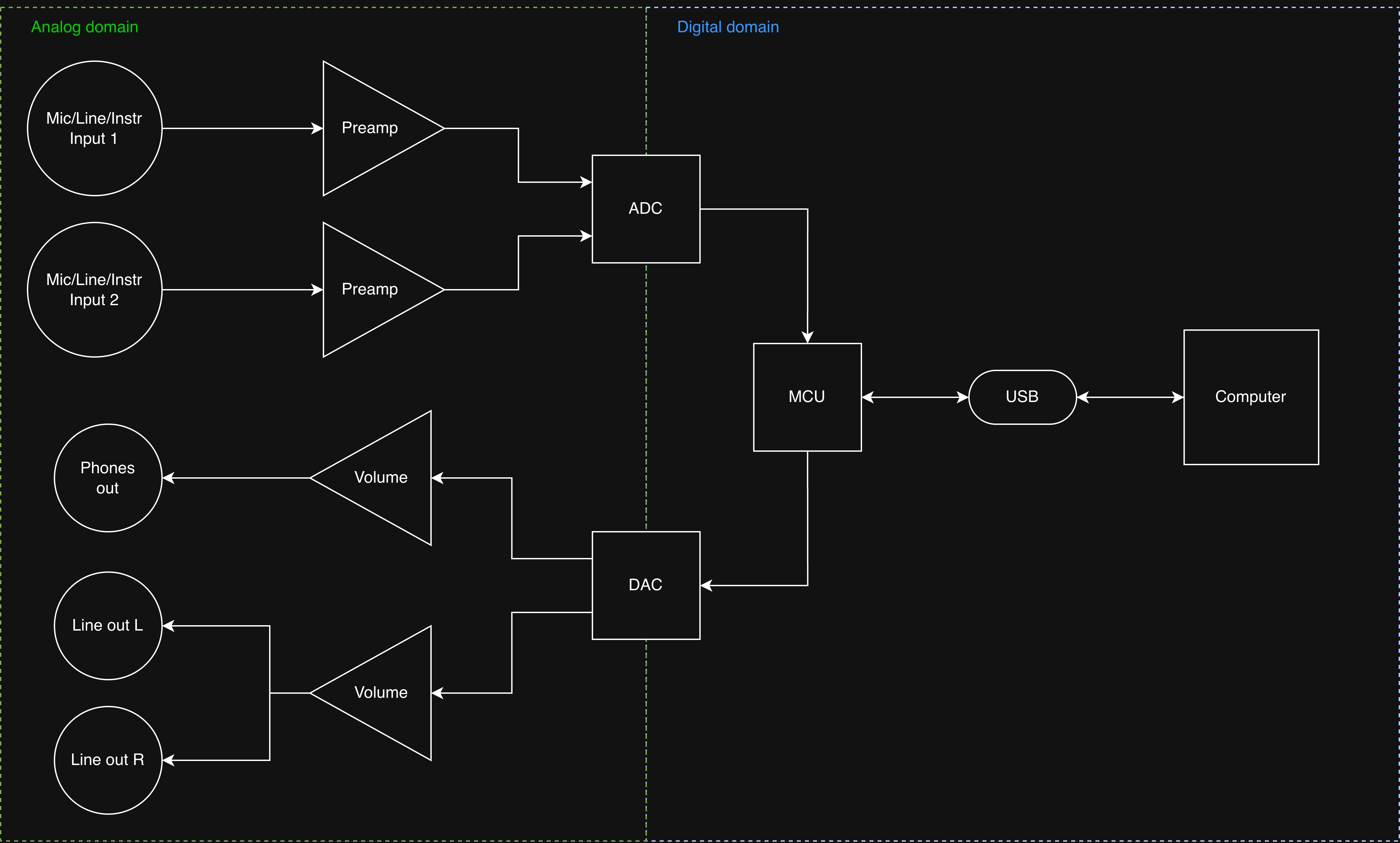 System block diagram
OpenMic is currently in the prototyping stage. The circuit has been designed and simulated, and individual systems are being built and tested. View the schematics to see the current circuit design.
Progress will be posted on the OpenMic blog as prototyping continues.
If you want to view/edit KiCAD files, make sure to add the part libraries located in /hardware/libs to your project or globally in your KiCAD instance.


THAT Corporation
Neutrik
| Qty | Value | Footprint | References |
|---|---|---|---|
| 14 | 100nF | Capacitor_SMD:C_0805_2012Metric_Pad1.18x1.45mm_HandSolder | C15, C16, C19, C20, C22, C23, C24, C25, C26, C27, C28, C29, C30, C31 |
| 10 | 1k | Resistor_SMD:R_0805_2012Metric_Pad1.20x1.40mm_HandSolder | R4, R21, R22, R23, R24, R25, R26, R27, R28, R29 |
| 10 | LED | LED_SMD:LED_0805_2012Metric_Pad1.15x1.40mm_HandSolder | D1, D2, D3, D8, D9, D10, D11, D12, D13, D14 |
| 5 | 2k | Resistor_SMD:R_0805_2012Metric_Pad1.20x1.40mm_HandSolder | R30, R31, R32, R33, R34 |
| 4 | 10 | Resistor_SMD:R_0805_2012Metric_Pad1.20x1.40mm_HandSolder | R6, R7, R35, R36 |
| 4 | 1k2 | Resistor_SMD:R_0805_2012Metric_Pad1.20x1.40mm_HandSolder | R9, R10, R15, R20 |
| 4 | 1uF | Capacitor_SMD:C_0805_2012Metric_Pad1.18x1.45mm_HandSolder | C1, C6, C18, C21 |
| 4 | 22pF | Capacitor_SMD:C_0805_2012Metric_Pad1.18x1.45mm_HandSolder | C2, C3, C4, C5 |
| 4 | 510 | Resistor_SMD:R_0805_2012Metric_Pad1.20x1.40mm_HandSolder | R16, R17, R18, R19 |
| 4 | SolderJumper_2_Open | Jumper:SolderJumper-2_P1.3mm_Open_RoundedPad1.0x1.5mm | JP1, JP2, JP3, JP4 |
| 2 | 100k | Resistor_SMD:R_0805_2012Metric_Pad1.20x1.40mm_HandSolder | R8, R12 |
| 2 | 100pF | Capacitor_SMD:C_0805_2012Metric_Pad1.18x1.45mm_HandSolder | C10, C11 |
| 2 | 10uF | Capacitor_SMD:C_0805_2012Metric_Pad1.18x1.45mm_HandSolder | C12, C13 |
| 2 | 10uF | Capacitor_SMD:CP_Elec_5x5.4 | C32, C33 |
| 2 | 1M | Resistor_SMD:R_0805_2012Metric_Pad1.20x1.40mm_HandSolder | R13, R14 |
| 2 | 220pF | Capacitor_SMD:C_0805_2012Metric_Pad1.18x1.45mm_HandSolder | C7, C14 |
| 2 | 47uF | Capacitor_SMD:CP_Elec_6.3x5.8 | C8, C9 |
| 2 | 4k7 | Resistor_SMD:R_0805_2012Metric_Pad1.20x1.40mm_HandSolder | R1, R2 |
| 2 | 5k | Resistor_SMD:R_0805_2012Metric_Pad1.20x1.40mm_HandSolder | R37, R38 |
| 2 | 6k81 | Resistor_SMD:R_0805_2012Metric_Pad1.20x1.40mm_HandSolder | R3, R5 |
| 2 | BAV99 | Package_TO_SOT_SMD:TSOT-23_HandSoldering | D4, D5 |
| 2 | SolderJumper_2_Bridged | Jumper:SolderJumper-2_P1.3mm_Bridged2Bar_RoundedPad1.0x1.5mm | JP5, JP7 |
| 2 | VTVS19ASMF | Diode_SMD:D_SMF | D6, D7 |
| 1 | 100 | Resistor_SMD:R_0805_2012Metric_Pad1.20x1.40mm_HandSolder | R11 |
| 1 | 1000uF | Capacitor_SMD:CP_Elec_8x10 | C17 |
| 1 | 48V_PH | Connector_PinHeader_2.54mm:PinHeader_1x02_P2.54mm_Vertical | J5 |
| 1 | 5263 | Connector_PinHeader_2.54mm:PinHeader_1x06_P2.54mm_Vertical | J6 |
| 1 | 5263_GPO | Connector_PinHeader_2.54mm:PinHeader_1x02_P2.54mm_Vertical | J7 |
| 1 | AUDIO_OUT | Connector_PinHeader_2.54mm:PinHeader_1x02_P2.54mm_Vertical | J9 |
| 1 | BSS138 | Package_TO_SOT_SMD:SOT-23 | Q2 |
| 1 | Conn_01x04_Pin | Connector_PinHeader_2.54mm:PinHeader_1x04_P2.54mm_Vertical | J1 |
| 1 | GAIN_0 | openmic:DPDT_SW | SW3 |
| 1 | GAIN_1 | openmic:DPDT_SW | SW4 |
| 1 | GAIN_2 | openmic:DPDT_SW | SW5 |
| 1 | GAIN_3 | openmic:DPDT_SW | SW6 |
| 1 | INA1650 | Package_SO:TSSOP-14_4.4x5mm_P0.65mm | U1 |
| 1 | INST_SW | openmic:4PDT_SW | SW2 |
| 1 | INST_TP | TestPoint:TestPoint_Pad_D1.0mm | TP2 |
| 1 | IN_EN | openmic:DPDT_SW | SW7 |
| 1 | LINE_INST_N_TP | TestPoint:TestPoint_Pad_D1.0mm | TP6 |
| 1 | LINE_INST_P_TP | TestPoint:TestPoint_Pad_D1.0mm | TP5 |
| 1 | LINE_TP | TestPoint:TestPoint_Pad_D1.0mm | TP1 |
| 1 | MIC_N_TP | TestPoint:TestPoint_Pad_D1.0mm | TP4 |
| 1 | MIC_P_TP | TestPoint:TestPoint_Pad_D1.0mm | TP3 |
| 1 | NCJ10FI-H-0 | Connector_Audio:Jack_XLR-6.35mm_Neutrik_NCJ10FI-H-0_Horizontal | J2 |
| 1 | OPA1612AxD | Package_SO:SOIC-8_3.9x4.9mm_P1.27mm | U5 |
| 1 | OPA1637 | Package_SO:VSSOP-8_3x3mm_P0.65mm | U6 |
| 1 | OPA1641 | Package_SO:SOIC-8_3.9x4.9mm_P1.27mm | U2 |
| 1 | OUT_BIAS | Connector_PinHeader_2.54mm:PinHeader_1x02_P2.54mm_Vertical | J8 |
| 1 | OUT_N_TP | TestPoint:TestPoint_Pad_D1.0mm | TP7 |
| 1 | OUT_P_TP | TestPoint:TestPoint_Pad_D1.0mm | TP8 |
| 1 | THAT1580 | Package_DFN_QFN:QFN-16-1EP_4x4mm_P0.65mm_EP2.1x2.1mm_ThermalVias | U4 |
| 1 | THAT5263 | Package_DFN_QFN:QFN-24-1EP_5x5mm_P0.65mm_EP3.4x3.4mm | U3 |
| 1 | TRS_SIG | Connector_PinHeader_2.54mm:PinHeader_1x03_P2.54mm_Vertical | J3 |
| 1 | TRS_SW | openmic:4PDT_SW | SW1 |
| 1 | XLR_SIG | Connector_PinHeader_2.54mm:PinHeader_1x03_P2.54mm_Vertical | J4 |
It measures 100 × 61 mm and has 2 copper layers, 1.6 mm thick.
122 parts, built around the INA1650IPW, OPA1637DGK, OPA1641AID and THAT5263. The full list of its parts is on this page, with links to each part's symbol and footprint where PCBKit's library has them.
From the oliverpaddock/OpenMic repository on GitHub, at the commit this page was made from: the board is hardware/pcb/prototypes/input/v1/input.kicad_pcb and its schematic hardware/pcb/main-board/codec.kicad_sch. PCBKit opens the board in the browser, with nothing to install.
Its repository publishes it under the CERN-OHL-S-2.0 licence: you may reuse it on that licence's terms (keep the author's notice, and for a copyleft licence share your changes alike).


es-ude/eeg-hardware
Repo of the Custom Hardware Design Files of the EEG-based Gaming Controller


