

2 layers45.7 × 22.9 mm
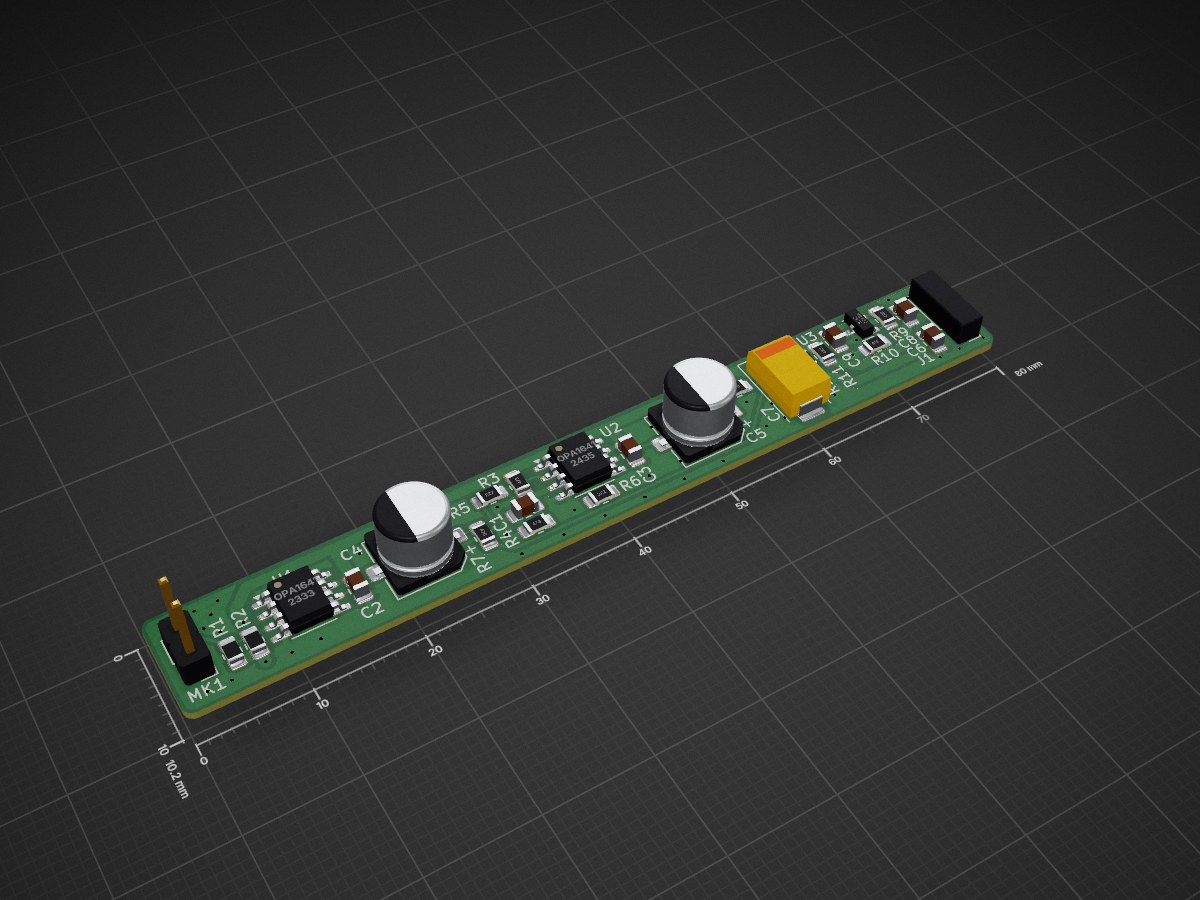
A phantom-powered balanced electret microphone interface
Mic is an open-source printed circuit board by werediver, from the werediver/mic repository on GitHub. It is a 2-layer board of 80 × 10.2 mm with 26 parts on 18 nets, routed with 64 tracks and 50 vias.
It is built around the OPA1641AID. Its parts include 12 resistors, 9 capacitors, 3 ICs and 1 connector. It belongs with the audio and music and interfaces and adapters boards of this library.
A phantom-powered balanced interface for an electret microphone capsule with a built-in JFET.
This interface has no gain, except for doubling the amplitude while converting the single-ended signal from the capsule into a balanced output signal.
The PCB is designed to fit into a metal tube ⌀11.5 or wider.
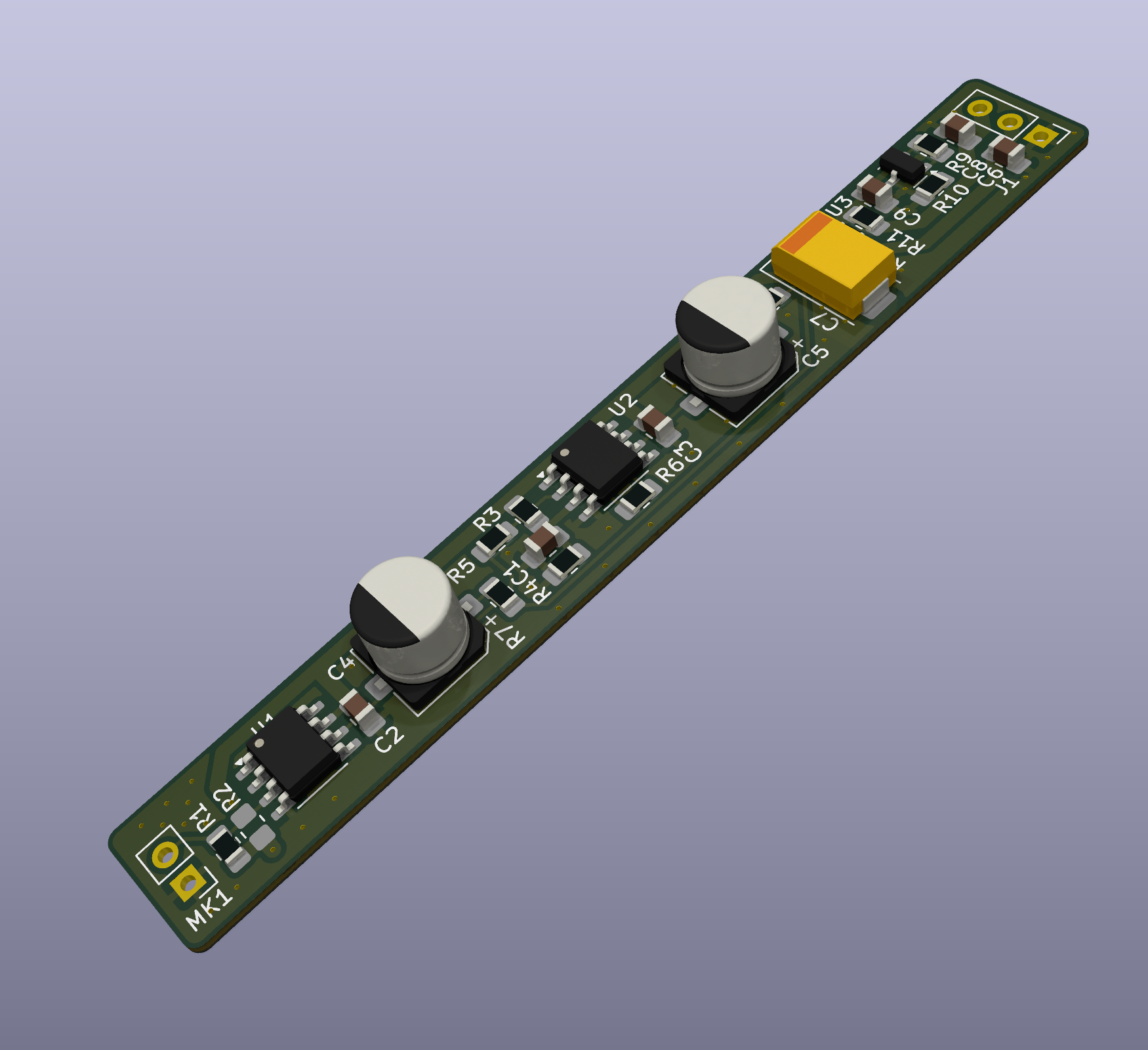
Please note that two OPA1641 ICs are used in the design just because I already had them when designing the circuit. Using OPA1642 would be more space-efficient and I recommend you using OPA1642, not OPA1641 in your design.
| Qty | Value | Footprint | References |
|---|---|---|---|
| 4 | 0.1u | Capacitor_SMD:C_0805_2012Metric_Pad1.18x1.45mm_HandSolder | C1, C2, C3, C9 |
| 4 | 2.2k | Resistor_SMD:R_0805_2012Metric_Pad1.20x1.40mm_HandSolder | R5, R6, R11, R12 |
| 2 | 22n | Capacitor_SMD:C_0805_2012Metric_Pad1.18x1.45mm_HandSolder | C6, C8 |
| 2 | 47 | Resistor_SMD:R_0805_2012Metric_Pad1.20x1.40mm_HandSolder | R7, R8 |
| 2 | 47k | Resistor_SMD:R_0805_2012Metric_Pad1.20x1.40mm_HandSolder | R3, R4 |
| 2 | 47u 50V | Capacitor_SMD:CP_Elec_6.3x5.8 | C4, C5 |
| 2 | OPA1641 | Package_SO:SOIC-8_3.9x4.9mm_P1.27mm | U1, U2 |
| 1 | 10k | Resistor_SMD:R_0805_2012Metric_Pad1.20x1.40mm_HandSolder | R10 |
| 1 | 10k* | Resistor_SMD:R_0805_2012Metric_Pad1.20x1.40mm_HandSolder | R1 |
| 1 | 47u 25V | Capacitor_Tantalum_SMD:CP_EIA-7343-31_Kemet-D_Pad2.25x2.55mm_HandSolder | C7 |
| 1 | 68k | Resistor_SMD:R_0805_2012Metric_Pad1.20x1.40mm_HandSolder | R9 |
| 1 | Electret w/ FET | Connector_PinHeader_2.54mm:PinHeader_1x02_P2.54mm_Vertical | MK1 |
| 1 | TS432 | Package_TO_SOT_SMD:SOT-23 | U3 |
| 1 | XLR3 | Connector_PinHeader_2.54mm:PinHeader_1x03_P2.54mm_Vertical | J1 |
| 1 | ~ | Resistor_SMD:R_0805_2012Metric_Pad1.20x1.40mm_HandSolder | R2 |
It measures 80 × 10.2 mm and has 2 copper layers, 0.8 mm thick.
26 parts, built around the OPA1641AID. The full list of its parts is on this page, with links to each part's symbol and footprint where PCBKit's library has them.
From the werediver/mic repository on GitHub, at the commit this page was made from: the board is KiCad/Mic/Mic.kicad_pcb and its schematic KiCad/Mic/Mic.kicad_sch. PCBKit opens the board in the browser, with nothing to install.
Its repository states no licence, so its author keeps all rights: ask werediver before reusing the design.


