2 layers
 oliverpaddock/OpenMic
An open source audio interface
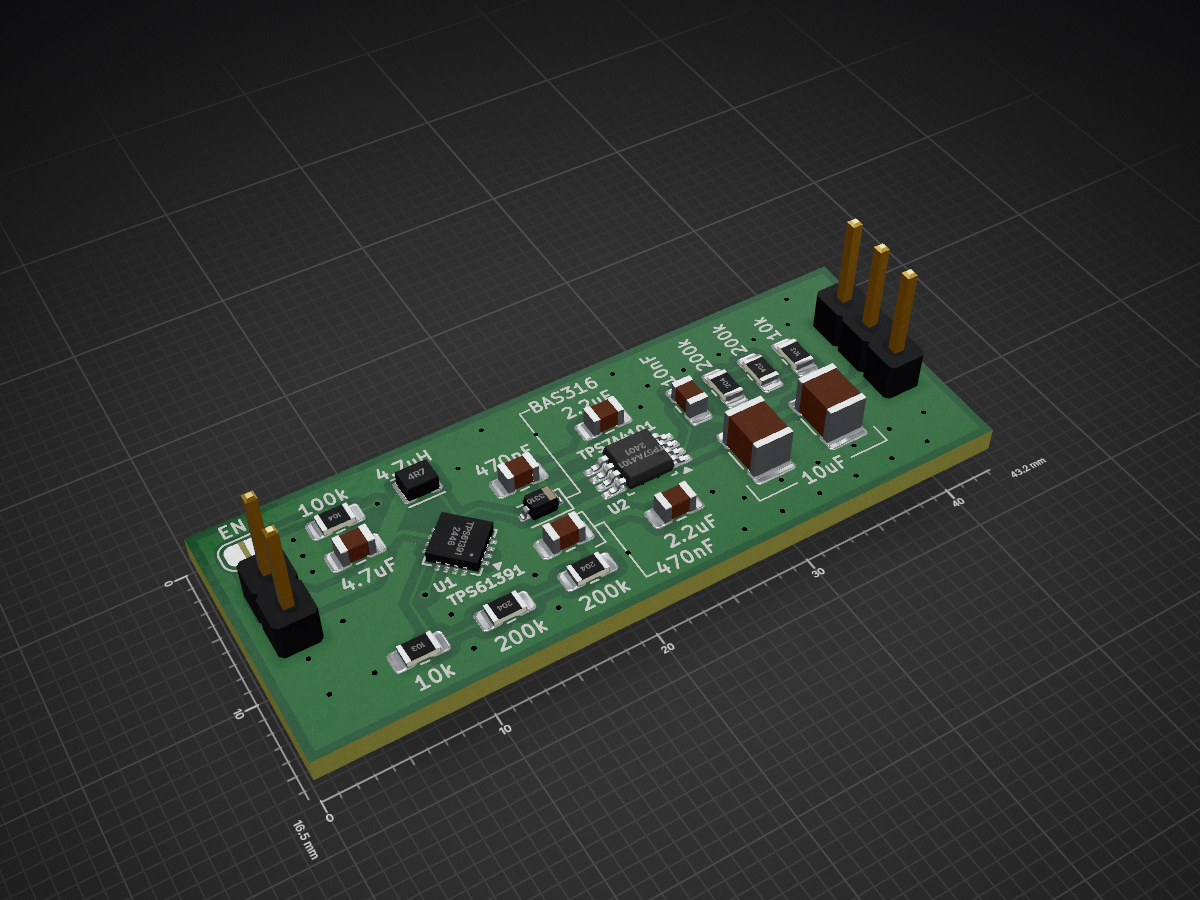
Phantom is an open-source printed circuit board by oliverpaddock, from the oliverpaddock/OpenMic repository on GitHub, published under the CERN-OHL-S-2.0 licence. It is a 2-layer board of 43.2 × 16.5 mm with 22 parts on 18 nets, routed with 75 tracks and 42 vias.
It is built around the TPS61391RTE, TPS7A4101DGN and CL21A106KAYNNNE, with the CL21A225KBQNNNE, CL21B474KBFNNNE and 0805W8F1003T5E (SMT业务专用) among its other parts. Its parts include 8 capacitors, 7 resistors, 2 ICs, 2 connectors and 1 diode.


OpenMic is an open-source, 2-in, 2-out, usb-c audio interface.
Open source audio/music hardware is not scarce, but general-purpose open source audio interfaces for musicians are essentially non-existent. OpenMic brings repairability, transparency, and education to an overlooked corner of music hardware.
You own your hardware. All schematics, firmware, and design files are publicly accessible so you can repair it, modify it, and understand it.
If you aren't familiar with audio interfaces like the Focusrite Scarlett 2i2 or the Universal Audio Apollo Twin, they basically take analog audio - from a microphone, a guitar, a synth, etc. - and convert it into digital audio your computer can use in a DAW like Ableton, Logic, or Audacity. They also convert digital audio from your computer back into analog audio that you can hear through speakers or headphones. Interfaces also typically provide some sort of amplification or volume control on the inputs and outputs.
This is exactly what OpenMic does. Two inputs that can take microphone/line/instrument level signals, outputs for your speakers, and a headphone jack. Plus a few other features like phantom power that are listed in more detail in the Features section.
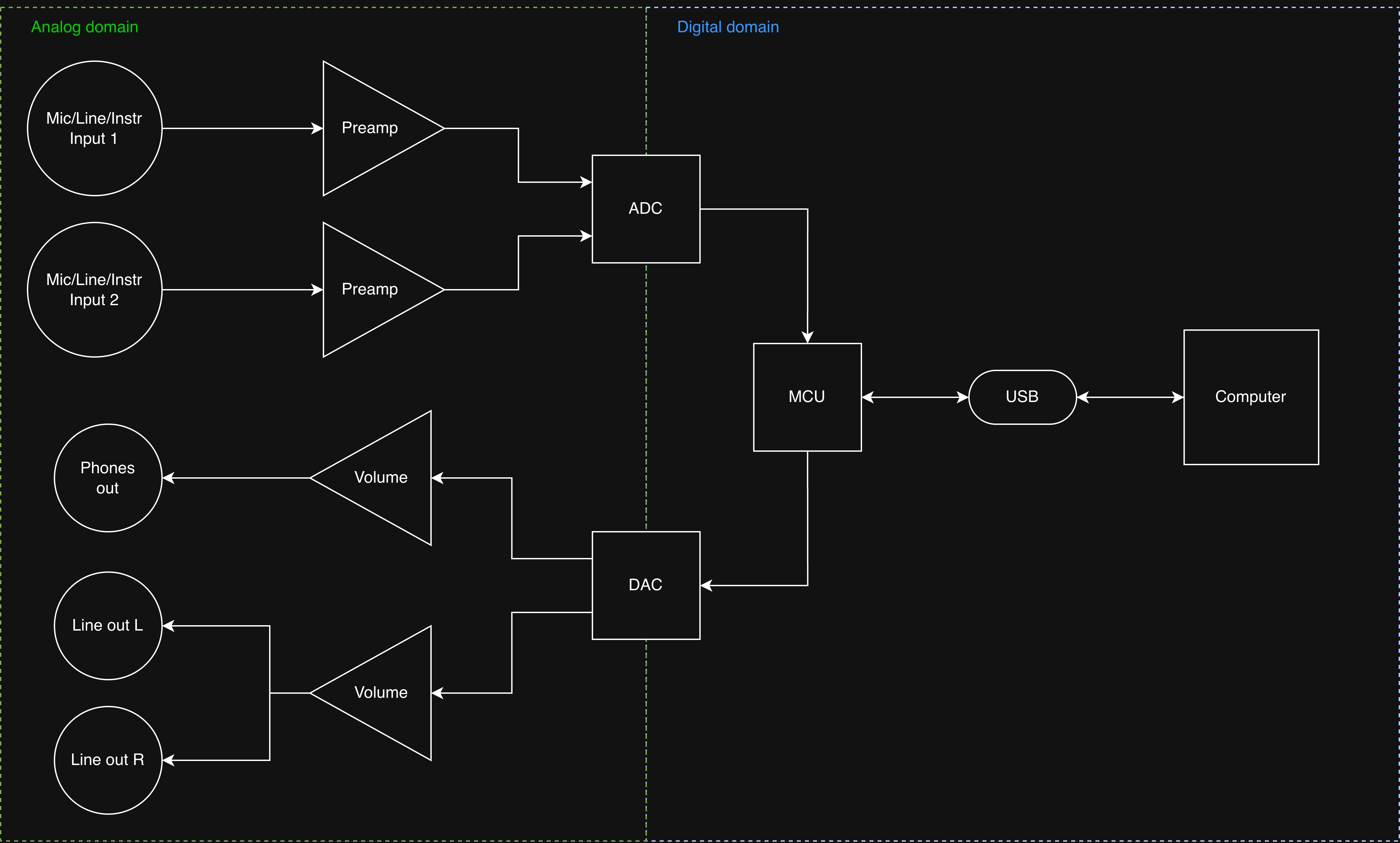 System block diagram
OpenMic is currently in the prototyping stage. The circuit has been designed and simulated, and individual systems are being built and tested. View the schematics to see the current circuit design.
Progress will be posted on the OpenMic blog as prototyping continues.
If you want to view/edit KiCAD files, make sure to add the part libraries located in /hardware/libs to your project or globally in your KiCAD instance.


THAT Corporation
Neutrik
| Qty | Value | Footprint | References |
|---|---|---|---|
| 4 | 200k | Resistor_SMD:R_0805_2012Metric_Pad1.20x1.40mm_HandSolder | R2, R3, R5, R6 |
| 2 | 10k | Resistor_SMD:R_0805_2012Metric_Pad1.20x1.40mm_HandSolder | R4, R7 |
| 2 | 10uF | Capacitor_SMD:C_1210_3225Metric_Pad1.33x2.70mm_HandSolder | C7, C8 |
| 2 | 2.2uF | Capacitor_SMD:C_0805_2012Metric_Pad1.18x1.45mm_HandSolder | C4, C5 |
| 2 | 470nF | Capacitor_SMD:C_0805_2012Metric_Pad1.18x1.45mm_HandSolder | C2, C3 |
| 1 | 100k | Resistor_SMD:R_0805_2012Metric_Pad1.20x1.40mm_HandSolder | R1 |
| 1 | 10nF | Capacitor_SMD:C_0805_2012Metric_Pad1.18x1.45mm_HandSolder | C6 |
| 1 | 4.7uF | Capacitor_SMD:C_0805_2012Metric_Pad1.18x1.45mm_HandSolder | C1 |
| 1 | 4.7uH | Inductor_SMD:L_Wuerth_PMCI-201610 | L1 |
| 1 | 5V | Connector_PinHeader_2.54mm:PinHeader_1x02_P2.54mm_Vertical | J1 |
| 1 | BAS316 | Diode_SMD:D_SOD-323 | D1 |
| 1 | Conn_01x03_Pin | Connector_PinHeader_2.54mm:PinHeader_1x03_P2.54mm_Vertical | J2 |
| 1 | EN | Jumper:SolderJumper-2_P1.3mm_Open_RoundedPad1.0x1.5mm | JP1 |
| 1 | TPS61391 | Package_DFN_QFN:WQFN-16-1EP_3x3mm_P0.5mm_EP1.6x1.6mm | U1 |
| 1 | TPS7A4101 | Package_SO:Texas_DGN0008B_VSSOP-8-1EP_3x3mm_P0.65mm_EP2x3mm_Mask1.88x1.98mm_ThermalVias | U2 |
It measures 43.2 × 16.5 mm and has 2 copper layers, 1.6 mm thick.
22 parts, built around the TPS61391RTE, TPS7A4101DGN, CL21A106KAYNNNE and CL21A225KBQNNNE. The full list of its parts is on this page, with links to each part's symbol and footprint where PCBKit's library has them.
From the oliverpaddock/OpenMic repository on GitHub, at the commit this page was made from: the board is hardware/pcb/prototypes/power/v2-48v/phantom/phantom.kicad_pcb and its schematic hardware/pcb/main-board/codec.kicad_sch. PCBKit opens the board in the browser, with nothing to install.
Its repository publishes it under the CERN-OHL-S-2.0 licence: you may reuse it on that licence's terms (keep the author's notice, and for a copyleft licence share your changes alike).


lhr-solar/Power-Generation-Sunscatter
The current maintainer of this project is Matthew Yu as of 07/16/2023. His email is matthewjkyu@gmail.com.


igorilla666/water-controller
Scheda di controllo basata sul modulo Waveshare ESP32-S3-ETH, con ingressi sensore, RS-485, pilotaggio rele, buzzer e alimentazione/protezioni dedicate.

mahmoud-elghamry/thermocouple
This directory is a self-contained KiCad 10 project. It does not share files with, and must not be confused with, the single-channel board in hardware/single-channel/.
