


6 layers140 × 56 mm
Trenz mounted
naturalhazardscience/groundlark
Open source hardware for community-powered citizen science
207 partsMIT

Open source hardware for community-powered citizen science
Skylark is an open-source printed circuit board by naturalhazardscience, from the naturalhazardscience/groundlark repository on GitHub, published under the MIT licence. It is a 2-layer board with 128 parts on 96 nets.
It is built around the BMP388 and TYPE-C-31-M-12. Its parts include 46 capacitors, 43 resistors, 14 diodes, 10 ICs and 3 connectors.

Groundlark is a family of hardware boards and companion software for seismic and environmental monitoring. Each board has its own hardware directory, with shared component libraries, interfaces and validation tools.
The family has three products: the Groundlark FPGA HAT, Skylark and Burrowlark USB sensor heads. All share the sensor contracts, simulation tools and local workbench.
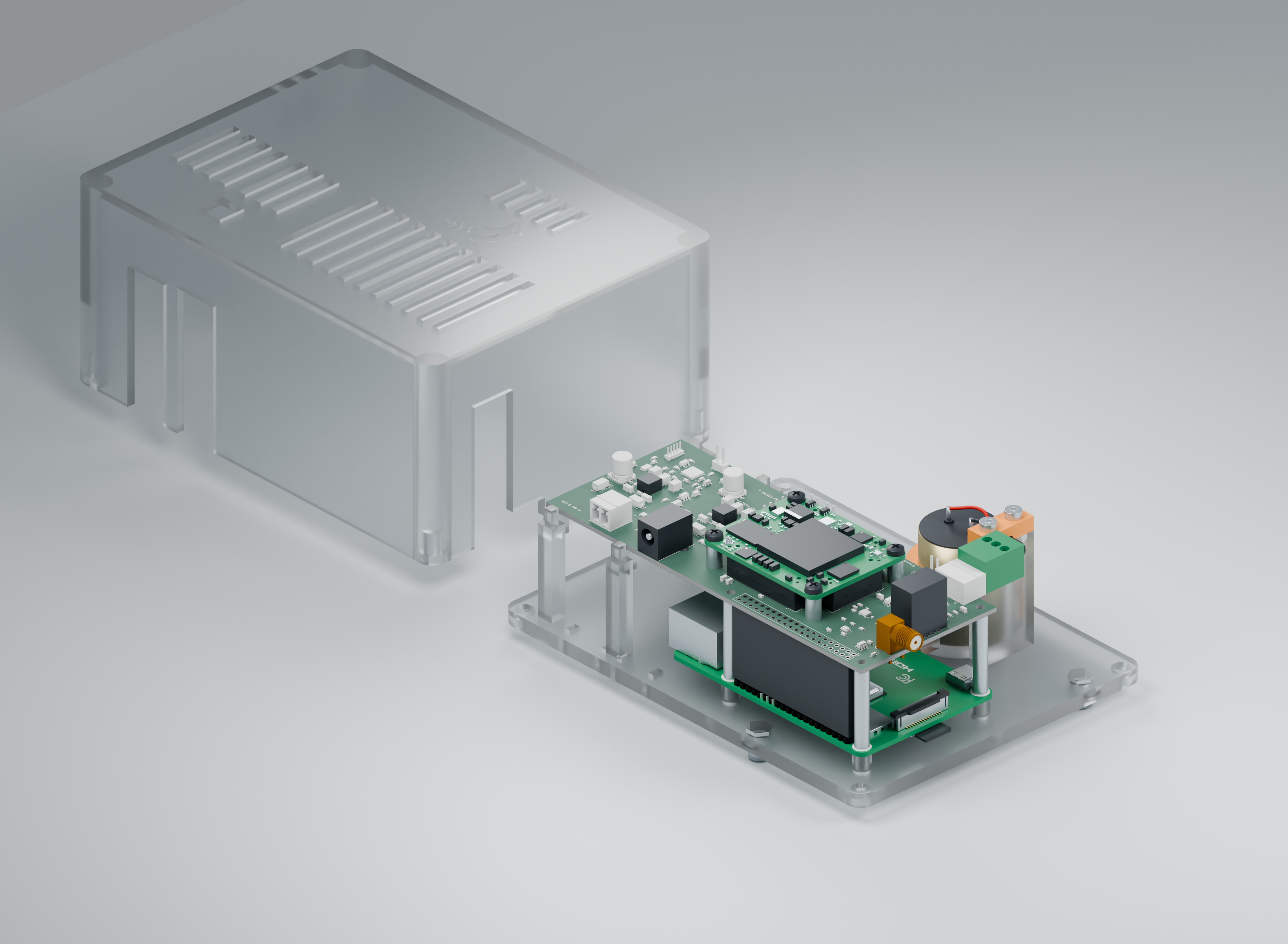
Seismic monitoring on a Raspberry Pi. The active Groundlark FPGA HAT, model DAQHAT-01, is a 140 × 56 mm, six-layer FR-4 board with three XYZ LSM6DSO IMUs and an ADS122C04 input for an external Racotech geophone, plus a fitted SDP32-125PA infrasound sensor and u-blox MAX-M10S GNSS with a side-facing SMA antenna connector. The stack is Pi → HAT → Trenz Artix-7 200T FPGA. Pi acquisition works independently of a configured FPGA.
The internal FPGA link provides six QSPI wires, UART, reset and switched Pi-driven JTAG. An SPI echo bitstream is implemented; accelerated sensor processing and native quad transfers remain future work. The FPGA uses a separate Nexys Video-compatible 12 V, center-positive adapter through J83 and an onboard 3.326 V converter. See the power limits.
Status: active prototype. Physical power, fit, timing, noise and thermal
qualification remain pending. See the stack assembly guide,
JLCPCB instructions and bench procedure.
The JLCPCB package targets one assembled HAT; sourcing, placement and J1 fit
checks remain open. Fabrication packages stay local in ignored hw/releases/.
R3 prototype enclosure, current 140 mm HAT CAD with GNSS/SMA, infrasound, TI Pi supervision and independent FPGA power, vendor Trenz components and a detailed Pi 4B model by integrated-circuit / FreeCAD community (CC BY 3.0). Clear PETG appearance, risers, geophone and wiring are approximate. Physical fit remains unqualified. Render provenance.
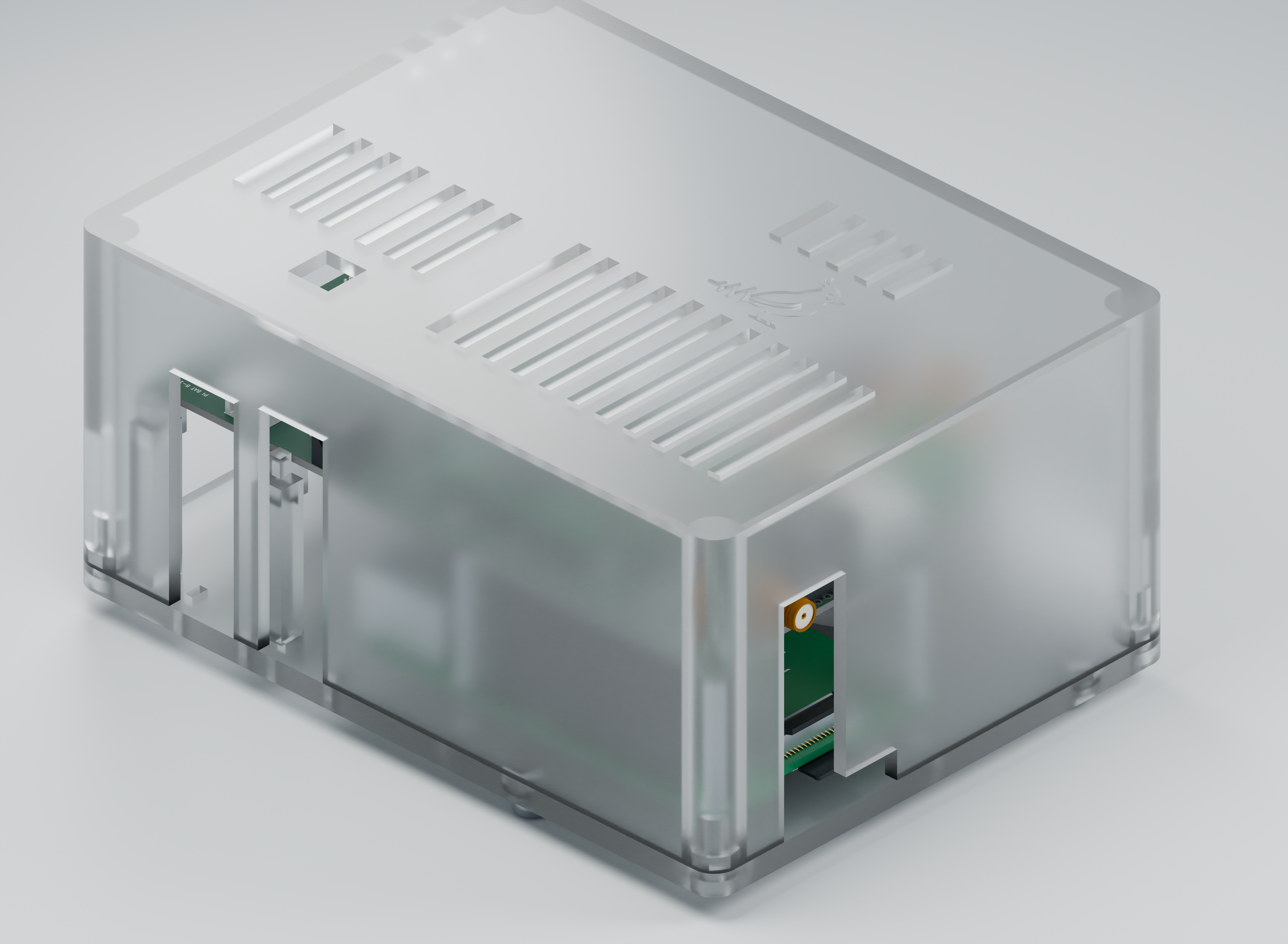
Closed enclosure render provenance. Measured gain/offset workflows and PCB probe access are in the calibration guide. Seismic recordings support local miniSEED export.
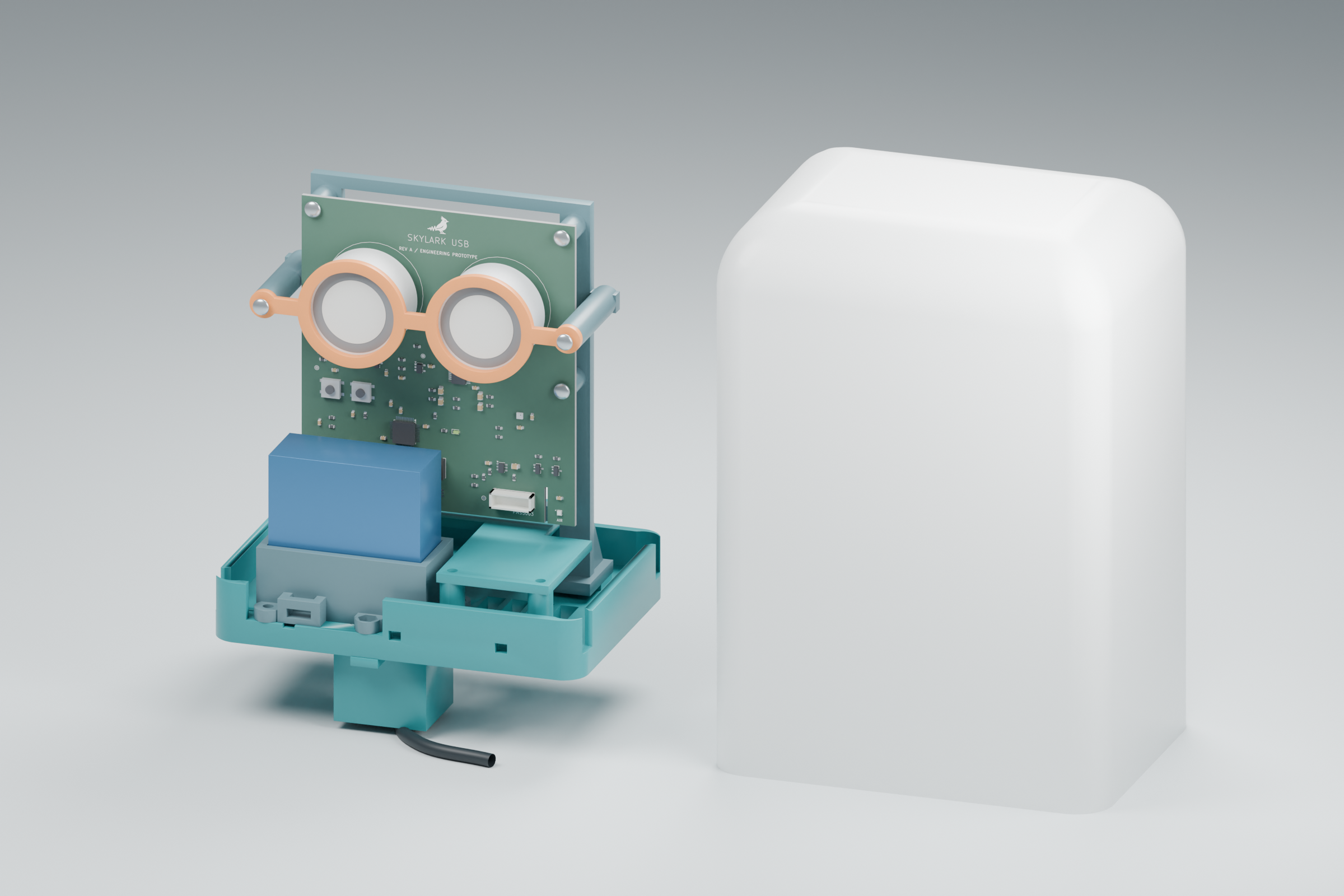
Outdoor air-quality monitoring over USB. Skylark USB combines a vertical 90 × 100 mm PCB with a removable sensor tray and a 130 × 94 × 185 mm bell enclosure.
Prototype firmware implements sensor acquisition and USB streaming. The shared workbench includes Skylark simulation, recording/replay, board-specific tests and an interactive 3D PCB. Gas data retains separate raw working and auxiliary electrode counts; concentrations require calibration.
Status: Rev A PCB, Rev G enclosure and prototype firmware are implemented. Physical fit, USB power behavior, analog performance, gas response and weather resistance still require qualification. The ventilated enclosure has no assigned IP rating. Follow the PCB guide and enclosure assembly instructions.
Render: native PCB artwork and authored component models in the CAD-derived tray, with the bell set beside it. Component bodies are dimension envelopes; fasteners and cable dressing are illustrative. Render provenance.
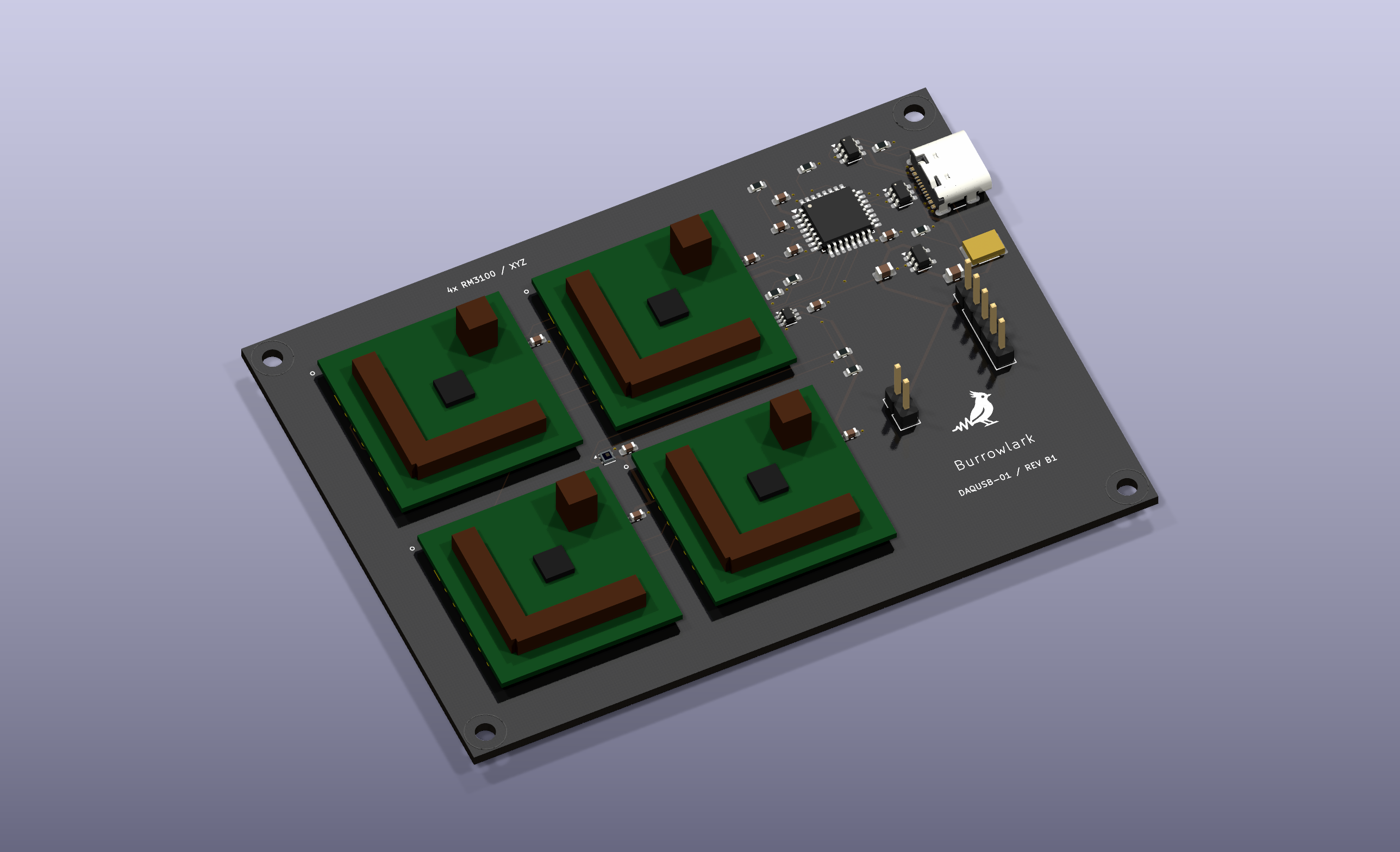
Remote magnetic and enclosure-climate sensing over USB. Burrowlark USB, model DAQUSB-01, carries four RM3100 magnetometers on a 30 mm square grid and an SHT45 temperature/humidity sensor. One STM32F042K6 coordinates their measurements and sends each sensor's raw data and timing evidence to the Pi over USB-C. The SDP32-125PA infrasound sensor is fitted on Groundlark DAQHAT-01.
Status: routed prototype hardware, MCU firmware and workbench simulation are implemented. Physical USB, synchronization, magnetic cross-talk and noise qualification remain pending. See the USB sensor-head guide for interfaces and assembly details.
Render: native 96 × 70 mm PCB with favicon, Burrowlark name and DAQUSB-01 / REV B1 silkscreen, four RM3100 modules and SHT45 U6/C10; the former infrasound footprint and bypass capacitor are removed. Module, fuse and SHT45 bodies are simplified dimensional envelopes. Render provenance.
The dark-mode Python UI lets you switch between Groundlark, Skylark and Burrowlark, with interactive 3D views, raw-data charts, stimulus/fault controls, board-specific tests and recording/replay. No hardware or Docker is required. Follow the beginner walkthrough to create your first signal.
# Windows: set up once, then launch
./setup-ui.ps1 -Check
./ui.ps1
On Linux/macOS, use sh ./setup-ui.sh --check, then sh ./ui.sh.
Open http://127.0.0.1:8080. Tools and dependencies stay in ignored .local/.
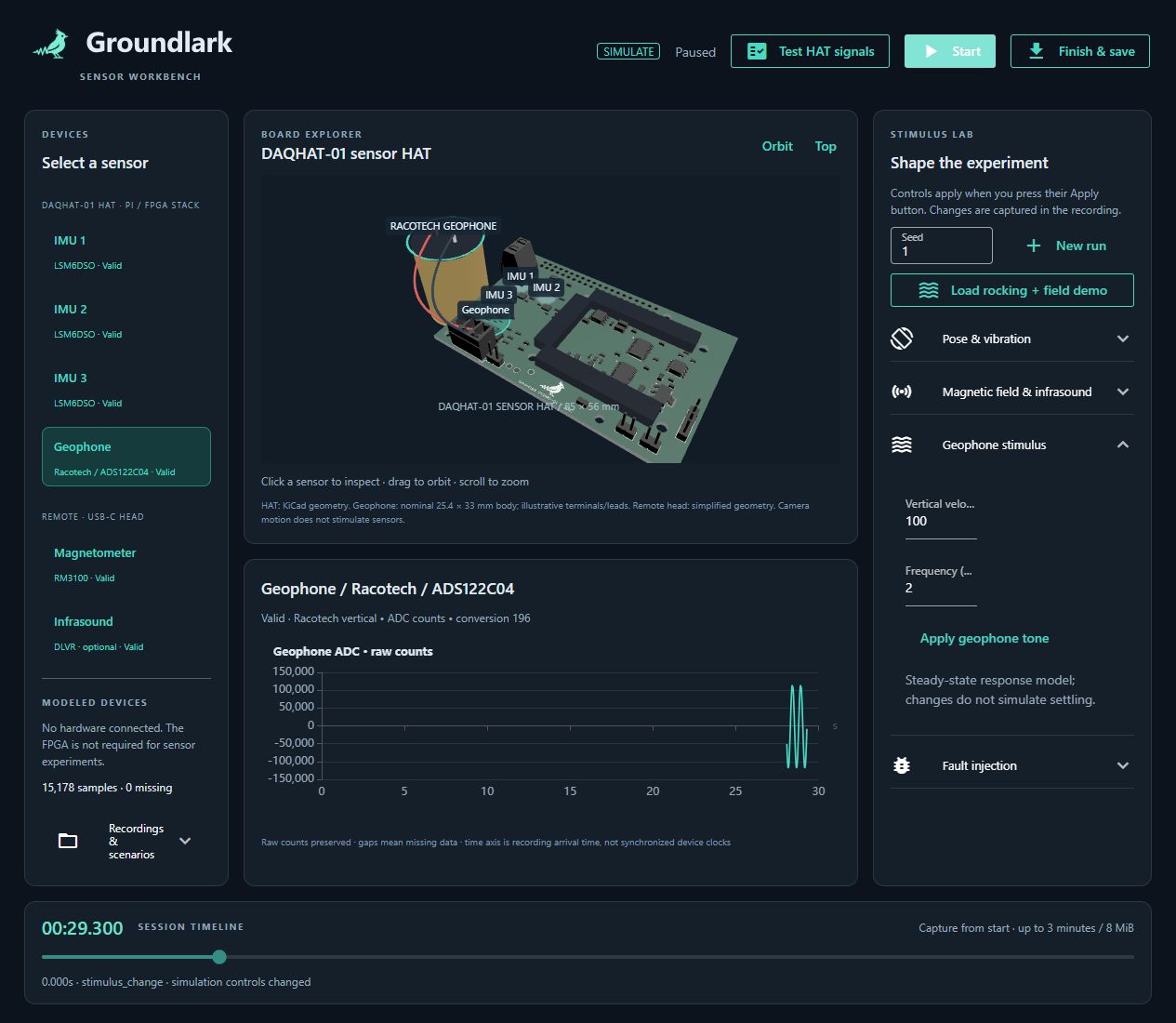
This is an actual browser screenshot with simulated data. Select the geophone can or its HAT input to highlight both and inspect the same ADC stream. Use the Board selector for the FPGA HAT, Burrowlark or Skylark. Test selected board runs the selected board’s checks; the HAT test covers all six sensors over eight simulated seconds. IMU, ADC and GNSS use production Pi drivers on modeled buses; infrasound uses a raw-response model pending its Pi driver. Signal checks and recordings/results are downloadable. The Groundlark GNSS panel also models disconnected or shorted antennas, lock loss and recovery, and PPS loss independently. The UI simulates and replays; physical acquisition uses the Pi software. Live seismic capture stores raw geophone and IMU counts locally as miniSEED 3, with SSREC companions for diagnostics and replay.
| Directory | Contents |
|---|---|
| hw/ | Four product directories, shared component resources, hardware checks and SPICE. |
| sw/ | Pi acquisition, contracts, simulator, FPGA and remote firmware interfaces. |
| docs/ | Setup, hardware specifications, assembly, interfaces and testing instructions. |
| environment/ | Pinned Docker test environment and bounded cleanup tooling. |
For the full test environment, run ./lab.ps1 build once, then ./lab.ps1 test.
Use ./lab.ps1 test -Profile software for sensor contracts, acquisition,
recording/replay and recovery. Use ./lab.ps1 test -Profile simulation for fresh
circuit builds, CAD checks and all models while excluding the procurement release
gate. See the simulation scope and portable lab guide
for Linux commands, test scope, five-run retention and cleanup.
Hardware sources: DAQHAT-01 circuit, KiCad PCB, Burrowlark DAQUSB-01, and Skylark USB. See build instructions and source references.
Project-authored code, hardware designs and documentation use the MIT License. Third-party assets and dependencies retain their own licenses and attribution.
| Qty | Value | Footprint | References |
|---|---|---|---|
| 42 | skylark:Resistor_SMD__R_0603_1608Metric | R1, R2, R10, R11, R12, R13, R14, R15, R16, R17, R18, R19, R20, R21, R30, R31 +26 | |
| 25 | skylark:Capacitor_SMD__C_0603_1608Metric | C1, C3, C5, C10, C11, C13, C14, C15, C16, C17, C18, C19, C37, C38, C57, C58 +9 | |
| 14 | skylark:Capacitor_SMD__C_1206_3216Metric | C30, C33, C36, C50, C53, C56, C80, C81, C82, C83, C84, C85, C86, C87 | |
| 9 | skylark:Package_TO_SOT_SMD__SOT-23 | D4, Q1, Q2, Q3, Q4, Q5, Q6, Q7, U4 | |
| 7 | skylark:TestPoint__TestPoint_Pad_D1.0mm | TP1, TP2, TP3, TP4, TP5, TP6, TP7 | |
| 4 | skylark:Package_TO_SOT_SMD__SOT-23-5 | U2, U5, U8, U10 | |
| 4 | skylark:Package_TO_SOT_SMD__SOT-23-6 | D1, D2, U3, U13 | |
| 4 | 10uF | Skylark:Capacitor_SMD__C_0805_2012Metric | C31, C34, C51, C54 |
| 3 | skylark:Capacitor_SMD__C_0805_2012Metric | C2, C4, C12 | |
| 2 | skylark:Button_Switch_SMD__SW_SPST_TL3342 | SW1, SW2 | |
| 2 | skylark:SGX7_AQ_Socket | GS1, GS2 | |
| 2 | skylark:Package_SO__VSSOP-8_3x3mm_P0.65mm | U7, U9 | |
| 1 | skylark:Connector_JST__JST_GH_BM08B-GHS-TBT_1x08-1MP_P1.25mm_Vertical | J2 | |
| 1 | skylark:Package_SO__TSSOP-16_4.4x5mm_P0.65mm | U6 | |
| 1 | skylark:Connector_PinHeader_1.27mm__PinHeader_2x05_P1.27mm_Vertical | J3 | |
| 1 | skylark:Package_QFP__LQFP-48_7x7mm_P0.5mm | U1 | |
| 1 | skylark:LED_SMD__LED_0603_1608Metric | D3 | |
| 1 | skylark:Fuse_1206 | F1 | |
| 1 | skylark:SHT40 | U11 | |
| 1 | 82000R | Skylark:Resistor_SMD__R_0603_1608Metric | R3 |
| 1 | BMP388 | Skylark:BMP388 | U12 |
| 1 | TYPE-C-31-M-12 | Skylark:USB_C_HRO_TYPE-C-31-M-12 | J1 |
naturalhazardscience/groundlark
Open source hardware for community-powered citizen science

naturalhazardscience/groundlark
Open source hardware for community-powered citizen science

naturalhazardscience/groundlark
Open source hardware for community-powered citizen science

naturalhazardscience/groundlark
Open source hardware for community-powered citizen science

naturalhazardscience/groundlark
Open source hardware for community-powered citizen science

rishikesh2715/STM32F7_FC
STM32F722RET6 Based Flight Controller with ICM-42688-P IMU, BMP388 Barometer, and much more!

fdiwth/tvc-drone
This repository contains the documentation, hardware designs, and source code for a Thrust Vector Control (TVC) drone.


MartinVerges/womolin-waterlevel
DIY project to build a smart fuel sensor for RVs or in other projects. It is based on air pressure and is able to measure fresh water as well as grey and black water levels with high precision.


128 parts, built around the BMP388 and TYPE-C-31-M-12. The full list of its parts is on this page, with links to each part's symbol and footprint where PCBKit's library has them.
From the naturalhazardscience/groundlark repository on GitHub, at the commit this page was made from: the board is hw/skylark-usb/layout/skylark/skylark.kicad_pcb and its schematic hw/burrowlark-usb/boards/groundlark-field-head/01-usb-power-page-01.kicad_sch. PCBKit opens the board in the browser, with nothing to install.
Its repository publishes it under the MIT licence: you may reuse it on that licence's terms (keep the author's notice, and for a copyleft licence share your changes alike).