Skip to the content
PCBKitNew board
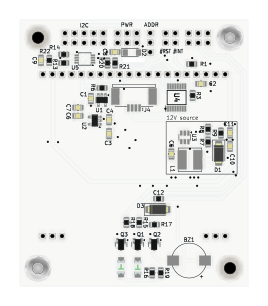
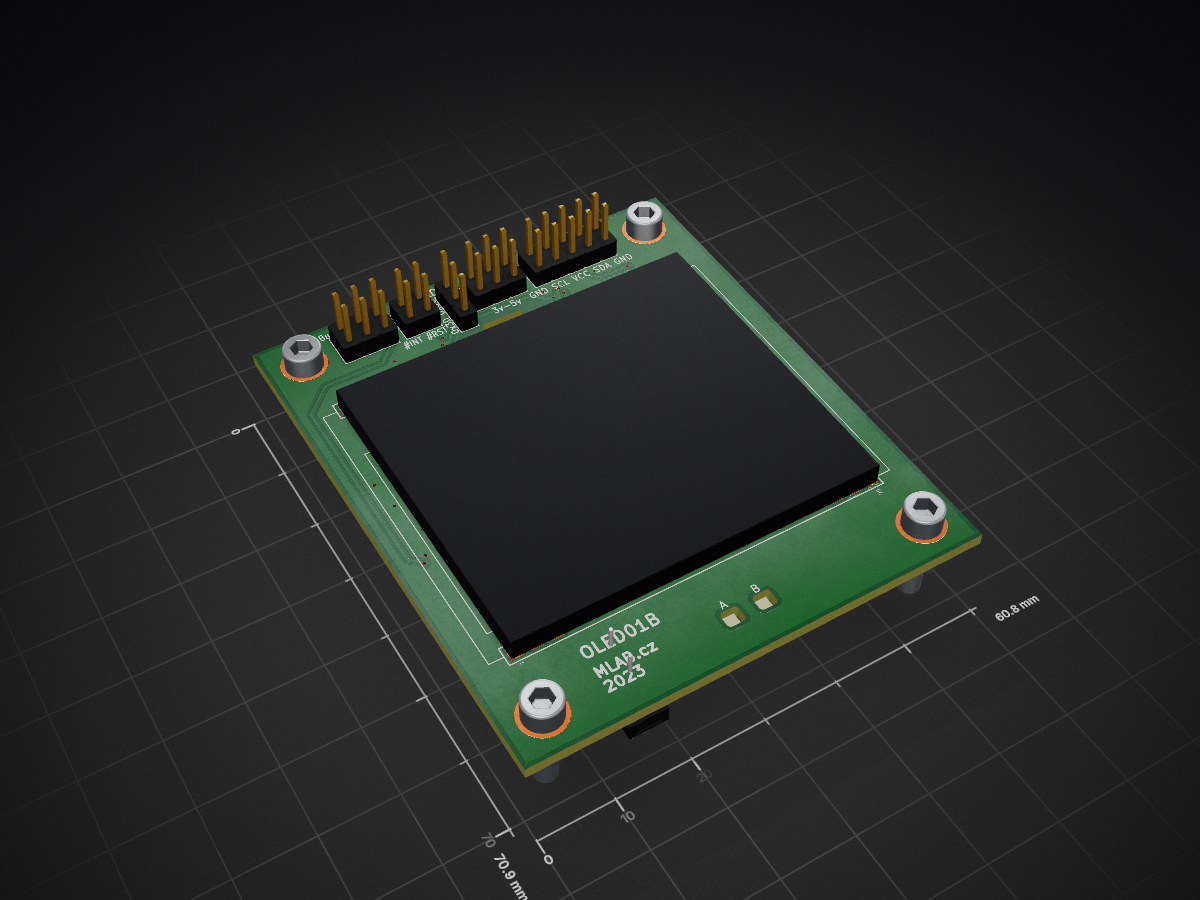
2 layers60.8 × 70.9 mmOLED01, the printed circuit board in 3D

OLED module with SSD1306 controller, I2C interface level shifter, integrated buzzer, touchscreen, and LEDs.

Size
60.8 × 70.9 mm
Copper layers
2
Thickness
1.6 mm
Parts
54
Nets
47
Pads
184
Tracks, vias
279, 54
Pours
4
Routed
Yes
KiCad
KiCad 8.0 (file 20240108)
Created
12 May 2022
Updated
13 Apr 2025

Overview

OLED01 is an open-source printed circuit board by mlab-modules, from the mlab-modules/OLED01 repository on GitHub, published under the GPL-3.0 licence. It is a 2-layer board of 60.8 × 70.9 mm with 54 parts on 47 nets, routed with 279 tracks and 54 vias.

It is built around the TLV840EVM, TSC2007IPWG4 and MIC5504-2.5YM5-TR, with the PCA9306DP, BC817-25 and EA OLEDM128-6GGA among its other parts. Its parts include 16 resistors, 12 capacitors, 6 connectors, 5 ICs and 5 diodes. It belongs with the lEDs and displays and interfaces and adapters boards of this library.

Main components

9

README

README.md

OLED01 - OLED Display Touchscreen with I2C interface

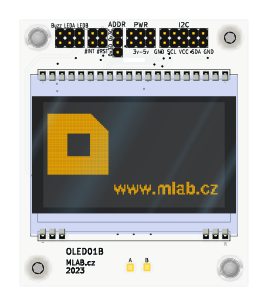
The OLED01 is an MLAB module, designed for using OLED displays, specifically the EA OLEDM128-6GGA built around the SSD1306 controller, this module communicates using the I2C protocol. The module's design uses standard MLAB headers and an internal 12V power supply, for powering the OLED display. This module provides a solution for integrating high-contrast OLED displays into various systems.

An important feature of the OLED01 module is the integrated I2C level converter, which can operate within a 3-5V power supply and signal range. The OLED01 also incorporates a pair of LEDs and a buzzer, driven by an integrated transistor and it is equipped with a reset circuit to ensure proper clear display initialization after power-up.

Design
OLED01 OLED01

The OLED01 module is designed to promote user-friendly integration and durability. Its compact form factor allows for easy placement within diverse hardware configurations, and the robust construction assures longevity. The contained OLED display delivers a resolution of 128x64 pixels with high-contrast visual output.

Touchscreen Support

The OLED01 module supports 4-wire resistive touchscreens through integration with the TSC2007 touch controller. This I2C-based controller enables position and pressure detection with 12-bit resolution, low power consumption, and internal preprocessing for noise reduction. The PENIRQ output allows interrupt-based touch event detection.

This expands the module's usability for interactive user interfaces in embedded systems.

Specifications

  • Interface: I2C
  • Touchscreen Support: 4-wire resistive touchscreen interface via TSC2007 (I2C, 12-bit ADC)
  • Power Supply: 3-5V operational range for I2C, Internal 12V supply for OLED
  • Display: 128x64 pixels resolution
  • Additional Features: Pair of LEDs and buzzer driven by integrated transistor by external GPIO
  • Reset Circuit: Included for proper initialization of the OLED display

Possible Applications

The OLED01 module's versatility allows for use in a wide range of applications:

  1. Industrial Control Systems: The robustness and clarity of the OLED display, coupled with the additional buzzer and LED indicators, make this module a top choice for control panels in industrial machinery and robotics.
  2. Automotive Systems: The OLED01 can serve as an interface for vehicle systems, providing clear and sharp visual output under various lighting conditions.
  3. Experimental Projects and Prototyping: The module's easy integration through MLAB headers and broad compatibility with the I2C interface make it suitable for experimental electronics projects, prototyping, and educational applications.

Schematics

Schematics

Usage examples

Parts

54
QtyValueFootprintReferences
510kResistor_SMD:R_0805_2012MetricR6, R13, R14, R20, R21
41uFCapacitor_SMD:C_0805_2012MetricC3, C6, C10, C11
4M3Mlab_Mechanical:MountingHole_3mmH1, H2, H3, H4
3BC817-25Package_TO_SOT_SMD:SOT-23Q1, Q2, Q3
3C_SmallCapacitor_SMD:C_0805_2012MetricC1, C4, C7
210uFCapacitor_SMD:C_0805_2012MetricC5, C8
220kResistor_SMD:R_0805_2012MetricR15, R18
2HEADER_2x03_PARALLELMlab_Pin_Headers:Straight_2x03J1, J2
2RResistor_SMD:R_0805_2012MetricR16, R19
1100RResistor_SMD:R_0805_2012MetricR9
1100nFCapacitor_SMD:C_0805_2012MetricC9
110uFResistor_SMD:R_0805_2012MetricC12
11A 20V 15MQ040NDiode_SMD:D_SMAD1
12.2uFCapacitor_SMD:C_0805_2012MetricC2
1200kResistor_SMD:R_0805_2012MetricR22
1220RResistor_SMD:R_0805_2012MetricR17
133RResistor_SMD:R_0805_2012MetricR3
14.7uHInductor_SMD:L_Bourns_SRN6045TAL1
173k2Resistor_SMD:R_0805_2012MetricR7
18k2Resistor_SMD:R_0805_2012MetricR8
1910kResistor_SMD:R_0805_2012MetricR1
1BZV55C-5,6VDiode_SMD:D_MiniMELFD2
1Conn_01x04_ShieldedMlab_CON:EA_WF100-04SJ4
1EA_OLEDM128-6Mlab_DISPLAY:EA_OLEDM128-6GGADISP1
1HEADER_1x03Mlab_Pin_Headers:Straight_1x03J5
1HEADER_2x01_PARALLELMlab_Pin_Headers:Straight_2x02J3
1HEADER_2x05_PARALLELMlab_Pin_Headers:Straight_2x05J6
1KPTR-3216CGCKMlab_D:LED_1206_2D5
1KPTR-3216SURCKMlab_D:LED_1206_2D4
1LET9032ES-03L-2.7-16-RMLAB_BUZZER:MagneticBuzzer_LET9032ES-03L-2.7-16-RBZ1
1M4Diode_SMD:D_SMAD3
1MAX5026Package_TO_SOT_SMD:TSOT-23-6U3
1MIC5504-2.5YM5Package_TO_SOT_SMD:SOT-23-5U2
1PCA9306DPPackage_SO:TSSOP-8_3x3mm_P0.65mmU5
1TLV840Package_TO_SOT_SMD:SOT-23-5U1
1TSC2007IPWG4Mlab_IO:SOP65P640X120-16NU4

Questions

How big is the OLED01 PCB?

It measures 60.8 × 70.9 mm and has 2 copper layers, 1.6 mm thick.

What parts does the OLED01 use?

54 parts, built around the TLV840EVM, TSC2007IPWG4, MIC5504-2.5YM5-TR and PCA9306DP. The full list of its parts is on this page, with links to each part's symbol and footprint where PCBKit's library has them.

Where can I download the OLED01 KiCad files?

From the mlab-modules/OLED01 repository on GitHub, at the commit this page was made from: the board is hw/sch_pcb/OLED01.kicad_pcb and its schematic hw/sch_pcb/OLED01.kicad_sch. PCBKit opens the board in the browser, with nothing to install.

Can I use the OLED01 design in my own project?

Its repository publishes it under the GPL-3.0 licence: you may reuse it on that licence's terms (keep the author's notice, and for a copyleft licence share your changes alike).

Similar boards

  • 4 layers51 × 44.3 mmOrion1, the printed circuit board in 3D

    Orion1

    kanha2907/Gps-using-neom9n-

    Compact GPS breakout board based on the u-blox NEO-M9N module. Includes support circuitry for battery-backed operation, LEDs, and passives—designed for low-power embedded GPS applications.

    70 parts
  • 2 layers37.5 × 19 mmTFRPM01, the printed circuit board in 3D

    TFRPM01

    ThunderFly-aerospace/TFRPM01

    Revolutions per minute (RPM) meter for UAV, rotors, wheels and engines.

    28 parts9GPL-3.0
  • 2 layers70.6 × 50.3 mmTFUNIPAYLOAD01, the printed circuit board in 3D

    TFUNIPAYLOAD01

    ThunderFly-aerospace/TFUNIPAYLOAD01

    Universal interface for TF-ATMON sensor payload.

    81 parts1GPL-3.0
  • 2 layers85 × 38.2 mmProgrammer Sensor Stencil, the printed circuit board in 3D

    Programmer Sensor Stencil

    MichalVarsanyi/VoxLink

    VoxLink is a high-speed solution that allows interfacing of up to 100 sensors using a single high-speed host device.

    152 parts1MIT
  • 2 layers40.1 × 30 mmBLE02, the printed circuit board in 3D

    BLE02

    mlab-modules/BLE02

    Bluetooth 4.1 controller for UART HCI-based BLE and BR/EDR communication with external host MCU.

    41 partsGPL-3.0
  • 2 layers101.1 × 60.5 mmDATALOGGER02, the printed circuit board in 3D

    DATALOGGER02

    mlab-modules/DATALOGGER02

    Arduino based data logger with LoRa IoT interface.

    161 partsGPL-3.0
  • 2 layers20 × 35 mmKiCAD ICOM Internal GPS, the printed circuit board in 3D

    KiCAD ICOM Internal GPS

    MSF-Telecom/UT-GPS

    A small, internal, and open-source GPS module for ICOM IC-5060 and IC-6060 radios.

    30 partsCC-BY-SA-4.0
  • 2 layers65 × 56.5 mmLtp kikad, the printed circuit board in 3D

    Ltp kikad

    ADDTDR/Pitanga

    Prototype 0.01 | Pitanga V1 | Pitanga V2.1a :-------------------------:|:-------------------------:|:-------------------------: | |

    54 parts4MIT