
4 layers58.9 × 48.4 mm
Apppd
chithigun23/ANUFS-APPPD
An update to the Accelerator Pedal Position Plausibility Device to remain compliant with the use of a paddle shift system.
103 parts

HomeKey-ESP32-PCB A miniaturized, wall-mountable HomeKey reader board
Homekey is an open-source printed circuit board by lollokara, from the lollokara/HomeKey-ESP32-PCB repository on GitHub. It is a 2-layer board of 41.6 × 47.3 mm with 71 parts on 73 nets, routed with 468 tracks and 149 vias.
It is built around the ESP32-C3-WROOM-02-H4, TLV75533PDRV and PMEG2010BER. Its parts include 33 capacitors, 15 resistors, 4 ICs, 3 diodes and 3 connectors. It belongs with the ESP32 and RISC-V boards of this library.


A miniaturized, wall-mountable HomeKey reader board
A custom PCB implementation of rednblkx/HomeKey-ESP32 that brings Apple HomeKey NFC unlocking into a form factor small enough to hide behind your existing wall plate.

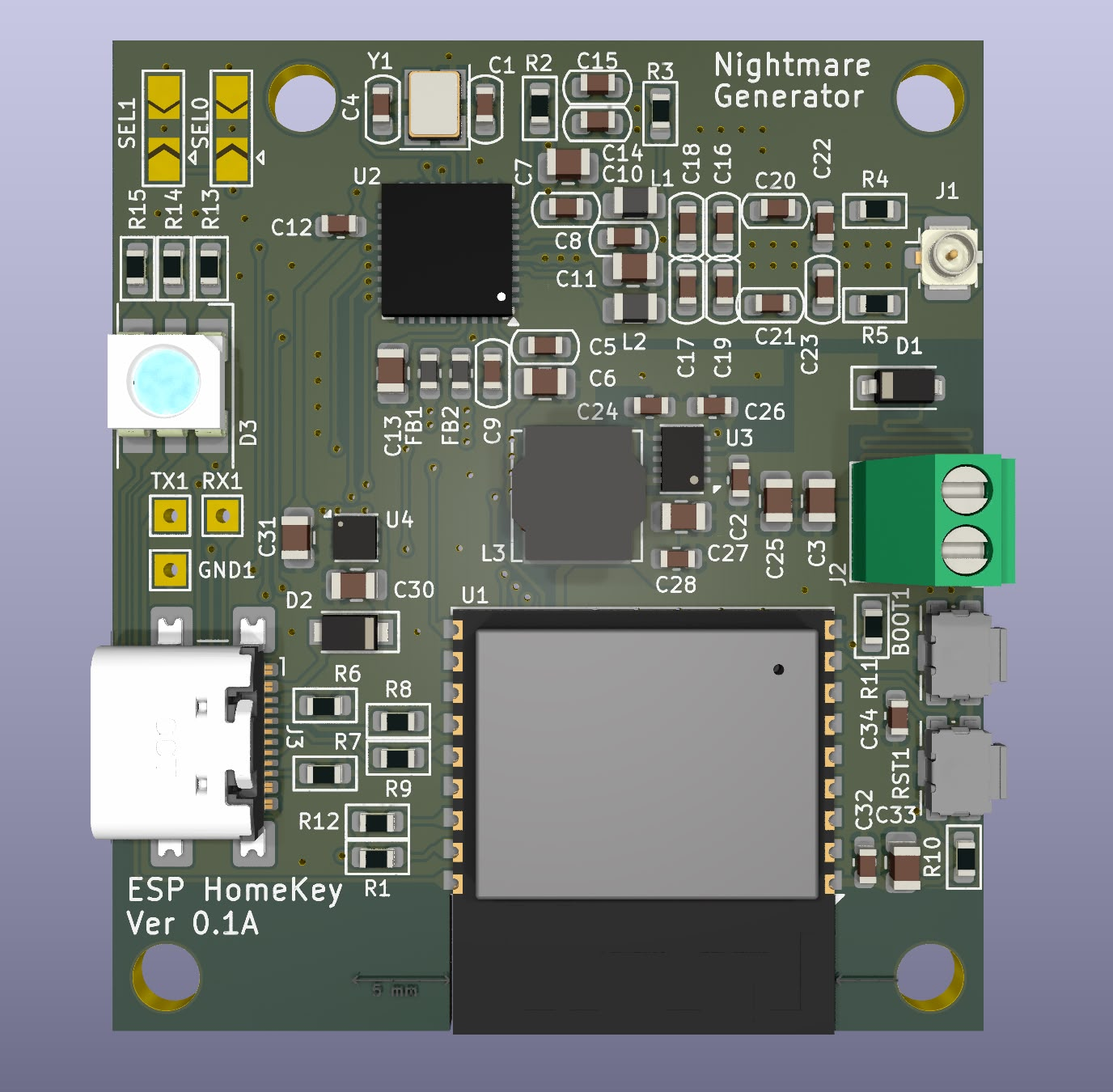
This project is a hardware redesign of the excellent HomeKey-ESP32 firmware by @rednblkx. Instead of using a separate development board wired to a breakout PN532 module, everything is integrated onto a single, compact PCB.
The board packs an ESP32-C3 and an NFC reader front-end with an on-board coaxial NFC antenna into a footprint designed to fit inside a European 503 (3-module) flush-mount wall box. This lets you install a fully functional Apple HomeKey reader directly behind a standard wall plate — no external modules, no messy wiring.
Don't want to fabricate it yourself? You can order the PCB directly from PCBWay:
The entire board is designed with KiCad, so the complete hardware source is open and editable. The repository includes:
Homekey.kicad_sch, ESP32.kicad_sch, NFC.kicad_sch, Power.kicad_sch, Square.kicad_sch)Homekey.kicad_pcb) and project file (Homekey.kicad_pro)Homekey.pdf)Homekey.xlsx)Homekey 3D.step.zip)You can open the project directly in KiCad to review, modify, or re-fabricate the board.
HomeKey-ESP32-PCB/
├── Firmware/              # HomeKey-ESP32 firmware (based on the original repo)
├── Gerbers/               # Fabrication-ready Gerber files
├── ESP32.kicad_sch        # ESP32-C3 subsheet
├── NFC.kicad_sch          # NFC front-end + antenna subsheet
├── Power.kicad_sch        # Power supply subsheet
├── Square.kicad_sch       # Additional subsheet
├── Homekey.kicad_sch      # Top-level schematic
├── Homekey.kicad_pcb      # PCB layout
├── Homekey.kicad_pro      # KiCad project file
├── Homekey.pdf            # Schematic (PDF export)
├── Homekey.xlsx           # Bill of Materials
├── Homekey-job.gbrjob     # Gerber job file
├── Homekey 3D.step.zip    # 3D model of the board
├── Homekey-3D-render.png  # 3D render of the assembled board
└── README.mdGerbers folder with your preferred PCB fab house.Homekey.xlsx for the Bill of Materials and Homekey.pdf for the schematic.Homekey.kicad_pro in KiCad.The board runs the standard HomeKey-ESP32 firmware. The Firmware folder contains a build based on the original repository.
# Install esptool (one-time setup)
pip install esptool

# Flash the firmware (replace YOUR_PORT)
esptool.py --port YOUR_PORT write_flash 0x0 firmware.factory.bin
Prefer a GUI? Use the browser-based flasher — no command line needed.
For firmware configuration, pairing, and usage, follow the official documentation:
This project is licensed under the MIT License — see the LICENSE file for details.
This project implements Apple HomeKey functionality through reverse engineering.
| Qty | Value | Footprint | References |
|---|---|---|---|
| 10 | 10uF | Capacitor_SMD:C_0805_2012Metric | C3, C6, C10, C11, C13, C25, C27, C30, C31, C33 |
| 5 | 100nF | Capacitor_SMD_AKL:C_0603_1608Metric | C5, C7, C8, C9, C14 |
| 4 | 100nF | Capacitor_SMD:C_0603_1608Metric | C2, C12, C28, C32 |
| 4 | 10K | Resistor_SMD_AKL:R_0603_1608Metric | R1, R10, R11, R12 |
| 4 | 22pF | Capacitor_SMD_AKL:C_0603_1608Metric | C1, C4, C20, C21 |
| 3 | TestPoint | TestPoint:TestPoint_THTPad_1.5x1.5mm_Drill0.7mm | GND1, RX1, TX1 |
| 2 | 1R5 1% | Resistor_SMD_AKL:R_0603_1608Metric | R4, R5 |
| 2 | 1uF | Capacitor_SMD:C_0603_1608Metric | C26, C34 |
| 2 | 220R@100Mhz | Inductor_SMD:L_0603_1608Metric | FB1, FB2 |
| 2 | 220pF | Capacitor_SMD_AKL:C_0603_1608Metric | C16, C17 |
| 2 | 22R 1% | Resistor_SMD_AKL:R_0603_1608Metric | R8, R9 |
| 2 | 560nH | Inductor_SMD:L_0805_2012Metric | L1, L2 |
| 2 | 5K1 1% | Resistor_SMD_AKL:R_0603_1608Metric | R6, R7 |
| 2 | 75R | Resistor_SMD_AKL:R_0603_1608Metric | R13, R15 |
| 2 | CK_KMS2xxG | Button_Switch_SMD:SW_SPST_CK_KMS2xxGP | BOOT1, RST1 |
| 2 | NC | Capacitor_SMD_AKL:C_0603_1608Metric | C18, C19 |
| 1 | 100pF | Capacitor_SMD:C_0603_1608Metric | C22 |
| 1 | 100pF | Capacitor_SMD_AKL:C_0603_1608Metric | C23 |
| 1 | 150R | Resistor_SMD_AKL:R_0603_1608Metric | R14 |
| 1 | 1K 1% | Resistor_SMD_AKL:R_0603_1608Metric | R2 |
| 1 | 1K69 1% | Resistor_SMD_AKL:R_0603_1608Metric | R3 |
| 1 | 1nF | Capacitor_SMD_AKL:C_0603_1608Metric | C15 |
| 1 | 1nF | Capacitor_SMD:C_0603_1608Metric | C24 |
| 1 | 27.12MHz | Crystal:Crystal_SMD_3225-4Pin_3.2x2.5mm | Y1 |
| 1 | 330uH | Inductor_SMD:L_Bourns_SRN6045TA | L3 |
| 1 | ESP32-C3-WROOM-02 | RF_Module:ESP32-C3-WROOM-02 | U1 |
| 1 | Hirose | Connector_Coaxial:U.FL_Hirose_U.FL-R-SMT-1_Vertical | J1 |
| 1 | Inolux_IN-P55TATRGB | LED_SMD:LED_Inolux_IN-P55TATRGB_PLCC6_5.0x5.5mm_P1.8mm | D3 |
| 1 | MAX17501AxTB | Package_DFN_QFN:TDFN-10-1EP_2x3mm_P0.5mm_EP0.9x2mm | U3 |
| 1 | MBR0570 | Diode_SMD:D_SOD-123 | D1 |
| 1 | PMEG2010BER | Diode_SMD:Nexperia_CFP3_SOD-123W | D2 |
| 1 | PN5321A3HN_C1xx | Package_DFN_QFN:HVQFN-40-1EP_6x6mm_P0.5mm_EP4.1x4.1mm | U2 |
| 1 | SEL0 | Jumper:SolderJumper-3_P2.0mm_Open_TrianglePad1.0x1.5mm | SEL0 |
| 1 | SEL1 | Jumper:SolderJumper-3_P2.0mm_Open_TrianglePad1.0x1.5mm | SEL1 |
| 1 | Screw_Terminal_01x02 | TerminalBlock_Phoenix:TerminalBlock_Phoenix_MPT-0,5-2-2.54_1x02_P2.54mm_Horizontal | J2 |
| 1 | TLV75533PDRV | Package_SON:WSON-6-1EP_2x2mm_P0.65mm_EP1x1.6mm | U4 |
| 1 | USB_C_Receptacle_USB2.0_16P | Connector_USB:USB_C_Receptacle_GCT_USB4110 | J3 |
chithigun23/ANUFS-APPPD
An update to the Accelerator Pedal Position Plausibility Device to remain compliant with the use of a paddle shift system.

chithigun23/ANUFS-Telemetry
To use custom hardware to measure parameters and dynamics of an ICE Formula SAE car.

DEV-ajthedj/memboard
A custom development board aimed at maximizing the RAM of an RP2350A.

dosdude1/2.5-inch-ide-ssd
A custom-designed IDE SSD for use in any machine that utilizies a 2.5" IDE hard disk.

teklabsdigital/TekTag
Biosensor for telehealth, patient monitoring, fall detection, dementia geofencing and cardiograms

mikelawrence/esphome-indoor-multi-sensor-hardware
ESPHome Indoor Multi-Sensor hardware. This design supports Radar/PIR Presence, Temperature, Humidity, Pressure, Light, CO2, CO, VOC, NOX and PM sensors.

JeffersonSchostakovich/halowBoards
MM8108-based adapters in different form factors for EU availability of sub-GHz halow 802.11ah hardware - mainly for decentralised networking (Reticulum mesh) and distributed IoT experimentation purposes.

mimok/yast-hw
Hardware source files of the YAST security token from OTS Security
It measures 41.6 × 47.3 mm and has 2 copper layers, 1.6 mm thick.
71 parts, built around the ESP32-C3-WROOM-02-H4, TLV75533PDRV and PMEG2010BER. The full list of its parts is on this page, with links to each part's symbol and footprint where PCBKit's library has them.
From the lollokara/HomeKey-ESP32-PCB repository on GitHub, at the commit this page was made from: the board is Homekey.kicad_pcb and its schematic ESP32.kicad_sch. PCBKit opens the board in the browser, with nothing to install.
Its repository states no licence, so its author keeps all rights: ask lollokara before reusing the design.