Skip to the content
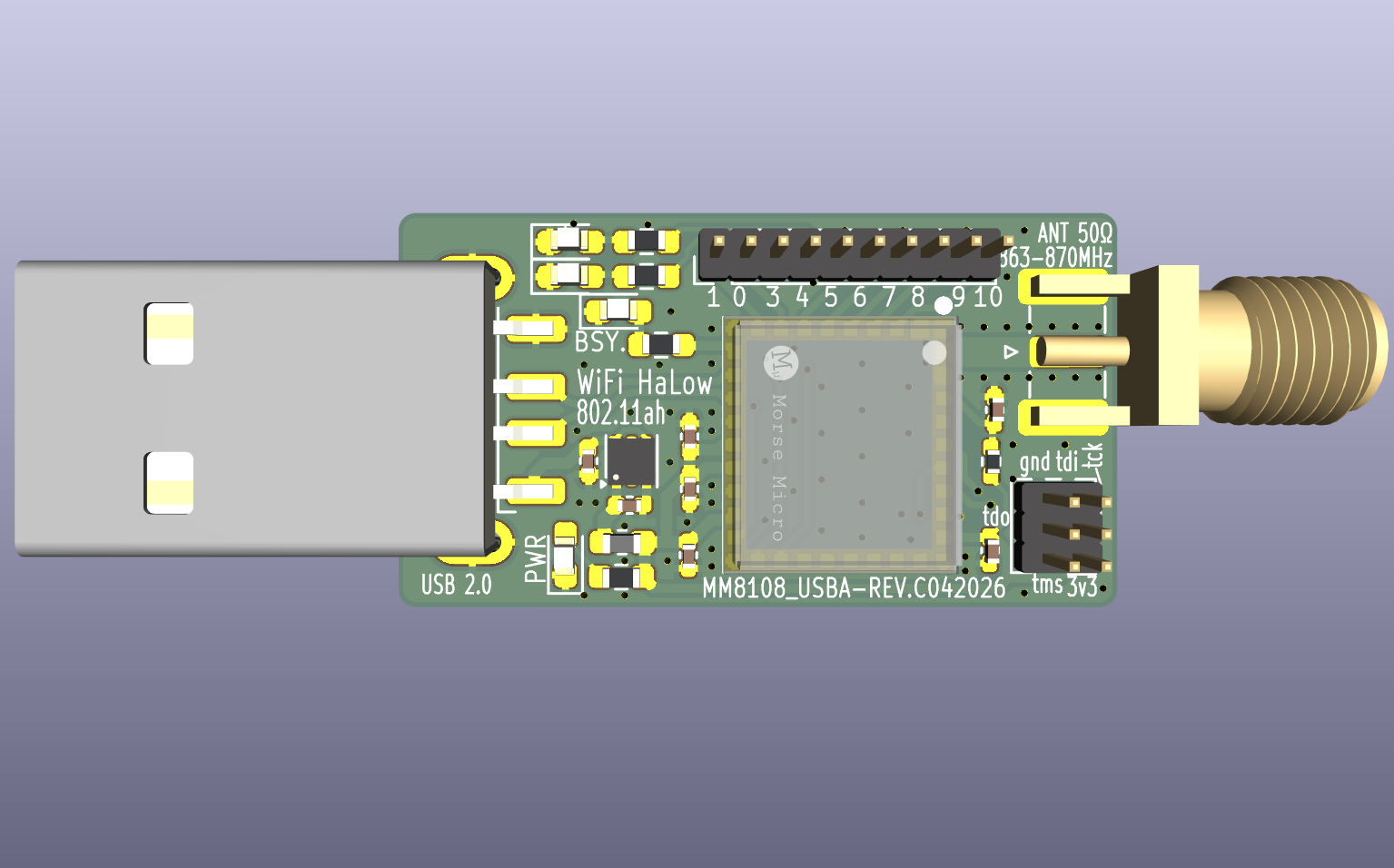
2 layers31 × 17 mmUsbCarrierMM8108, the printed circuit board in 3D

MM8108-based adapters in different form factors for EU availability of sub-GHz halow 802.11ah hardware - mainly for decentralised networking (Reticulum mesh) and distributed IoT experimentation purposes.

Size
31 × 17 mm
Copper layers
2
Thickness
1.6 mm
Parts
23
Nets
36
Pads
131
Tracks, vias
194, 67
Pours
2
Routed
Yes
KiCad
KiCad 10.0 (file 20260206)
Created
13 Apr 2026
Updated
13 Apr 2026

Overview

UsbCarrierMM8108 is an open-source printed circuit board by JeffersonSchostakovich, from the JeffersonSchostakovich/halowBoards repository on GitHub. It is a 2-layer board of 31 × 17 mm with 23 parts on 36 nets, routed with 194 tracks and 67 vias.

It is built around the MM8108-MF15457 and TLV75533PDRV. Its parts include 7 capacitors, 5 resistors, 4 diodes, 4 connectors and 2 ICs. It belongs with the computers and single-board computers boards of this library.

Main components

2

README

README.md

MM8108 Carrier Platform (Wi-Fi HaLow)

Low-cost experimental hardware platform for Morse Micro MM8108 Wi-Fi HaLow (802.11ah) modules.
USB-A carrier board is the current reference design, with additional form factors planned (M.2, USB-C/PCIe, HAT-style).

Focus: cost reduction vs official evaluation hardware, wireless networking experimentation, Reticulum mesh comms, IoT/embedded.

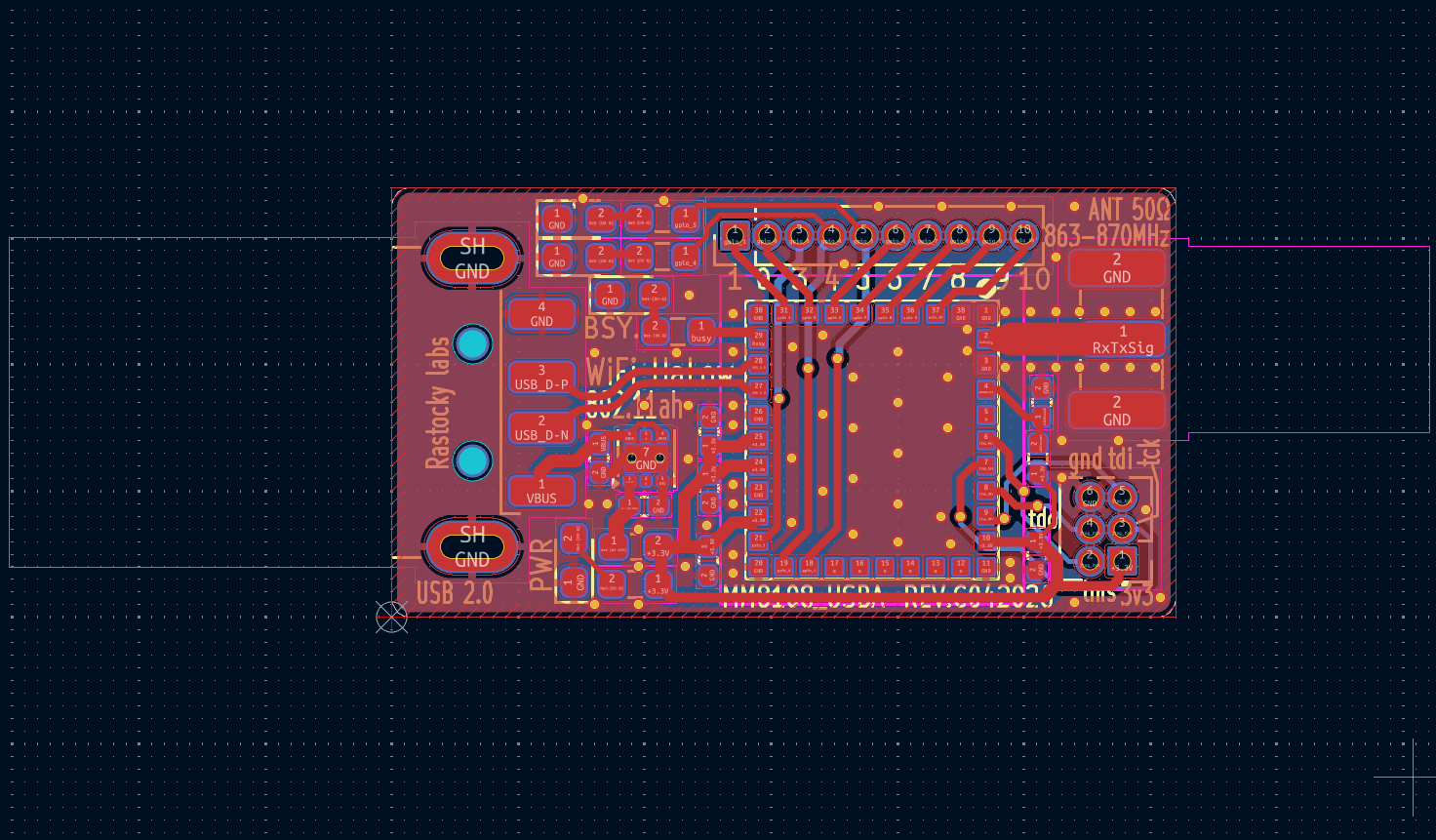
3D ViewLayout

Objectives

  • Reduce cost vs official MM8108 dev kits / dongles
  • Optimize for low-cost PCB fabrication (JLCPCB / PCBWay class vendors)
  • 2-layer 1.6mm FR4 standard stackup
  • Relaxed DFM (large vias, conservative routing constraints)
  • Use widely available low-cost but robust components
  • Maintain compact footprint (depending on form factor USB-A dongle, mini pcie/m.2, RPi hat)
  • Provide expansion access for GPIO and debug experimentation

Current Hardware: USB-A Carrier (usbaCarrierMM8108)

USB-A form-factor carrier board for MM8108 module.

USB-A Carrier (revC)

Features

  • USB-A plug carrier interface
  • On-board power regulation (derated LDO design)
  • Status LEDs mapped to GPIO
  • GPIO breakout for future firmware revisions
  • Optional debug-oriented signal breakout (experimental)

Notes (GPIO / Debug / JTAG)

  • Some pins exposed for GPIO and firmware experimentation
  • JTAG functionality is not guaranteed and not officially supported by vendor
  • Routing included for flexibility, reverse engineering, and bring-up scenarios
  • Intended for experimental firmware and hardware exploration use only

Revision History (USB-A Carrier)

  • revA: initial baseline MM8108 carrier design
  • revB: LED GPIO reassignment (GPIO0/1 → GPIO4/5)
  • revC: component sizing increased (0201 → 0402, 0402 → 0603) for assembly robustness and sourcing flexibility

Future Work

Planned additional carrier variants:

  • USB-C / USB-to-PCIe Mini form factor
  • M.2 (Key E / Key B) carrier board
  • Raspberry Pi HAT-style integration
  • Embedded IoT node variants

Repository Structure

  • usbaCarrierMM8108/ – USB-A carrier PCB (active design)
  • libParts/ – shared KiCad libraries
  • manuf/ – fabrication outputs per revision (GERBER, BOM, PnP)
  • future form factors added as separate KiCad projects

Manufacturing Targets

  • 2-layer FR4, 1.6mm
  • low-cost PCB fabs (global vendors)
  • relaxed DFM constraints
  • assembly-friendly but compact component selection (0402 / 0603 preferred)
  • no high-density / advanced process requirements

Application Space

  • Wi-Fi HaLow (802.11ah) experimentation
  • long-range IoT links
  • mesh / decentralized networking (e.g. Reticulum-class systems)
  • embedded wireless prototyping

Status

Active hardware development. USB-A carrier is the current reference implementation.

License

This project is released under the MIT License.

Hardware designs may be used, modified, and manufactured for personal, educational, and commercial purposes.

No warranty is provided.

Disclaimer

This project is an independent hardware design and is not affiliated with Morse Micro.

  • Debug, GPIO, and JTAG-related routing is experimental
  • JTAG functionality is not guaranteed and not officially supported
  • Some signals are exposed for firmware experimentation and hardware bring-up
  • Use at your own risk

Hardware Intent Summary

Low-cost experimental Wi-Fi HaLow (802.11ah) hardware platform for embedded IoT and decentralized networking research.

Parts

23
QtyValueFootprintReferences
410uCapacitor_SMD:C_0402_1005Metric_Pad0.74x0.62mm_HandSolderC2, C3, C4, C5
4LEDLED_SMD:LED_0201_0603Metric_Pad0.64x0.40mm_HandSolderD1, D2, D3, D4
3560RResistor_SMD:R_0201_0603Metric_Pad0.64x0.40mm_HandSolderR6, R7, R8
21uCapacitor_SMD:C_0402_1005Metric_Pad0.74x0.62mm_HandSolderC6, C7
11000 Ohm@100MHzInductor_SMD:L_0402_1005Metric_Pad0.77x0.64mm_HandSolderFB1
1220kResistor_SMD:R_0201_0603Metric_Pad0.64x0.40mm_HandSolderR1
12u2Capacitor_SMD:C_0402_1005Metric_Pad0.74x0.62mm_HandSolderC1
1470RResistor_SMD:R_0201_0603Metric_Pad0.64x0.40mm_HandSolderR5
1Conn_01x10_PinConnector_PinHeader_1.27mm:PinHeader_1x10_P1.27mm_VerticalJ4
1Conn_02x03_Odd_EvenConnector_PinHeader_1.27mm:PinHeader_2x03_P1.27mm_VerticalJ3
1Conn_Coaxial_SmallConnector_Coaxial:SMA_Samtec_SMA-J-P-H-ST-EM1_EdgeMountJ2
1MM8108-MF15457MM8108_myFpLib:MM8108MF15457IC1
1TLV75533PDRVPackage_SON:WSON-6-1EP_2x2mm_P0.65mm_EP1x1.6mm_ThermalViasU2
1USB_AConnector_USB:USB_A_CNCTech_1001-011-01101_HorizontalJ1

More from JeffersonSchostakovich/halowBoards

1
  • 2 layers31 × 17 mmUsbaCarrierMM8108 revC, the printed circuit board in 3D

    UsbaCarrierMM8108 revC

    JeffersonSchostakovich/halowBoards

    MM8108-based adapters in different form factors for EU availability of sub-GHz halow 802.11ah hardware - mainly for decentralised networking (Reticulum mesh) and distributed IoT experimentation purposes.

    23 parts8

Similar boards

  • 6 layers76 × 56 mmCM4 MANET, the printed circuit board in 3D

    CM4 MANET

    ties1887/Mesh-radio-Halow-LoRa

    Modular mesh radio system using Raspberry Pi + HaLow (802.11ah) + LoRa.

    122 parts40
  • 2 layers26.4 × 39.2 mmMM8108-Dev Kit, the printed circuit board in 3D

    MM8108-Dev Kit

    CSutter5/MM8108-Dev-Kit

    32 partsMIT
  • 4 layers26 × 30 mmDay 01 Wi Fi Halow, the printed circuit board in 3D

    Day 01 Wi Fi Halow

    i2cjak/Framework_Expansion_Cards

    In which i2cjak creates a new expansion card design every day until he is given a NICE Framework laptop

    21 parts95CERN-OHL-P-2.0
  • 4 layers65 × 49.8 mm2.5in IDE SSD no lengthmatch, the printed circuit board in 3D

    2.5in IDE SSD no lengthmatch

    dosdude1/2.5-inch-ide-ssd

    A custom-designed IDE SSD for use in any machine that utilizies a 2.5" IDE hard disk.

    91 parts334GPL-3.0
  • 2 layers41.6 × 47.3 mmHomekey, the printed circuit board in 3D

    Homekey

    lollokara/HomeKey-ESP32-PCB

    HomeKey-ESP32-PCB A miniaturized, wall-mountable HomeKey reader board

    71 parts20
  • 6 layers26 × 25 mmTektag, the printed circuit board in 3D

    Tektag

    teklabsdigital/TekTag

    Biosensor for telehealth, patient monitoring, fall detection, dementia geofencing and cardiograms

    93 parts18
  • 4 layers52.5 × 59.7 mmESPHome Indoor Multi Sensor, the printed circuit board in 3D

    ESPHome Indoor Multi Sensor

    mikelawrence/esphome-indoor-multi-sensor-hardware

    ESPHome Indoor Multi-Sensor hardware. This design supports Radar/PIR Presence, Temperature, Humidity, Pressure, Light, CO2, CO, VOC, NOX and PM sensors.

    113 parts14CERN-OHL-P-2.0
  • 2 layers46 × 15.2 mmTots, the printed circuit board in 3D

    Tots

    mimok/yast-hw

    Hardware source files of the YAST security token from OTS Security

    29 parts6CC-BY-4.0

Questions

How big is the UsbCarrierMM8108 PCB?

It measures 31 × 17 mm and has 2 copper layers, 1.6 mm thick.

What parts does the UsbCarrierMM8108 use?

23 parts, built around the MM8108-MF15457 and TLV75533PDRV. The full list of its parts is on this page, with links to each part's symbol and footprint where PCBKit's library has them.

Where can I download the UsbCarrierMM8108 KiCad files?

From the JeffersonSchostakovich/halowBoards repository on GitHub, at the commit this page was made from: the board is usbaCarrierMM8108/manuf/042026_rev-B/usbCarrierMM8108.kicad_pcb and its schematic usbaCarrierMM8108/manuf/042026_rev-A/usbCarrierMM8108_rev-A042026.kicad_sch. PCBKit opens the board in the browser, with nothing to install.

Can I use the UsbCarrierMM8108 design in my own project?

Its repository states no licence, so its author keeps all rights: ask JeffersonSchostakovich before reusing the design.