6 layers149.4 × 124.8 mm
Low noise power probe panel
blinken/power-rail-probe
Low-noise oscilloscope power rail probe
245 parts101

 Ledger-Donjon/curmea2
To analyze the power consumption of a component, it is common to measure the current going to the ground by placing a small resistor and measuring the voltage across it.
Curmea is an open-source printed circuit board by Ledger-Donjon, from the Ledger-Donjon/curmea repository on GitHub, published under the LGPL-3.0 licence. It is a 2-layer board of 48.8 × 18.5 mm with 30 parts on 27 nets, routed with 132 tracks and 51 vias.
It is built around the ADP7142AUJZ-2.5-R7 and ADP7182AUJZ-2.5-R7. Its parts include 10 capacitors, 7 resistors, 5 ICs, 3 connectors and 2 diodes.

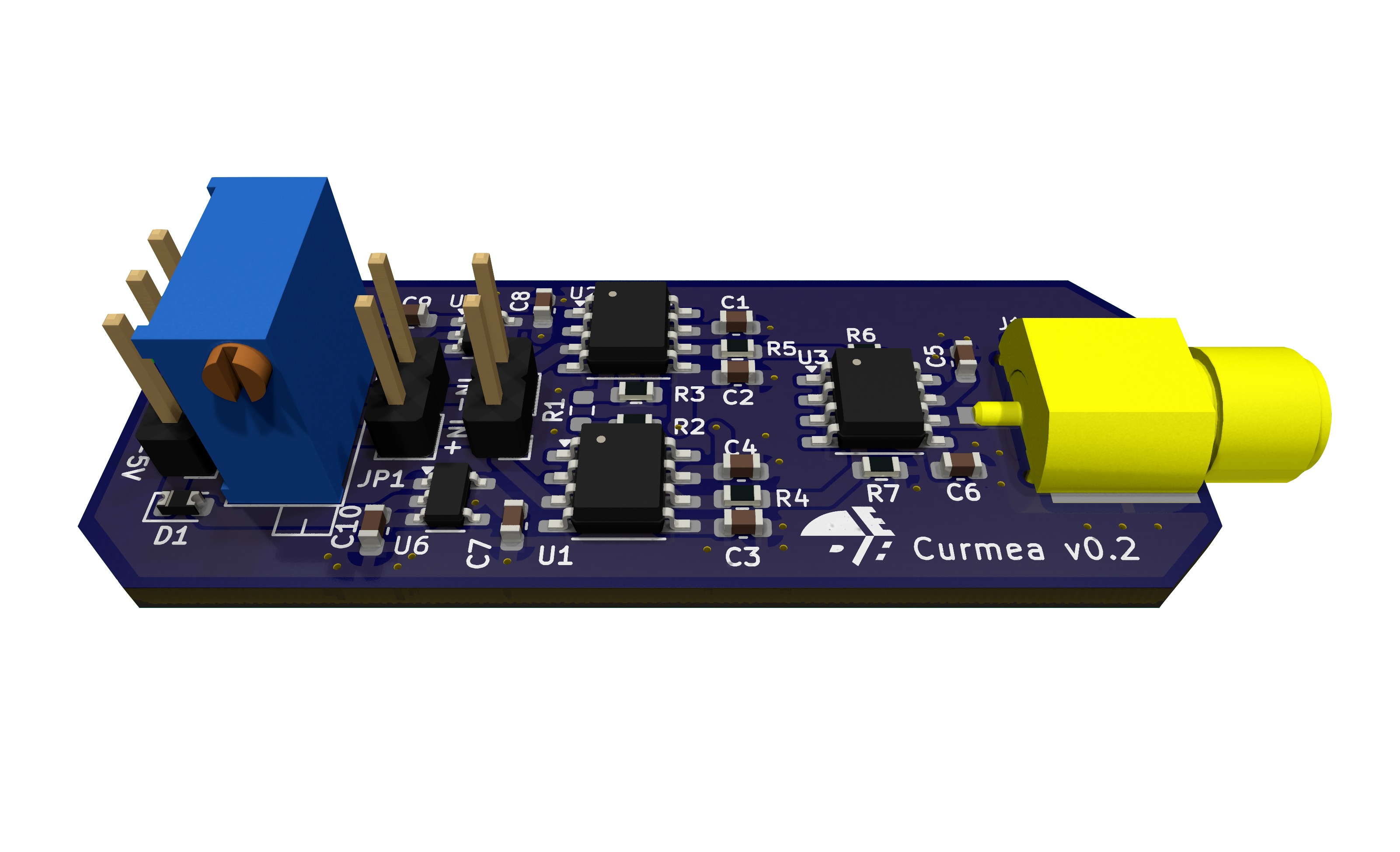 Curmea (for current measurement) is an open-source hardware power analysis device, designed for hardware security research.
To analyze the power consumption of a component, it is common to measure the current going to the ground by placing a small resistor and measuring the voltage across it. However, when the component cannot be isolated from the entire system, it can be challenging to obtain a direct line from the component to the ground without interference from other components. Additionally, the component itself may have multiple ground lines, causing the current to split into several paths.
Some electronic configurations of devices gives a simplier access from the power supply pin of the component. The tradeoff of this configuration is that a differential probe is needed and the input voltage is reduced by the input resistor.
The board is based on the Instrumentation amplifier coupled with low-dropout regulators to power supply the amplifiers at -2.5v to 2.5v range.
This work is currently in progress and not fully tested and optimized.
Curmea is released under GNU Lesser General Public Licence version 3 (LGPLv3). See COPYING and COPYING.LESSER for license details.
| Qty | Value | Footprint | References |
|---|---|---|---|
| 6 | 100n | Capacitor_SMD:C_0603_1608Metric | C1, C2, C3, C4, C5, C6 |
| 6 | 1k | Resistor_SMD:R_0603_1608Metric | R2, R3, R4, R5, R6, R7 |
| 4 | 10uF | Capacitor_SMD:C_0603_1608Metric | C7, C8, C9, C10 |
| 3 | LTC6268xS8-10 | Package_SO:SO-8_3.9x4.9mm_P1.27mm | U1, U2, U3 |
| 2 | D | Diode_SMD:D_0603_1608Metric | D1, D2 |
| 1 | ADP7142AUJZ-2.5 | Package_TO_SOT_SMD:TSOT-23-5 | U7 |
| 1 | ADP7182AUJZ-2.5 | Package_TO_SOT_SMD:TSOT-23-5 | U6 |
| 1 | Conn_01x02_Pin | Connector_PinHeader_2.54mm:PinHeader_1x02_P2.54mm_Vertical | J3 |
| 1 | Conn_01x03_Pin | Connector_PinHeader_2.54mm:PinHeader_1x03_P2.54mm_Vertical | J5 |
| 1 | Conn_Coaxial | SAMTECSMA:SAMTEC_SMA_J_P_H_ST_EM3 | J1 |
| 1 | Jumper_2_Open | Connector_PinHeader_2.54mm:PinHeader_1x02_P2.54mm_Vertical | JP1 |
| 1 | LOGO | logo:DonjonLogo-4x3 | G*** |
| 1 | OPT | Resistor_SMD:R_0603_1608Metric | R1 |
| 1 | R_Potentiometer_Trim | Potentiometer_THT:Potentiometer_Bourns_3296X_Horizontal | RV1 |
blinken/power-rail-probe
Low-noise oscilloscope power rail probe


es-ude/eeg-hardware
Repo of the Custom Hardware Design Files of the EEG-based Gaming Controller

amonbenson/expad
A four-jack USB MIDI adapter for expression and sustain pedals, built on a Raspberry Pi Pico 2 W. It works out what is plugged into each jack - whichever contact a pedal's wiper is on, and whether it is a potentiometer…


martijnschouten/tiepielcr-hardware
Contains the design files of the TiePieLCR multi-frequency spectrometer front-end


google/mozc-devices
Circuit diagrams and firmware source code for Gboard DIY keyboards
It measures 48.8 × 18.5 mm and has 2 copper layers, 1.6 mm thick.
30 parts, built around the ADP7142AUJZ-2.5-R7 and ADP7182AUJZ-2.5-R7. The full list of its parts is on this page, with links to each part's symbol and footprint where PCBKit's library has them.
From the Ledger-Donjon/curmea repository on GitHub, at the commit this page was made from: the board is Curmea.kicad_pcb and its schematic Curmea.kicad_sch. PCBKit opens the board in the browser, with nothing to install.
Its repository publishes it under the LGPL-3.0 licence: you may reuse it on that licence's terms (keep the author's notice, and for a copyleft licence share your changes alike).