Skip to the content
2 layers71.7 × 65.2 mmSensor tmp107, the printed circuit board in 3D

Sensor tmp107

L0czek/rakieta

The starter board provides the ignition impulse to fire the engine. It includes an I2C IO expander and an 8-channel digital comparator to require a correct safety byte/address to be present before firing.

Size
71.7 × 65.2 mm
Copper layers
2
Thickness
1.6 mm
Parts
18
Nets
12
Pads
56
Tracks, vias
92, 11
Pours
1
Routed
Yes
KiCad
KiCad 9.0 (file 20241229)
Created
24 Jun 2025
Updated
8 Sep 2026

Overview

Sensor tmp107 is an open-source printed circuit board by L0czek, from the L0czek/rakieta repository on GitHub. It is a 2-layer board of 71.7 × 65.2 mm with 18 parts on 12 nets, routed with 92 tracks and 11 vias.

It is built around the MMBT3904. Its parts include 4 resistors, 2 capacitors, 2 diodes, 2 transistors and 2 connectors. It belongs with the sensors and measurement boards of this library.

Main components

1

README

starter/README.md

Starter board

Purpose

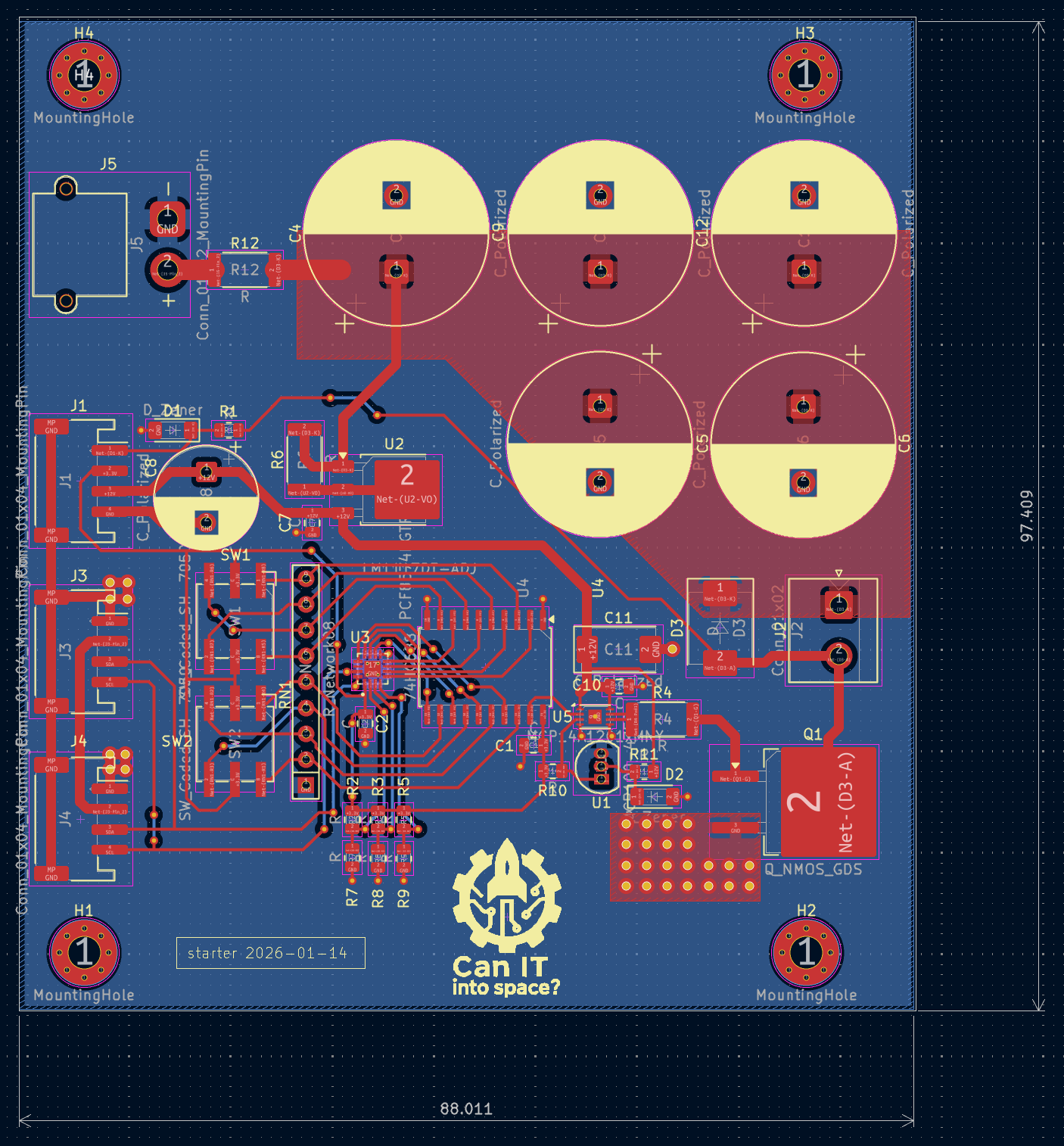
The starter board provides the ignition impulse to fire the engine. It includes an I2C IO expander and an 8-channel digital comparator to require a correct safety byte/address to be present before firing. The rocket engine is fired by discharging a large battery of capacitors via a high power mosfet.

Features

  • Safety: ignition only occurs when the correct I2C address/byte is presented to the IO expander. The sent byte is later compared with fixed value that can be set by encoders on PCB.
  • Igniter presence sensing (so an ignition attempt can be inhibited if no igniter detected)
PCB

Parts

18
QtyValueFootprintReferences
4MountingHole_Pad_MPMountingHole:MountingHole_6.4mm_M6H1, H2, H3, H4
210kResistor_SMD:R_0805_2012MetricR3, R4
2200Resistor_SMD:R_0805_2012MetricR1, R2
2DE9_Socket_MountingHolesConnector_Dsub:DSUB-9_Socket_Horizontal_P2.77x2.84mm_EdgePinOffset9.90mm_Housed_MountingHolesOffset11.32mmJ1, J2
2MMBT3904Package_TO_SOT_SMD:SOT-23Q1, Q2
1100nFCapacitor_SMD:C_0805_2012MetricC1
110uFCapacitor_SMD:CP_Elec_4x5.4C2
1LED czerwonyLED_SMD:LED_0805_2012MetricD2
1LED żółtozielonyLED_SMD:LED_0805_2012MetricD1
1LOGOshared:logo10x10G***
1TMP107BIDRlocal:SOIC127P599X175-8NU1

More from L0czek/rakieta

4
  • 2 layers99.1 × 99.1 mmConnector test stand, the printed circuit board in 3D

    Connector test stand

    L0czek/rakieta

    The starter board provides the ignition impulse to fire the engine. It includes an I2C IO expander and an 8-channel digital comparator to require a correct safety byte/address to be present before firing.

    86 parts
  • 4 layers55.7 × 46.4 mmBlackbox, the printed circuit board in 3D

    Blackbox

    L0czek/rakieta

    The starter board provides the ignition impulse to fire the engine. It includes an I2C IO expander and an 8-channel digital comparator to require a correct safety byte/address to be present before firing.

    64 parts
  • 2 layers97.3 × 100.3 mmConnector main computer, the printed circuit board in 3D

    Connector main computer

    L0czek/rakieta

    The starter board provides the ignition impulse to fire the engine. It includes an I2C IO expander and an 8-channel digital comparator to require a correct safety byte/address to be present before firing.

    62 parts
  • 2 layers88.3 × 97.8 mmStarter, the printed circuit board in 3D

    Starter

    L0czek/rakieta

    The starter board provides the ignition impulse to fire the engine. It includes an I2C IO expander and an 8-channel digital comparator to require a correct safety byte/address to be present before firing.

    45 parts

Similar boards

  • 4 layers95 × 55.5 mmEinkPDA keyboard, the printed circuit board in 3D

    EinkPDA keyboard

    TalismanDesign/PocketMage_PDA

    An E-Ink PDA device using the ESP32 S3.

    137 parts2kApache-2.0
  • 4 layers99 × 53.3 mmPSLab, the printed circuit board in 3D

    PSLab

    fossasia/pslab-hardware

    PSLab Hardware Design and Schematics https://pslab.io

    199 parts1.7kApache-2.0
  • 2 layers90 × 25.5 mmBadgeMagic, the printed circuit board in 3D

    BadgeMagic

    fossasia/badgemagic-hardware

    Badge Magic Hardware Board

    525 parts1.5kApache-2.0
  • 4 layers85 × 56 mmPslab mini, the printed circuit board in 3D

    Pslab mini

    fossasia/pslab-mini-hardware

    PSLab Mini Hardware https://pslab.io

    182 parts1.2kApache-2.0
  • 4 layers74.5 × 70.3 mmNest mini v2-drop in pcb, the printed circuit board in 3D

    Nest mini v2-drop in pcb

    iMike78/nest-mini-drop-in-pcb

    Drop-in PCB replacement for the Google Nest Mini v2 with ESP32-S3, ESP32-P4 and optional ESP32-C6. Inspired by Onju Voice and Home Assistant Voice PE.

    229 parts628CERN-OHL-S-2.0
  • 2 layers148 × 84.5 mmPanel daisy, the printed circuit board in 3D

    Panel daisy

    ohmtech-rdi/eurorack-blocks

    Software to Hardware Prototyping for Eurorack using C++, Max/Gen~ or Faust

    259 parts410
  • 4 layers46.8 × 34.8 mmSmartWatch V4, the printed circuit board in 3D

    SmartWatch V4

    Bellafaire/ESP32-Smart-Watch

    An open source smartwatch based on the ESP32 compatible with the Arduino IDE.

    74 parts258MIT
  • 2 layers68.8 × 53.6 mmRelatively Universal ROM Programmer, the printed circuit board in 3D

    Relatively Universal ROM Programmer

    AndersBNielsen/Relatively-Universal-ROM-Programmer

    Hardware to program W27C512 EEPROM or any 24/28/32 pin ROM requiring from 5V to 27V programming voltage.

    149 parts257GPL-3.0

Questions

How big is the Sensor tmp107 PCB?

It measures 71.7 × 65.2 mm and has 2 copper layers, 1.6 mm thick.

What parts does the Sensor tmp107 use?

18 parts, built around the MMBT3904. The full list of its parts is on this page, with links to each part's symbol and footprint where PCBKit's library has them.

Where can I download the Sensor tmp107 KiCad files?

From the L0czek/rakieta repository on GitHub, at the commit this page was made from: the board is sensor-tmp107/sensor-tmp107.kicad_pcb and its schematic blackbox/blackbox.kicad_sch. PCBKit opens the board in the browser, with nothing to install.

Can I use the Sensor tmp107 design in my own project?

Its repository states no licence, so its author keeps all rights: ask L0czek before reusing the design.