4 layers117.9 × 99.1 mm
GNSS Firehose
pmonta/GNSS_Firehose
Wideband front-end digitizer for GPS, GLONASS, Galileo, BeiDou
519 parts69

 kfilipekk/iridium_drone2
STM32H743 flight controller that navigates without GPS from Iridium satellite Doppler
NAVCORE SoOP is an open-source printed circuit board by kfilipekk, from the kfilipekk/iridium_drone repository on GitHub, published under the MIT licence. It is a 6-layer board of 46.5 × 47.2 mm with 217 parts on 141 nets, routed with 3,256 tracks and 512 vias.
It is built around the 74LVC1G17Z, MAX2112CTI+ and LMR33630ADDA, with the SRV05-4, AP22653W6 and ICM-42605 among its other parts. Its parts include 81 capacitors, 59 resistors, 17 ICs, 13 connectors and 6 diodes. It belongs with the radio and wireless and robots and motor control boards of this library.


A 46.5 × 47.2 mm, 6-layer STM32H743 flight controller that navigates without GPS using the Doppler shift of Iridium satellites. It runs ArduPilot with a MatekH743-compatible pinout. Made by Krystian Filipek for my GNSS-denied drone.
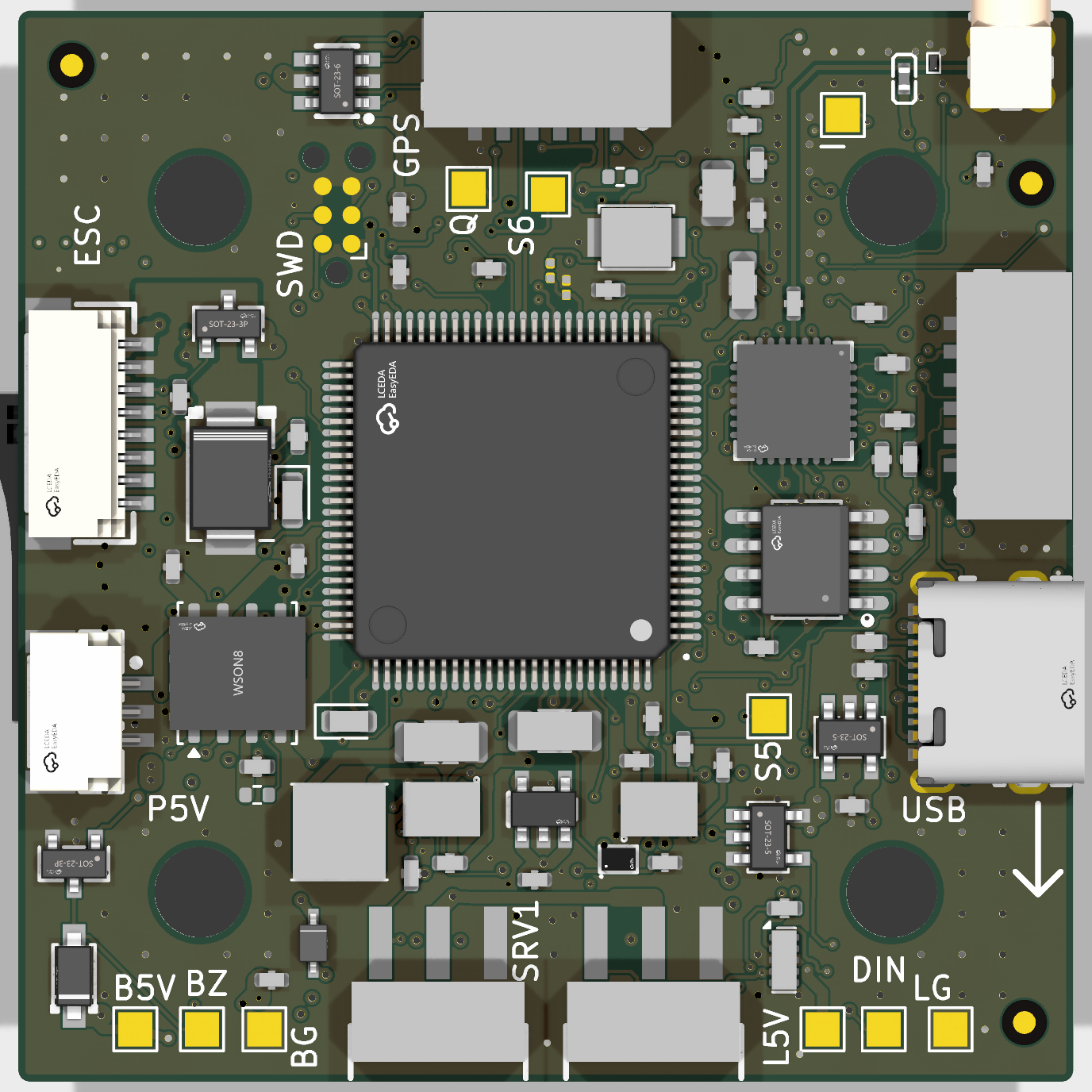
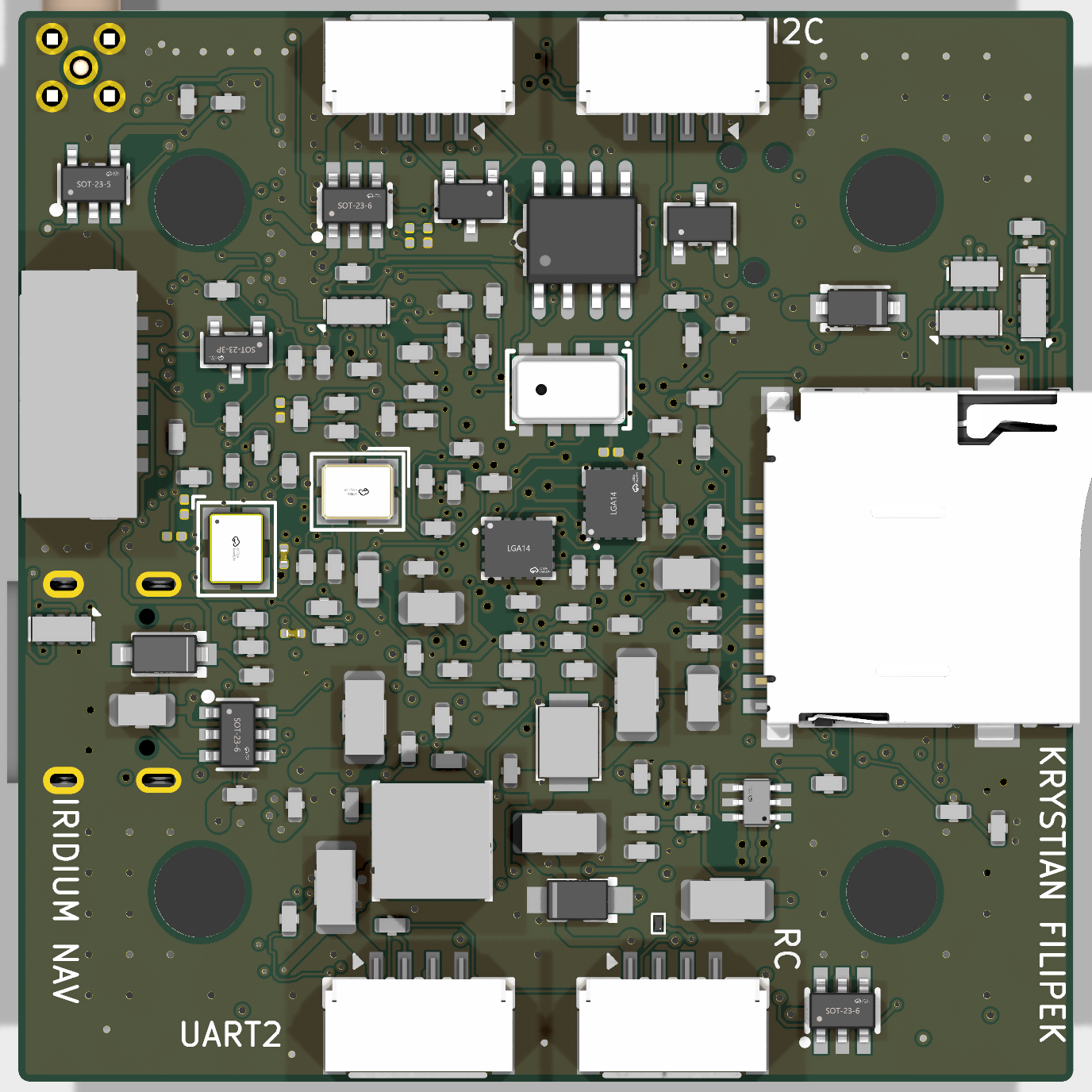
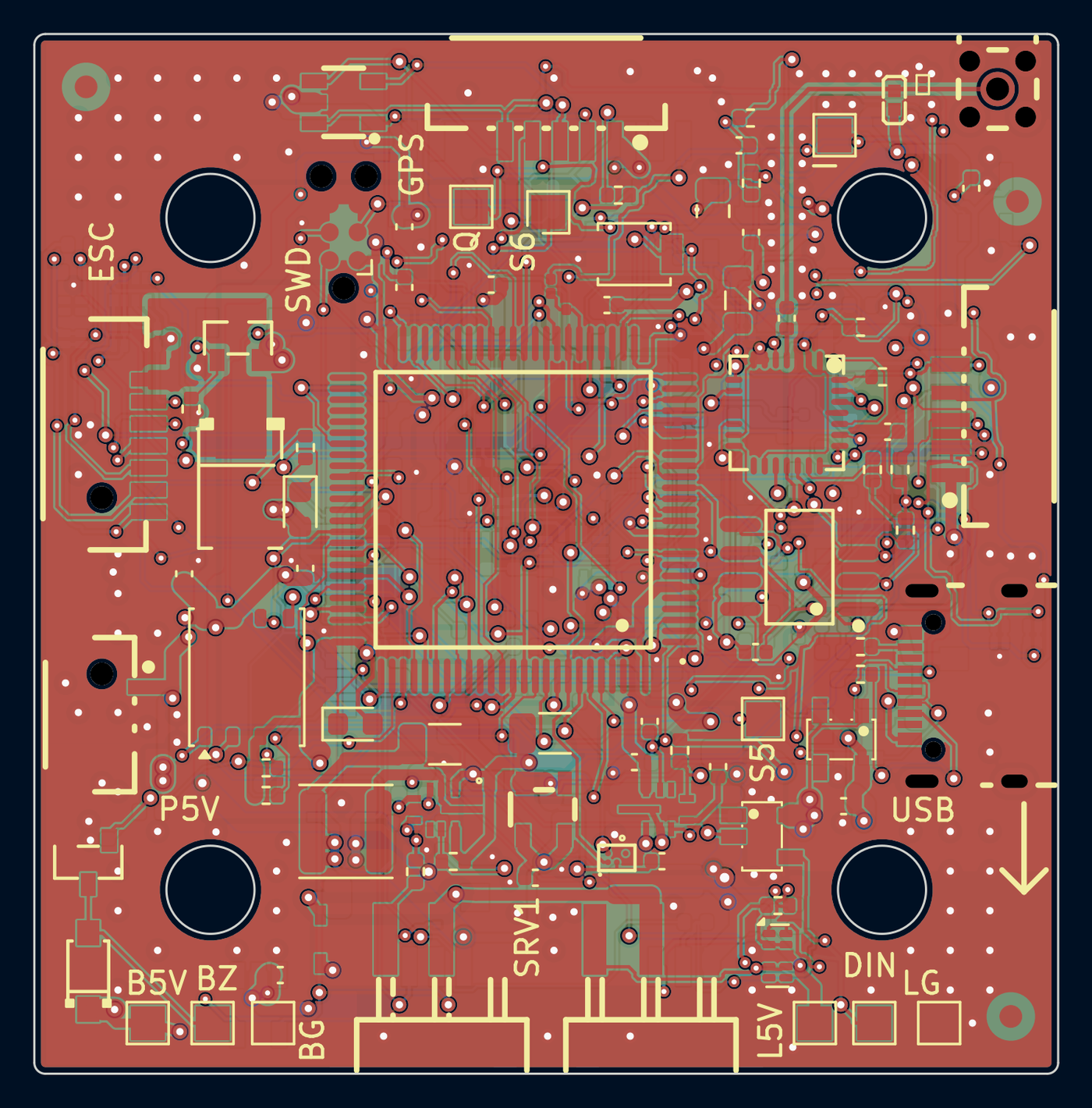
Optical flow and visual-inertial odometry drift without bound over long flights. Iridium NEXT satellites orbit at ~780 km and ~7.5 km/s and transmit continuously at 1616-1626.5 MHz, so the Doppler shift of their bursts gives an absolute position with bounded error (typically 100-200 m) that complements the faster inertial sensors.
| Subsystem | Components |
|---|---|
| MCU | STM32H743VIT6, Cortex-M7 @ 480 MHz, 2 MB flash, 1 MB RAM |
| IMUs | ICM-45686 (SPI1) and ICM-42605 (SPI4) on a separate analogue 3.3 V rail, shared with the tuner |
| Barometer | MS5611 on I2C2 |
| Storage | W25Q128 flash for the orbit catalogue, microSD over SDIO |
| Power | 3S-5S input, TVS and reverse-polarity protection, two 3 A LMR33630 bucks, run to 1.6 A (system) and 2.1 A (payload) by the inductors' rms ratings; L2/L5 saturate at 2.4/2.5 A, below the IC's 4.2 A current limit, so a hard short on a 5 V rail saturates the inductor first and three 3.3 V LDOs |
| Connectors | Latching JST-GH on every cable port, two servo headers, MMCX, USB-C, TC2030 SWD pads |
| Protection | ESD clamp on every cable-facing signal, series resistors on the motor, telemetry, current, lidar and servo lines |
F.Cu:   MCU, RF receiver, bucks and LDOs, flash, the edge connectors
In1.Cu: Continuous ground plane
In2.Cu: Mixed signal with GND fill
In3.Cu: Mixed signal with GND fill
In4.Cu: Split power planes (+5V, +5V_PAYLOAD, +3V3, VBAT)
B.Cu: IMUs, baro, both crystals, CAN, microSD, the underside connectors30.5 mm stack mount, DShot ESC on J2, optical flow on J14, lidar on J11, companion computer on J21, DroneCAN on J6
| NAVCORE-SoOP | SpeedyBee F405 V4 | Matek H743-SLIM V3 | Pixhawk 6C | |
|---|---|---|---|---|
| MCU | STM32H743 | STM32F405 | STM32H743 | STM32H743 + F103 |
| IMUs | ICM-45686 + ICM-42605 | ICM-42688-P | ICM-42688-P + ICM-42605 | ICM-42688-P + BMI088 |
| Input | 3-5S | 3-6S | 2-8S | power module |
| Port ESD | every cable signal | none stated | none stated | none stated |
| Position without GNSS | Iridium Doppler, 100-200 m | none | none | none |
It has no OSD and no 9-12 V video rail, and it takes 5S at most.
tools/build_firmware.sh pins Copter-4.7.0)Clone the repository:
git clone https://github.com/kfilipekk/iridium_drone.git
cd iridium_drone
Simulate the analogue blocks (bucks, LDOs, antenna feed, tuner PLL, baseband filter):
python3 sim/run_suite.pyBuild the navigation code and its tests for the host (SGP4, burst detection, the position solve):
make -C firmware/soopBuild ArduPilot for the board with the SoOP backend:
bash tools/build_firmware.shThe checks need KiCad's Python (the pcbnew module), and irdrop.py needs numpy. Run them from the repository root:
kicad-cli pcb drc --schematic-parity NAVCORE-SoOP.kicad_pcb
python3 tools/check.py geometry     # acute corners, dangling ends, dead copper, vias in pads
python3 tools/check.py backside     # pins landing under parts on the other side
python3 tools/check.py footprints   # pad counts against JLCPCB's own parts
python3 tools/irdrop.py check       # DC drop and current density on every power rail
python3 tools/fab.py bundle         # gerbers, BOM, CPL and the order sheet, into fab/
--help on any of them lists the rest.
The JLCPCB files are in fab/: the Gerber and drill bundle, BOM, pick-and-place and schematic PDF. Order 6 layers, 1 oz copper inside and out, ENIG, epoxy-filled and capped vias, and assembly on both sides.
├── NAVCORE-SoOP.kicad_pcb   # PCB
├── NAVCORE-SoOP.kicad_sch   # Schematic, generated from tools/design.py
├── fab/                     # JLCPCB order files
├── firmware/                # ArduPilot hwdef, the SoOP backend and the on-board navigation
├── tools/                   # Design model, schematic and hwdef generators, board checks
├── sim/                     # ngspice simulations of the analogue blocks
├── cad/                     # OpenSCAD airframe, printed mounts and renders
└── libraries/ # Footprint and symbol librariesI made this project to explore:
Developed by kfilipekk
| Qty | Value | Footprint | References |
|---|---|---|---|
| 35 | 100n | Capacitor_SMD:C_0402_1005Metric | C1, C2, C3, C4, C10, C12, C14, C19, C21, C30, C31, C32, C33, C34, C35, C36 +19 |
| 12 | 10k | Resistor_SMD:R_0402_1005Metric | R1, R14, R39, R45, R48, R49, R50, R51, R52, R53, R59, R60 |
| 11 | 1u | Capacitor_SMD:C_0402_1005Metric | C11, C13, C26, C27, C28, C51, C67, C75, C78, C79, C80 |
| 8 | 4k7 | Resistor_SMD:R_0402_1005Metric | R9, R10, R12, R31, R36, R37, R47, R58 |
| 6 | 100R | Resistor_SMD:R_0402_1005Metric | R38, R70, R72, R73, R74, R75 |
| 6 | 47k | Resistor_SMD:R_0402_1005Metric | R22, R23, R24, R25, R26, R27 |
| 5 | 100k | Resistor_SMD:R_0402_1005Metric | R4, R6, R40, R42, R46 |
| 5 | TPD4E05U06 | Package_SON:USON-10_2.5x1.0mm_P0.5mm | U26, U27, U28, U29, U30 |
| 4 | 1k | Resistor_SMD:R_0402_1005Metric | R19, R20, R21, R35 |
| 3 | 100p | Capacitor_SMD:C_0201_0603Metric | C56, C98, C99 |
| 3 | 1n | Capacitor_SMD:C_0402_1005Metric | C81, C84, C86 |
| 3 | 2u2 | Capacitor_SMD:C_0402_1005Metric | C8, C9, C29 |
| 3 | 47u | Capacitor_SMD:C_1206_3216Metric | C23, C69, C70 |
| 3 | Fiducial | Fiducial:Fiducial_1mm_Mask2mm | FID1, FID2, FID3 |
| 2 | 0R | Resistor_SMD:R_0402_1005Metric | R28, R29 |
| 2 | 100n | Capacitor_SMD:C_0201_0603Metric | C59, C97 |
| 2 | 100p | Capacitor_SMD:C_0402_1005Metric | C76, C77 |
| 2 | 10n | Capacitor_SMD:C_0402_1005Metric | C58, C73 |
| 2 | 10u | Capacitor_SMD:C_0805_2012Metric | C45, C93 |
| 2 | 10u | Capacitor_SMD:C_1206_3216Metric | C17, C18 |
| 2 | 1n | Capacitor_SMD:C_0201_0603Metric | C100, C101 |
| 2 | 22k | Resistor_SMD:R_0402_1005Metric | R5, R41 |
| 2 | 24k9 | Resistor_SMD:R_0402_1005Metric | R7, R43 |
| 2 | 30p | Capacitor_SMD:C_0402_1005Metric | C15, C16 |
| 2 | 47n | Capacitor_SMD:C_0402_1005Metric | C61, C63 |
| 2 | 4u7 | Capacitor_SMD:C_0805_2012Metric | C6, C7 |
| 2 | 5k1 | Resistor_SMD:R_0402_1005Metric | R16, R17 |
| 2 | 680R | Resistor_SMD:R_0201_0603Metric | R76, R77 |
| 2 | AO3400A | jlc:SOT-23-3_L2.9-W1.3-P1.90-LS2.4-BR | Q1, Q3 |
| 2 | LMR33630A | jlc:VQFN-12_L3.0-W2.0-P0.65-BL_TI_RNX | U8, U20 |
| 2 | PESD5V0C1BSF | jlc:DSN0603-2_L0.6-W0.3-P0.40-BI | D7, D9 |
| 2 | SRV05-4 | jlc:SOT-23-6_L2.9-W1.6-P0.95-LS2.8-BR | U22, U23 |
| 1 | 100u | Capacitor_SMD:C_1206_3216Metric | C22 |
| 1 | 10k | Resistor_SMD:R_0603_1608Metric | R18 |
| 1 | 10p | Capacitor_SMD:C_0402_1005Metric | C91 |
| 1 | 10uH | Inductor_SMD:L_APV_ANR4030 | L2 |
| 1 | 10uH | Inductor_SMD:L_APV_ANR5040 | L5 |
| 1 | 120R | Resistor_SMD:R_0402_1005Metric | R15 |
| 1 | 1N4148W | jlc:SOD-123F_L2.7-W1.6-LS3.8-RD | D4 |
| 1 | 1u | Capacitor_SMD:C_0805_2012Metric | C42 |
| 1 | 210k | Resistor_SMD:R_0402_1005Metric | R61 |
| 1 | 22u | Capacitor_SMD:C_1206_3216Metric | C92 |
| 1 | 25MHz TCXO | jlc:OSC-SMD_4P-L3.2-W2.5-BL | Y2 |
| 1 | 27nH | jlc:L0402 | L6 |
| 1 | 2R2 | Resistor_SMD:R_0402_1005Metric | R62 |
| 1 | 2k2 | Resistor_SMD:R_0402_1005Metric | R71 |
| 1 | 330R | Resistor_SMD:R_0402_1005Metric | R34 |
| 1 | 33R x4 | Resistor_SMD:R_Array_Convex_4x0402 | RN1 |
| 1 | 33p | Capacitor_SMD:C_0402_1005Metric | C52 |
| 1 | 470R | Resistor_SMD:R_0402_1005Metric | R57 |
| 1 | 4k7 | Resistor_SMD:R_0201_0603Metric | R11 |
| 1 | 600R@100MHz | Inductor_SMD:L_0805_2012Metric | L1 |
| 1 | 74LVC1G17 | jlc:SOT-23-5_L3.0-W1.7-P0.95-LS2.8-BR | U17 |
| 1 | 8MHz | jlc:CRYSTAL-SMD_4P-L3.2-W2.5-BL | Y1 |
| 1 | AP22653 | jlc:SOT-23-6_L2.9-W1.6-P0.95-LS2.8-BR | U24 |
| 1 | B2020WS | jlc:SOD-323_L1.7-W1.3-LS2.7-RD | D10 |
| 1 | B5819W | jlc:SOD-123_L2.7-W1.6-LS3.7-RD-1 | D_USB |
| 1 | BLUE | LED_SMD:LED_0603_1608Metric | D2 |
| 1 | BOOT | Button_Switch_SMD:SW_SPST_B3U-1000P | SW1 |
| 1 | BUZ_5V | TestPoint:TestPoint_Pad_1.5x1.5mm | P161 |
| 1 | BUZ_GND | TestPoint:TestPoint_Pad_1.5x1.5mm | P163 |
| 1 | BUZ_OUT | TestPoint:TestPoint_Pad_1.5x1.5mm | P162 |
| 1 | BZT52C15 | jlc:SOD-123_L2.7-W1.6-LS3.7-RD | DZ1 |
| 1 | CAN 4P | jlc:CONN-SMD_4P-P1.25_BX-GH1.25-4PWT | J6 |
| 1 | COMPANION | jlc:CONN-SMD_XY-SM06B-GHS-TB | J21 |
| 1 | ESC 8P | jlc:CONN-TH_SM08B-SRSS-TB-LF-SN | J2 |
| 1 | FLOW 6P | jlc:CONN-SMD_XY-SM06B-GHS-TB | J14 |
| 1 | GPS+I2C | jlc:CONN-SMD_XY-SM06B-GHS-TB | J3 |
| 1 | GREEN | LED_SMD:LED_0603_1608Metric | D3 |
| 1 | I2C 4P | jlc:CONN-SMD_4P-P1.25_BX-GH1.25-4PWT | J9 |
| 1 | ICM-42605 | jlc:LGA-14_L3.0-W2.5-P0.50-TL | U3 |
| 1 | ICM-45686 | jlc:LGA-14_L3.0-W2.5-P0.50-TL | U2 |
| 1 | INA180A2 | jlc:SOT-23-5_L3.0-W1.7-P0.95-LS2.8-BL | U25 |
| 1 | LED_5V | TestPoint:TestPoint_Pad_1.5x1.5mm | P151 |
| 1 | LED_DIN | TestPoint:TestPoint_Pad_1.5x1.5mm | P152 |
| 1 | LED_GND | TestPoint:TestPoint_Pad_1.5x1.5mm | P153 |
| 1 | LM66100 | jlc:SC-70-6_L2.0-W1.3-P0.65-LS2.1-BL | U31 |
| 1 | MAX2112 | jlc:TQFN-28_L5.0-W5.0-P0.50-BL-EP3.3 | U13 |
| 1 | MMCX-KWE-90 | jlc:MMCX-TH_DL-MMCX-KWE-90 | J12 |
| 1 | MS5611 | jlc:SENSORS-SMD_MS5611-01BA03 | U4 |
The 191 most common of 217 parts.
pmonta/GNSS_Firehose
Wideband front-end digitizer for GPS, GLONASS, Galileo, BeiDou


Hy-5/VesselV3
Custom "Vessel" Keyboard - PCB + 3D Case Model + Firmware + Keycaps vector


NBence0/JedlikBots
Welcome to the official GitHub page of JedlikBots! 🎓🤖 We are the dedicated team of software development and robotics students from the Jedlik Ányos Technical School in Győr, Hungary.


dridri/bcflight
Raspberry Pi based drone flight controller and remote control
It measures 46.5 × 47.2 mm and has 6 copper layers, 1.6 mm thick.
217 parts, built around the 74LVC1G17Z, MAX2112CTI+, LMR33630ADDA and SRV05-4. The full list of its parts is on this page, with links to each part's symbol and footprint where PCBKit's library has them.
From the kfilipekk/iridium_drone repository on GitHub, at the commit this page was made from: the board is NAVCORE-SoOP.kicad_pcb and its schematic NAVCORE-SoOP.kicad_sch. PCBKit opens the board in the browser, with nothing to install.
Its repository publishes it under the MIT licence: you may reuse it on that licence's terms (keep the author's notice, and for a copyleft licence share your changes alike).