2 layers59.7 × 67.5 mm
GuitarML FunBox funbox v3
punkfab/pcb-corpus
235 real KiCad boards from open-source hardware repositories, prepared as a placement and routing benchmark
70 parts1

 kadinelbak/DTE2026
DTE 2026 Alyssa Collier, Alexa Boksiner, Mia Beltran, Juliana Galvez, Kadin El Bakkouri
Emg board is an open-source printed circuit board by kadinelbak, from the kadinelbak/DTE2026 repository on GitHub, published under the MIT licence. It is a 2-layer board of 106.7 × 81.3 mm with 42 parts on 28 nets, routed with 178 tracks and 20 vias.
It is built around the MCP6002-I/P, TLC272CD and L7805. Its parts include 16 resistors, 9 capacitors, 4 ICs, 4 diodes and 3 connectors. It belongs with the ESP32 boards of this library.


Hardware for the DTE Designathon project.
KiCad 8 project in hardware/emg_board/. Open emg_board.kicad_pro in KiCad; the symbol and footprint libraries are project-local, so nothing needs to be installed.
hardware/emg_board/
├── emg_board.kicad_pro     project
├── emg_board.kicad_sch     schematic
├── emg_board.kicad_pcb     PCB layout
├── EMG_Board.kicad_sym     project symbol library
├── EMG_Board.pretty/       project footprint library (*.kicad_mod)
├── sym-lib-table           points to ${KIPRJMOD}/EMG_Board.kicad_sym
├── fp-lib-table            points to ${KIPRJMOD}/EMG_Board.pretty
└── docs/                   schematic and PCB previews and screenshots
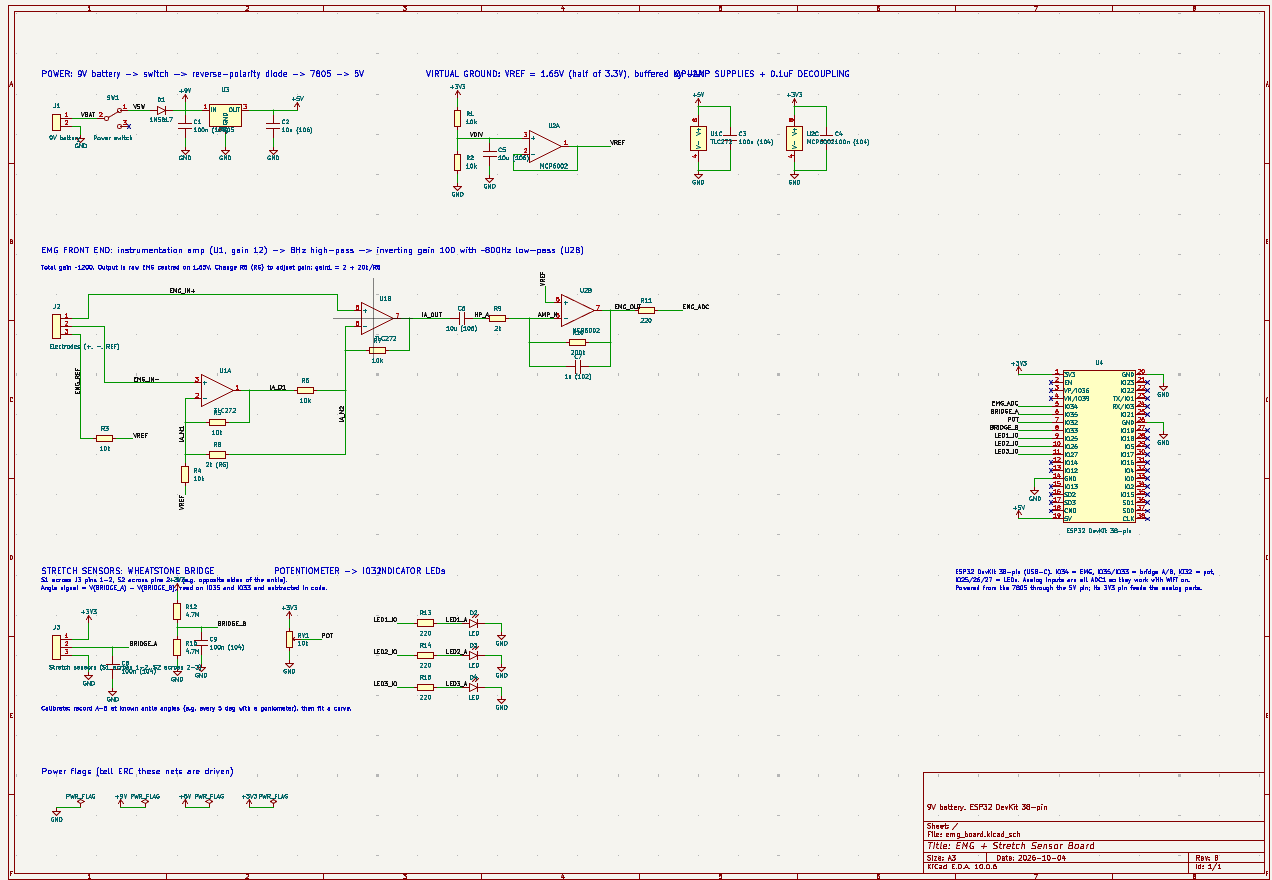
The board runs from a 9 V battery through a switch, a reverse-polarity diode and a 7805 regulator into an ESP32 DevKit (38-pin). It carries:
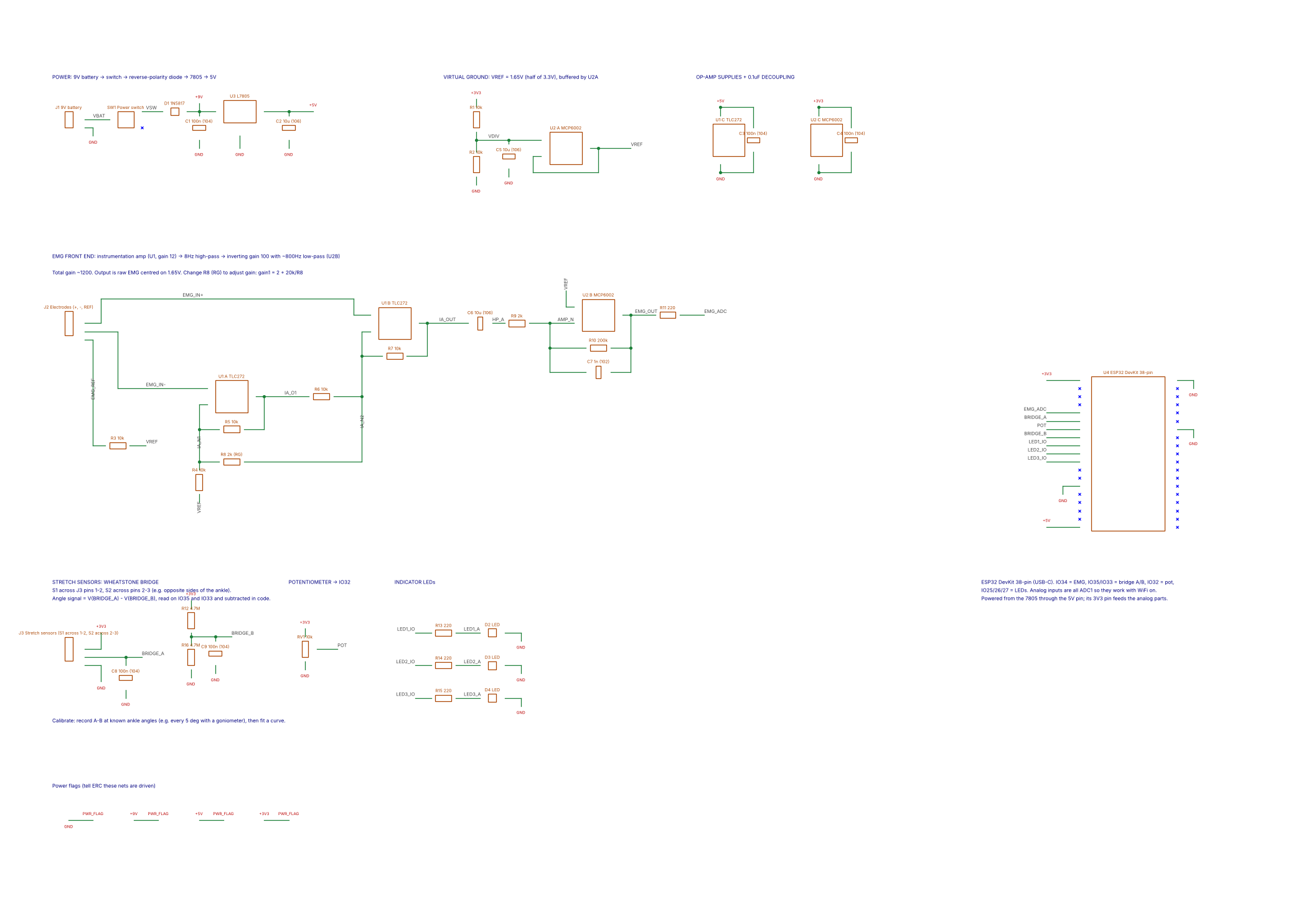
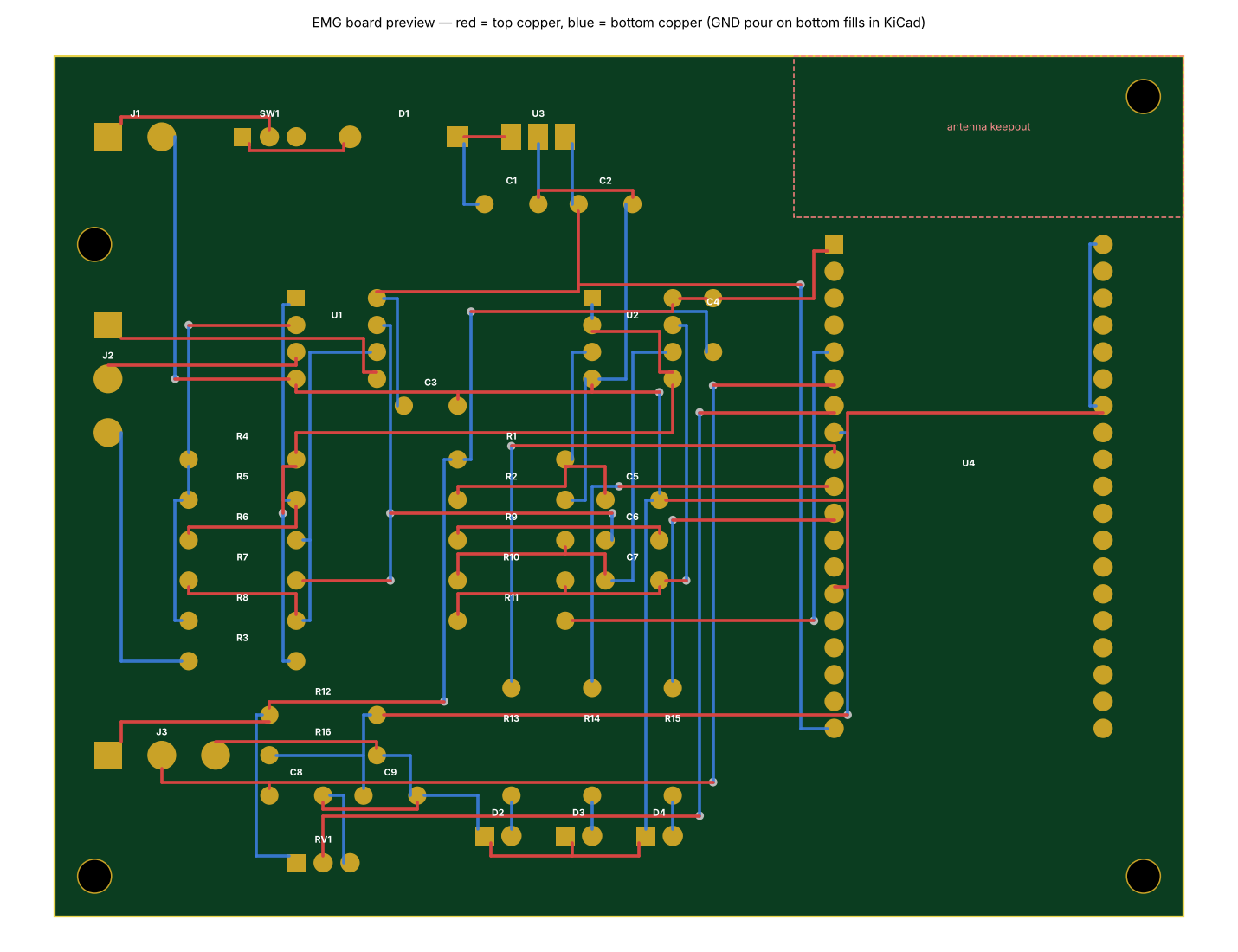
PCB layout:
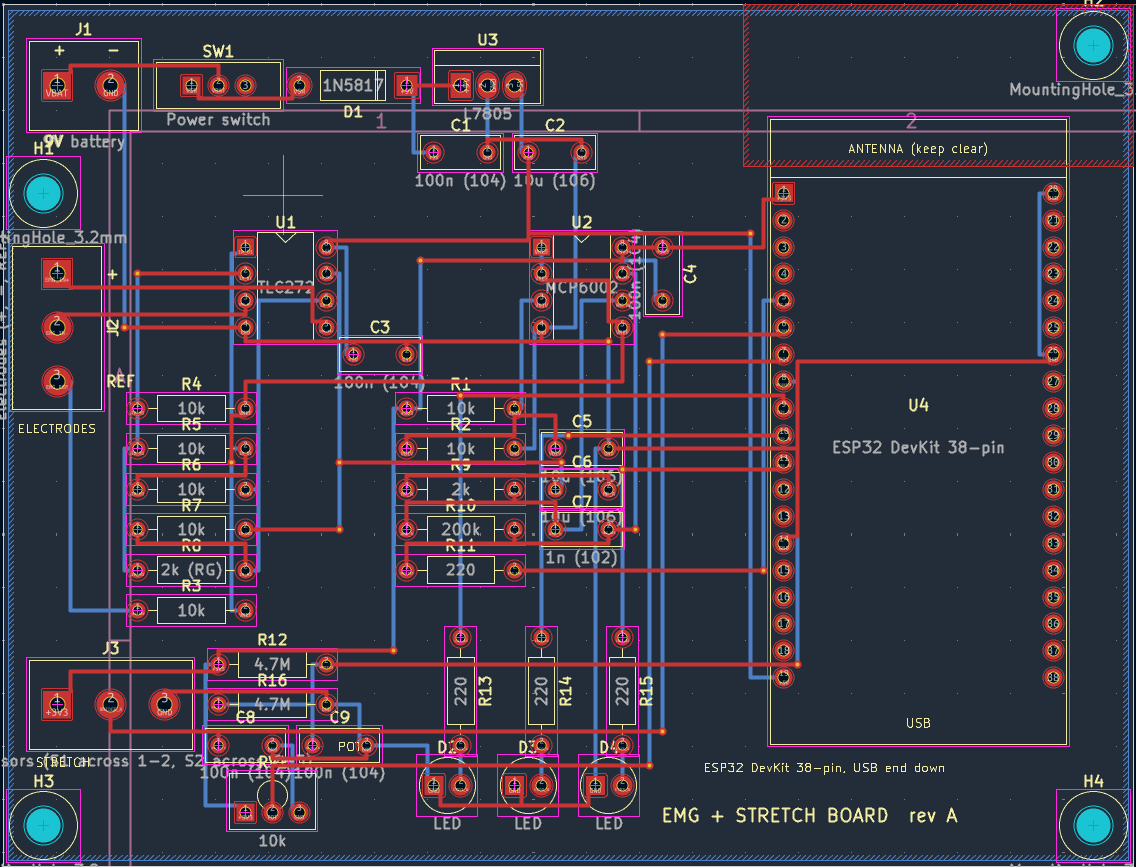
Schematic:
Arduino sketches in microcontroller_code/. Each sketch is in a folder with the same name, as the Arduino IDE expects.
WiFi/: ESP32 button that sends a "Danger mode approached, increase stiffness?" alert to the phone and Apple Watch through ntfy.sh. The notification has Increase stiffness and Decrease stiffness buttons that change the stiffness level (0 to 5) on the ESP32, which confirms with a follow-up notification. The LEDs show the stiffness level: green for low (0-1), yellow for medium (2-3) and red for high (4-5). Before building, copy secrets.example.h to secrets.h and put your WiFi name and password in it. secrets.h is git-ignored so the password stays out of the repo.EMG/: samples the EMG signal on A0 at 1200 Hz, cancels 60 Hz mains hum with a one-cycle comb filter, and prints the smoothed muscle-activity envelope over serial at 115200 baud.RotationalDrive/: reads the outside stretch sensor on A1, zeroes at neutral, and lights a blue warning LED and a blinking red danger LED as the ankle rolls past the limits. Type an angle over serial to calibrate it to degrees (saved to EEPROM), or z to re-zero.SolidWorks files for the hydraulic right foot brace are in cad/hydraulic_brace/: the assembly (hydraulics brace Assem.SLDASM), the brace body (hydraulic right foot brace), bottom brace, BottomBraceHydraulics, InnerBore, OuterBore and Gasket. Keep the file names as they are, because the assembly finds its parts by name.
images/model/: SolidWorks render of the full brace assembly.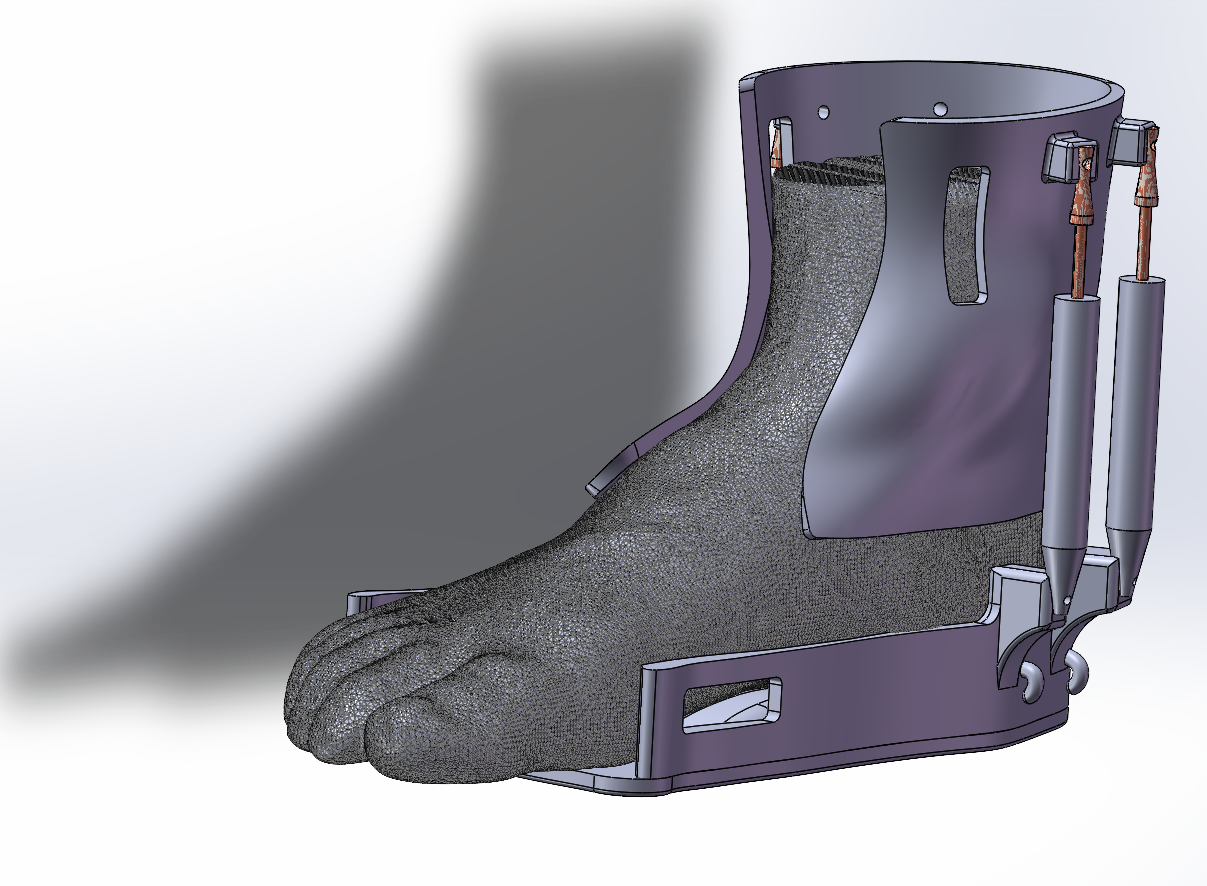
| Qty | Value | Footprint | References |
|---|---|---|---|
| 7 | 10k | EMG_Board:R_Axial_P10.16mm | R1, R2, R3, R4, R5, R6, R7 |
| 5 | 100n (104) | EMG_Board:C_Disc_P5.08mm | C1, C3, C4, C8, C9 |
| 4 | 220 | EMG_Board:R_Axial_P10.16mm | R11, R13, R14, R15 |
| 4 | MountingHole_3.2mm | EMG_Board:MountingHole_3.2mm | H1, H2, H3, H4 |
| 3 | 10u (106) | EMG_Board:C_Disc_P5.08mm | C2, C5, C6 |
| 3 | LED | EMG_Board:LED_D5.0mm | D2, D3, D4 |
| 2 | 4.7M | EMG_Board:R_Axial_P10.16mm | R12, R16 |
| 1 | 10k | EMG_Board:Potentiometer_Inline_P2.54mm | RV1 |
| 1 | 1N5817 | EMG_Board:D_DO-41_P10.16mm | D1 |
| 1 | 1n (102) | EMG_Board:C_Disc_P5.08mm | C7 |
| 1 | 200k | EMG_Board:R_Axial_P10.16mm | R10 |
| 1 | 2k | EMG_Board:R_Axial_P10.16mm | R9 |
| 1 | 2k (RG) | EMG_Board:R_Axial_P10.16mm | R8 |
| 1 | 9V battery | EMG_Board:TerminalBlock_1x02_P5.08mm | J1 |
| 1 | ESP32 DevKit 38-pin | EMG_Board:ESP32_DevKitC_38pin_W25.4mm | U4 |
| 1 | Electrodes (+, -, REF) | EMG_Board:TerminalBlock_1x03_P5.08mm | J2 |
| 1 | L7805 | EMG_Board:TO-220-3_Vertical | U3 |
| 1 | MCP6002 | EMG_Board:DIP-8_W7.62mm | U2 |
| 1 | Power switch | EMG_Board:SW_Slide_SPDT_P2.54mm | SW1 |
| 1 | Stretch sensors (S1 across 1-2, S2 across 2-3) | EMG_Board:TerminalBlock_1x03_P5.08mm | J3 |
| 1 | TLC272 | EMG_Board:DIP-8_W7.62mm | U1 |
punkfab/pcb-corpus
235 real KiCad boards from open-source hardware repositories, prepared as a placement and routing benchmark


CASE-Association/christmas-cards
All CASE christmas cards over the years

GadgetReboot/ATTiny_LFO
Dual low frequency oscillators using ATTiny and MCP4725 DACs

letelescope/ascom-flat-panel
Open source ASCOM and INDI driven automated flat panel for astrophotography

Tinkerforge/distance-us-v2-bricklet-techniker
This repository contains the firmware source code and the hardware design files. The documentation generator configs can be found at https://github.com/Tinkerforge/generators
It measures 106.7 × 81.3 mm and has 2 copper layers, 1.6 mm thick.
42 parts, built around the MCP6002-I/P, TLC272CD and L7805. The full list of its parts is on this page, with links to each part's symbol and footprint where PCBKit's library has them.
From the kadinelbak/DTE2026 repository on GitHub, at the commit this page was made from: the board is hardware/emg_board/emg_board.kicad_pcb and its schematic hardware/emg_board/emg_board.kicad_sch. PCBKit opens the board in the browser, with nothing to install.
Its repository publishes it under the MIT licence: you may reuse it on that licence's terms (keep the author's notice, and for a copyleft licence share your changes alike).