4 layers54.5 × 80 mm

 GadgetReboot/ATTiny_LFO3
Dual low frequency oscillators using ATTiny and MCP4725 DACs
GR ATTiny LFO is an open-source printed circuit board by GadgetReboot, from the GadgetReboot/ATTiny_LFO repository on GitHub. It is a 2-layer board of 50 × 40.9 mm with 36 parts on 27 nets, routed with 302 tracks and 82 vias.
It is built around the ATTINY1604-SSF, TLC272CD and AMS1117-5.0. Its parts include 14 resistors, 6 capacitors, 5 ICs, 5 connectors and 3 diodes. It belongs with the AVR (ATmega, ATtiny) boards of this library.


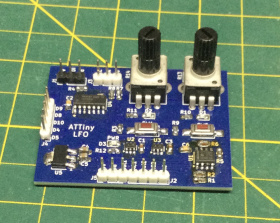
Dual low frequency oscillators using ATTiny and MCP4725 DACs
| Qty | Value | Footprint | References |
|---|---|---|---|
| 6 | 1K | Resistor_SMD:R_0805_2012Metric_Pad1.15x1.40mm_HandSolder | R1, R4, R5, R10, R11, R12 |
| 3 | 100nF | Capacitor_SMD:C_0805_2012Metric_Pad1.15x1.40mm_HandSolder | C1, C3, C6 |
| 2 | 100r | Resistor_SMD:R_0805_2012Metric_Pad1.15x1.40mm_HandSolder | R3, R9 |
| 2 | 10K | Resistor_SMD:R_0805_2012Metric_Pad1.15x1.40mm_HandSolder | R7, R8 |
| 2 | 10K | _Pot:Potentiometer_Bourns_PTV09A-1 | R13, R14 |
| 2 | 10uF | Capacitor_SMD:C_0805_2012Metric_Pad1.15x1.40mm_HandSolder | C4, C5 |
| 2 | 380r | Resistor_SMD:R_0805_2012Metric_Pad1.15x1.40mm_HandSolder | R2, R6 |
| 2 | Conn_01x03 | Connector_PinHeader_2.54mm:PinHeader_1x03_P2.54mm_Vertical | J1, J3 |
| 2 | Conn_01x05 | Connector_PinHeader_2.54mm:PinHeader_1x05_P2.54mm_Vertical | J2, J4 |
| 2 | LED | LED_SMD:LED_0805_2012Metric_Pad1.15x1.40mm_HandSolder | D1, D2 |
| 2 | MCP4725 | Package_TO_SOT_SMD:SOT-23-6 | U2, U3 |
| 2 | SW_Push | _Pot:SW_SPST_60x35 | SW1, SW2 |
| 1 | 100nF | Capacitor_SMD:C_0805_2012Metric_Pad1.18x1.45mm_HandSolder | C2 |
| 1 | 1x2 | Connector_PinHeader_2.54mm:PinHeader_1x02_P2.54mm_Vertical | J5 |
| 1 | AMS1117-5.0 | Package_TO_SOT_SMD:SOT-223-3_TabPin2 | U5 |
| 1 | ATtiny1604-SS | Package_SO:SOIC-14_3.9x8.7mm_P1.27mm | U4 |
| 1 | LOGO | _Custom_Footprints:pcb way logo | G*** |
| 1 | Power | LED_SMD:LED_0805_2012Metric_Pad1.15x1.40mm_HandSolder | D3 |
| 1 | TLC272 | Package_SO:SOIC-8_3.9x4.9mm_P1.27mm | U1 |


It measures 50 × 40.9 mm and has 2 copper layers, 1.6 mm thick.
36 parts, built around the ATTINY1604-SSF, TLC272CD and AMS1117-5.0. The full list of its parts is on this page, with links to each part's symbol and footprint where PCBKit's library has them.
From the GadgetReboot/ATTiny_LFO repository on GitHub, at the commit this page was made from: the board is KiCad/GR_ATTiny_LFO.kicad_pcb and its schematic KiCad/GR_ATTiny_LFO.kicad_sch. PCBKit opens the board in the browser, with nothing to install.
Its repository states no licence, so its author keeps all rights: ask GadgetReboot before reusing the design.