2 layers40.6 × 20.1 mm

 GadgetReboot/Serial_UPDI1
Serial UPDI Programmer
Serial UPDI is an open-source printed circuit board by GadgetReboot, from the GadgetReboot/Serial_UPDI repository on GitHub. It is a 2-layer board of 28.2 × 27.9 mm with 21 parts on 20 nets, routed with 153 tracks and 38 vias.
It is built around the CH340E, XC6206P332MR-G and BAT54GWJ, with the MF-FSMF050X-2 among its other parts. Its parts include 5 resistors, 4 capacitors, 3 diodes, 2 ICs and 2 connectors. It belongs with the interfaces and adapters boards of this library.


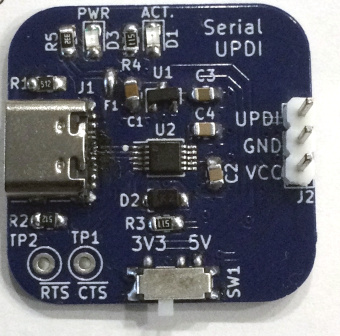
Serial UPDI Programmer
| Qty | Value | Footprint | References |
|---|---|---|---|
| 2 | 100nF | Capacitor_SMD:C_0805_2012Metric_Pad1.15x1.40mm_HandSolder | C2, C4 |
| 2 | 1uF | Capacitor_SMD:C_0805_2012Metric_Pad1.15x1.40mm_HandSolder | C1, C3 |
| 2 | 470r | Resistor_SMD:R_0805_2012Metric_Pad1.15x1.40mm_HandSolder | R3, R4 |
| 2 | 5K1 | Resistor_SMD:R_0805_2012Metric_Pad1.15x1.40mm_HandSolder | R1, R2 |
| 2 | TestPoint | TestPoint:TestPoint_Loop_D1.80mm_Drill1.0mm_Beaded | TP1, TP2 |
| 1 | 3K3 | Resistor_SMD:R_0805_2012Metric_Pad1.15x1.40mm_HandSolder | R5 |
| 1 | Activity | LED_SMD:LED_0805_2012Metric_Pad1.15x1.40mm_HandSolder | D1 |
| 1 | BAT54GWJ | footprints:SOD-123 | D2 |
| 1 | CH340E | Package_SO:MSOP-10_3x3mm_P0.5mm | U2 |
| 1 | Conn_01x03 | Connector_PinHeader_2.54mm:PinHeader_1x03_P2.54mm_Vertical | J2 |
| 1 | LOGO | _Custom_Footprints:pcb way logo | G*** |
| 1 | MF-FSMF050X | Resistor_SMD:R_0603_1608Metric_Pad1.05x0.95mm_HandSolder | F1 |
| 1 | Power | LED_SMD:LED_0805_2012Metric_Pad1.15x1.40mm_HandSolder | D3 |
| 1 | SW_SPDT | footprints:SW_SPDT_PCM12_ | SW1 |
| 1 | USB_C_Receptacle | Connector_USB:USB_C_Receptacle_XKB_U262-16XN-4BVC11 | J1 |
| 1 | XC6206P332MR-G | Package_TO_SOT_SMD:SOT-23 | U1 |
It measures 28.2 × 27.9 mm and has 2 copper layers, 1.6 mm thick.
21 parts, built around the CH340E, XC6206P332MR-G, BAT54GWJ and MF-FSMF050X-2. The full list of its parts is on this page, with links to each part's symbol and footprint where PCBKit's library has them.
From the GadgetReboot/Serial_UPDI repository on GitHub, at the commit this page was made from: the board is KiCad/Serial_UPDI.kicad_pcb and its schematic KiCad/Serial_UPDI.kicad_sch. PCBKit opens the board in the browser, with nothing to install.
Its repository states no licence, so its author keeps all rights: ask GadgetReboot before reusing the design.

loopj/short-stack
World's Smallest Nintendo Wii, using a trimmed motherboard and custom stacked PCBs

hasenbanck/heteromycin
A 3D printer board using a powerfull STM32 MCU, TMC5160/TMC2160 driver and a Raspberry Pi or compatible SBC

hasenbanck/remram
32bit STM32F7 based 3D printing controller using TMC2130 stepper driver

PCB-Arts/fast-open-switch-hardware
KlusterLab is an open FPGA development platform designed for experimenting with high-speed interfaces and formally verified IP cores.


BenjaminJAnderson/CUBE
CUBE is a miniature, six-faced OLED display cube built from a stack of custom interconnected PCBs. The current design combines an ESP32-S2 motherboard, five further display boards, a magnet-held 3D-printed frame and…
