2 layers33 × 33 mm
DFR0264
fcl2002/Open-Ruche-Monitoring
An intelligent beehive monitoring solution combining embedded AI, LoRaWAN communication, and solar power to help beekeepers protect their colonies and optimize hive management.
15 parts1MIT
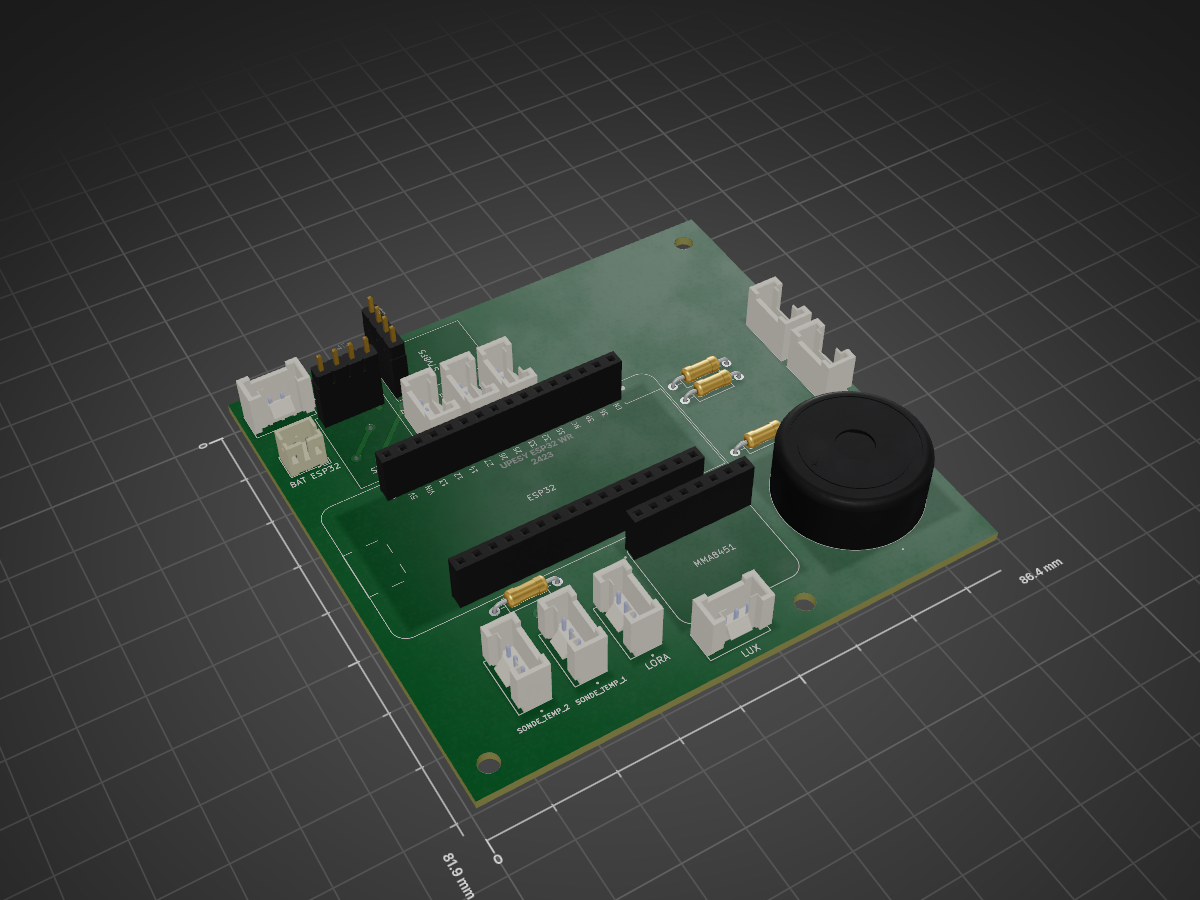
 fcl2002/Open-Ruche-Monitoring1
An intelligent beehive monitoring solution combining embedded AI, LoRaWAN communication, and solar power to help beekeepers protect their colonies and optimize hive management.
Open ruche monitoring is an open-source printed circuit board by fcl2002, from the fcl2002/Open-Ruche-Monitoring repository on GitHub, published under the MIT licence. It is a 2-layer board of 86.4 × 81.9 mm with 28 parts on 47 nets, routed with 144 tracks and 6 vias.
It is built around the HX711 and MMA8451QT. Its parts include 12 connectors, 4 resistors and 3 ICs. It belongs with the ESP32 boards of this library.


Système de Monitorage Autonome de Ruches en Temps-réel
Protéger les abeilles, préserver demain.
An intelligent beehive monitoring solution combining embedded AI, LoRaWAN communication, and solar power to help beekeepers protect their colonies and optimize hive management.
Bee colonies face an accelerating global decline driven by the Varroa destructor mite, the Asian hornet (Vespa velutina), pesticides, and climate change. Continuous 24/7 manual monitoring is impossible for beekeepers — Open Ruche fills that gap with autonomous, real-time surveillance and automatic threat detection.
| Role | Name |
|---|---|
| Project Manager, System Integration & Firmware Lead | Fernando COSTA LASMAR |
| AI/ML Engineer & Model Development | Flávio ROSIM DE SOUSA |
| Hardware Design & PCB Engineer | Matheus SISTON GALDINO |
| Power Management & Solar Systems | Karim SAWAYA |
| HMI & Documentation | Yan DING |
Academic context: Polytech Sorbonne — EI4 FISE | Projet Systèmes Embarqués IoT 2025-2026 | Groupe 4 – Ruche 9
Open Ruche is built around four integrated layers:
Power Layer
Sensor Layer (custom PCB)
AI Processing Layer
Communication & Cloud Layer
The firmware implements a 4-state machine to minimise power consumption:
BOOT → INIT → LECTURE (sensors + AI) → DEEP SLEEP
              ↑___________________________________|
Wake after configurable interval| Phase | Average Current |
|---|---|
| Active period (AI + sensors + LoRa) | ~85.8 mA |
| Deep Sleep | ~0.822 mA |
Charge breakdown per cycle (54 s total):
Estimated autonomy (1000 mAh battery): ~13 days without solar charging.
| Objective | Status |
|---|---|
| Sensor accuracy & LoRa transmission | ✅ Done |
| Real-time image & audio AI detection | ✅ Done |
| Alarm creation & notifications | ✅ Done |
| Remote parameter & alarm configuration | ✅ Done |
| System energy autonomy | ✅ Done |
| PCB schematic & assembly | ✅ Done |
| Enclosure fabrication & prototype wiring | ✅ Done |
| Data display on cloud platforms | ✅ Done |
| Accelerometer for fall/theft detection | ❌ Not implemented |
# Clone the repository
git clone https://github.com/[your-username]/OpenRuche.git
cd OpenRuche

# Project structure
# hardware/   — KiCad schematics & PCB files
# software/   — Firmware (Arduino / PlatformIO)
# ai/         — TensorFlow Lite model training scripts
# docs/       — Documentation & guides
For detailed development guidelines, see CONTRIBUTING.md.
This project is open-source. See LICENSE for details.
| Qty | Value | Footprint | References |
|---|---|---|---|
| 2 | 1k | Resistor_THT:R_Axial_DIN0207_L6.3mm_D2.5mm_P10.16mm_Horizontal | R3, R4 |
| 1 | 100 | Resistor_THT:R_Axial_DIN0207_L6.3mm_D2.5mm_P10.16mm_Horizontal | R2 |
| 1 | 4.7k | Resistor_THT:R_Axial_DIN0207_L6.3mm_D2.5mm_P10.16mm_Horizontal | R1 |
| 1 | ARDUINO | Grove:SEEED_110990030 | J8 |
| 1 | BAT ESP32 | Connector_JST:JST_PH_B2B-PH-K_1x02_P2.00mm_Vertical | J12 |
| 1 | CONN ALIM | Grove:SEEED_110990030 | J11 |
| 1 | DHT22_EXT | Grove:SEEED_110990030 | J2 |
| 1 | DHT22_INT | Grove:SEEED_110990030 | J3 |
| 1 | HX711 | Grove:SEEED_110990030 | J1 |
| 1 | KPEG222 | KPEG222:KPEG222 | BUZZER |
| 1 | LOGO | battery:polytechLogo | G*** |
| 1 | LOGO | battery:syria | G*** |
| 1 | LOGO | battery:china | G*** |
| 1 | LOGO | battery:brasil | G*** |
| 1 | LORA | Grove:SEEED_110990030 | J7 |
| 1 | LUX | Grove:SEEED_110990030 | J6 |
| 1 | MMA8451 | Acc Adafruit:MODULE_2019 | J10 |
| 1 | S7V8F3 | Pololu:MODULE_STEP-DOWN_VOLTAGE_REGULATOR_D24V6F3 | U2 |
| 1 | S7V8F5 | Pololu:MODULE_STEP-DOWN_VOLTAGE_REGULATOR_D24V6F3 | U3 |
| 1 | SONDE_TEMP_1 | Grove:SEEED_110990030 | J4 |
| 1 | SONDE_TEMP_2 | Grove:SEEED_110990030 | J5 |
| 1 | XIAO | Grove:SEEED_110990030 | J9 |
| 1 | uPesy ESP32 Wroom Low Power DevKit | uPesy Boards:uPesy_ESP32_Wroom_Low_Power_DevKit | U1 |
The 24 most common of 28 parts.
fcl2002/Open-Ruche-Monitoring
An intelligent beehive monitoring solution combining embedded AI, LoRaWAN communication, and solar power to help beekeepers protect their colonies and optimize hive management.

fcl2002/Open-Ruche-Monitoring
An intelligent beehive monitoring solution combining embedded AI, LoRaWAN communication, and solar power to help beekeepers protect their colonies and optimize hive management.
fcl2002/Open-Ruche-Monitoring
An intelligent beehive monitoring solution combining embedded AI, LoRaWAN communication, and solar power to help beekeepers protect their colonies and optimize hive management.

toniebox-reverse-engineering/toniebox-pcb
KiCad schematic of the Toniebox PCB (including datasheets).


Sebastian-S-Posada/balloon-data-logger-shield
An Arduino Uno shield, designed in KiCad, that logs temperature, humidity, barometric pressure, and acceleration to a microSD card. It's built as a lightweight, low-power payload for a high-altitude balloon flight.

vul-os/sirboard
Open hardware: 107 KiCad PCB designs — SMD-to-THT breakout adapters, ATTiny/ATMega/ESP development boards, and a 39-part sensor line on a common JST-SH connector.


KnoxMakers/Electronics
schematics, board files, firmware, slide decks, and the like
It measures 86.4 × 81.9 mm and has 2 copper layers, 1.6 mm thick.
28 parts, built around the HX711 and MMA8451QT. The full list of its parts is on this page, with links to each part's symbol and footprint where PCBKit's library has them.
From the fcl2002/Open-Ruche-Monitoring repository on GitHub, at the commit this page was made from: the board is hardware/openRuche/open-ruche-monitoring.kicad_pcb and its schematic hardware/Arduino/Arduino.kicad_sch. PCBKit opens the board in the browser, with nothing to install.
Its repository publishes it under the MIT licence: you may reuse it on that licence's terms (keep the author's notice, and for a copyleft licence share your changes alike).