2 layers88 × 102 mm
Toniebox v1v2
toniebox-reverse-engineering/toniebox-pcb
KiCad schematic of the Toniebox PCB (including datasheets).
11 parts37

 Sebastian-S-Posada/balloon-data-logger-shield
An Arduino Uno shield, designed in KiCad, that logs temperature, humidity, barometric pressure, and acceleration to a microSD card. It's built as a lightweight, low-power payload for a high-altitude balloon flight.
MicroP Final Porject is an open-source printed circuit board by Sebastian-S-Posada, from the Sebastian-S-Posada/balloon-data-logger-shield repository on GitHub. It is a 2-layer board of 68.6 × 53.3 mm with 21 parts on 43 nets, routed with 82 tracks and 0 vias.
It is built around the BME280, DS18B20 and MMA8451QT. Its parts include 8 connectors, 7 resistors and 6 diodes.


An Arduino Uno shield, designed in KiCad, that logs temperature, humidity, barometric pressure, and acceleration to a microSD card. It's built as a lightweight, low-power payload for a high-altitude balloon flight.
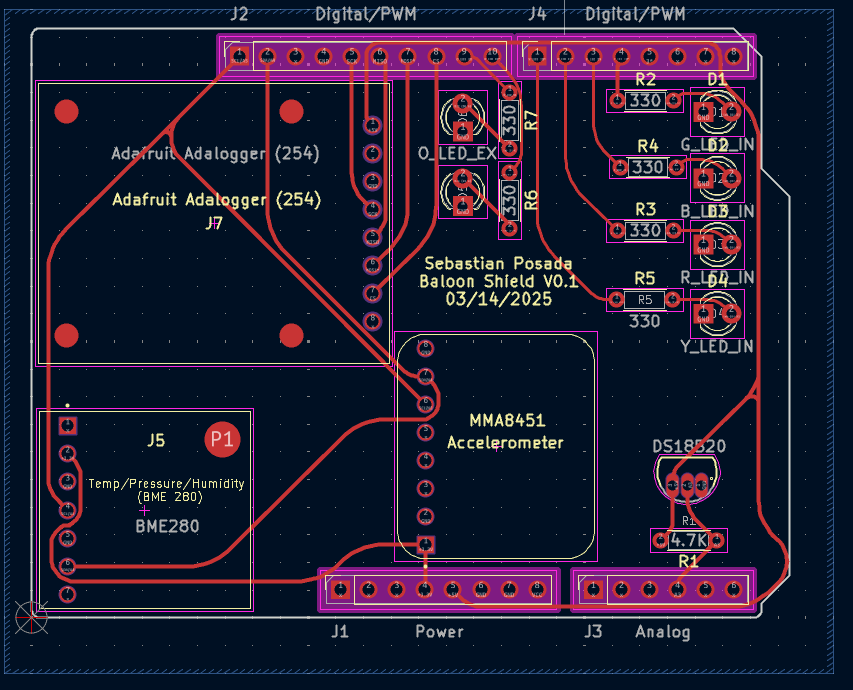
| Function | Part | Interface |
|---|---|---|
| Temperature / humidity / pressure | Adafruit BME280 | I²C |
| 3-axis acceleration | Adafruit MMA8451 | I²C |
| External temperature probe | DS18B20 (with 4.7 kΩ pull-up) | 1-Wire |
| Data storage | Adafruit MicroSD breakout (#254) | SPI |
| Status indicators | 4 internal LEDs (green, blue, red, yellow) + 2 external LEDs (blue, orange) | GPIO |
The course's baseline design used six separate analog sensors. I redesigned it around shared-bus, multi-function parts:
| Baseline design | My design | |
|---|---|---|
| Cost (sensors + logger) | $135.81* | $35.36 |
| Power draw | 1.28 W | 0.41 W |
| Runtime on a 9 V battery (4.5 Wh) | ~3.5 h | ~11 h |
*The baseline total includes the Arduino Uno and 9 V battery. My total doesn't, so the true difference is smaller than it looks, but still large.
The full requirements, block diagram, flowchart, and power and weight budgets are in docs/design-presentation.pdf.
| Top | Bottom |
|---|---|
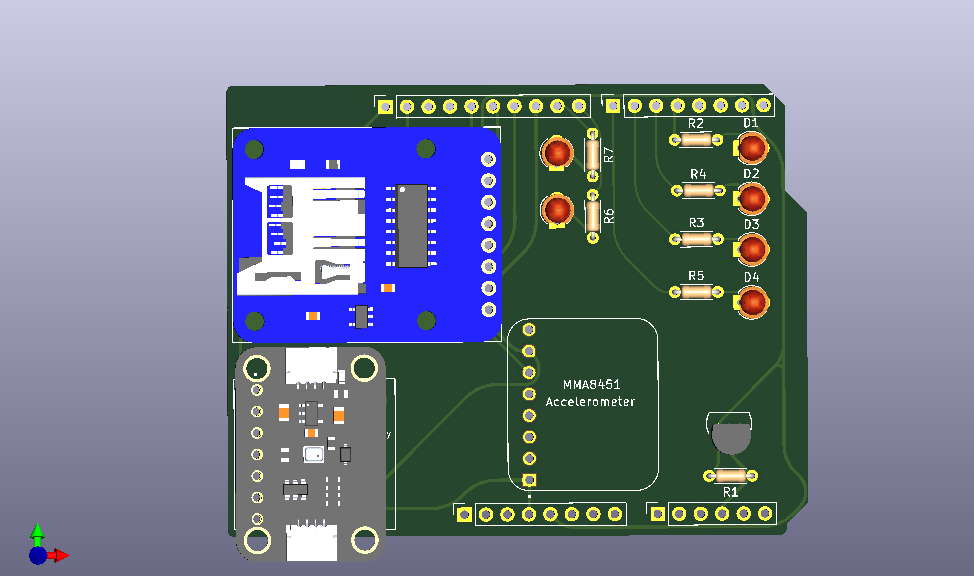 | 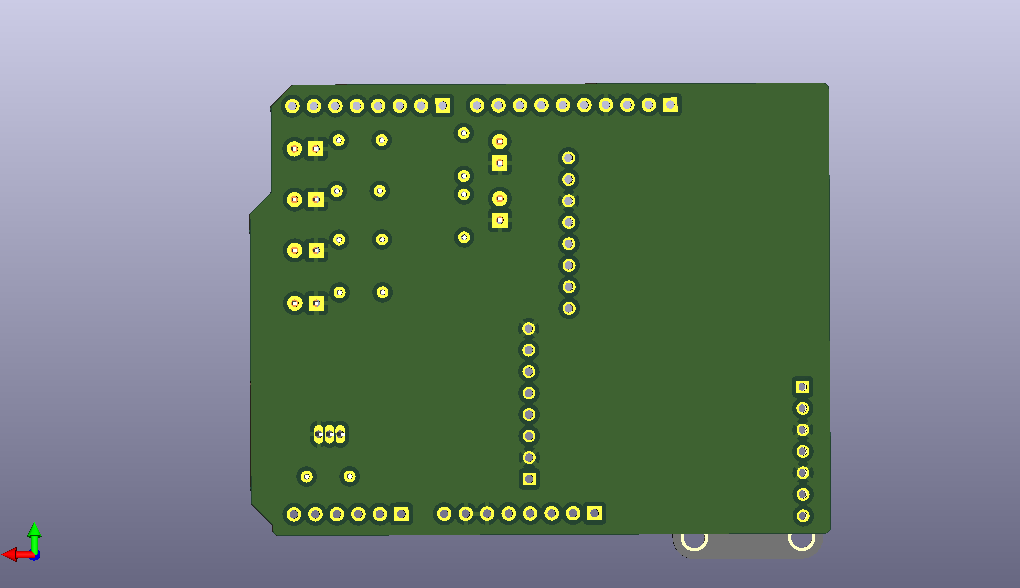 |
Schematic: docs/schematic.pdf
hardware/
  MicroP_Final_Porject.kicad_pro / .kicad_sch / .kicad_pcb   KiCad project
  Components/                 Custom symbols, footprints, and 3D models for each module
  Arduino_MountingHole.pretty/ Uno mounting-hole footprints
  BOM/ibom.html               Interactive BOM (open in a browser)
  gerber/                     Fabrication files
images/                       Board renders
docs/ Schematic PDF and design presentationInstall KiCad 7 or newer and open hardware/MicroP_Final_Porject.kicad_pro. To order boards, send the contents of hardware/gerber/ to a PCB fab.
Final project for a microprocessors course (ENCE 3210), March 2025.
| Qty | Value | Footprint | References |
|---|---|---|---|
| 6 | 330 | Resistor_THT:R_Axial_DIN0204_L3.6mm_D1.6mm_P5.08mm_Horizontal | R2, R3, R4, R5, R6, R7 |
| 1 | 4.7K | Resistor_THT:R_Axial_DIN0204_L3.6mm_D1.6mm_P5.08mm_Horizontal | R1 |
| 1 | Adafruit Adalogger (254) | adaFruitMicroSD_254:AdaFruit_MicroSD_254 | J7 |
| 1 | Analog | Connector_PinSocket_2.54mm:PinSocket_1x06_P2.54mm_Vertical | J3 |
| 1 | BME280 | ADAFruitBME280:MODULE_2652 | J5 |
| 1 | B_LED_EX* | LED_THT:LED_D3.0mm | D5 |
| 1 | B_LED_IN | LED_THT:LED_D3.0mm | D2 |
| 1 | DS18B20 | DS18B20:DS18B20_TO-92 | J6 |
| 1 | Digital/PWM | Connector_PinSocket_2.54mm:PinSocket_1x10_P2.54mm_Vertical | J2 |
| 1 | Digital/PWM | Connector_PinSocket_2.54mm:PinSocket_1x08_P2.54mm_Vertical | J4 |
| 1 | G_LED_IN | LED_THT:LED_D3.0mm | D1 |
| 1 | MMA8451 | AdaFruit_Accel_MMA8451:MODULE_2019 | J10 |
| 1 | O_LED_EX | LED_THT:LED_D3.0mm | D6 |
| 1 | Power | Connector_PinSocket_2.54mm:PinSocket_1x08_P2.54mm_Vertical | J1 |
| 1 | R_LED_IN | LED_THT:LED_D3.0mm | D3 |
| 1 | Y_LED_IN | LED_THT:LED_D3.0mm | D4 |
toniebox-reverse-engineering/toniebox-pcb
KiCad schematic of the Toniebox PCB (including datasheets).


fcl2002/Open-Ruche-Monitoring
An intelligent beehive monitoring solution combining embedded AI, LoRaWAN communication, and solar power to help beekeepers protect their colonies and optimize hive management.


vul-os/sirboard
Open hardware: 107 KiCad PCB designs — SMD-to-THT breakout adapters, ATTiny/ATMega/ESP development boards, and a 39-part sensor line on a common JST-SH connector.


KnoxMakers/Electronics
schematics, board files, firmware, slide decks, and the like
It measures 68.6 × 53.3 mm and has 2 copper layers, 1.6 mm thick.
21 parts, built around the BME280, DS18B20 and MMA8451QT. The full list of its parts is on this page, with links to each part's symbol and footprint where PCBKit's library has them.
From the Sebastian-S-Posada/balloon-data-logger-shield repository on GitHub, at the commit this page was made from: the board is hardware/MicroP_Final_Porject.kicad_pcb and its schematic hardware/MicroP_Final_Porject.kicad_sch. PCBKit opens the board in the browser, with nothing to install.
Its repository states no licence, so its author keeps all rights: ask Sebastian-S-Posada before reusing the design.