2 layers27.9 × 101.6 mm

 emeb/RP2040_Audio23
A Eurorack module for stereo audio effects based on the Raspberry Pi RP2040 MCU
RP2040 Audio is an open-source printed circuit board by emeb, from the emeb/RP2040_Audio repository on GitHub, published under the MIT licence. It is a 2-layer board of 38.1 × 101.6 mm with 121 parts on 109 nets, routed with 925 tracks and 114 vias.
It is built around the RP2040, MCP6004-E/P and W25Q32JVSSIQ, with the LM1117-5.0, LP2985-33DBV and BAT54C among its other parts. Its parts include 50 capacitors, 31 resistors, 11 connectors, 9 ICs and 3 diodes. It belongs with the audio and music boards and the RP2040 boards of this library.


A Eurorack module for stereo audio effects based on the Raspberry Pi RP2040 MCU
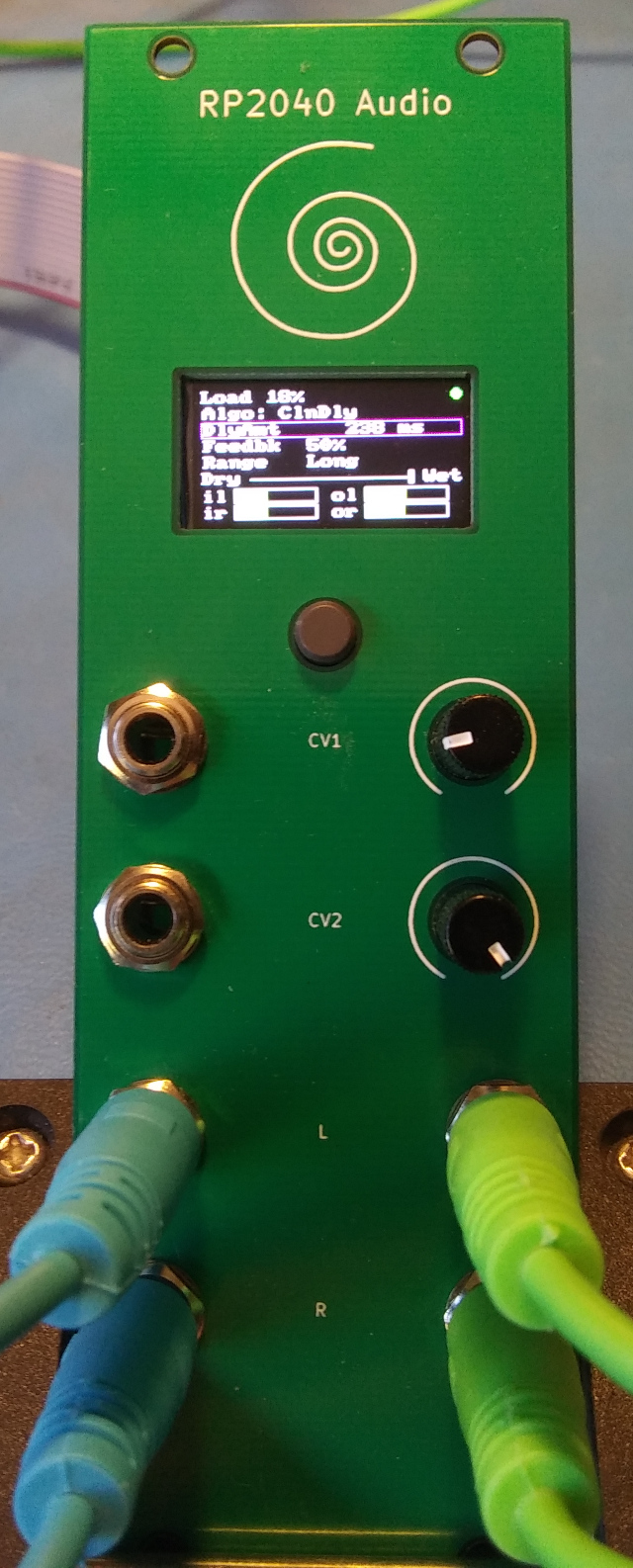
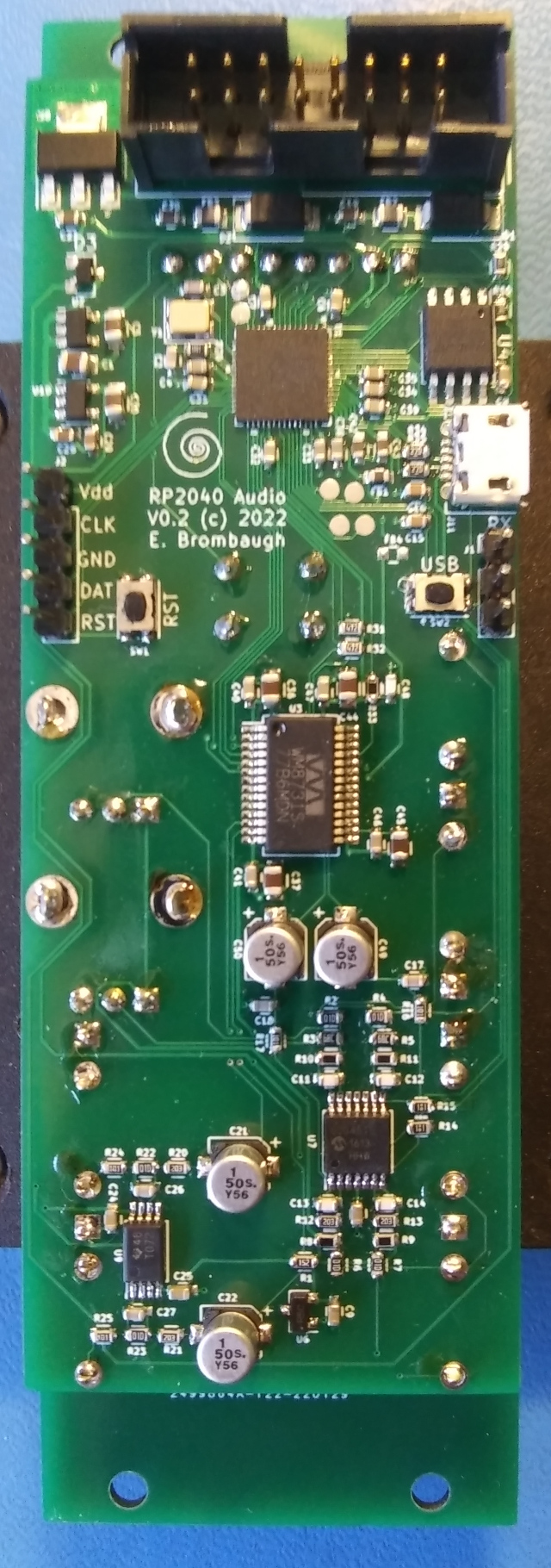
I've been doing audio synthesis and effects in the Eurorack modular market for a number of years. I started out in the late 2000's using the Microchip dsPIC and migrated over to ARM Cortex M devices, mostly STM32 in order to get access to higher speeds, more memory and floating point math. This was my main platform for most of the 2010's until the great silicon drought of the 2020's made high-end STM32 devices almost impossible to get. Into the vacuum stepped the good folks at the Raspberry Pi Foundation with the RP2040 MCU which has a fair chunk of on-chip SRAM, dual ARM Cortex M0 cores and a decent complement of peripherals.
This project is a feasibility study of using the RP2040 MCU as an audio effects processor, with particular emphasis on performance with challenging DSP.
The complete design consists of two PCBs:
The system PCB has the following features:
A demonstration firmware is included that exercises all of the capabilities of the system, including the LCD, UI button, CV inputs and stereo audio I/O. It is a basic multi-effects unit that supports a complement of audio DSP algorithms that are easily extended by adding standardized modules to a data structure. As provided here just three algorithms are available:
Other algorithms have been tested including phasers, flangers, frequency shifters, resampling delays and reverbs, but these are not publicly released at this time.
Overall the RP2040 is a capable device that can do a reasonable amount of audio DSP. The lack of floating point is not a huge incovenience if one is handy with fixed point arithmetic and the large on-chip SRAM is sufficiently large for reasonable audio data buffers. The PIO is handy for building interfaces and is capable of full-duplex I2S with no difficulty. The on-chip ADC underperforms its 12-bit data width however and requires a fair bit of post-processing to remove noise and jitter in the conversion results. The dual ARM cores are useful in dividing up user interface and DSP tasks to keep a snappy response, but even with two cores the system struggles to compete with higher-spec ARM systems.
TL;DR - you can use it for DSP, but I'd prefer a Cortex M7.
| Qty | Value | Footprint | References |
|---|---|---|---|
| 19 | 0.1uf | Capacitors_SMD:C_0603 | C4, C6, C10, C24, C25, C31, C32, C33, C34, C35, C38, C39, C40, C41, C46, C47 +3 |
| 7 | 10uf | Capacitors_SMD:C_0805 | C1, C5, C30, C36, C37, C44, C45 |
| 6 | 100k | Resistors_SMD:R_0603 | R2, R4, R6, R7, R22, R23 |
| 6 | 1uf | Capacitors_SMD:C_0603 | C19, C20, C23, C28, C42, C43 |
| 6 | AudioJack2_SwitchT | footprints:Jack_3.5mm_QingPu_WQP-PJ398SM_Vertical_CircularHoles | J4, J5, J6, J7, J9, J10 |
| 6 | TestPoint | Measurement_Points:Measurement_Point_Round-SMD-Pad_Small | TP1, TP2, TP3, TP4, TP5, TP6 |
| 5 | 330pf | Capacitors_SMD:C_0603 | C11, C12, C13, C14, C48 |
| 4 | 100 | Resistors_SMD:R_0603 | R16, R17, R24, R25 |
| 4 | 1uf | Capacitors_SMD:CP_Elec_4x5.3 | C21, C22, C49, C50 |
| 4 | 20k | Resistors_SMD:R_0603 | R12, R13, R20, R21 |
| 3 | 0.01uf | Capacitors_SMD:C_0603 | C15, C16, C29 |
| 2 | 10k | footprints:Potentiometer_TT_P0915N | RV1, RV2 |
| 2 | 180 | Resistors_SMD:R_0603 | R14, R15 |
| 2 | 1k | Capacitors_SMD:C_0603 | FB1, FB4 |
| 2 | 1k | Resistors_SMD:R_0603 | R28, R30 |
| 2 | 220 | Resistors_SMD:R_0805 | FB2, FB3 |
| 2 | 220pf | Capacitors_SMD:C_0603 | C17, C18 |
| 2 | 27.5 | Resistors_SMD:R_0603 | R34, R35 |
| 2 | 27pf | Capacitors_SMD:C_0603 | C2, C3 |
| 2 | 33k | Resistors_SMD:R_0603 | R10, R11 |
| 2 | 4.7k | Resistors_SMD:R_0603 | R31, R32 |
| 2 | 49.9k | Resistors_SMD:R_0603 | R3, R5 |
| 2 | 60.4k | Resistors_SMD:R_0603 | R8, R9 |
| 2 | 68pf | Capacitors_SMD:C_0603 | C26, C27 |
| 2 | D | Diodes_SMD:D_SMA | D1, D2 |
| 2 | SW_Push | Buttons_Switches_SMD:SW_SPST_KMR2 | SW1, SW2 |
| 1 | 1.5k | Resistors_SMD:R_0603 | R1 |
| 1 | 10k | Resistors_SMD:R_0603 | R29 |
| 1 | 49 | Resistors_SMD:R_0603 | R33 |
| 1 | BAT54C | Package_TO_SOT_SMD:SOT-23 | D3 |
| 1 | Conn_02x08_Odd_Even | footprints:5103308-3 | J8 |
| 1 | Crystal_4pin_SMD | Crystals:Crystal_SMD_3225-4pin_3.2x2.5mm | Y1 |
| 1 | LCD | footprints:LCD_80x160_0.96 | J3 |
| 1 | LM1117-5.0 | TO_SOT_Packages_SMD:SOT-223-3_TabPin2 | U8 |
| 1 | LM4040DBZ-5 | Package_TO_SOT_SMD:SOT-23 | U6 |
| 1 | LP2985-3.3 | TO_SOT_Packages_SMD:SOT-23-5 | U10 |
| 1 | MCP1802x-xx02xOT | TO_SOT_Packages_SMD:SOT-23-5 | U2 |
| 1 | MCP6004 | Housings_SSOP:TSSOP-14_4.4x5mm_Pitch0.65mm | U7 |
| 1 | RP2040 | footprints:RP2040 | U1 |
| 1 | SWD | Pin_Headers:Pin_Header_Straight_1x05_Pitch2.54mm | J2 |
| 1 | SW_Push | footprints:SW_PUSH_6mm_Center | SW4 |
| 1 | Serial | Pin_Headers:Pin_Header_Straight_1x03_Pitch2.54mm | J1 |
| 1 | TL072PW | Housings_SSOP:TSSOP-8_4.4x3mm_Pitch0.65mm | U9 |
| 1 | USB_B_Micro | footprints:USB_Micro-B_10103594-0001LF_actual_outline | J11 |
| 1 | Val** | footprints:avatar_small | Ref** |
| 1 | W25Q32JVSS | Package_SO:SOIC-8_5.23x5.23mm_P1.27mm | U4 |
| 1 | WM8731 | Housings_SSOP:SSOP-28_5.3x10.2mm_Pitch0.65mm | U3 |
It measures 38.1 × 101.6 mm and has 2 copper layers, 1.6 mm thick.
121 parts, built around the RP2040, MCP6004-E/P, W25Q32JVSSIQ and LM1117-5.0. The full list of its parts is on this page, with links to each part's symbol and footprint where PCBKit's library has them.
From the emeb/RP2040_Audio repository on GitHub, at the commit this page was made from: the board is Hardware/rp2040_audio.kicad_pcb and its schematic Hardware/Euro.kicad_sch. PCBKit opens the board in the browser, with nothing to install.
Its repository publishes it under the MIT licence: you may reuse it on that licence's terms (keep the author's notice, and for a copyleft licence share your changes alike).

emeb/ESP32S2_Audio
A Eurorack module demonstrating the use of the ESP32S2 as an audio effects processor

emeb/up5k_osc
The brute-force approach is to synthesize these analog waveforms at sufficiently high sample rates that the timing jitter becomes imperceptible.


sinitsinmike/Audcalc2
I'm happy with this, but its not 100% feature complete on the firmware side. Its really neat though, and I think you'll like it.


MarkSherstan/Drone
Mechanical, electrical, and software package for a custom quadcopter drone.