2 layers17.8 × 30.5 mm
 Ehryk/ehryk.github.com2
Code
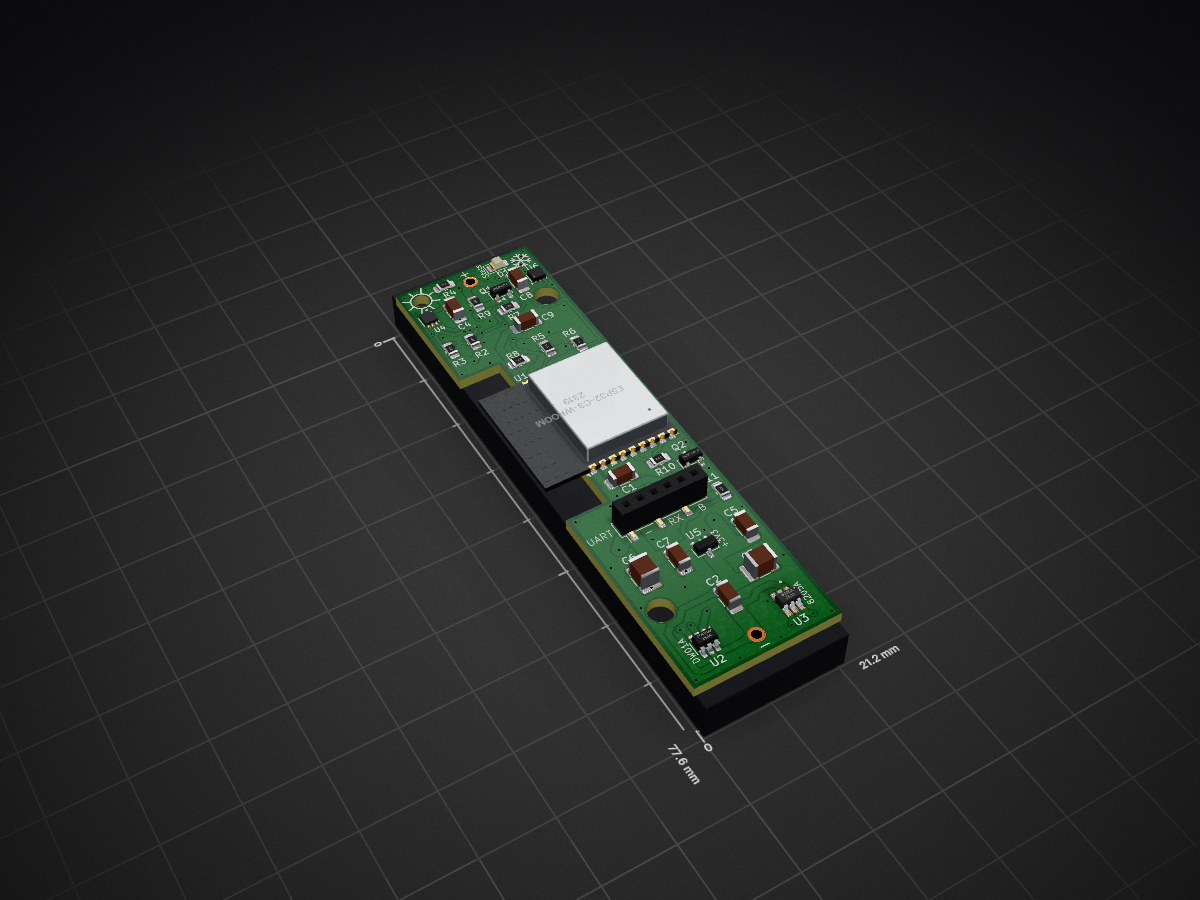
ESPFridge is an open-source printed circuit board by Ehryk, from the Ehryk/ehryk.github.com repository on GitHub. It is a 2-layer board of 21.2 × 77.6 mm with 30 parts on 28 nets, routed with 311 tracks and 73 vias.
It is built around the ESP32-C3-WROOM-02-H4, OPT3001DNPRQ1 and DW01A, with the AO3401A and MMBT3904 among its other parts. Its parts include 10 resistors, 9 capacitors, 6 ICs, 2 transistors and 1 diode. It belongs with the ESP32 and RISC-V boards of this library.


This is my github pages repo, viewable at ehryk.github.io. It also has some setup files that I sync between various computers, most notably git and bash aliases.
Github Pages (/, /js, /css, /img)
/linux && /git
These are the settings I sync between various computers. Update Config.bat for windows, update-config.sh for linux.
/rainmeter
Custom Rainmeter skins for GPU and CPU temps, etc.
/brian
Brian's Stuff. See more at Dr. Bird.org
| Qty | Value | Footprint | References |
|---|---|---|---|
| 7 | 0.1µF | Capacitor_SMD:C_1206_3216Metric_Pad1.33x1.80mm_HandSolder | C1, C2, C4, C5, C7, C8, C9 |
| 3 | 10kΩ | Resistor_SMD:R_0805_2012Metric_Pad1.20x1.40mm_HandSolder | R5, R6, R11 |
| 3 | 4.7kΩ | Resistor_SMD:R_0805_2012Metric_Pad1.20x1.40mm_HandSolder | R2, R3, R4 |
| 2 | 10µF | Capacitor_SMD:C_1210_3225Metric_Pad1.33x2.70mm_HandSolder | C3, C6 |
| 1 | 2.2kΩ | Resistor_SMD:R_0805_2012Metric_Pad1.20x1.40mm_HandSolder | R10 |
| 1 | 220kΩ | Resistor_SMD:R_0805_2012Metric_Pad1.20x1.40mm_HandSolder | R7 |
| 1 | 470kΩ | Resistor_SMD:R_0805_2012Metric_Pad1.20x1.40mm_HandSolder | R8 |
| 1 | 47kΩ | Resistor_SMD:R_0805_2012Metric_Pad1.20x1.40mm_HandSolder | R9 |
| 1 | 8205A | Ehryk:SOT95P285X140-6N | U3 |
| 1 | AO3401A | Package_TO_SOT_SMD:SOT-23 | Q1 |
| 1 | Battery_Cell | Ehryk:Keystone_1043 | BT1 |
| 1 | Conn_01x06_Socket | Connector_PinSocket_2.00mm:PinSocket_1x06_P2.00mm_Vertical_SMD_Pin1Left | J1 |
| 1 | DW01A | Package_TO_SOT_SMD:SOT-23-6 | U2 |
| 1 | ESP32-C3-WROOM-02 | RF_Module:ESP32-C3-WROOM-02 | U1 |
| 1 | MCP1700x-330xxTT | Package_TO_SOT_SMD:SOT-23 | U5 |
| 1 | MMBT3904 | Package_TO_SOT_SMD:SOT-23 | Q2 |
| 1 | OPT3001DNPRQ1 | Ehryk:SON65P200X200X65-7N | U4 |
| 1 | RED | LED_SMD:LED_0805_2012Metric_Pad1.15x1.40mm_HandSolder | D1 |
| 1 | TMP117xxDRV | Package_SON:WSON-6-1EP_2x2mm_P0.65mm_EP1x1.6mm | U6 |
It measures 21.2 × 77.6 mm and has 2 copper layers, 1.6 mm thick.
30 parts, built around the ESP32-C3-WROOM-02-H4, OPT3001DNPRQ1, DW01A and AO3401A. The full list of its parts is on this page, with links to each part's symbol and footprint where PCBKit's library has them.
From the Ehryk/ehryk.github.com repository on GitHub, at the commit this page was made from: the board is Circuits/ESPFridge/ESPFridge.kicad_pcb. PCBKit opens the board in the browser, with nothing to install.
Its repository states no licence, so its author keeps all rights: ask Ehryk before reusing the design.


Fred98246/STM32-Environmental-Sensor-and-Datalogging-Board
An open-source STM32F103C8T6 development board designed for environmental monitoring, featuring integrated Li-Ion battery management, USB-C, MicroSD data logging, and onboard I2C sensors for temperature, humidity, and…

DINDIN2007/Blystwatch
This is a demo board to showcase development with both the BlystL15 (based on the nrf54L15) and the IOComposer AI from I-Syst.inc.

BrandonFors/convention_pcb_badge
Design for a custom pcb badge for opensauce convention and maybe other conventions in the future.


Wudker/Clickfy
Compact ESP32-C3 based BLE multimedia remote with custom PCB, battery monitoring and low-power operation.

houseofthe051010/ESP32-Walkie-Talkie-V2
This ESP32 Walkie Talkie is redesigned with a SX1262 radio, a PCB, and a full case redesign.

jonny190/TableLight
A 3D-printable, battery-powered, USB-C rechargeable table lamp in the classic "Poldina" shape - honeycomb disc base, thin stem, down-firing cone shade with a white top - running WLED on an ESP32, with a capacitive touch…

louismomo66/field-eyes_pcb
Open fieldeyesv2.kicadpro in KiCad 9. The whole circuit is one flat schematic (fieldeyesv2.kicadsch): all 168 parts are on a single page, in four framed sections.