
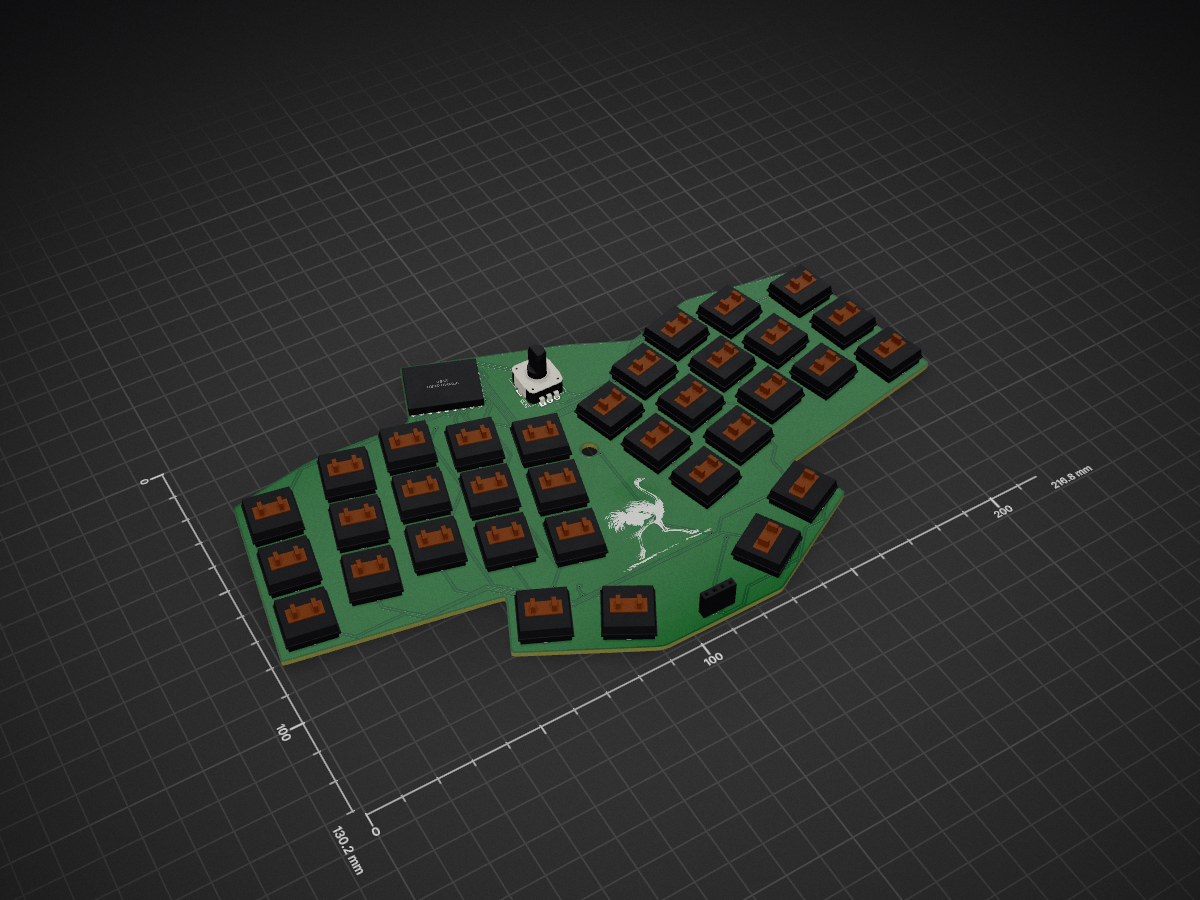
2 layers217.1 × 130.2 mm
 doesntfazer/Ostrich9
34 key keyboard based on RP2040 with canted MCU.
Ostrich is an open-source printed circuit board by doesntfazer, from the doesntfazer/Ostrich repository on GitHub, published under the GPL-3.0 licence. It is a 2-layer board of 217.1 × 130.2 mm with 73 parts on 57 nets, routed with 806 tracks and 28 vias.
It is built around the RP2040-ZERO. Its parts include 35 switches, 34 diodes and 1 IC. It belongs with the keyboards and input boards and the RP2040 boards of this library.

34 key keyboard based on RP2040 with canted MCU.
This keyboard was inspired by the Reviung34 keyboard.
You can find the qmk firmware here
If you are interested in using VIAL instead, (This is a GUI for qmk). Then please go here
It is important to note, the 0.9 version of this keyboard keyboard is built with an mcp23017-e/so MCP chip instead of using diodes.
This chip requires pull-up resistors. Since this was meant to use an OLED, it just borrows the one built into the SSD1306. If you decide you don't want an OLED, you will need to solder pull up resistors on GP0 and GP1. (4.7k have been sufficient in my testing)
If you are using the 1.0 or later versions of this keyboard, the keyboards will use diodes, and you won't have to worry about it.
| Qty | Value | Footprint | References |
|---|---|---|---|
| 34 | DIODE | Diode_SMD:D_SOD-123 | D1, D2, D10, D11, D12, D13, D14, D15, D16, D17, D18, D19, D20, D21, D22, D23 +18 |
| 34 | SW_PUSH | kbd:CherryMX_Choc_1u-w3 | SW1, SW2, SW10, SW11, SW12, SW13, SW14, SW15, SW16, SW17, SW18, SW19, SW20, SW21, SW22, SW23 +18 |
| 1 | LOGO | images:ostrich35mm | G*** |
| 1 | LOGO | images:qmk20mm | G*** |
| 1 | OLED | kbd:OLED_v2 | OL1 |
| 1 | RotaryEncoder | Rotary_Encoder:RotaryEncoder_Alps_EC12E_Vertical_H20mm | SW35 |
| 1 | rp2040-zero | mcu:rp2040-zero-smd-no-cut | U1 |


beekeeb/zerosprey42
Zerosprey42 Keyboard is a wired, beginner friendly, choc hotswap, MonoBlockSplit (Unibody), column-staggered, DIY mechanical keyboard.


ravinrabbid/DonCon2040
RP2040 based firmware and hardware for DIY Taiko no Tatsujin Drum Controllers
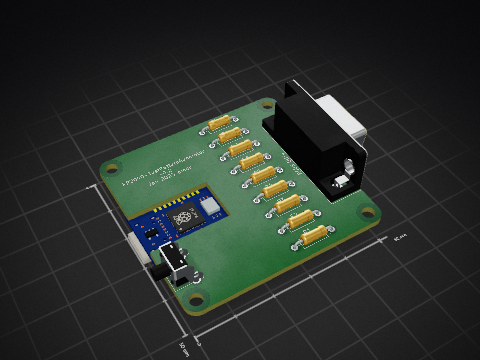
nmur/RP2040-TestPatternGenerator
A simple test pattern generator running on the RP2040 microcontroller

ChrisChrisLoLo/bunchiez40
A pocket keyboard that makes use of mouse switches to achieve a miniscule size

It measures 217.1 × 130.2 mm and has 2 copper layers, 1.6 mm thick.
73 parts, built around the RP2040-ZERO. The full list of its parts is on this page, with links to each part's symbol and footprint where PCBKit's library has them.
From the doesntfazer/Ostrich repository on GitHub, at the commit this page was made from: the board is Ostrich PCB/rev1 - diodes/Ostrich.kicad_pcb and its schematic Ostrich PCB/rev0.9-mcp23017/Ostrich.kicad_sch. PCBKit opens the board in the browser, with nothing to install.
Its repository publishes it under the GPL-3.0 licence: you may reuse it on that licence's terms (keep the author's notice, and for a copyleft licence share your changes alike).