2 layers58 × 48 mm
 Cybdo/CybdoClock
word clock / calendar / whatever. I'm too broke to afford a good looking word clock so i'm making my own !!
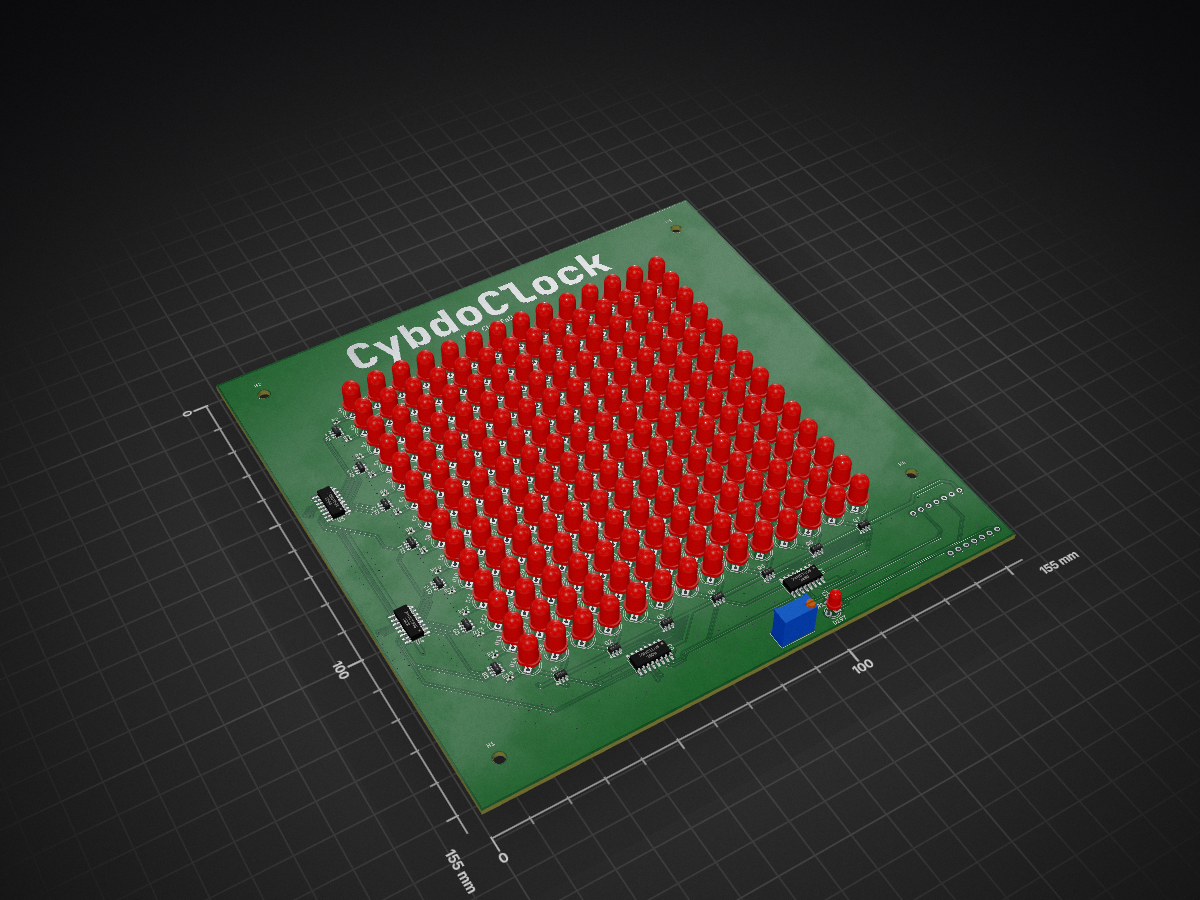
CybdoClock is an open-source printed circuit board by Cybdo, from the Cybdo/CybdoClock repository on GitHub, published under the MIT licence. It is a 2-layer board of 155 × 155 mm with 237 parts on 101 nets, routed with 402 tracks and 215 vias.
It is built around the ALS-PDIC144-6C/L378, 74HCT595D and CJL2301, with the HSW6822 and 3296W-1-103LF among its other parts. Its parts include 197 diodes, 15 resistors, 14 transistors, 5 ICs and 1 capacitor. It belongs with the lEDs and displays boards and the ESP32 and RISC-V boards of this library.


14 by 14 letter word clock / calendar / whatever, powered by esp32-c6!
Word clocks are arguably better and cooler than normal analog or digital clocks, but they are way too expensive comercially for a decent product, and even then there's not much customisation to it (the only one i could find was over 1000 dollars and could only show the time in 5 minute increments). CybdoClock was made to be able to show time down to the minute, in multiple formats, all while being customisable and allowing for different uses. The face plate can be swapped to show different languages or formats, and a calendar faceplate is coming soon!
pdf at ./zine.pdf
The housing requires 4x M3 screws, as well as 4x M3 heat-set inserts, and 4x 5mm diameter, 2.5mm thick magnets. Each faceplate also requires 4x 4x 5mm diameter, 2.5mm thick magnets, in the opposite polarity to the housing. Magnets should be able to friction fit and stay in place, however a drop of superglue can aid in its placement.
circup install -r requirements.txtCybdoClock will now turn on and sync to NTP once connected to a USB power source!
CybdoClock runs off CircuitPython 10.x, and code can be found under ./firmware/
CybdoClock is powered by a 14x14 LED matrix. NOTE: CybdoClock refreshes vertically, and defaults to left -> right. This is a hardware limitation, and overrides in firmware could cause permanent damage to components.
While the provided firmware uses the adafruit library and pins, a custom firmware can interface with the pins by sending the following serial data:
| 0 | 1 | 2 | 3 | 4 | 5 | 6 | 7 | 8 | 9 | 10 | 11 | 12 | 13 | 14 | 15 | 16 | 17 | 18 | 19 | 20 | 21 | 22 | 23 | 24 | 25 | 26 | 27 | 28 | 29 | 30 | 31 |
|---|---|---|---|---|---|---|---|---|---|---|---|---|---|---|---|---|---|---|---|---|---|---|---|---|---|---|---|---|---|---|---|
| Row 14 | Row 13 | Row 12 | Row 11 | Row 10 | Row 9 | Row 8 | NC | Row 7 | Row 6 | Row 5 | Row 4 | Row 3 | Row 2 | Row 1 | NC | Col 14 | Col 13 | Col 12 | Col 11 | Col 10 | Col 9 | Col 8 | NC | Col 7 | Col 6 | Col 5 | Col 4 | Col 3 | Col 2 | Col 1 | NC |
Please note - the net labels for columns and rows do not reflect their physical layouts, nor does the layout of the matrix in the schematic
a pdf can be found at ./schematics.pdf
| Qty | Value | Footprint | References |
|---|---|---|---|
| 196 | LED | LED_THT:LED_D5.0mm | D1, D10, D11, D100, D101, D102, D103, D104, D105, D106, D107, D108, D109, D110, D111, D112 +180 |
| 14 | 220R | Resistor_SMD:R_0402_1005Metric_Pad0.72x0.64mm_HandSolder | R2, R3, R4, R5, R6, R7, R8, R9, R10, R11, R12, R13, R14, R15 |
| 7 | CJL2301 | easyeda2kicad:SOT-23-6_L2.9-W1.6-P0.95-LS2.8-BL | Q1, Q2, Q3, Q4, Q5, Q6, Q7 |
| 7 | HSW6822 | easyeda2kicad:SOT-23-6_L2.9-W1.6-P0.95-LS2.8-BL | Q8, Q9, Q10, Q11, Q12, Q13, Q14 |
| 4 | 74HCT595 | Package_SO:SOIC-16_3.9x9.9mm_P1.27mm | U2, U3, U4, U5 |
| 4 | MountingHole | MountingHole:MountingHole_3.2mm_M3 | H1, H2, H3, H4 |
| 1 | 100nF | Capacitor_SMD:C_0402_1005Metric_Pad0.74x0.62mm_HandSolder | C1 |
| 1 | 28kR | Resistor_SMD:R_0402_1005Metric_Pad0.72x0.64mm_HandSolder | R1 |
| 1 | 3296W-1-103LF | Potentiometer_THT:Potentiometer_Bourns_3296W_Vertical | RV1 |
| 1 | ALS-PDIC144-6C/L378 | LED_THT:LED_D3.0mm | D197 |
| 1 | XIAO-ESP32-C6-DIP | imports:XIAO-ESP32-C6-DIP | U1 |
It measures 155 × 155 mm and has 2 copper layers, 1.6 mm thick.
237 parts, built around the ALS-PDIC144-6C/L378, 74HCT595D, CJL2301 and HSW6822. The full list of its parts is on this page, with links to each part's symbol and footprint where PCBKit's library has them.
From the Cybdo/CybdoClock repository on GitHub, at the commit this page was made from: the board is PCB/CybdoClock.kicad_pcb and its schematic PCB/CybdoClock.kicad_sch. PCBKit opens the board in the browser, with nothing to install.
Its repository publishes it under the MIT licence: you may reuse it on that licence's terms (keep the author's notice, and for a copyleft licence share your changes alike).


DD1SB/ARDF-TX
Date: 2026-10-15. Engineering review only; unbuilt and unenergized. Open RF80.kicadpro, schematic and native PCB in KiCad10.0.6. Three primary PCBs and the separate VHF true-AM design are unchanged.

hjafari890/passive-rf-backscatter-tag
Single-Sided FR-4 Passive RF Backscatter Tag System: Hardware, SDR Software, and Electrodynamic Modeling

jeffrey500/ServoBoard
A custom PCB that drives up to 4 PWM servos. The board uses the atmega328PB and has variable input and variable servo voltage using the LM2596S buck and AMS1117 LDO. The board also has 3 6n137 optocouplers.