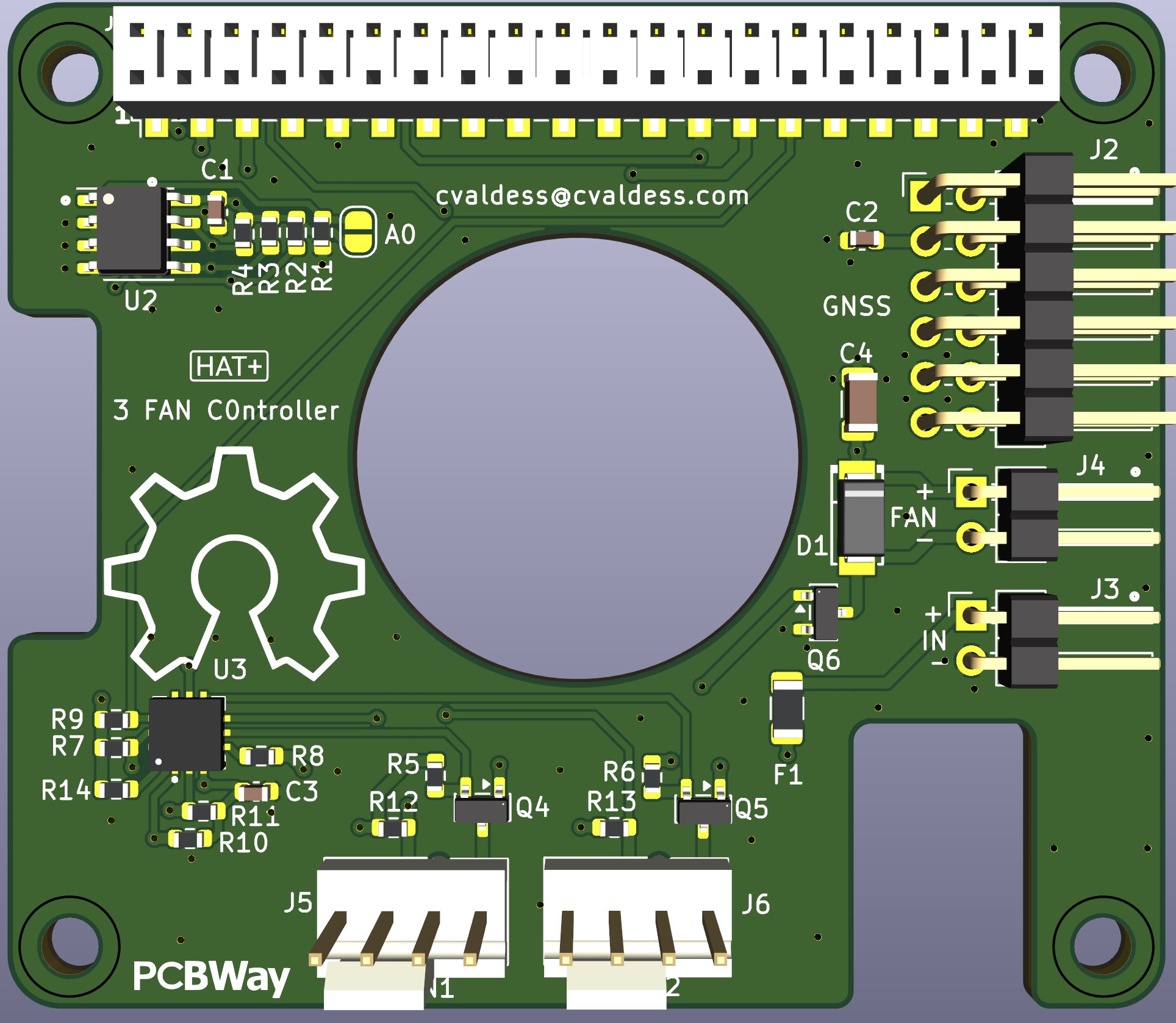
HAT+ is an open-source printed circuit board by cvaldess, from the cvaldess/Rpi3FanHatPlus repository on GitHub, published under the CERN-OHL-S-2.0 licence. It is a 4-layer board of 65 × 56.5 mm with 41 parts on 53 nets, routed with 305 tracks and 108 vias.
It is built around the EMC2303-1-KP-TR, AT24CS64-MAHM-T and AT24CS64-SSHM-B, with the HRC0603F4701ENTN, HRC0603F3901ENTN and CC0603KRX7R9BB104 among its other parts. Its parts include 14 resistors, 6 connectors, 4 capacitors, 3 ICs and 3 transistors. It belongs with the interfaces and adapters and radio and wireless boards of this library.
Raspberry Pi 5 HAT+ that drives the three fans of a case with a Microchip EMC2303
fan controller and breaks out the Pi's UART and a PPS input for a GNSS module (J2).
Status: revision 1, not yet manufactured or tested.
Features
EMC2303 I²C fan controller on the Pi's I²C1 bus (address 0x2E, ALERT on GPIO5).
Fan 1 / Fan 2 (J5, J6): standard 4-pin PWM fans with tachometer, e.g. Noctua NF-A4x10 PWM (12 V).
Fan 3 (J4): small 2-wire 12 V fan (up to 100 mA) that cools the GNSS module, switched on
the low side by an AO3400A MOSFET with an SS14 flyback diode.
GNSS connector (J2): connects a GNSS module (a Unicore UM982 in this build) to the
Raspberry Pi: UART0 (GPIO14/15), PPS on GPIO18, 5 V and GND.
12 V input (J3) for the fans, protected by a 0.5 A resettable fuse.
HAT+ ID EEPROM (AT24CS64) as required by the HAT+ specification.
4-layer board, 65 × 56.5 mm HAT+ outline, M3 mounting holes. Designed to sit on top of a PoE HAT.
Connectors
Ref
Function
Pinout
J1
Raspberry Pi 40-pin GPIO (Samtec HLE-120-02-F-DV-BE-A, bottom-entry SMT socket)
Standard Raspberry Pi header
J2
GNSS module to Raspberry Pi (2×6, 2.54 mm, right angle)
HAT+-BOM-PCBWay.csv: bill of materials with manufacturer part numbers and LCSC codes.
HAT+-CPL-PCBWay.csv: component placement file, in millimetres, top side only.
The files are prepared for PCB fabrication and assembly (PCBA) at
PCBWay. Board: 4 layers, 1.6 mm, ENIG recommended,
minimum track/space 0.15 mm, minimum drill 0.4 mm.
Design files and tools
KiCad 10 project in HATPlus/ (HAT+.kicad_pro); project
footprint libraries in HATPlus/libs/ and libs/.
The schematic review, design changes, footprints and fabrication outputs were done with
Konnect, an AI-assisted PCB design tool for
KiCad 10, driven by Anthropic's Claude through Claude Code.
This source describes Open Hardware and is licensed under the CERN-OHL-S v2
(LICENSE). You may redistribute and modify this source and make products using it
under the terms of the CERN-OHL-S v2. This source is distributed WITHOUT ANY EXPRESS OR IMPLIED
WARRANTY, INCLUDING OF MERCHANTABILITY, SATISFACTORY QUALITY AND FITNESS FOR A PARTICULAR
PURPOSE. Please see the CERN-OHL-S v2 for applicable conditions.
This is where the electronics for the Mothbox are developed, such as the PCB! It's copied over from https://github.com/Digital-Naturalism-Laboratories/Mothbox/tree/main/Hardware/PCB so you can check that out if you want…
The tutorial's 2x12 adapter (/mudd/133electronics/icepi-zero-dac-adc/adapterboard/) with a 2 x 6 right-angle Pmod socket on a 15 mm extension of its right-hand end, so an Icepi Zero can drive AMOD-A's and RF-MOD's Pmod…
This repository collects KiCad hardware design projects. Project specifications, validation results, and individual contributions are being documented; the presence of design files does not imply production readiness or…
It measures 65 × 56.5 mm and has 4 copper layers, 1.62 mm thick.
What parts does the HAT+ use?
41 parts, built around the EMC2303-1-KP-TR, AT24CS64-MAHM-T, AT24CS64-SSHM-B and HRC0603F4701ENTN. The full list of its parts is on this page, with links to each part's symbol and footprint where PCBKit's library has them.
Where can I download the HAT+ KiCad files?
From the cvaldess/Rpi3FanHatPlus repository on GitHub, at the commit this page was made from: the board is HATPlus/HAT+.kicad_pcb and its schematic HATPlus/HAT+.kicad_sch. PCBKit opens the board in the browser, with nothing to install.
Can I use the HAT+ design in my own project?
Its repository publishes it under the CERN-OHL-S-2.0 licence: you may reuse it on that licence's terms (keep the author's notice, and for a copyleft licence share your changes alike).