2 layers60 × 130 mm

 beatenavenue/hw_cursorboard
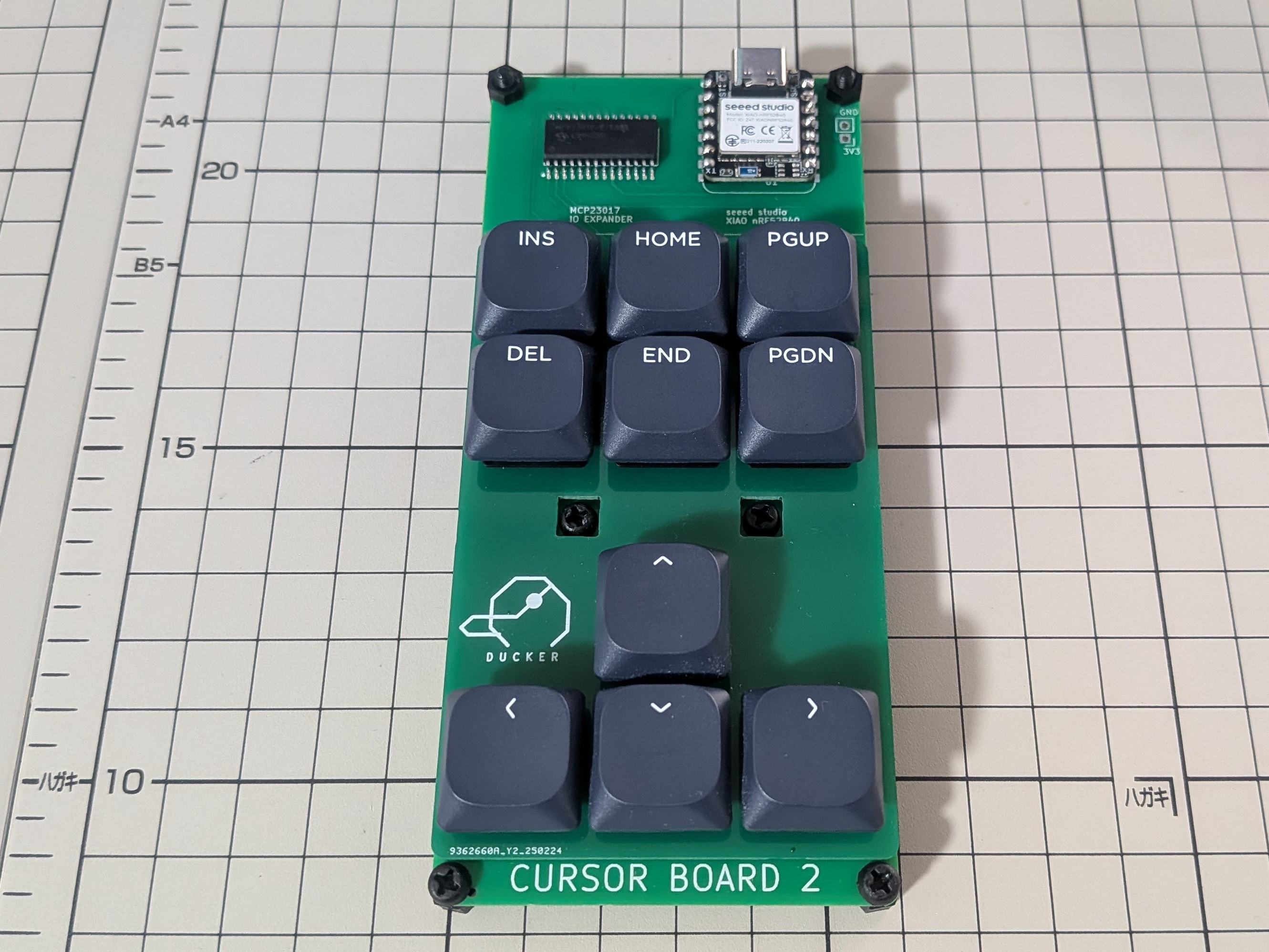
keyboard prototype
Hw cursorboard is an open-source printed circuit board by beatenavenue, from the beatenavenue/hw_cursorboard repository on GitHub, published under the MIT licence. It is a 2-layer board of 60 × 130 mm with 34 parts on 52 nets, routed with 193 tracks and 9 vias.
It is built around the MCP23017-E/SO and TS-1187A-B-A-B. Its parts include 10 diodes, 3 resistors, 2 ICs, 1 capacitor and 1 connector. It belongs with the nRF52 and nRF5x boards of this library.


keyboard prototype
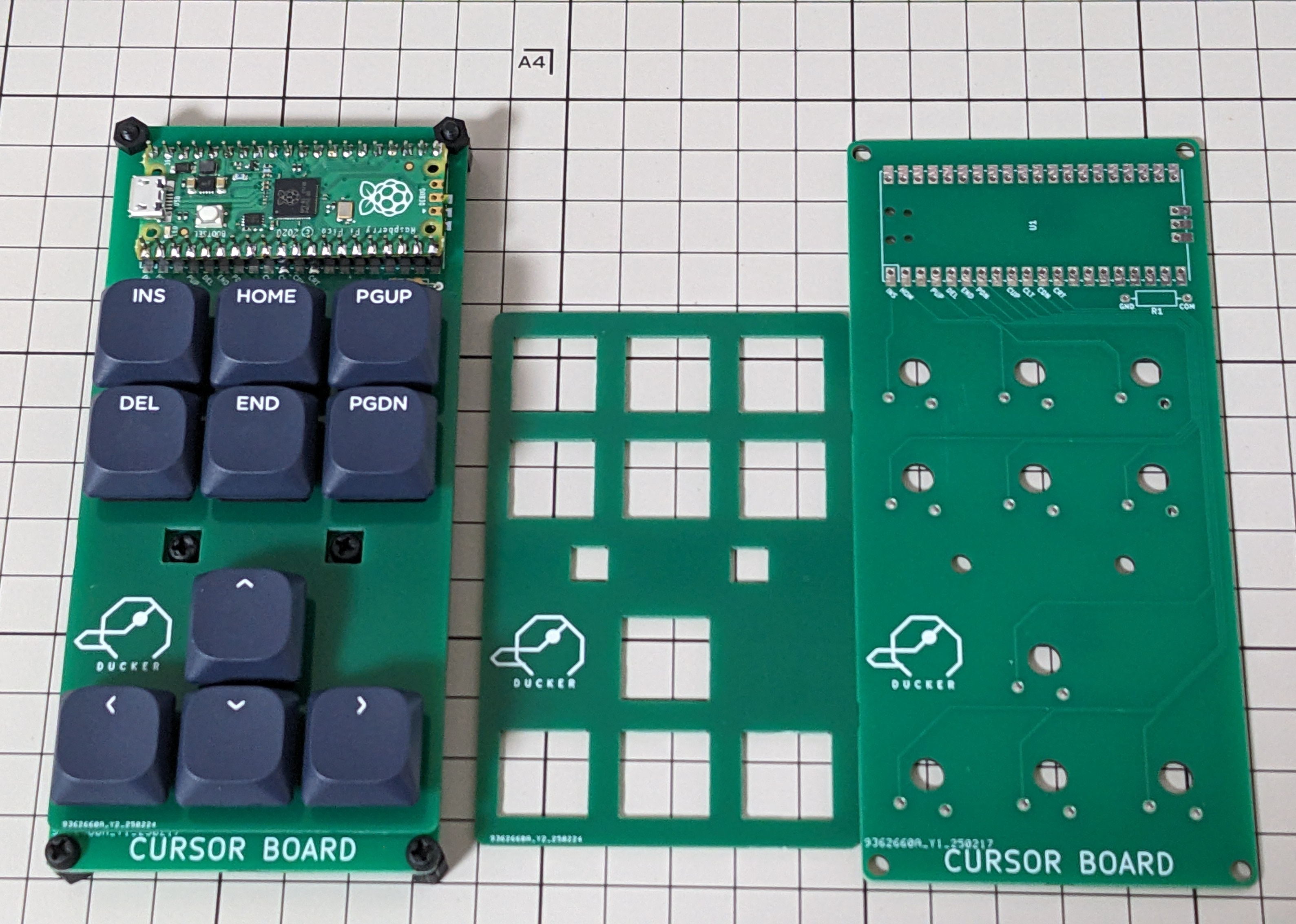
KS-33 switch stabilize plate, not required for electrical. but useful pretty visual.
IMPORTANT Top plate is MUST 1.2mm thickness.
Symbol and footprint geometry is embedded in the .kicad_sch / .kicad_pcb
files, so both projects can be opened, inspected and plotted to Gerber
without installing anything below. The libraries are only needed to edit the
parts themselves, or to re-import them into the schematic.
These are not current KiCad projects — type1 was last saved with KiCad 8.0 and type2 with KiCad 9.0. The library versions listed below are likewise the ones that were current when each board was designed. Fetching today's version from an upstream source may well give you a part that no longer drops in: library and part names get renamed, pin numbering and pad layout get revised, and easyeda2kicad output changes as LCSC updates its data. If a freshly fetched part does not match, compare it against the geometry already embedded in the board file — that is the version these designs were actually verified with.
| Library | Bundled | Source | License |
|---|---|---|---|
Gateron_KS33_Solderable | yes — type1/Library.pretty/ | ai03-2725/MX_V2 | MIT |
MCU_RaspberryPi_and_Boards | no | ncarandini/KiCad-RP-Pico | CC-BY-SA 4.0 with exception |
KS33_mount | yes — type1/Library.pretty/ | this project | MIT |
MCU_RaspberryPi_and_Boards provides the RPi_Pico_SMD_TH footprint. Clone
the repository above and register RP-Pico Libraries/MCU_RaspberryPi_and_Boards.pretty
as a global footprint library named MCU_RaspberryPi_and_Boards.
type1 does not use any easyeda2kicad-generated parts.
| Library | Bundled | Source | License |
|---|---|---|---|
KS33 | yes — type2/Library.pretty/ | ai03-2725/MX_V2 | MIT |
KS33_mount | yes — type2/Library.pretty/ | this project | MIT |
xiao, xiao2 | yes — type2/xiao/102010448/ | Seeed-Studio/OPL_Kicad_Library @ 3be8215 | CC BY-SA 4.0 |
easyeda2kicad | no | LCSC part data, via easyeda2kicad | not redistributed here |
type2/xiao/102010448/ provides the XIAO nRF52840 symbol (xiao2) and
footprint (xiao). Both files are taken unmodified from
Seeed-Studio/OPL_Kicad_Library,
Seeed Studio XIAO Series Library/, at commit
3be8215
(2026-03-18), and are redistributed here under CC BY-SA 4.0 with attribution
to Seeed Studio.
That commit is pinned deliberately. Upstream re-saved
Seeed_Studio_XIAO_Series.kicad_sym with KiCad 10.0 after this board was
designed, so the current upstream file is not interchangeable with the one
here. XIAO-nRF52840-DIP.kicad_mod is unchanged upstream at the time of
writing.
Two parts are taken from LCSC through easyeda2kicad. The generated library is not redistributed here; regenerate it from the LCSC part numbers instead:
pip install easyeda2kicad

easyeda2kicad --full --lcsc_id=C47023    # MCP23017-E/SO   (U2)
easyeda2kicad --full --lcsc_id=C318884   # TS-1187A-B-A-B  (SW1, reset switch)
Register the output as a global library named easyeda2kicad:
easyeda2kicad.kicad_symeasyeda2kicad.prettyeasyeda2kicad.3dshapes, exposed as the EASYEDA2KICAD path variableThe LCSC part numbers are also stored in the schematic as an LCSC Part field
on each symbol, which is what the JLCPCB BOM / CPL export reads.
The XIAO footprint refers to 3D models through the AMZPATH path variable.
These models are not included; the boards render without them.
type2 was ordered from JLCPCB. Gerber, BOM and CPL files are not kept in the repository — generate them from the board with the JLCPCB tools plugin.
U2 (MCP23017) is hand-soldered, so exclude it from the BOM and the CPL
before ordering assembly. Every other part carries an LCSC Part field in the
schematic, which is what the plugin reads.
MIT, for the design files created in this repository.
Third-party symbols and footprints — both the bundled libraries listed above and the geometry embedded in the KiCad files — are not covered by that grant; each remains under the terms of the upstream project it came from, as listed in the table.
| Qty | Value | Footprint | References |
|---|---|---|---|
| 10 | D | Diode_SMD:D_SOD-123 | D1, D2, D3, D4, D5, D6, D7, D8, D9, D10 |
| 10 | SW_Push | KS33:Gateron-KS33-Solderable-1U | SW_CD9, SW_CL8, SW_CR10, SW_CU7, SW_DEL4, SW_END5, SW_HOME2, SW_INS1, SW_PGDN6, SW_PGUP3 |
| 6 | , , , , , | ||
| 2 | 4k7 | Resistor_SMD:R_0603_1608Metric | R1, R2 |
| 1 | 0.1u | Capacitor_SMD:C_1206_3216Metric | C1 |
| 1 | 10k | Resistor_SMD:R_0603_1608Metric | R3 |
| 1 | Conn_01x02 | Connector_PinHeader_2.54mm:PinHeader_1x02_P2.54mm_Vertical | J1 |
| 1 | MCP23017-E/SO | easyeda2kicad:SOIC-28_L18.0-W7.5-P1.27-LS10.3-BL | U2 |
| 1 | TS-1187A-B-A-B | easyeda2kicad:SW-SMD_4P-L5.1-W5.1-P3.70-LS6.5-TL_H1.5 | SW1 |
| 1 | XIAO-nRF52840-DIP | xiao:XIAO-nRF52840-DIP | U1 |

pierrechevalier83/ferris
A low profile split keyboard designed to satisfy one single use case elegantly


BrownSpaceEngineering/PVDX-ADCS-PMB
Avionics files related to ADCS and Perovskite schematics, pcb design, and documentation


techie66/EngineDataLogger-EngineData
Arduino code for SleepyPi that is attached to main datalogger. Reads engine sensors.

techie66/EngineDataLogger-FrontControls
Arduino code for front controls device.

wubneh/MCTR260-pico-firmware
Raspberry Pi Pico W robot controller firmware for MCTR 260 Mechatronics Design. Dual-core BLE architecture with mecanum drive, stepper/DC motor support, and configurable motion profiles.
It measures 60 × 130 mm and has 2 copper layers, 1.6 mm thick.
34 parts, built around the MCP23017-E/SO and TS-1187A-B-A-B. The full list of its parts is on this page, with links to each part's symbol and footprint where PCBKit's library has them.
From the beatenavenue/hw_cursorboard repository on GitHub, at the commit this page was made from: the board is type2/hw_cursorboard.kicad_pcb and its schematic type1/hw_cursorboard.kicad_sch. PCBKit opens the board in the browser, with nothing to install.
Its repository publishes it under the MIT licence: you may reuse it on that licence's terms (keep the author's notice, and for a copyleft licence share your changes alike).