
2 layers132.3 × 94.9 mm

 aniketkharel/sweepv1
RP2040 corne style keyboard.
Sweepv1 is an open-source printed circuit board by aniketkharel, from the aniketkharel/sweepv1 repository on GitHub. It is a 2-layer board of 271.9 × 107.3 mm with 95 parts on 66 nets, routed with 635 tracks and 25 vias.
It is built around the RP2040-ZERO. Its parts include 42 diodes, 42 switches, 1 IC and 1 connector. It belongs with the keyboards and input boards and the RP2040 boards of this library.
A custom 42-key ergonomic keyboard inspired by the Corne layout and strongly based on the layout work shared by Mark Stosberg.
Main layout credit: Mark Stosberg Corne 3x5+1 Keyboard Layout
This version uses a single PCB with one RP2040-Zero module in the centre. It keeps the Corne-style left and right key clusters while avoiding a detachable split design.
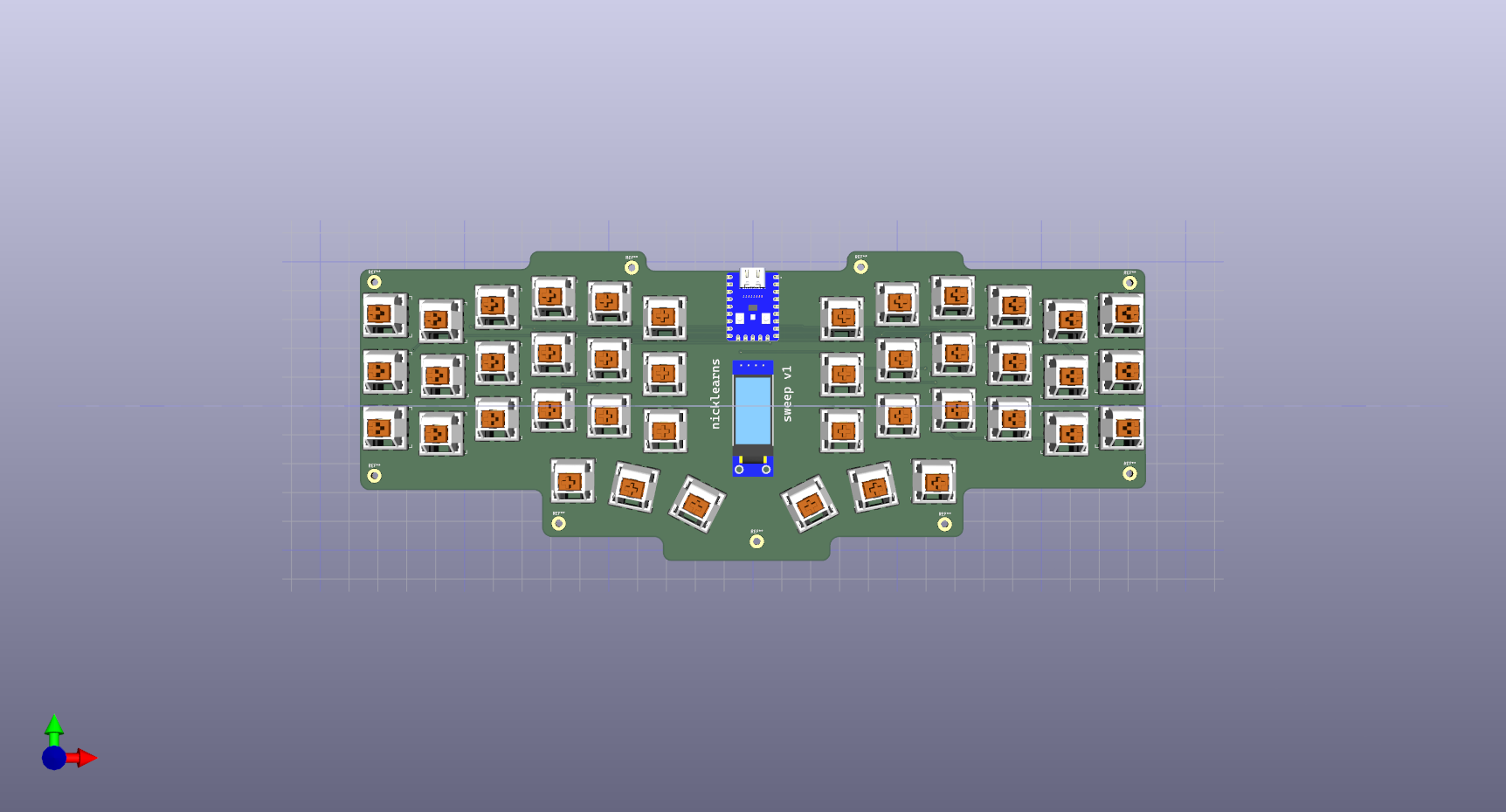
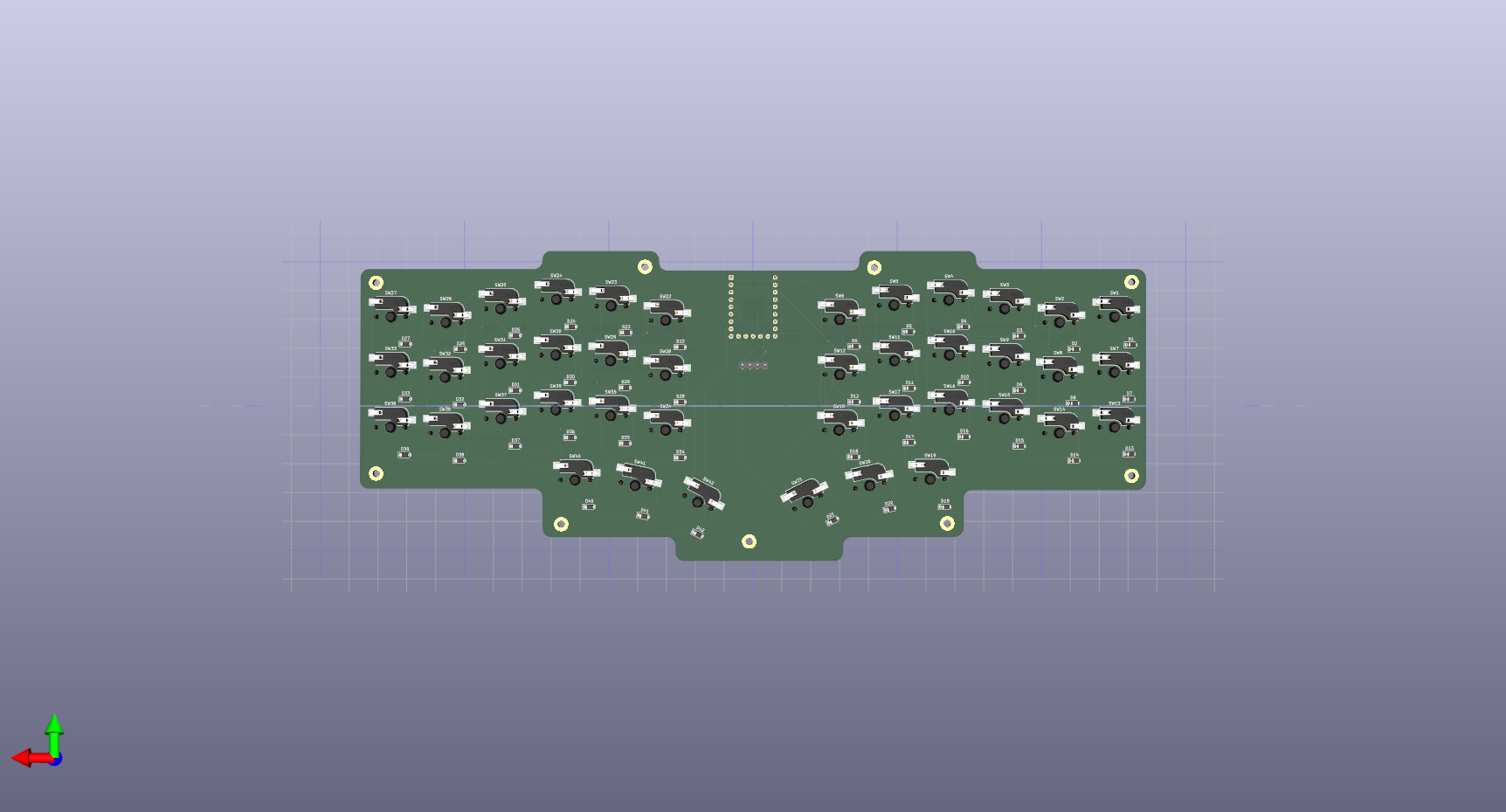
The keyboard uses an 8-row by 6-column matrix with shared columns.
Rows:
Columns:
| GPIO | Function |
|---|---|
| GP0 | LROW0 |
| GP1 | LROW1 |
| GP2 | LROW2 |
| GP3 | LROW3 |
| GP4 | RROW0 |
| GP5 | RROW1 |
| GP6 | RROW2 |
| GP7 | RROW3 |
| GP8 | COL0 |
| GP9 | COL1 |
| GP10 | COL2 |
| GP11 | COL3 |
| GP12 | COL4 |
| GP13 | COL5 |
| GP26 | OLED SDA |
| GP27 | OLED SCL |
0.91 inch SSD1306 OLED module:
The key layout and ergonomic direction were heavily inspired by Mark Stosberg's Corne 3x5+1 layout:
https://mark.stosberg.com/markstos-corne-3x5-1-keyboard-layout/
Compile:
qmk compile -kb sweepv1 -km matrix_test
Flash the generated UF2 to the RP2040-Zero.
The OLED should display:
Every physical key also outputs a unique printable character for matrix testing.
Compile:
qmk compile -kb sweepv1 -km default
The normal OLED screen displays the current layer, Caps Lock state, and QMK status.
This project is released under the MIT License.
| Qty | Value | Footprint | References |
|---|---|---|---|
| 42 | D | Diode_SMD:D_SOD-123 | D1, D2, D10, D11, D12, D13, D14, D15, D16, D17, D18, D19, D20, D21, D22, D23 +26 |
| 42 | SW_Push | Footprints:Kailh_socket_MX | SW1, SW2, SW10, SW11, SW12, SW13, SW14, SW15, SW16, SW17, SW18, SW19, SW20, SW21, SW22, SW23 +26 |
| 1 | Conn_01x04 | Connector_PinHeader_2.54mm:PinHeader_1x04_P2.54mm_Vertical | J6 |
| 1 | RP2040-ZERO | RP2040-ZERO:MODULE_RP2040-ZERO | U2 |
The 86 most common of 95 parts.


beekeeb/zerosprey42
Zerosprey42 Keyboard is a wired, beginner friendly, choc hotswap, MonoBlockSplit (Unibody), column-staggered, DIY mechanical keyboard.


ravinrabbid/DonCon2040
RP2040 based firmware and hardware for DIY Taiko no Tatsujin Drum Controllers
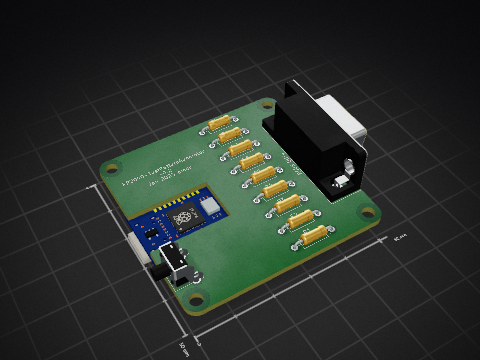
nmur/RP2040-TestPatternGenerator
A simple test pattern generator running on the RP2040 microcontroller

ChrisChrisLoLo/bunchiez40
A pocket keyboard that makes use of mouse switches to achieve a miniscule size

It measures 271.9 × 107.3 mm and has 2 copper layers, 1.6 mm thick.
95 parts, built around the RP2040-ZERO. The full list of its parts is on this page, with links to each part's symbol and footprint where PCBKit's library has them.
From the aniketkharel/sweepv1 repository on GitHub, at the commit this page was made from: the board is Sweepv1/Sweepv1.kicad_pcb and its schematic Sweepv1/KEYS_MATRIX.kicad_sch. PCBKit opens the board in the browser, with nothing to install.
Its repository states no licence, so its author keeps all rights: ask aniketkharel before reusing the design.