
2 layers52.3 × 75 mm
Tactileskin
aidanmohammed-ali/Tactile-Skin
A high-resolution, low-power capacitive tactile sensing technology optimised for use in wearable devices, robotics and healthcare.
16 parts

 aidanmohammed-ali/Tactile-Skin
A high-resolution, low-power capacitive tactile sensing technology optimised for use in wearable devices, robotics and healthcare.
Tactileskin is an open-source printed circuit board by aidanmohammed-ali, from the aidanmohammed-ali/Tactile-Skin repository on GitHub. It is a 2-layer board of 52.3 × 75 mm with 16 parts on 66 nets, routed with 284 tracks and 42 vias.
It is built around the 74HC4051. Its parts include 7 capacitors and 2 resistors. It belongs with the robots and motor control and sensors and measurement boards of this library.
This project focuses on creating a thin, flexible tactile skin that measures mechanical pressure, rather than just proximity. This repository contains the firmware and signal processing logic to convert physical deformation and capacitance into usable digital data and the schematics and Gerber files for the requisite hardware.
The core software running on the microcontroller, built using PlatformIO. It handles high-speed analog acquisition from the skin matrix and packs it for serial transmission.
/src: Main firmware source files (.c & .cpp)./include: Global header files (.h).platformio.ini: The core PlatformIO configuration script./tools)/common: Shared, hardware-agnostic C++ data engine containing the core signal processing logic and GUI rendering requirements. Folder required to compile both visualiser and raw-streaming./visualiser: A high-performance, cross-platform desktop utility built with Raylib. Features include:
.ini configuration files to calibrate individual sensor variations dynamically without recompiling the codebase./raw-streaming: A utility based on the visualiser for streaming the raw sensor data without any signal processing. Raw data across a specified time frame can be saved in .csv format and used for data analysis./hardware)/fpc: Flexible Printed Circuit manufacturing files.
/pcb: Main rigid Printed Circuit Board design histories.
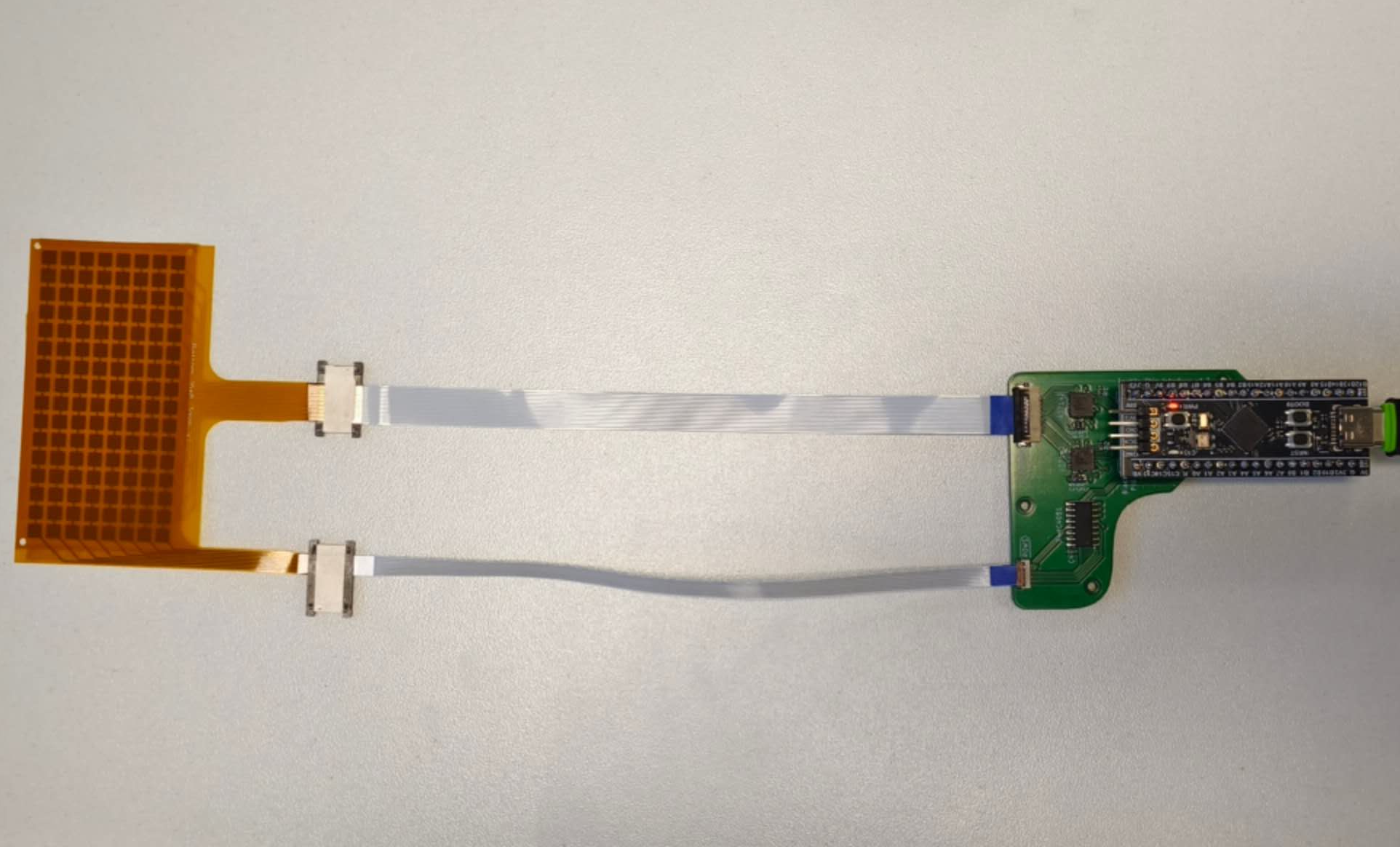
The tactile skin is built around a 16 x 8 capacitive matrix sensor. Each taxel in the matrix responds to local pressure-induced deformation, producing a change in capacitance that can be mapped into a two-dimensional tactile image. This layout provides a compact sensing surface while preserving enough spatial resolution to estimate where and how an object contacts the skin.
The signal collection board interfaces the sensor matrix with AD7142 capacitance-to-digital converters and an STM32F411CEU6 microcontroller. The AD7142 devices convert small capacitance changes from the tactile array into digital measurements, while the STM32 firmware coordinates sensor scanning, data acquisition, packet formatting, and USB serial transmission to the host computer. Together, the flexible sensor and collection board form a complete tactile feedback module for robotic manipulation experiments.
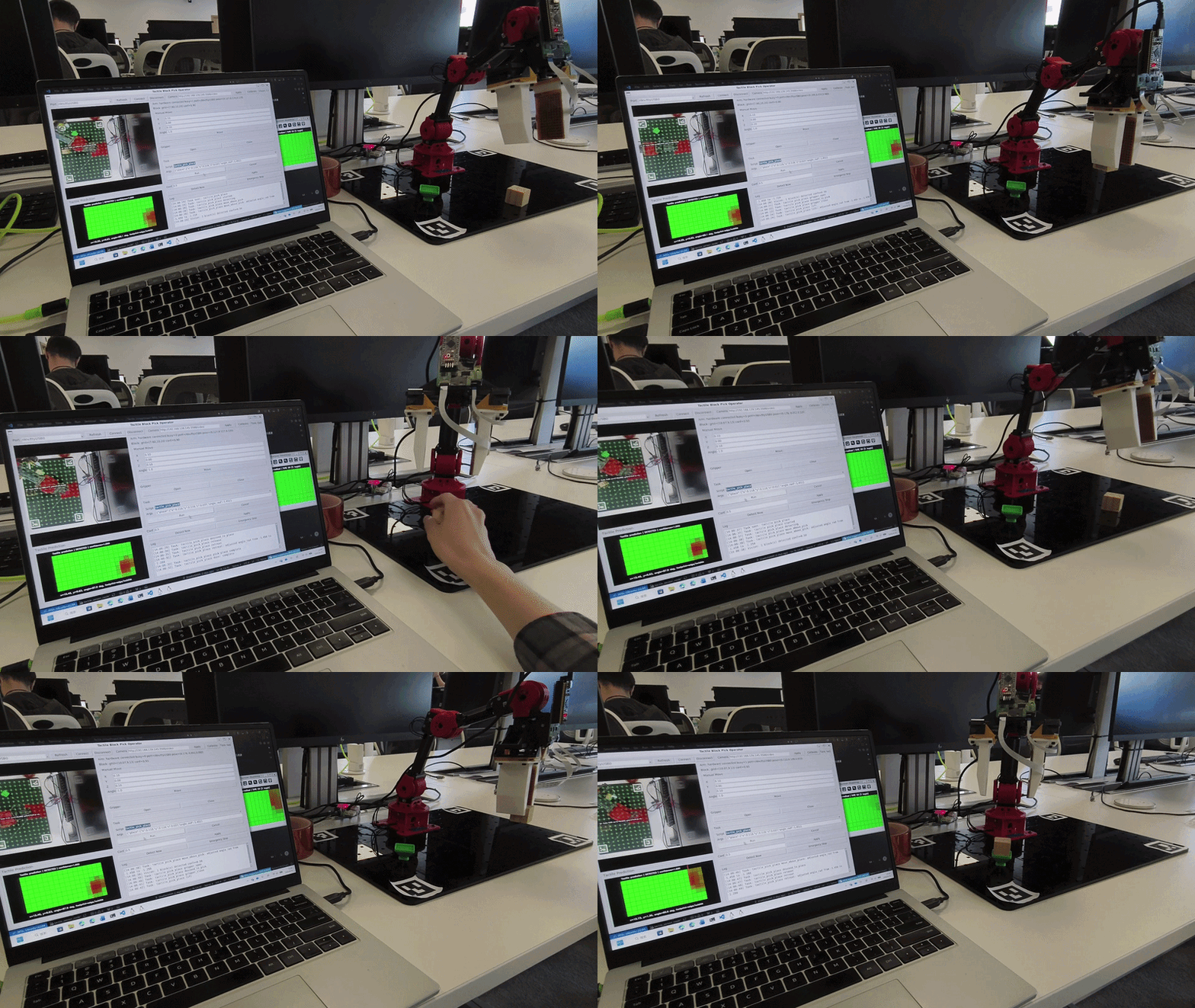
This demo shows a robot using tactile feedback to grasp and place a block more accurately. When the robot picks up the block, the tactile contact pattern is visualised on the computer as a red region on the green heat map. The robot uses this tactile pattern to estimate an offset for the final placement position, allowing it to compensate when the YOLO vision prediction is inaccurate or when the block is disturbed after detection.
In the first trial, the robot detects the block with computer vision, picks it up, and places it in the holder. In the second trial, the block is manually moved after YOLO detection, but the robot still places it successfully because the tactile feedback corrects the placement position during the task.
To keep the project history clean and professional, please follow these conventions:
Use Conventional Commits. Start every commit message with one of these:
Docs: Documentation changes or code comments (e.g., Docs: update README).Feat: New features or logic (e.g., Feat: implementation of scan loop).Fix: Bug fixes (e.g., Fix: corrected index overflow).Chore: Maintenance tasks, library imports, or project scaffolding (e.g., Chore: import USB core libraries).| Qty | Value | Footprint | References |
|---|---|---|---|
| 2 | 0.1u | Capacitor_SMD:C_0402_1005Metric | C2, C6 |
| 2 | 10n | Capacitor_SMD:C_0402_1005Metric | C1, C5 |
| 2 | 10u | Capacitor_SMD:C_0402_1005Metric | C3, C7 |
| 2 | 2.2k | Resistor_SMD:R_0402_1005Metric | R1, R2 |
| 2 | Conn_01x20_Pin | Connector_PinHeader_2.54mm:PinHeader_1x20_P2.54mm_Vertical | Black, J_MCU_LEFT1 |
| 2 | ~ | AD7142:QFN50P500X500X100-33N | AD7142, AD7142 |
| 1 | 100n | Capacitor_SMD:C_0402_1005Metric | C4 |
| 1 | 74HC4051 | Package_SO:SOIC-16_3.9x9.9mm_P1.27mm | 74HC4051 |
| 1 | FH12-16S-0.5SH_55_ | 16pinfpc:HIROSE_FH12-16S-0.5SH_55_ | COLUMNS |
| 1 | FH12-8S-0.5SH_55_ | 8pinfpc:HIROSE_FH12-8S-0.5SH_55_ | ROWS |
aidanmohammed-ali/Tactile-Skin
A high-resolution, low-power capacitive tactile sensing technology optimised for use in wearable devices, robotics and healthcare.

fossasia/pslab-hardware
PSLab Hardware Design and Schematics https://pslab.io

eddyem/stm32samples
Code samples and ready projects based on bare-metal STM32


sporkus/le_capybara_keyboard
Capactive sensing (EC) pcb for Le Chiffre keyboard

ginjake/ec_helix_build
商用利用したい場合は twitter @sirojake にご相談ください please contact me for commercial use. ## developer ginjake

It measures 52.3 × 75 mm and has 2 copper layers, 1.6 mm thick.
16 parts, built around the 74HC4051. The full list of its parts is on this page, with links to each part's symbol and footprint where PCBKit's library has them.
From the aidanmohammed-ali/Tactile-Skin repository on GitHub, at the commit this page was made from: the board is hardware/pcb/v1.2/tactileskin.kicad_pcb and its schematic hardware/pcb/v1.0/cdcmux.kicad_sch. PCBKit opens the board in the browser, with nothing to install.
Its repository states no licence, so its author keeps all rights: ask aidanmohammed-ali before reusing the design.