
2 layers55.4 × 54.4 mm
LED Project
WilliamHarkness/Chess_Boardgame_Timer_Project
This repository contains a simple Chess Clock application implemented in Arduino IDE language (C? / C++?)
18 parts
 WilliamHarkness/Chess_Boardgame_Timer_Project
This repository contains a simple Chess Clock application implemented in Arduino IDE language (C? / C++?)
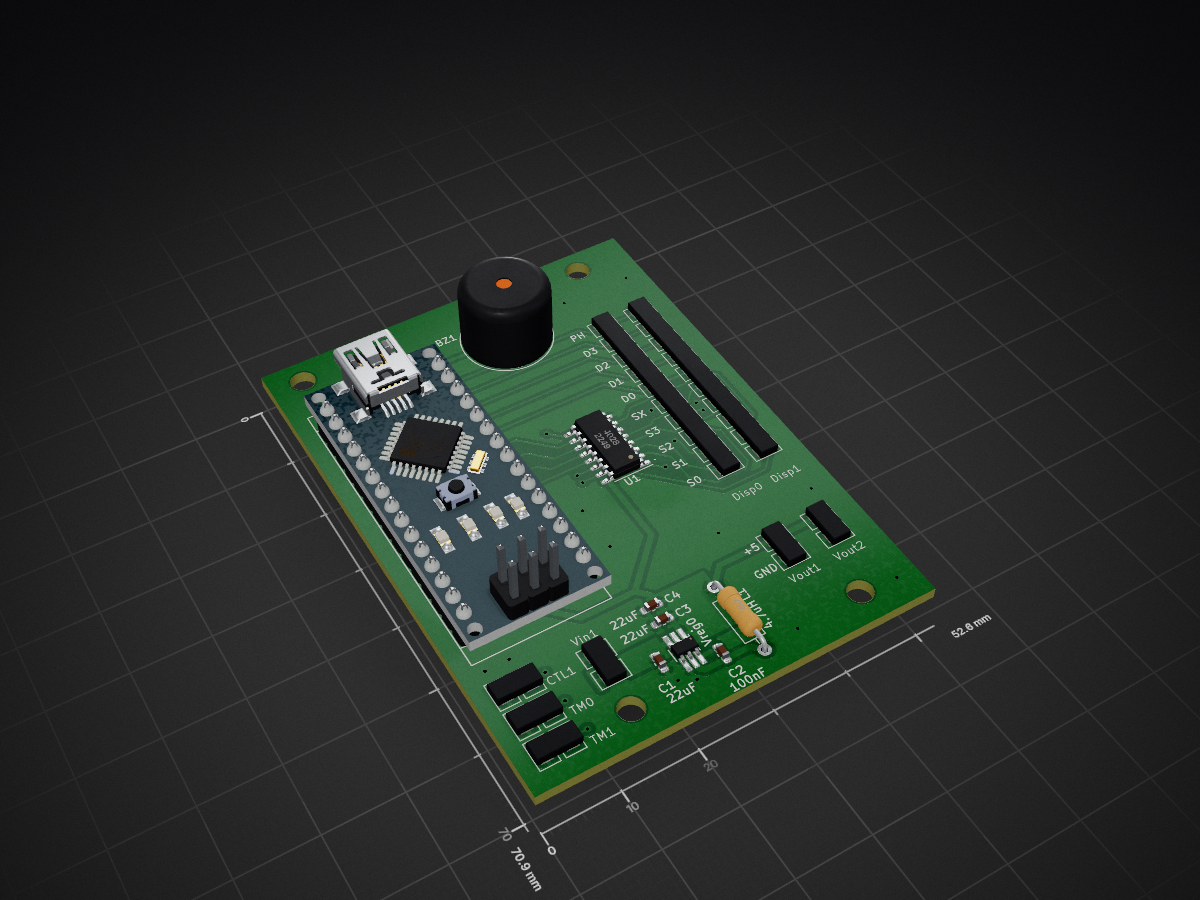
LED MAIN BOARD POWER is an open-source printed circuit board by WilliamHarkness, from the WilliamHarkness/Chess_Boardgame_Timer_Project repository on GitHub. It is a 2-layer board of 52.6 × 70.9 mm with 21 parts on 41 nets, routed with 156 tracks and 25 vias.
It is built around the AP63205WU. Its parts include 4 capacitors, 1 IC and 1 inductor. It belongs with the AVR (ATmega, ATtiny) boards of this library.
This repository contains a simple Chess Clock application implemented in Arduino IDE language (C? / C++?)
| Component | Part Number/Description |
|---|---|
| ATMEGA | ATMEGA32 |
| Control SW | SW-PB1-1DZ-A-P1-A |
| Multiplexer | CD4028BM96 |
| Buzzer | WST-1210T |
| Battery Holder | 36-234-ND |
| 5v Switching Reg | AP63205QWU-7 |
| Inductor | B78108E1472K000 |
| Caps 100nF 0603 | |
| Caps 22uF 0603 | |
| Main Button (Amazon) | DaierTek 6pcs 12V Momentary Push Button Switch 12mm Waterproof Small Round Mini Micro Black Metal Power Pushbutton SPST for Car RV Marine Boat Automotive |
| Power Button (Amazon) | QTEATAK 5Pcs On/Off Boat Rocker Switch 5Pcs 2 Pin 2 Position Snap 12V 110V 250V |
| Player Button | 12Pcs Arcade Joystick Game Console Buttons 30mm Replacement Button for Most Hori and for MadCatz, Snap in Installation |
I may be missing some parts from the list. I got most on digikey and the rest on amazon. This design should be simplified But was sucessful for my purposes.
| Qty | Value | Footprint | References |
|---|---|---|---|
| 4 | MountingHole | MountingHole:MountingHole_3.2mm_M3 | H1, H2, H3, H4 |
| 3 | 22uF | Capacitor_SMD:C_0603_1608Metric_Pad1.08x0.95mm_HandSolder | C1, C3, C4 |
| 3 | ~ | CUSTOM_PADS:2-Pad_FP | Vin1, Vout1, Vout2 |
| 2 | ~ | CUSTOM_PADS:10-Pad-OP | Disp0, Disp1 |
| 1 | 100nF | Capacitor_SMD:C_0603_1608Metric_Pad1.08x0.95mm_HandSolder | C2 |
| 1 | 4.7uH | Resistor_THT:R_Axial_DIN0207_L6.3mm_D2.5mm_P10.16mm_Horizontal | L1 |
| 1 | 4028 | Package_SO:SOIC-16_3.9x9.9mm_P1.27mm | U1 |
| 1 | AP63205WU | Package_TO_SOT_SMD:TSOT-23-6_HandSoldering | Vreg0 |
| 1 | Arduino_Nano_v3.x | Module:Arduino_Nano | A1 |
| 1 | Buzzer | Buzzer_Beeper:Buzzer_12x9.5RM7.6 | BZ1 |
| 1 | SW_CTRL | CUSTOM_PADS:2-Pad_FP | CTL1 |
| 1 | SW_T0 | CUSTOM_PADS:2-Pad_FP | TM0 |
| 1 | SW_T1 | CUSTOM_PADS:2-Pad_FP | TM1 |
WilliamHarkness/Chess_Boardgame_Timer_Project
This repository contains a simple Chess Clock application implemented in Arduino IDE language (C? / C++?)

VoronDesign/Voron-Tap
Tap is a nozzle-based z-probe for the V2 and Trident printer designs. The entire toolhead moves to trigger an optical switch. Tap offers many advantages:

FujiNetWIFI/fujinet-hardware
Schematics and design files for FujiNet hardware

andrekuehne/openradfan
An ESPHome-driven controller for radiator fans to improve heat output


doppelhub/Honda_Insight_LiBCM
Replacement BCM for G1 Honda Insight Lithium Conversion

GaudiLabs/qPocketPCR
Quantitative PCR machine detecting fluorescence using a camera

Qballjos/Voron-2.4-Otopus-pro-SB2209-U2C-CAN
Voron 2.4 R2 with ,Stealthburner, Voron Tap, Bambu lab Hotend. Octopus pro with TMC2209 UART, EBB SB2209 v1.0 and U2C v2.1 running klipper

ahillbom/TougherPowerMonitor-HW
Triple-channel power monitor based on INA3221 and TPS1HB08A with some filtering for tougher conditions. Compatible with Arduino Nano and Feathers.
It measures 52.6 × 70.9 mm and has 2 copper layers, 1.6 mm thick.
21 parts, built around the AP63205WU. The full list of its parts is on this page, with links to each part's symbol and footprint where PCBKit's library has them.
From the WilliamHarkness/Chess_Boardgame_Timer_Project repository on GitHub, at the commit this page was made from: the board is KiCAN/LED_PROJECT/LED_MAIN_BOARD_POWER/LED_MAIN_BOARD_POWER.kicad_pcb and its schematic KiCAN/LED_PROJECT/LED_MAIN_BOARD_POWER/LED_Display/LED Project.kicad_sch. PCBKit opens the board in the browser, with nothing to install.
Its repository states no licence, so its author keeps all rights: ask WilliamHarkness before reusing the design.