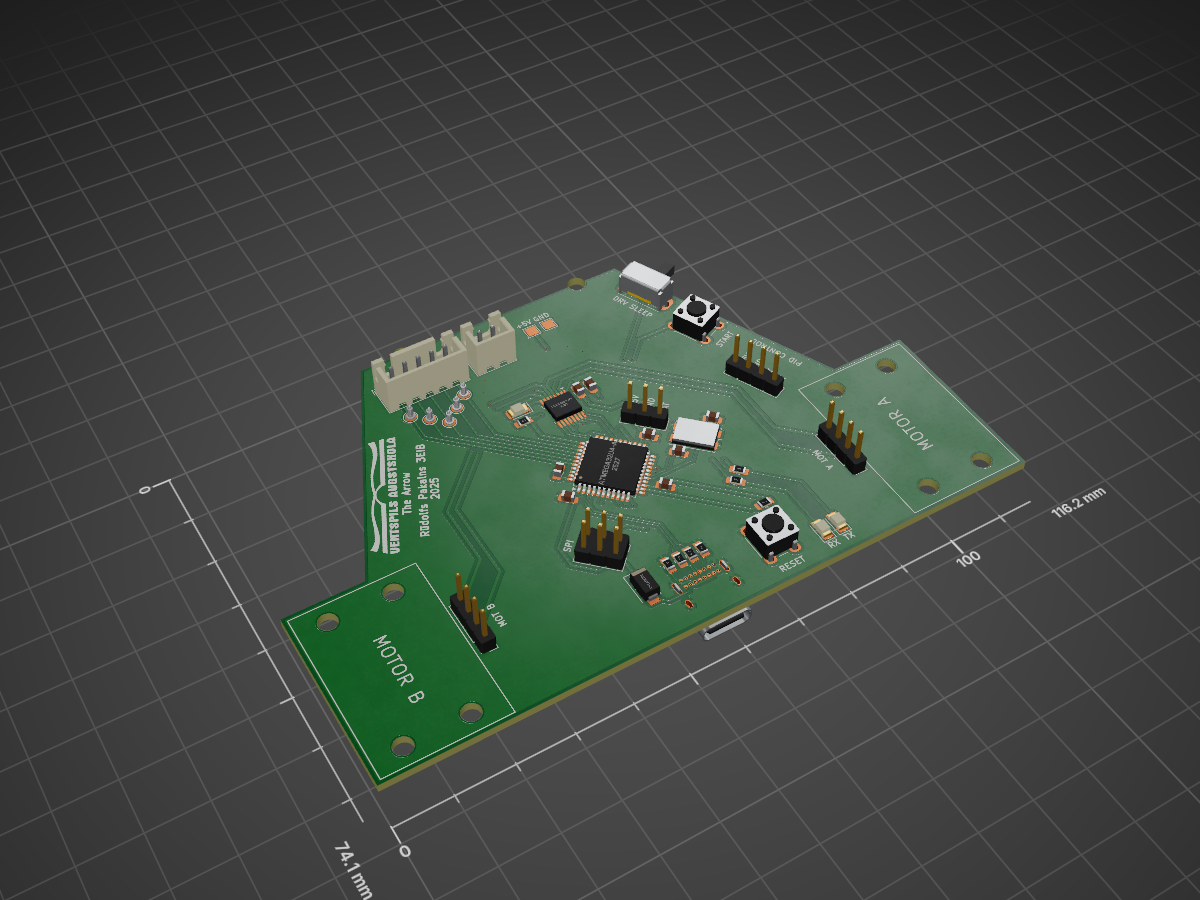
2 layers116.2 × 36 mm
 Rudolfs-Pakalns/Line-Follower
My personal line follower robot project
MCB-100-A is an open-source printed circuit board by Rudolfs-Pakalns, from the Rudolfs-Pakalns/Line-Follower repository on GitHub. It is a 2-layer board of 116.2 × 74.1 mm with 62 parts on 56 nets, routed with 314 tracks and 40 vias.
It is built around the ATMEGA32U4-AU and DRV8833PWP. Its parts include 14 capacitors, 12 resistors, 8 connectors, 4 diodes and 3 switches. It belongs with the AVR (ATmega, ATtiny) boards of this library.


| Qty | Value | Footprint | References |
|---|---|---|---|
| 10 | MountingHole | MountingHole:MountingHole_3.2mm_M3 | H1, H2, H3, H4, H5, H6, H7, H8, H9, H10 |
| 8 | 100n | Capacitor_SMD:C_0805_2012Metric_Pad1.18x1.45mm_HandSolder | C1, C1, C2, C2, C3, C6, C15, C16 |
| 5 | TestPoint | TestPoint:TestPoint_Pad_D2.0mm | A1, A2, A3, A4, A5 |
| 3 | 10k | Resistor_SMD:R_0805_2012Metric_Pad1.20x1.40mm_HandSolder | R1, R4, R15 |
| 3 | 1k | Resistor_SMD:R_0805_2012Metric_Pad1.20x1.40mm_HandSolder | R10, R11, R12 |
| 2 | 0.2 | Resistor_SMD:R_2512_6332Metric | R13, R14 |
| 2 | 20p | Capacitor_SMD:C_0805_2012Metric_Pad1.18x1.45mm_HandSolder | C4, C5 |
| 2 | 22 | Resistor_SMD:R_0805_2012Metric_Pad1.20x1.40mm_HandSolder | R2, R3 |
| 2 | 5k1 | Resistor_SMD:R_0805_2012Metric_Pad1.20x1.40mm_HandSolder | R31, R32 |
| 2 | TestPoint | TestPoint:TestPoint_Pad_2.0x2.0mm | TP9, TP10 |
| 1 | 10n | Capacitor_SMD:C_0805_2012Metric_Pad1.18x1.45mm_HandSolder | C14 |
| 1 | 10u | Capacitor_SMD:C_0805_2012Metric_Pad1.18x1.45mm_HandSolder | C12 |
| 1 | 1u | Capacitor_SMD:C_0805_2012Metric_Pad1.18x1.45mm_HandSolder | C7 |
| 1 | 2u2 | Capacitor_SMD:C_0805_2012Metric_Pad1.18x1.45mm_HandSolder | C13 |
| 1 | ATmega32U4-A | Package_QFP:TQFP-44_10x10mm_P0.8mm | U2 |
| 1 | BT | Connector_PinHeader_2.54mm:PinHeader_1x04_P2.54mm_Vertical | J4 |
| 1 | Conn_01x03_Pin | Connector_PinHeader_2.54mm:PinHeader_1x03_P2.54mm_Vertical | J9 |
| 1 | Crystal_GND24 | Crystal:Crystal_SMD_FOX_FQ7050-4Pin_7.0x5.0mm | Y1 |
| 1 | DRV8833PWP | Package_SO:HTSSOP-16-1EP_4.4x5mm_P0.65mm_EP3.4x5mm_Mask2.46x2.31mm_ThermalVias | U1 |
| 1 | D_Schottky | Diode_SMD:D_SMA | D12 |
| 1 | FAULT | LED_SMD:LED_1206_3216Metric | D5 |
| 1 | LOGO | VeA_Logo:VeA_Logo | G*** |
| 1 | MOT A | Connector_PinHeader_2.54mm:PinHeader_1x04_P2.54mm_Vertical | J1 |
| 1 | MOT B | Connector_PinHeader_2.54mm:PinHeader_1x04_P2.54mm_Vertical | J2 |
| 1 | Power | Connector_JST:JST_XH_B2B-XH-A_1x02_P2.50mm_Vertical | J7 |
| 1 | RESET | Button_Switch_THT:SW_PUSH_6mm_H4.3mm | SW3 |
| 1 | RX_LED | LED_SMD:LED_1206_3216Metric | D3 |
| 1 | SPI | Connector_PinHeader_2.54mm:PinHeader_2x03_P2.54mm_Vertical | J14 |
| 1 | Signals | Connector_JST:JST_XH_B5B-XH-A_1x05_P2.50mm_Vertical | J6 |
| 1 | Sl_En | Button_Switch_THT:SW_Slide_SPDT_Angled_CK_OS102011MA1Q | SW2 |
| 1 | TX_LED | LED_SMD:LED_1206_3216Metric | D4 |
| 1 | USB_C_Receptacle_USB2.0_16P | Connector_USB:USB_C_Receptacle_GCT_USB4085 | J3 |
| 1 | USER | Button_Switch_THT:SW_PUSH_6mm_H4.3mm | SW1 |

langpie/langpie
An Opensource Raspberry Pi Based Smart Car Project (ORPSC Project) - 树莓派开源智能车项目

AleksaHeler/OpenHand
Our attempt at a prosthetic hand using STM32 microcontroller with custom PCB and mechanics


shurik179/yozh
Small robot based on Pololu's Zumo chassis but programmable in CircuitPython

KushlaVR/models-heart
Можливості: Керування через WIFI з телефона або ПК 5 незалежних каналів (світлодіоди/сервомотори) 1 Н-міст для підключення мотора (піковий струм до 3А) Вмонтована BMS 1S та контроллер заряду Li-Ion акумулятора з…

opulo-inc/lumenpnp-archive
This repository is a public archive of the LumenPnP Pick and Place (formerly Index) source material from the beginning in mid-2020 until May 2022. The current source can be found at https://github.com/opulo-inc/lumenpnp


wallComputer/PiZumo_Robot
Git Folder to share hardware and software files for PiZumo Robot.
It measures 116.2 × 74.1 mm and has 2 copper layers, 1.6 mm thick.
62 parts, built around the ATMEGA32U4-AU and DRV8833PWP. The full list of its parts is on this page, with links to each part's symbol and footprint where PCBKit's library has them.
From the Rudolfs-Pakalns/Line-Follower repository on GitHub, at the commit this page was made from: the board is Line_Follower_PCBs/MCB/MCB-100-A/MCB-100-A.kicad_pcb and its schematic Line_Follower_PCBs/MCB/MCB-100-A/ATmega32u4.kicad_sch. PCBKit opens the board in the browser, with nothing to install.
Its repository states no licence, so its author keeps all rights: ask Rudolfs-Pakalns before reusing the design.
