
4 layers41.1 × 53 mm
Vacuum Tweezers
Legohead259/Vacuum-Tweezers-ECAD
KiCAD repository for the electrical designs for the SL_ST vacuum tweezer design
64 parts1MIT

This repository is a public archive of the LumenPnP Pick and Place (formerly Index) source material from the beginning in mid-2020 until May 2022. The current source can be found at https://github.com/opulo-inc/lumenpnp
Mobo is an open-source printed circuit board by opulo-inc, from the opulo-inc/lumenpnp-archive repository on GitHub, published under the GPL-3.0 licence. It is a 2-layer board of 200 × 100 mm with 88 parts on 66 nets, routed with 656 tracks and 82 vias.
It is built around the MAX3078EIN, DRV8833PWP and MCP16301-E/CH, with the QRE1113GR, TCS40DPR,LF and B140 among its other parts. Its parts include 20 capacitors, 12 resistors, 7 ICs, 7 diodes and 4 switches. It belongs with the STM32 boards of this library.


The LumenPnP is an open source pick and place machine to aid in Mid-Scale Manufacturing.
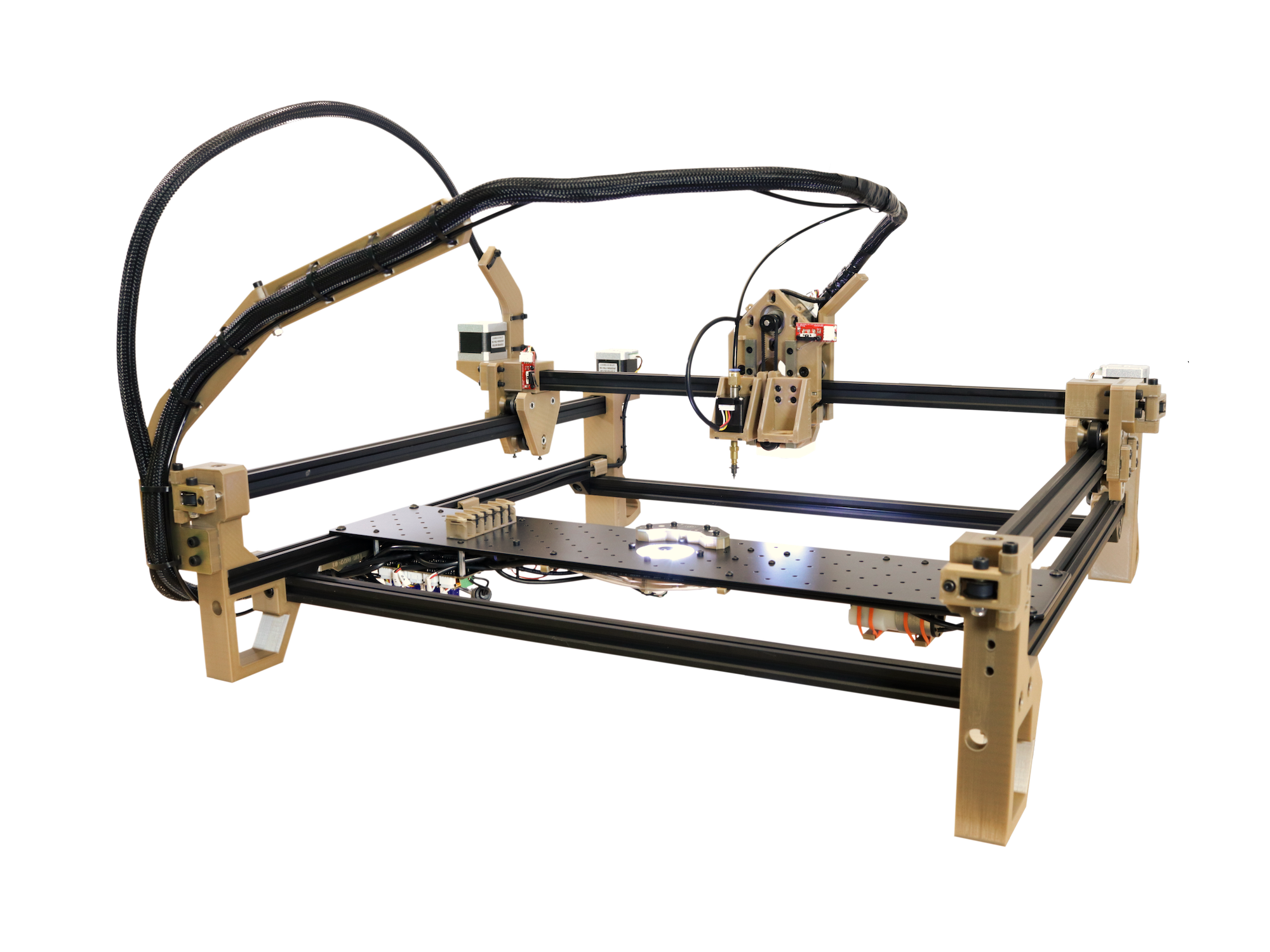
LumenPnP kits are available for sale on the Opulo Website. Machines are being used in active production daily. If you build or buy one, please help the project by documenting bugs with a GitHub issue.
Please read the wiki here! The wiki covers information about the state of the project, contributing instructions, and frequently asked questions.
The LumenPnP is designed to be low-cost enough that someone could buy or build one to support making production runs at home or as a small business. It runs using OpenPnP.
Along with the pick and place machine itself, the project also includes feeders designed to work with the machine. Powered feeders are in the final design phase. Having a proven validated design is the next goal of the project.
The LumenPnP's development process is being cataloged in a series of videos. A playlist of these can be found here.
You can buy a kit on the Opulo Website and follow the build instructions on the docs page!
If you would like to contribute to the project, awesome! Check out the contributing page to get started.
Discussion about the project happens on the STR Discord server!
| Qty | Value | Footprint | References |
|---|---|---|---|
| 26 | G*** | label | svg2mod, svg2mod, svg2mod, svg2mod, svg2mod, svg2mod, svg2mod, svg2mod, svg2mod, svg2mod, svg2mod, svg2mod, svg2mod, svg2mod, svg2mod, svg2mod +10 |
| 6 | 100n | Capacitor_SMD:C_0805_2012Metric | C3, C4, C5, C6, C10, C15 |
| 5 | 10u | Capacitor_SMD:C_0805_2012Metric | C9, C13, C16, C18, C20 |
| 5 | 470 | Resistor_SMD:R_0805_2012Metric | R2, R3, R5, R7, R8 |
| 4 | 10k | Resistor_SMD:R_0805_2012Metric | R4, R6, R9, R12 |
| 3 | 4.7u | Capacitor_SMD:C_0805_2012Metric | C7, C8, C11 |
| 3 | Fiducial | Fiducial:Fiducial_0.5mm_Mask1mm | FID1, FID2, FID3 |
| 2 | 10n | Capacitor_SMD:C_0805_2012Metric | C12, C17 |
| 2 | 15p | Capacitor_SMD:C_0805_2012Metric | C1, C2 |
| 2 | LOGO | index:logo | G***, G*** |
| 1 | 1N4148 | Diode_SMD:D_SOD-123 | D7 |
| 1 | 100 | Resistor_SMD:R_0805_2012Metric | R1 |
| 1 | 15u | Inductor_SMD:L_Taiyo-Yuden_NR-50xx_HandSoldering | L1 |
| 1 | 1k | Resistor_SMD:R_0805_2012Metric | R10 |
| 1 | 1uF | Capacitor_SMD:C_0805_2012Metric | C14 |
| 1 | 2.2u | Capacitor_SMD:C_0805_2012Metric | C19 |
| 1 | 56k | Resistor_SMD:R_0805_2012Metric | R11 |
| 1 | 8MHz | Crystal:Crystal_SMD_3225-4Pin_3.2x2.5mm_HandSoldering | Y1 |
| 1 | AP1117-33 | Package_TO_SOT_SMD:SOT-223-3_TabPin2 | U4 |
| 1 | B140 | Diode_SMD:D_SMB_Handsoldering | D6 |
| 1 | BOOT | Button_Switch_SMD:Panasonic_EVQPUJ_EVQPUA | SW4 |
| 1 | BUTTON_1 | Button_Switch_SMD:Panasonic_EVQPUJ_EVQPUA | SW2 |
| 1 | BUTTON_2 | Button_Switch_SMD:Panasonic_EVQPUJ_EVQPUA | SW3 |
| 1 | DRIVE_MOTOR | Connector_PinHeader_2.54mm:PinHeader_1x02_P2.54mm_Vertical | M2 |
| 1 | DRV8833PWP | Package_SO:HTSSOP-16-1EP_4.4x5mm_P0.65mm_EP3.4x5mm_Mask2.46x2.31mm_ThermalVias | U6 |
| 1 | FTDI_HEADER | Connector_PinHeader_2.54mm:PinHeader_1x06_P2.54mm_Vertical | J2 |
| 1 | LED1 | LED_SMD:LED_0805_2012Metric | D1 |
| 1 | LED2 | LED_SMD:LED_0805_2012Metric | D2 |
| 1 | LED3 | LED_SMD:LED_0805_2012Metric | D3 |
| 1 | LED4 | LED_SMD:LED_0805_2012Metric | D4 |
| 1 | LED5 | LED_SMD:LED_0805_2012Metric | D5 |
| 1 | MAX3078E | Package_SO:SOIC-8_3.9x4.9mm_P1.27mm | U7 |
| 1 | MCP16301 | Package_TO_SOT_SMD:SOT-23-6 | U5 |
| 1 | PEEL_MOTOR | Connector_PinHeader_2.54mm:PinHeader_1x02_P2.54mm_Vertical | M1 |
| 1 | PLATED_PADS | index:5-pad-spring-finger-interface | J3 |
| 1 | QRE1113GR | OptoDevice:OnSemi_CASE100CY | U1 |
| 1 | RESET | Button_Switch_SMD:Panasonic_EVQPUJ_EVQPUA | SW1 |
| 1 | STM32F103C8Tx | Package_QFP:LQFP-48_7x7mm_P0.5mm | U2 |
| 1 | SWD_10 | Connector_PinHeader_1.27mm:PinHeader_2x05_P1.27mm_Vertical_SMD | J1 |
| 1 | TCS40DPR | Package_TO_SOT_SMD:SOT-23W | U3 |
Legohead259/Vacuum-Tweezers-ECAD
KiCAD repository for the electrical designs for the SL_ST vacuum tweezer design


homesensors/hardware
KiCad project for the homesensors BLE door sensor — a custom small PCB with STM32WB09KEVx + TCS40DPR Hall sensor + active-low LED + CR2032 holder.

freeDSP/freeDSP-StdConnectorAdapter
Adapter of the old freeDSP Classic connector to the new freeDSP standard connector.


manhoosbilli1/tpa6110-stereo-amp-input-router
Stereo audio amplifier (TPA6110A2) with 74AHC1G66 analog input switching and op-amp signal conditioning

It measures 200 × 100 mm and has 2 copper layers, 1.6 mm thick.
88 parts, built around the MAX3078EIN, DRV8833PWP, MCP16301-E/CH and QRE1113GR. The full list of its parts is on this page, with links to each part's symbol and footprint where PCBKit's library has them.
From the opulo-inc/lumenpnp-archive repository on GitHub, at the commit this page was made from: the board is feeder/pcb/mobo/mobo.kicad_pcb and its schematic feeder/pcb/feederFloor/feederFloor.kicad_sch. PCBKit opens the board in the browser, with nothing to install.
Its repository publishes it under the GPL-3.0 licence: you may reuse it on that licence's terms (keep the author's notice, and for a copyleft licence share your changes alike).