2 layers144.8 × 73.9 mm
Control
Robert-Riordan-UCD/8_Bit_CPU_PCB
PCB version of Ben Eaters 8-bit breadboard computer
68 partsCERN-OHL-P-2.0
 Robert-Riordan-UCD/8_Bit_CPU_PCB
PCB version of Ben Eaters 8-bit breadboard computer
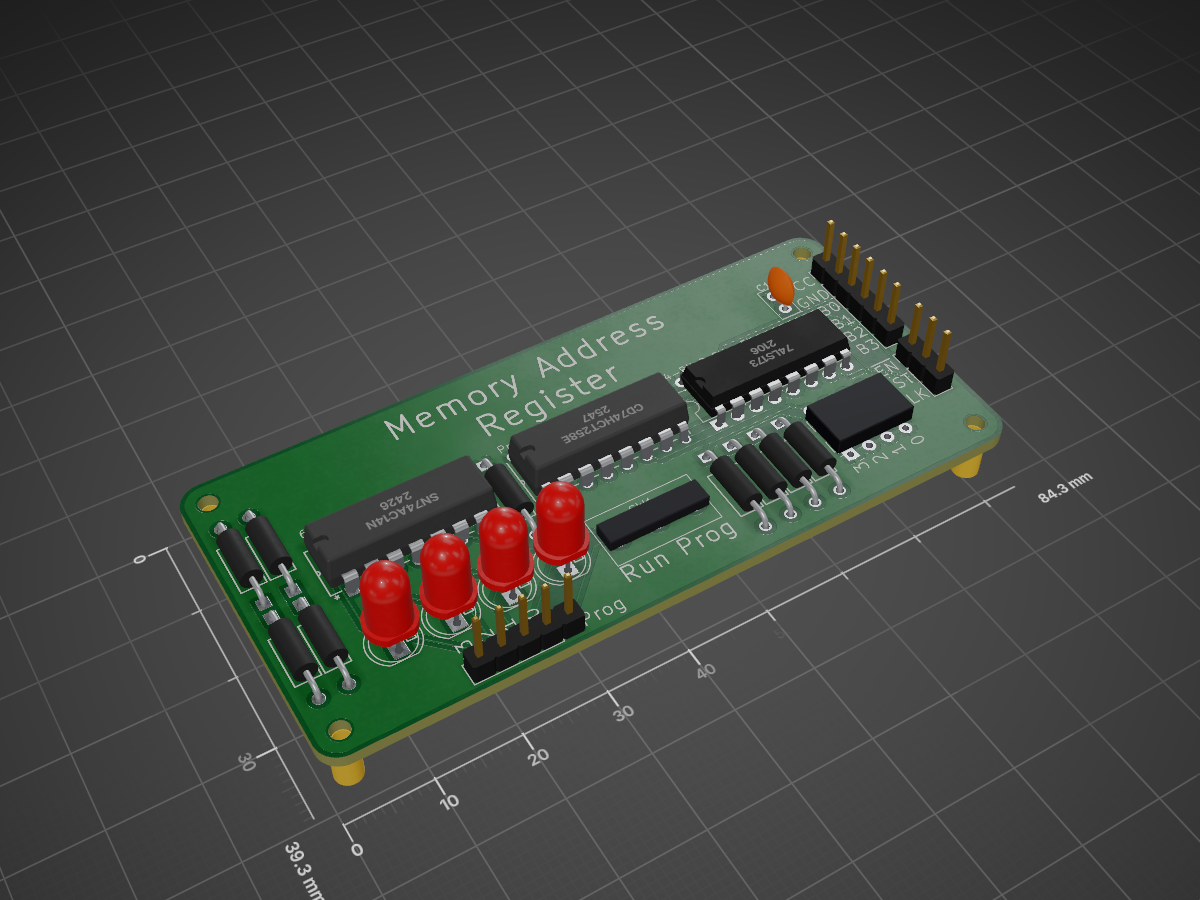
MemoryAccessRegister is an open-source printed circuit board by Robert-Riordan-UCD, from the Robert-Riordan-UCD/8_Bit_CPU_PCB repository on GitHub, published under the CERN-OHL-P-2.0 licence. It is a 2-layer board of 84.3 × 39.3 mm with 26 parts on 35 nets, routed with 151 tracks and 0 vias.
It is built around the 74LS173SC, CD74HCT258E and SN74AC14N. Its parts include 9 resistors, 4 ICs, 4 diodes, 3 connectors and 1 capacitor. It belongs with the retro computing and games boards of this library.


This is my version of Ben Eaters 8-bit breadboard SAP-1 CPU, converted to a PCB. I have made some minor changes as I could not find all of the components as listed in Ben's part list.
https://youtube.com/shorts/QNcSWgcGv9o?si=QzoUVq9Kj8X1f4Rs
CERN Open Hardware Licence Version 2 - Permissive
| Qty | Value | Footprint | References |
|---|---|---|---|
| 5 | 1k | _DownloadFootprints:CF_series_Resistors_THT | R5, R6, R7, R8, R9 |
| 4 | 220 | _DownloadFootprints:CF_series_Resistors_THT | R1, R2, R3, R4 |
| 4 | LED | LED_THT:LED_D5.0mm | D1, D2, D3, D4 |
| 1 | 0.1uF | Capacitor_THT:C_Disc_D5.0mm_W2.5mm_P2.50mm | C1 |
| 1 | 74LS173 | Package_DIP:DIP-16_W7.62mm | U4 |
| 1 | CD74HCT258E | _DownloadFootprints:2_to_1_selector | U2 |
| 1 | Conn_01x03_Pin | Connector_PinHeader_2.54mm:PinHeader_1x03_P2.54mm_Vertical | J3 |
| 1 | Conn_01x05_Pin | Connector_PinHeader_2.54mm:PinHeader_1x05_P2.54mm_Vertical | J1 |
| 1 | Conn_01x06_Pin | Connector_PinHeader_2.54mm:PinHeader_1x06_P2.54mm_Vertical | J2 |
| 1 | SN74AC14N | _DownloadFootprints:6x_not | U1 |
| 1 | SW_SPDT | 8BitCPUFootprints:DoubleThrowSwitch | SW1 |
| 1 | ~ | 8BitCPUFootprints:DIP-8 | U3 |
The 22 most common of 26 parts.
Robert-Riordan-UCD/8_Bit_CPU_PCB
PCB version of Ben Eaters 8-bit breadboard computer

Robert-Riordan-UCD/8_Bit_CPU_PCB
PCB version of Ben Eaters 8-bit breadboard computer

Robert-Riordan-UCD/8_Bit_CPU_PCB
PCB version of Ben Eaters 8-bit breadboard computer

Robert-Riordan-UCD/8_Bit_CPU_PCB
PCB version of Ben Eaters 8-bit breadboard computer
Robert-Riordan-UCD/8_Bit_CPU_PCB
PCB version of Ben Eaters 8-bit breadboard computer

Robert-Riordan-UCD/8_Bit_CPU_PCB
PCB version of Ben Eaters 8-bit breadboard computer

Robert-Riordan-UCD/8_Bit_CPU_PCB
PCB version of Ben Eaters 8-bit breadboard computer
Robert-Riordan-UCD/8_Bit_CPU_PCB
PCB version of Ben Eaters 8-bit breadboard computer

aditya02095/PCB-Design
Here are the gerber files for the digital frequency meter created using KiCAD


The-Invent0r/8-bit-Computer-PCB
These are the KiCAD files for my 8-Bit Computer.


rraider/Seminarkurs2021
Entwicklung eines turingvollständigen, primitiven Microcontroller in der Software Digital

Robert-Mones/Claculator
A reverse Polish notation calculator with added features such as comparisons, branching, and custom recursive operators taken from the Clac project from the 15-122 course at Carnegie Mellon University.
It measures 84.3 × 39.3 mm and has 2 copper layers, 1.6 mm thick.
26 parts, built around the 74LS173SC, CD74HCT258E and SN74AC14N. The full list of its parts is on this page, with links to each part's symbol and footprint where PCBKit's library has them.
From the Robert-Riordan-UCD/8_Bit_CPU_PCB repository on GitHub, at the commit this page was made from: the board is MemoryAccessRegister/MemoryAccessRegister.kicad_pcb and its schematic ALU/ALU.kicad_sch. PCBKit opens the board in the browser, with nothing to install.
Its repository publishes it under the CERN-OHL-P-2.0 licence: you may reuse it on that licence's terms (keep the author's notice, and for a copyleft licence share your changes alike).