2 layers100 × 72 mm
OM-16LED
OpenModbus/OM-16LED
A compact industrial-grade 16-channel Modbus RTU LED driver.
100 parts3GPL-3.0

 vekkuli/mv_io_box
24 V I/O Box with DIO and 5 and 12 V outputs.
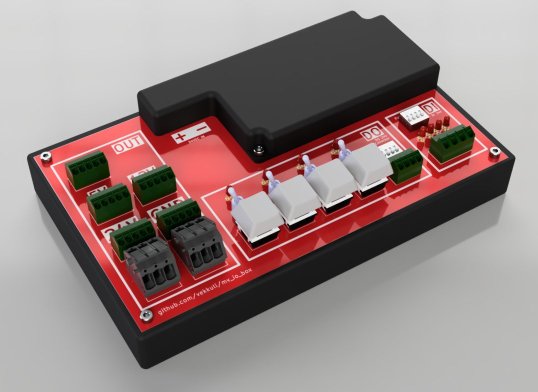
Io box is an open-source printed circuit board by vekkuli, from the vekkuli/mv_io_box repository on GitHub, published under the MIT licence. It is a 4-layer board of 200 × 120 mm with 76 parts on 51 nets, routed with 241 tracks and 0 vias.
It is built around the R-78E12-1.0/X9, R-78E5.0-1.0 and SN74AC14N. Its parts include 28 resistors, 10 connectors, 10 switches, 8 diodes and 4 capacitors.


24 V I/O Box with DIO and 5 and 12 V outputs.
This IO box was developed to be a tool for someone who works with different machine vision devices such as cameras, 3D scanners and other sensors.
Note that the images below may not be fully up to date with the code!
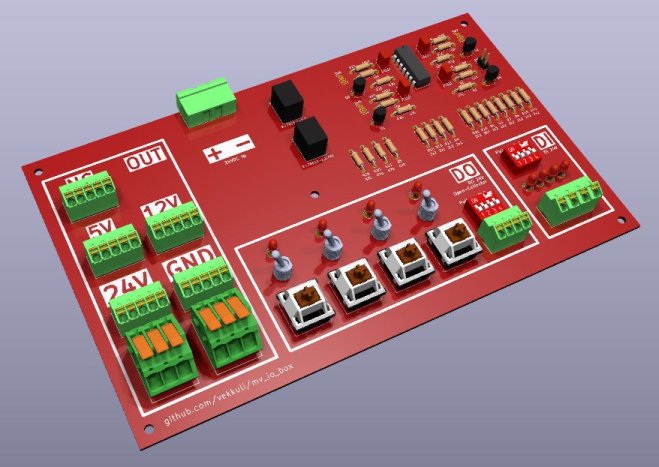
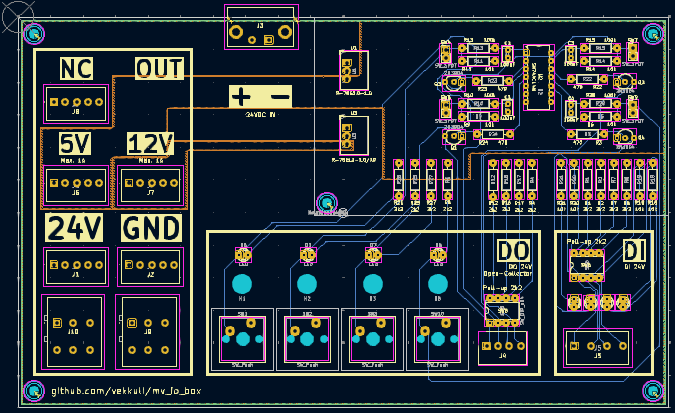
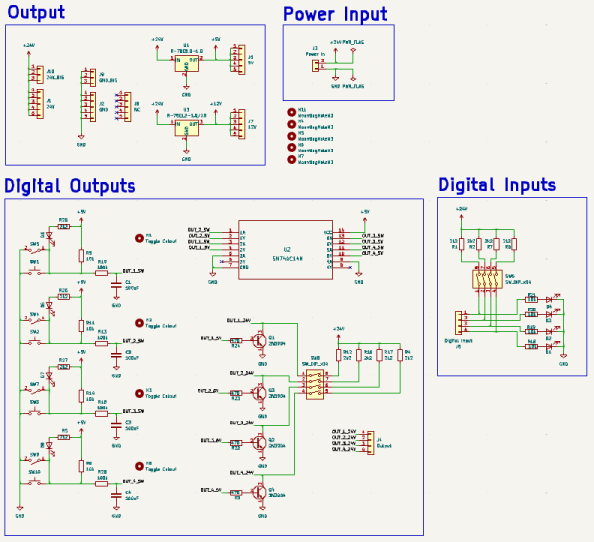
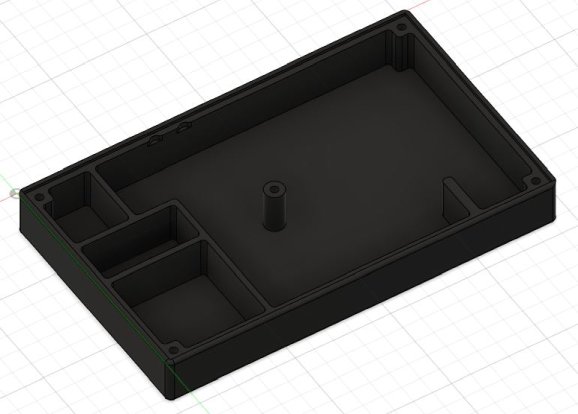
| Qty | Value | Footprint | References |
|---|---|---|---|
| 12 | 2k2 | Resistor_THT:R_Axial_DIN0207_L6.3mm_D2.5mm_P10.16mm_Horizontal | R1, R2, R4, R5, R7, R8, R12, R16, R17, R25, R26, R27 |
| 8 | 10k | Resistor_THT:R_Axial_DIN0207_L6.3mm_D2.5mm_P10.16mm_Horizontal | R6, R9, R11, R14, R18, R19, R20, R21 |
| 8 | LED | LED_THT:LED_D3.0mm | D1, D2, D3, D4, D5, D6, D7, D8 |
| 5 | MountingHoleM3 | MountingHole:MountingHole_3.2mm_M3 | H4, H5, H6, H7, H11 |
| 4 | 100k | Resistor_THT:R_Axial_DIN0207_L6.3mm_D2.5mm_P10.16mm_Horizontal | R10, R13, R15, R28 |
| 4 | 100nF | Capacitor_THT:C_Rect_L4.6mm_W3.0mm_P2.50mm_MKS02_FKP02 | C1, C2, C3, C4 |
| 4 | 2N3904 | Package_TO_SOT_THT:TO-92_Inline_Wide | Q1, Q2, Q3, Q4 |
| 4 | 470 | Resistor_THT:R_Axial_DIN0207_L6.3mm_D2.5mm_P10.16mm_Horizontal | R3, R22, R23, R24 |
| 4 | SW_Push | Button_Switch_Keyboard:SW_Cherry_MX_1.00u_PCB | SW1, SW2, SW3, SW10 |
| 4 | SW_SPDT | Connector_PinHeader_2.54mm:PinHeader_1x02_P2.54mm_Vertical | SW4, SW5, SW7, SW9 |
| 4 | Toggle Cutout | Project Footprints:Panel Cutout Hole D6.35mm | H1, H2, H3, H8 |
| 2 | SW_DIP_x04 | Package_DIP:DIP-8_W7.62mm | SW6, SW8 |
| 1 | 12V | Project Footprints:Phoenix Contact SPTA 1 5-3,5 - PCB terminal block | J7 |
| 1 | 24V | Project Footprints:Phoenix Contact SPTA 1 5-3,5 - PCB terminal block | J1 |
| 1 | 24V_BIG | Project Footprints:Phoenix Contact LPTA 2,5 3-5,0 - PCB terminal block | J10 |
| 1 | 5V | Project Footprints:Phoenix Contact SPTA 1 5-3,5 - PCB terminal block | J6 |
| 1 | Digital Input | Project Footprints:Phoenix Contact SPTA 1 4-5,0 - PCB terminal block | J5 |
| 1 | GND | Project Footprints:Phoenix Contact SPTA 1 5-3,5 - PCB terminal block | J2 |
| 1 | GND_BIG | Project Footprints:Phoenix Contact LPTA 2,5 3-5,0 - PCB terminal block | J9 |
| 1 | NC | Project Footprints:Phoenix Contact SPTA 1 5-3,5 - PCB terminal block | J8 |
| 1 | Output | Project Footprints:Phoenix Contact SPTA 1 4-3,5 - PCB terminal block | J4 |
| 1 | Power In | Project Footprints:Phoenix Contact MSTB 2,5 2-GF-5,08 - PCB header | J3 |
| 1 | R-78E12-1.0/X9 | Converter_DCDC:Converter_DCDC_RECOM_R-78E-0.5_THT | U3 |
| 1 | R-78E5.0-1.0 | Converter_DCDC:Converter_DCDC_RECOM_R-78E-0.5_THT | U1 |
| 1 | SN74AC14N | Project Footprints:SN74AC14N | U2 |
OpenModbus/OM-16LED
A compact industrial-grade 16-channel Modbus RTU LED driver.

aditya02095/PCB-Design
Here are the gerber files for the digital frequency meter created using KiCAD

Robert-Riordan-UCD/8_Bit_CPU_PCB
PCB version of Ben Eaters 8-bit breadboard computer

westlicht/performer-hardware
PER|FORMER Eurorack Sequencer - Hardware Design Files


arlyon/rust-matter-led
A Matter-compatible 5-channel RGBCW LED controller built on a custom PCB with an ESP32-C6, written entirely in Rust.

shareresearchteam/SAMI-Robot
Software and Hardware resources and development of the SAMI humanoid robot

It measures 200 × 120 mm and has 4 copper layers, 1.6 mm thick.
76 parts, built around the R-78E12-1.0/X9, R-78E5.0-1.0 and SN74AC14N. The full list of its parts is on this page, with links to each part's symbol and footprint where PCBKit's library has them.
From the vekkuli/mv_io_box repository on GitHub, at the commit this page was made from: the board is kicad_project/io_box.kicad_pcb and its schematic kicad_project/io_box.kicad_sch. PCBKit opens the board in the browser, with nothing to install.
Its repository publishes it under the MIT licence: you may reuse it on that licence's terms (keep the author's notice, and for a copyleft licence share your changes alike).