4 layers74.3 × 20 mm
Hardware rp2040 minisdr
Keyaan-07/RP2040-mini-SDR
An attempt to make an SDR using the RP2040.
53 parts3MIT
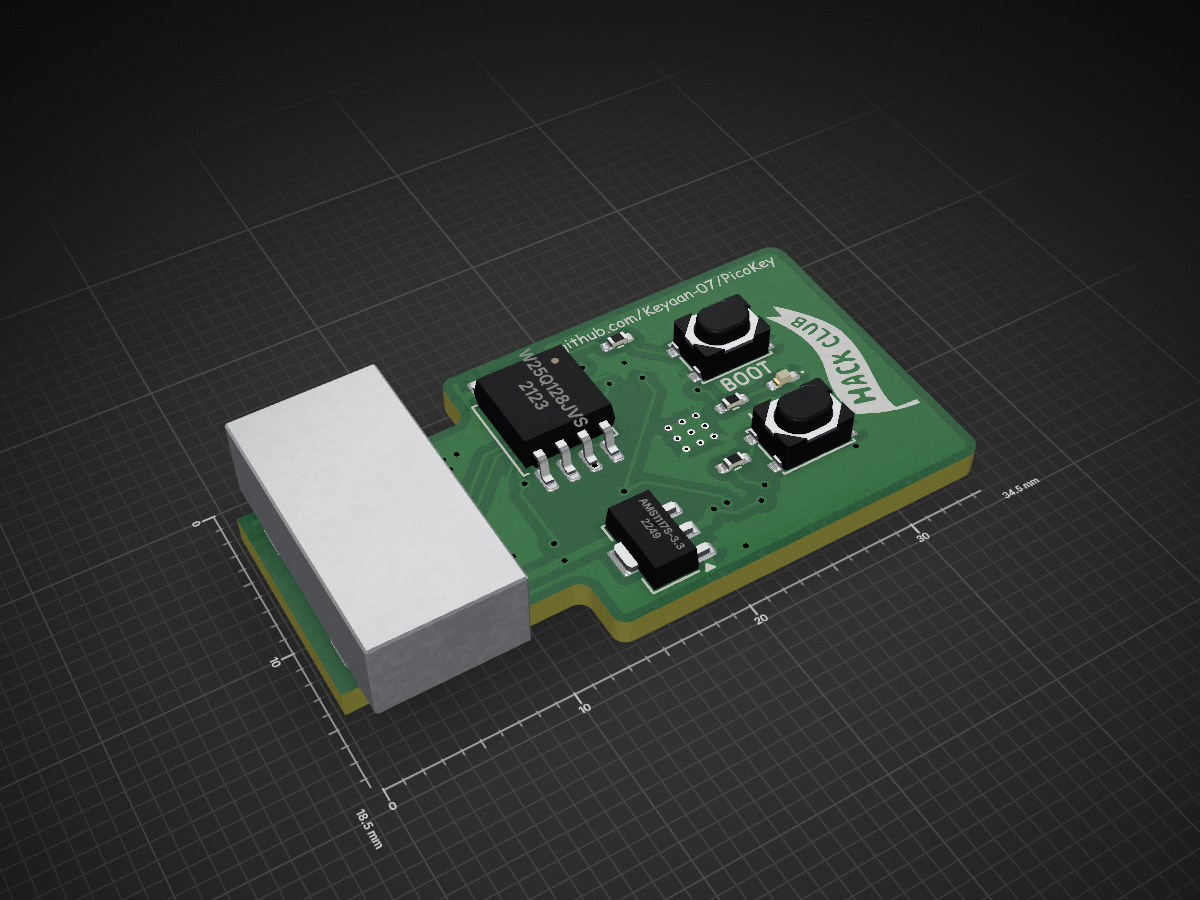
 Keyaan-07/PicoKey10
A FIDO2 based passkey using the RP2350A and in it's smallest form factor!
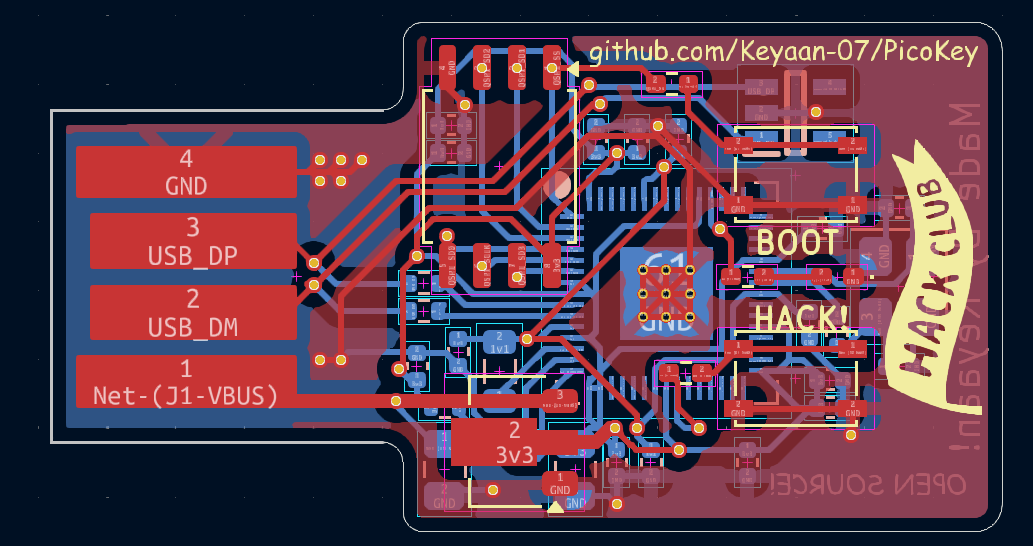
Hardware PicoKey is an open-source printed circuit board by Keyaan-07, from the Keyaan-07/PicoKey repository on GitHub, published under the MIT licence. It is a 2-layer board of 34.5 × 18.5 mm with 37 parts on 56 nets, routed with 317 tracks and 34 vias.
It is built around the W25Q128JVSIQ, AMS1117S-3.3 and ESDS314DBVR-TP. Its parts include 19 capacitors, 7 resistors, 3 ICs, 2 diodes and 2 switches. It belongs with the RP2350 boards of this library.


I go to highschool, and teens are always around when i try to login to my mail or github or any other account, so my password can be compromised.
To solve this, I created PicoKey, which is a hardware pass key in a very small form factor(34.5mm x 18.5mm). It uses the RP2350A chip, although I wanted to use my favourite MCU, the rp2040, it was not safe as a pass key, so I used the rp2350A this time, which is much more safer and secure than the RP2350A.
I think it can also function as a USB-HID device because it has an external button too and 16Mb of memory size.
It has USB-A in the PCB itself soo need for external connectors, however, you either need to order a 2.0mm thick PCB(expensive) or you need to order a 1.6mm PCB(pretty cheap) and make up for the 0.4mm using tape or some other method.
Small form factor: 3.45cm x 1.85 cm
Uses the latest MCU from Raspberyy Pi, the RP2350A
Could Potentially have HID Compatibility
USB inbuilt the PCB
Idea taken from @Rudy 's RP2350 hardware key
It is basically a single pcb, so assembling this project means soldering on all the components.
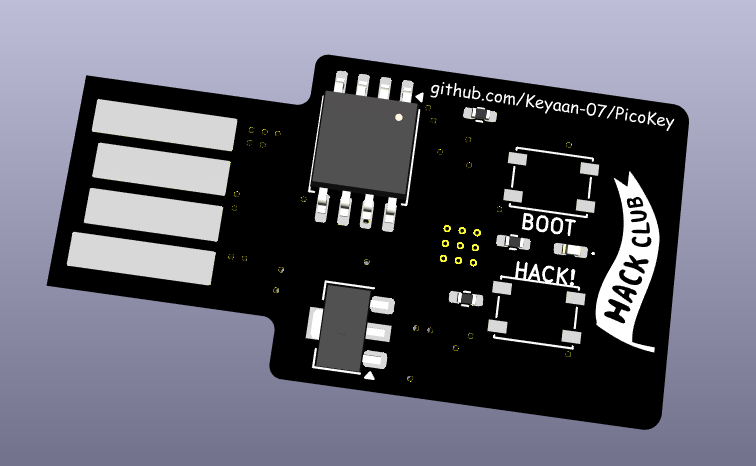
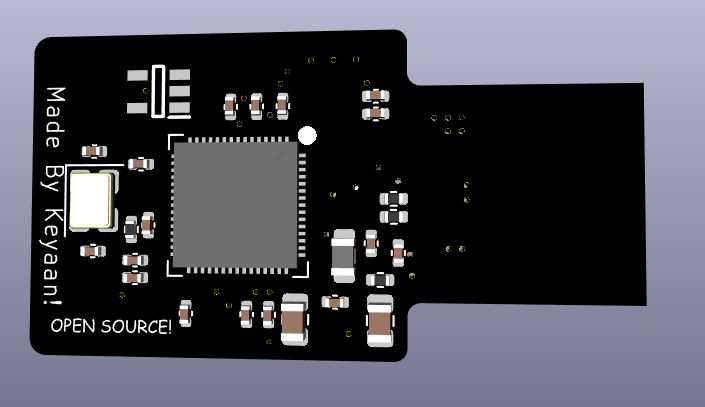
To solder, I would recommend buying a stencil along with the PCBs, or opting for PCBA from your PCB manufacturer, I am using JLC for this, and I will be opting for PCBA, as this is a 2 sided board, it will be much easier for 1 side to be PCBA(bottom side) and other by hand(top side).
The RP2350A is housed on the bottom side along with most of the components, and I have placed easy to solder components on the top, and the small pads for resistors and LED are a little bigger, which would help in soldering by hand.
I chose to make this project mainly for 2 reasons:
i wanted to have a secure hardware key and didn't wanna sign in using passwords in front of everyone.
I wanted to try out making a 2 sided PCB(where components are on 2 sides), to learn how to make such projects and the learning curve for dual sided PCBs.
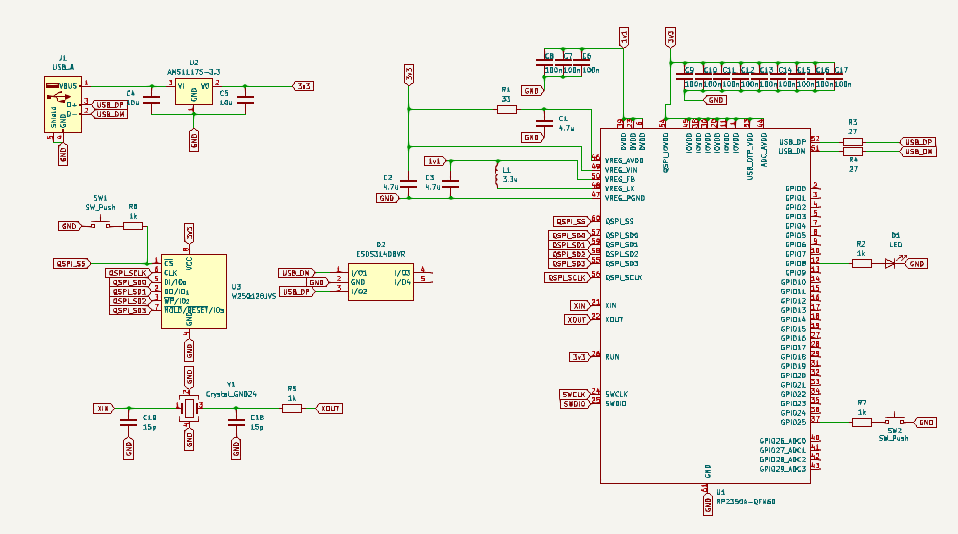
| ITEM NAME | ITEM PRICE | FUNCTION | URL |
|---|---|---|---|
| Pcb Manufacturing + stencil | 23.82 | main pcb and smt stencil | https://jlcpcb.com |
| PCB Components | 21.1131 | components on the PCB | https://lcsc.com |
| Total | 44.93 | USD |
| Qty | Value | Footprint | References |
|---|---|---|---|
| 12 | 100n | Capacitor_SMD:C_0402_1005Metric | C6, C7, C8, C9, C10, C11, C12, C13, C14, C15, C16, C17 |
| 3 | 1k | Resistor_SMD:R_0402_1005Metric_Pad0.72x0.64mm_HandSolder | R2, R6, R7 |
| 3 | 4.7u | Capacitor_SMD:C_0402_1005Metric | C1, C2, C3 |
| 2 | 10u | Capacitor_SMD:C_0805_2012Metric | C4, C5 |
| 2 | 15p | Capacitor_SMD:C_0402_1005Metric | C18, C19 |
| 2 | 27 | Resistor_SMD:R_0402_1005Metric | R3, R4 |
| 2 | SW_Push | Button_Switch_SMD:SW_SPST_PTS810 | SW1, SW2 |
| 1 | 1k | Resistor_SMD:R_0402_1005Metric | R5 |
| 1 | 3.3u | Inductor_SMD:L_0805_2012Metric | L1 |
| 1 | 33 | Resistor_SMD:R_0402_1005Metric | R1 |
| 1 | AMS1117S-3.3 | Package_TO_SOT_SMD:SOT-89-3 | U2 |
| 1 | Crystal_GND24 | Crystal:Crystal_SMD_3225-4Pin_3.2x2.5mm | Y1 |
| 1 | ESDS314DBVR | user_imported_devices:ESDS314BVR_SOT95P280X145-5N | D2 |
| 1 | LED | LED_SMD:LED_0402_1005Metric_Pad0.77x0.64mm_HandSolder | D1 |
| 1 | LOGO | LOGO | G*** |
| 1 | RP2350A-QFN60 | user_imported_devices:RP2350A_QFN-60_EP_7.75x7.75_Pitch0.4mm | U1 |
| 1 | USB_A | user_imported_devices:USBPCB | J1 |
| 1 | W25Q128JVS | Package_SO:SOIC-8_5.3x5.3mm_P1.27mm | U3 |
Keyaan-07/RP2040-mini-SDR
An attempt to make an SDR using the RP2040.

Astralis1409/VikramSat-RF-subsystem
WIP - VikramSat's Official Radio Communications Subsystem with hardware, software and more.


LimesKey/parsnip-node
A portable LoRa communicator. Custom 4-layer PCB (ESP32-S3 + E22P-915M30S LoRa + NEO-M9N GNSS), designed in KiCad for 915 MHz.

r4hulrr/ausign
Real-time Auslan (Australian Sign Language) to English speech translation glove. Built with ESP32-S3, flex sensors, IMU on a custom PCB, and a Bluetooth-connected Python GUI.


It measures 34.5 × 18.5 mm and has 2 copper layers, 1.6 mm thick.
37 parts, built around the W25Q128JVSIQ, AMS1117S-3.3 and ESDS314DBVR-TP. The full list of its parts is on this page, with links to each part's symbol and footprint where PCBKit's library has them.
From the Keyaan-07/PicoKey repository on GitHub, at the commit this page was made from: the board is hardware_PicoKey/hardware_PicoKey.kicad_pcb and its schematic hardware_PicoKey/hardware_PicoKey.kicad_sch. PCBKit opens the board in the browser, with nothing to install.
Its repository publishes it under the MIT licence: you may reuse it on that licence's terms (keep the author's notice, and for a copyleft licence share your changes alike).