2 layers170.3 × 151.7 mm
 I2000C/SmartCruiseControl
A home made cruise control for Smart forfour 454
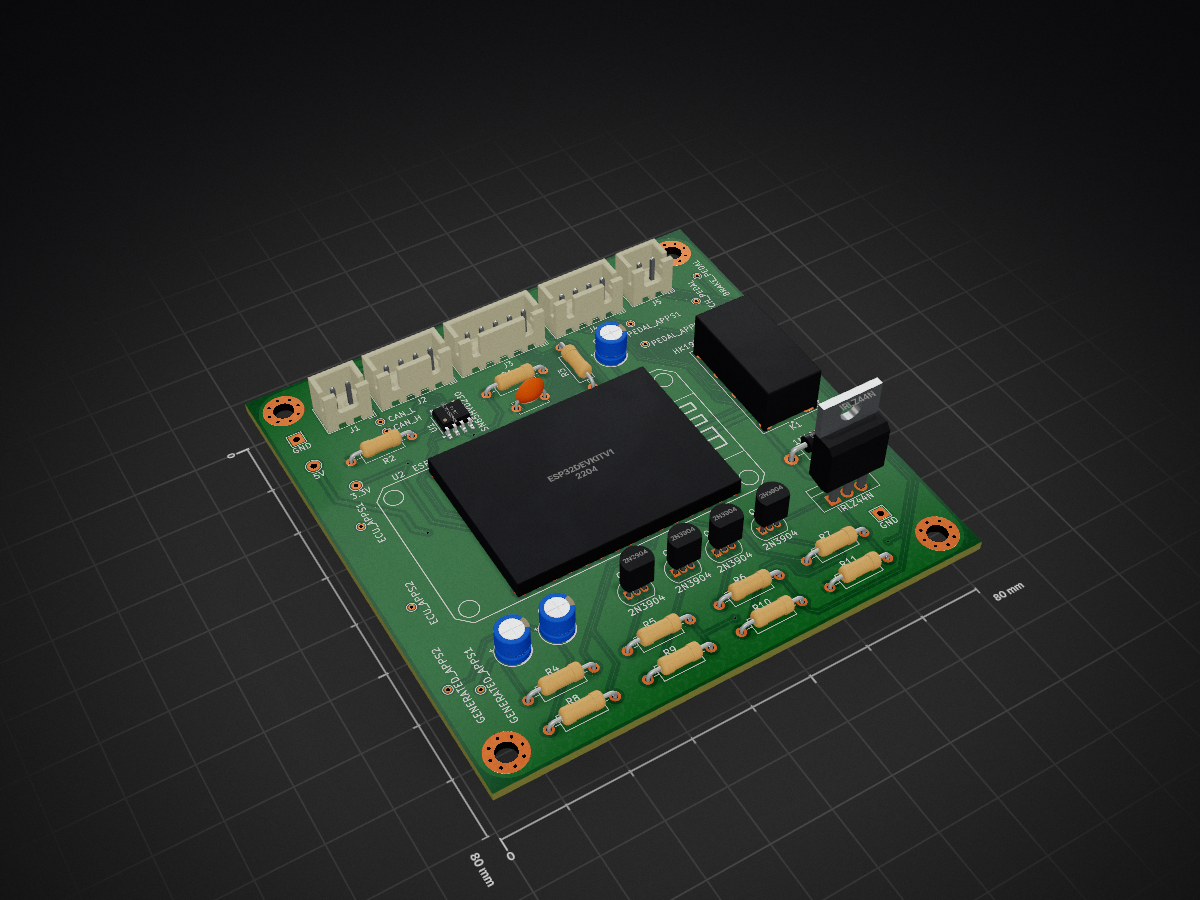
SmartCruiseControl is an open-source printed circuit board by I2000C, from the I2000C/SmartCruiseControl repository on GitHub, published under the MIT licence. It is a 2-layer board of 80 × 80 mm with 47 parts on 49 nets, routed with 245 tracks and 9 vias.
It is built around the SN65HVD230D and IRLZ44N. Its parts include 11 resistors, 5 transistors, 5 connectors, 4 capacitors and 2 ICs. It belongs with the ESP32 boards of this library.


SmartCruiseControl is an embedded ESP32 project that implements cruise control using CAN Bus data, with vehicle state monitoring and ELM327 command emulation for the Smart forfour 454 car
The software runs on an ESP32 using the Arduino framework and focuses on:
01xx and 22xx command responses.TWAI_MODE_LISTEN_ONLY) at 500 kbps.0x09E - total distance0x200 - speed0x208 - brake intensity and extra speed data0x210 - accelerator pedal position0x308 - engine RPM0x408 - fuel level0x416 - battery voltage0x423 - door status0x608 - refrigerant temperature and fuel rateSTATE_OFFSTATE_ACTIVESTATE_OVERRIDESerial with basic AT, 01, and 22 command handling.platformio.ini - PlatformIO configuration for ESP32.src/main.cpp - main entry point and FreeRTOS task setup.include/ - constants, state definitions, and shared headers.lib/ - modular libraries:
can/ - CAN bus reading and decoding.cruise_control/ - cruise control logic.elm327/ - ELM327 emulation and OBD response handling.fuel_range_estimator/ - fuel range estimation.indicator_led/ - PWM LED status indicator.pid_controller/ - generic PID controller.speed_estimator/ - speed estimation from CAN frames.throttle/ - throttle output and override management.buttons/ - analog button reading and cruise control button detection.doc/ - CAN Bus reverse engineering documentation.test/ - PlatformIO testing notes and setup.See requirements.md file for required software and hardware
See how-to-build.md file to build software and hardware
SET, RESUME, and CANCEL.STATE_OVERRIDE.doc/CAN bus reverse engineering.md.doc/CAN bus reverse engineering.md.doc/ESP32 pinout.png and is used under Creative Commons BY-NC-ND via www.mischianti.org.This project was inspired by:
See the LICENSE file for the project license terms.
| Qty | Value | Footprint | References |
|---|---|---|---|
| 5 | 100k | Resistor_THT:R_Axial_DIN0207_L6.3mm_D2.5mm_P10.16mm_Horizontal | R5, R6, R9, R10, R11 |
| 4 | 2N3904 | Package_TO_SOT_THT:TO-92_Inline | Q1, Q2, Q3, Q4 |
| 4 | MountingHole_Pad | MountingHole:MountingHole_3.2mm_M3_Pad_Via | H1, H2, H3, H4 |
| 3 | 1k | Resistor_THT:R_Axial_DIN0207_L6.3mm_D2.5mm_P10.16mm_Horizontal | R4, R7, R8 |
| 2 | 100uF | Capacitor_THT:CP_Radial_D5.0mm_P2.00mm | C3, C4 |
| 2 | GND | TestPoint:TestPoint_THTPad_2.0x2.0mm_Drill1.0mm | TP1, TP14 |
| 1 | 100nF | Capacitor_THT:C_Disc_D5.0mm_W2.5mm_P5.00mm | C2 |
| 1 | 10k | Resistor_THT:R_Axial_DIN0207_L6.3mm_D2.5mm_P10.16mm_Horizontal | R2 |
| 1 | 1N4003 | Diode_THT:D_DO-41_SOD81_P10.16mm_Horizontal | D1 |
| 1 | 1uF | Capacitor_THT:CP_Radial_D5.0mm_P2.00mm | C1 |
| 1 | 220 | Resistor_THT:R_Axial_DIN0207_L6.3mm_D2.5mm_P10.16mm_Horizontal | R3 |
| 1 | 3.3V | TestPoint:TestPoint_THTPad_D1.5mm_Drill0.7mm | TP9 |
| 1 | 5.1k | Resistor_THT:R_Axial_DIN0207_L6.3mm_D2.5mm_P10.16mm_Horizontal | R1 |
| 1 | 5V | TestPoint:TestPoint_THTPad_D2.0mm_Drill1.0mm | TP7 |
| 1 | Accelerator pedal | Connector_JST:JST_XH_B4B-XH-A_1x04_P2.50mm_Vertical | J4 |
| 1 | BRAKE_PEDAL | TestPoint:TestPoint_THTPad_D1.0mm_Drill0.5mm | TP2 |
| 1 | Brake+clutch | Connector_JST:JST_XH_B2B-XH-A_1x02_P2.50mm_Vertical | J5 |
| 1 | Buttons + led | Connector_JST:JST_XH_B5B-XH-A_1x05_P2.50mm_Vertical | J3 |
| 1 | CAN bus | Connector_JST:JST_XH_B4B-XH-A_1x04_P2.50mm_Vertical | J2 |
| 1 | CAN_H | TestPoint:TestPoint_THTPad_D1.0mm_Drill0.5mm | TP5 |
| 1 | CAN_L | TestPoint:TestPoint_THTPad_D1.0mm_Drill0.5mm | TP3 |
| 1 | CLUTCH_PEDAL | TestPoint:TestPoint_THTPad_D1.0mm_Drill0.5mm | TP6 |
| 1 | ECU_APPS1 | TestPoint:TestPoint_THTPad_D1.0mm_Drill0.5mm | TP10 |
| 1 | ECU_APPS2 | TestPoint:TestPoint_THTPad_D1.0mm_Drill0.5mm | TP11 |
| 1 | ESP32DevKitv1 | MCE_Modules:ESP32DevKitv1 | U2 |
| 1 | GENERATED_APPS1 | TestPoint:TestPoint_THTPad_D1.0mm_Drill0.5mm | TP13 |
| 1 | GENERATED_APPS2 | TestPoint:TestPoint_THTPad_D1.0mm_Drill0.5mm | TP12 |
| 1 | HK19F-DC 5V-SHG | Relay_THT:Relay_DPDT_Omron_G6A | K1 |
| 1 | IRLZ44N | Package_TO_SOT_THT:TO-220-3_Vertical | Q5 |
| 1 | PEDAL_APPS1 | TestPoint:TestPoint_THTPad_D1.0mm_Drill0.5mm | TP4 |
| 1 | PEDAL_APPS2 | TestPoint:TestPoint_THTPad_D1.0mm_Drill0.5mm | TP8 |
| 1 | SN65HVD230 | Package_SO:SOIC-8_3.9x4.9mm_P1.27mm | U1 |
| 1 | USB 5V | Connector_JST:JST_XH_B2B-XH-A_1x02_P2.50mm_Vertical | J1 |


menloresearch/asimov-1
v1 of Asimov, an open-source humanoid robot

tenderlove/initial-v
It's a BMW shifter converted to a Bluetooth Keyboard that you use with Vim


hirakuni45/RX
Renesas RX Microcontroller, C++ framework, Library, Sample

henrikssn/TurboCAN
This is the official repository for the TurboCAN controller board, designed specifically for the Voron AfterBurner toolhead but can also be used on similar toolheads using NEMA17 steppers.
It measures 80 × 80 mm and has 2 copper layers, 1.6 mm thick.
47 parts, built around the SN65HVD230D and IRLZ44N. The full list of its parts is on this page, with links to each part's symbol and footprint where PCBKit's library has them.
From the I2000C/SmartCruiseControl repository on GitHub, at the commit this page was made from: the board is kicad_project/SmartCruiseControl/SmartCruiseControl.kicad_pcb and its schematic kicad_project/SmartCruiseControl/SmartCruiseControl.kicad_sch. PCBKit opens the board in the browser, with nothing to install.
Its repository publishes it under the MIT licence: you may reuse it on that licence's terms (keep the author's notice, and for a copyleft licence share your changes alike).