2 layers47.8 × 39.1 mm
Usb c ffc
H3wastooshort/the_extender
it extends your phones storage, battery life, and audio interfaces
7 parts2GPL-3.0

 H3wastooshort/the_extender2
it extends your phones storage, battery life, and audio interfaces
The extender is an open-source printed circuit board by H3wastooshort, from the H3wastooshort/the_extender repository on GitHub, published under the GPL-3.0 licence. It is a 4-layer board of 51.2 × 51.2 mm with 123 parts on 156 nets, routed with 1,254 tracks and 499 vias.
It is built around the RP2040, HS-100B and FUSB302BMPX, with the W25Q32JVSSIQ, AP2114H-3.3TRG1 and CH334F among its other parts. Its parts include 47 capacitors, 29 resistors, 8 ICs, 6 connectors and 4 diodes. It belongs with the power and audio and music boards and the RP2040 boards of this library.


Modern phones suck in theor own unique way, don't they? Hard-to-replace or -expand lithium cells, no expandable storage, and worst of all: no headphone jack!
This projects aims to fix some of those flaws by combining a powerbank, USB hub, USB audio, and RP2040 IC into one very cursed PCB.
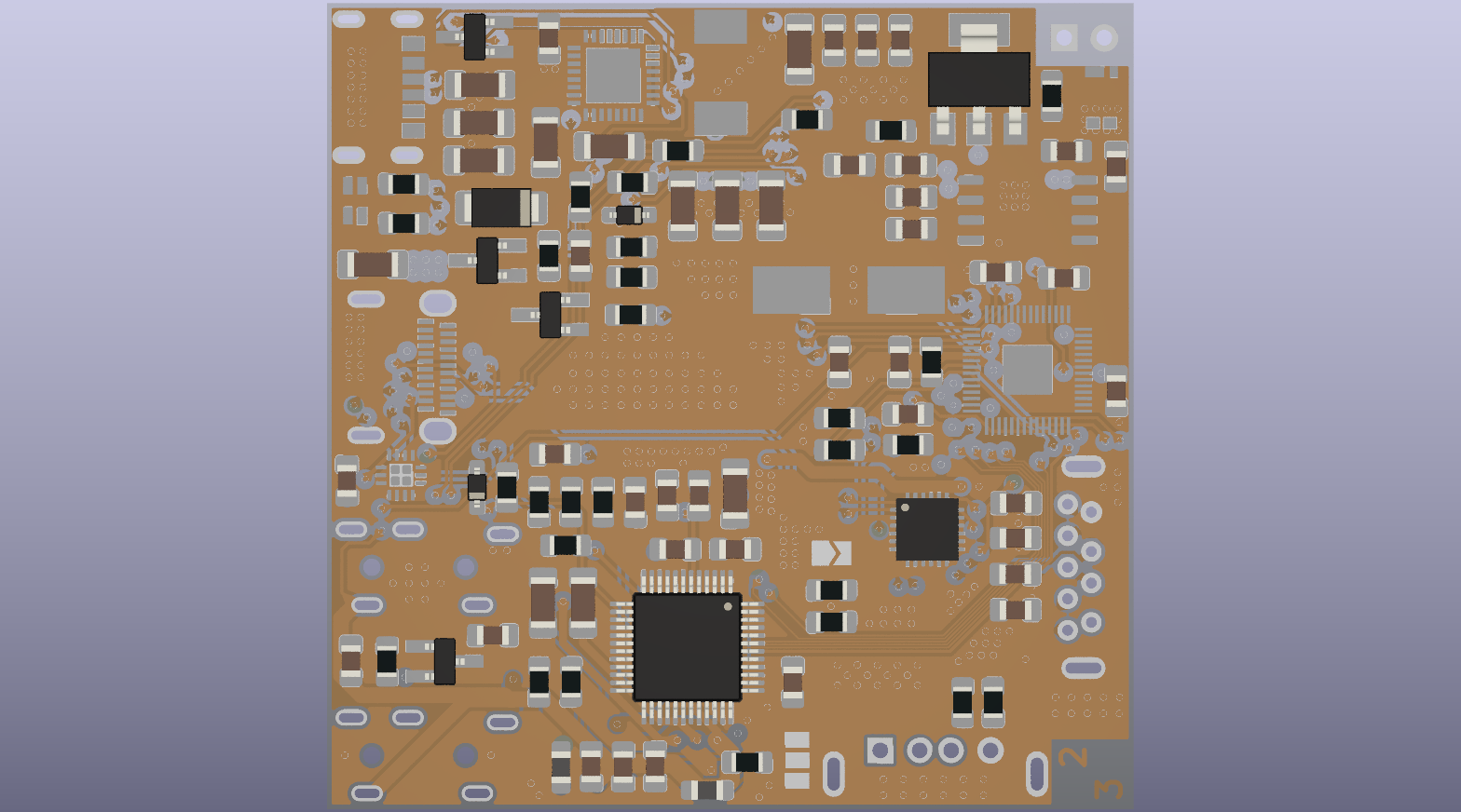
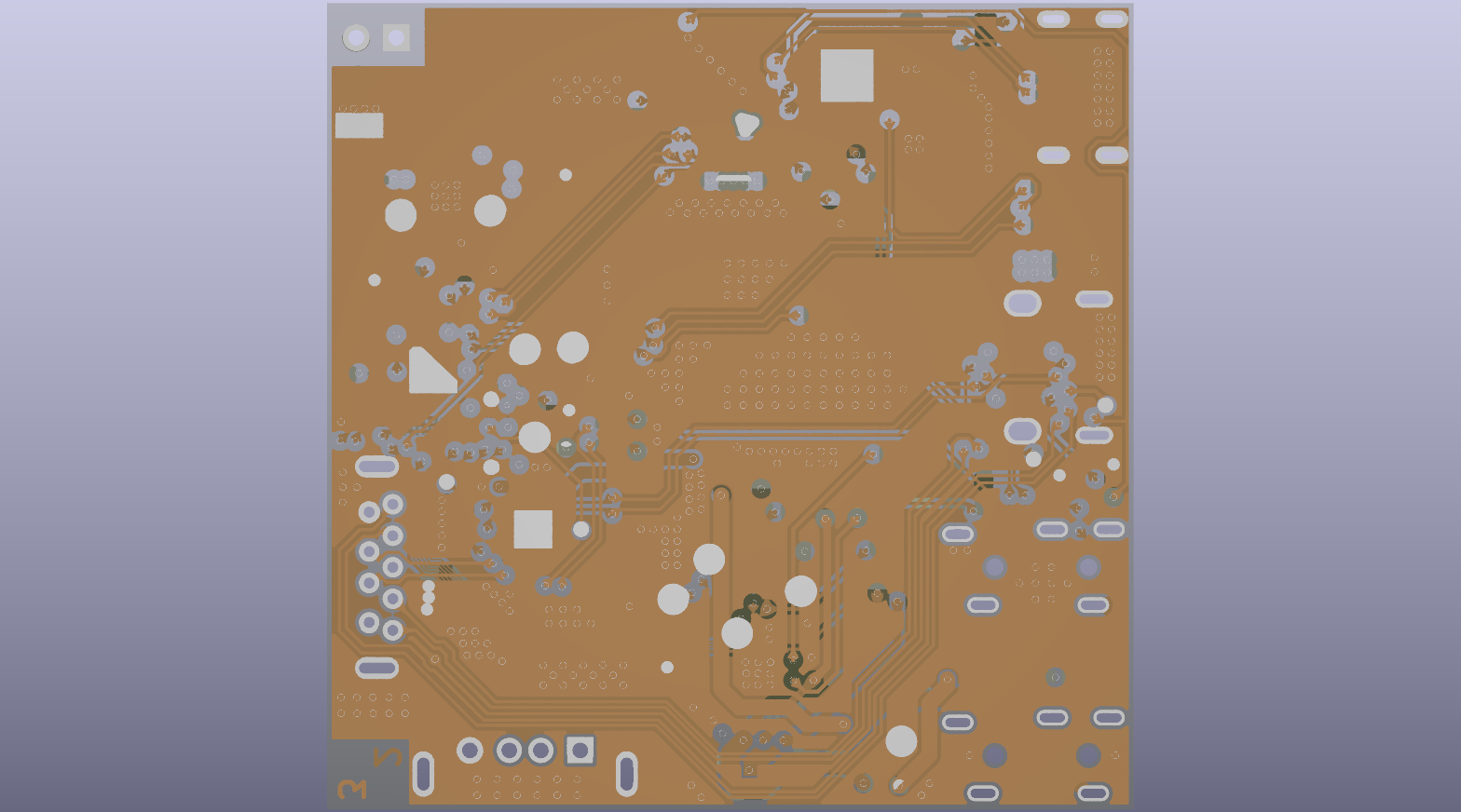
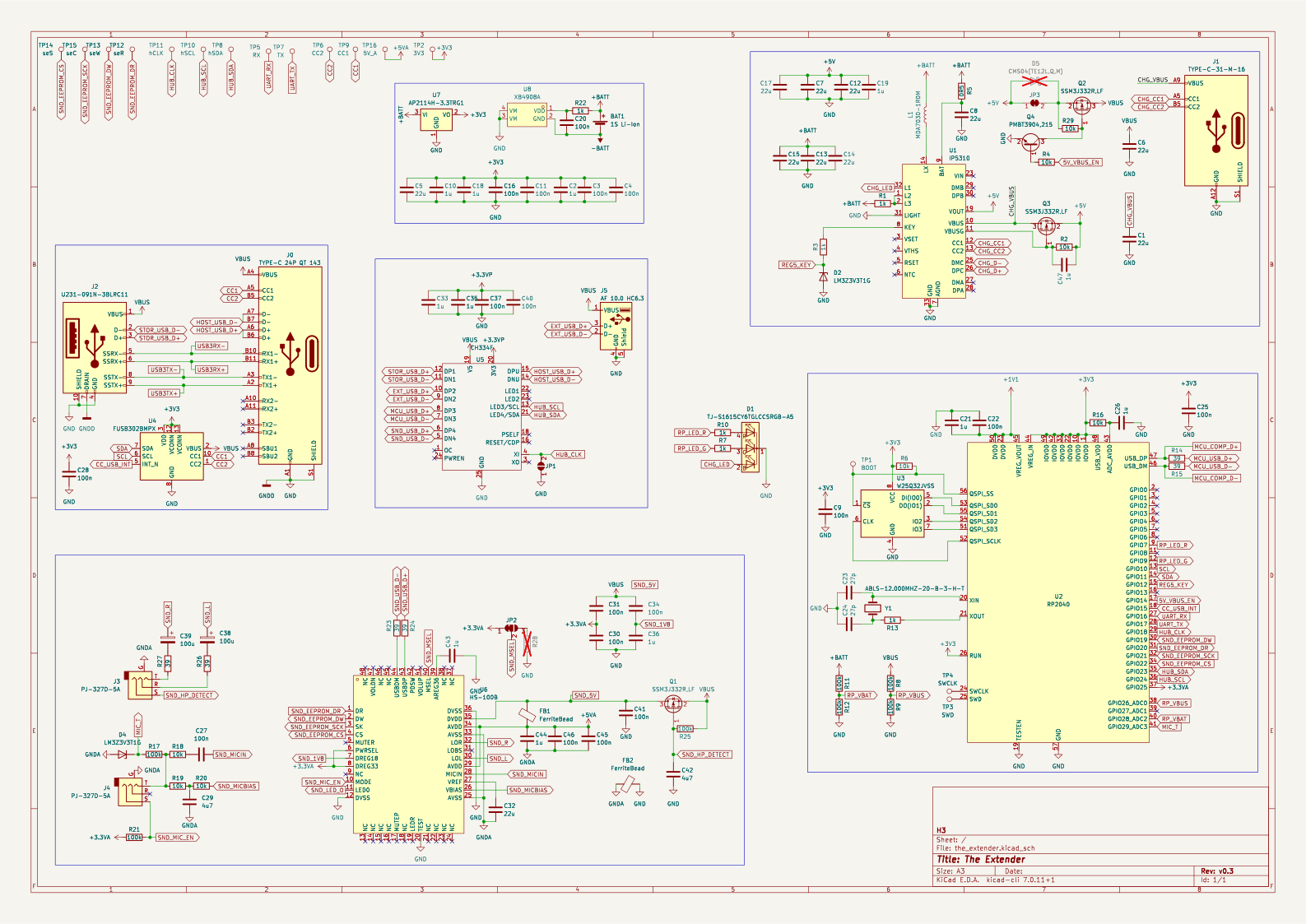
5V power and battery charging is handled by an IP5310 powerbank IC.
The PCB connects to a phone via a low-profile 90° USB Type C cable (either DIY or bought). Once connected, the RP2040 turns on 5V power, then uses the FUSB302 to tell the phone via USB Power Delivery, that it should keep charging while also switching into USB Data Host mode.
The phone then connects to the CH334F USB Hub IC, which in turn connects to several things:

WIP
The idea directory has some partially outdated notes.
| Qty | Value | Footprint | References |
|---|---|---|---|
| 18 | 100n | Capacitor_SMD:C_0805_2012Metric_Pad1.18x1.45mm_HandSolder | C3, C4, C11, C16, C20, C22, C25, C27, C28, C30, C31, C34, C37, C40, C41, C45 +2 |
| 12 | 1u | Capacitor_SMD:C_0805_2012Metric_Pad1.18x1.45mm_HandSolder | C2, C10, C18, C19, C21, C26, C33, C35, C36, C43, C44, C47 |
| 11 | 22u | Capacitor_SMD:C_1206_3216Metric_Pad1.33x1.80mm_HandSolder | C1, C5, C6, C7, C8, C12, C13, C14, C15, C17, C32 |
| 8 | 10k | Resistor_SMD:R_0805_2012Metric_Pad1.20x1.40mm_HandSolder | R2, R4, R6, R16, R18, R19, R20, R29 |
| 7 | 100k | Resistor_SMD:R_0805_2012Metric_Pad1.20x1.40mm_HandSolder | R8, R9, R11, R12, R17, R21, R25 |
| 7 | 1k | Resistor_SMD:R_0805_2012Metric_Pad1.20x1.40mm_HandSolder | R1, R3, R7, R10, R13, R22, R28 |
| 6 | 39 | Resistor_SMD:R_0805_2012Metric_Pad1.20x1.40mm_HandSolder | R14, R15, R23, R24, R26, R27 |
| 3 | SSM3J332R,LF | Package_TO_SOT_SMD:SOT-23_Handsoldering | Q1, Q2, Q3 |
| 2 | 100u | Capacitor_SMD:C_1206_3216Metric_Pad1.33x1.80mm_HandSolder | C38, C39 |
| 2 | 27p | Capacitor_SMD:C_0805_2012Metric_Pad1.18x1.45mm_HandSolder | C23, C24 |
| 2 | 4u7 | Capacitor_SMD:C_0805_2012Metric_Pad1.18x1.45mm_HandSolder | C29, C42 |
| 2 | FerriteBead | Inductor_SMD:L_0805_2012Metric_Pad1.05x1.20mm_HandSolder | FB1, FB2 |
| 2 | LM3Z3V3T1G | Diode_SMD:D_SOD-323_HandSoldering | D2, D4 |
| 2 | PJ-327D-5A | e2k_edit:AUDIO-TH_PJ-327D-5A | J3, J4 |
| 1 | TYPE-C-31-M-16 | H3_Connectors:TYPE-C-31-M-16 | J1 |
| 1 | 0R5 | Resistor_SMD:R_0805_2012Metric_Pad1.20x1.40mm_HandSolder | R5 |
| 1 | 3V3 | TestPoint:TestPoint_Pad_D2.0mm | TP2 |
| 1 | 5V_A | TestPoint:TestPoint_Pad_D2.0mm | TP16 |
| 1 | ABLS-12.000MHZ-20-B-3-H-T | Crystal:Crystal_SMD_7050-2Pin_7.0x5.0mm_HandSoldering | Y1 |
| 1 | AF 10.0 HC6.3 | easyeda2kicad:USB-A-TH_AF-10.0-HC6.3 | J5 |
| 1 | AP2114H-3.3TRG1 | Package_TO_SOT_SMD:SOT-223-3_TabPin2 | U7 |
| 1 | BOOT | TestPoint:TestPoint_Pad_D2.0mm | TP1 |
| 1 | CC1 | TestPoint:TestPoint_Pad_D1.0mm | TP9 |
| 1 | CC2 | TestPoint:TestPoint_Pad_D1.0mm | TP6 |
| 1 | CH334F | Package_DFN_QFN:QFN-24-1EP_4x4mm_P0.5mm_EP2.6x2.6mm | U5 |
| 1 | CMS04(TE12L,Q,M) | Diode_SMD:D_SOD-128 | D5 |
| 1 | FUSB302BMPX | Package_DFN_QFN:WQFN-14-1EP_2.5x2.5mm_P0.5mm_EP1.45x1.45mm | U4 |
| 1 | HS-100B | Package_QFP:LQFP-48_7x7mm_P0.5mm | U6 |
| 1 | IP5310 | easyeda2kicad:QFN-32_L5.0-W5.0-P0.50-BL-EP3.4 | U1 |
| 1 | Li-Ion | Connector_PinHeader_2.54mm:PinHeader_1x02_P2.54mm_Vertical | BAT1 |
| 1 | MDA7030-1R0M | easyeda2kicad:IND-SMD_L7.1-W6.6 | L1 |
| 1 | PMBT3904,215 | Package_TO_SOT_SMD:SOT-23_Handsoldering | Q4 |
| 1 | RP2040 | easyeda2kicad:LQFN-56_L7.0-W7.0-P0.4-EP | U2 |
| 1 | RX | TestPoint:TestPoint_Pad_D1.0mm | TP5 |
| 1 | SWCLK | TestPoint:TestPoint_Pad_D2.0mm | TP4 |
| 1 | SWD | TestPoint:TestPoint_Pad_D2.0mm | TP3 |
| 1 | SolderJumper_2_Bridged | Jumper:SolderJumper-2_P1.3mm_Bridged_Pad1.0x1.5mm | JP3 |
| 1 | SolderJumper_2_Open | Jumper:SolderJumper-2_P1.3mm_Open_TrianglePad1.0x1.5mm | JP1 |
| 1 | SolderJumper_3_Bridged12 | Jumper:SolderJumper-3_P1.3mm_Bridged12_Pad1.0x1.5mm_NumberLabels | JP2 |
| 1 | TJ-S1615CY6TGLCCSRGB-A5 | easyeda2kicad:LED-ARRAY-SMD_4P-L1.6-W1.5-BL-FD | D1 |
| 1 | TX | TestPoint:TestPoint_Pad_D2.0mm | TP7 |
| 1 | TYPE-C 24P QT 143 | e2k_edit:TYPE-C-SMD_C9900025773 | J0 |
| 1 | U231-091N-3BLRC11 | easyeda2kicad:USB-A-TH_XKB_U231-091N-XXX | J2 |
| 1 | W25Q32JVSS | Package_SO:SOIC-8_5.23x5.23mm_P1.27mm | U3 |
| 1 | XB4908A | easyeda2kicad:ESN-4_L2.8-W2.3-LS3.7-BL | U8 |
| 1 | hCLK | TestPoint:TestPoint_Pad_D1.0mm | TP11 |
| 1 | hSCL | TestPoint:TestPoint_Pad_D1.0mm | TP10 |
| 1 | hSDA | TestPoint:TestPoint_Pad_D1.0mm | TP8 |
| 1 | seC | TestPoint:TestPoint_Pad_D2.0mm | TP15 |
| 1 | seR | TestPoint:TestPoint_Pad_D2.0mm | TP12 |
| 1 | seS | TestPoint:TestPoint_Pad_D2.0mm | TP14 |
| 1 | seW | TestPoint:TestPoint_Pad_D2.0mm | TP13 |
The 122 most common of 123 parts.
H3wastooshort/the_extender
it extends your phones storage, battery life, and audio interfaces

H3wastooshort/the_extender
it extends your phones storage, battery life, and audio interfaces

H3wastooshort/the_extender
it extends your phones storage, battery life, and audio interfaces

H3wastooshort/the_extender
it extends your phones storage, battery life, and audio interfaces

H3wastooshort/the_extender
it extends your phones storage, battery life, and audio interfaces

H3wastooshort/BikeUSBv2
Charge your Phone off of your Bike while adapting charging power to available power / riding speed.


Telekomak/FiresportTimer
An open source firesport timer designed for "fire attack" discipline

Circuit-Digest/Smart-Universal-Remote-with-Learning-function-and-Google-Assistant-Support
Smart Universal Remote with Learning function and Google Assistant Support

hdsjulian/sparkles-old
Autonomous blinky devices that triangulate via soundd

hdsjulian/sparkles
This repo theoretically contains everything to build, assemble and run the sparkling forests light installation.

Space-and-Satellite-Systems-UC-Davis/Rover_Control_Board_v1
STM32G474 based motor control and sensor interface board for rover

gustebeast/public-steel-guitar
A pedal steel guitar you can build yourself, from parts anyone can buy.
It measures 51.2 × 51.2 mm and has 4 copper layers, 1.6 mm thick.
123 parts, built around the RP2040, HS-100B, FUSB302BMPX and W25Q32JVSSIQ. The full list of its parts is on this page, with links to each part's symbol and footprint where PCBKit's library has them.
From the H3wastooshort/the_extender repository on GitHub, at the commit this page was made from: the board is hardware/the_extender.kicad_pcb and its schematic cable/USB2/usb_c_2.kicad_sch. PCBKit opens the board in the browser, with nothing to install.
Its repository publishes it under the GPL-3.0 licence: you may reuse it on that licence's terms (keep the author's notice, and for a copyleft licence share your changes alike).