2 layers54 × 26.3 mm
ESP32CAM to PicoW Adapter
EliaKr/ESP32CAM-Weather-Station
[WIP] This repo includes electronics (schematics/PCBs), 3D-printable mechanical parts, and software for a custom ESP32-CAM weather station.
3 partsGPL-3.0

 EliaKr/ESP32CAM-Weather-Station
[WIP] This repo includes electronics (schematics/PCBs), 3D-printable mechanical parts, and software for a custom ESP32-CAM weather station. Logs data and images to SD card + online services and also has support for APRS/CWOP.
ESP32CAM Weather Station is an open-source printed circuit board by EliaKr, from the EliaKr/ESP32CAM-Weather-Station repository on GitHub, published under the GPL-3.0 licence. It is a 4-layer board of 50 × 38.9 mm with 96 parts on 57 nets, routed with 241 tracks and 271 vias.
It is built around the ESP32-CAM, BME688 and SGP41-D-R4, with the TPS63070RNMR, VEML7700-TT and GDT25-07-S1-RP among its other parts. Its parts include 28 resistors, 21 capacitors, 12 diodes, 10 ICs and 10 connectors. It belongs with the home automation and IoT boards and the ESP32 and RISC-V boards of this library.


This project uses a custom weather-station PCB that combines power management, protection, and an I2C sensor/expansion bus.
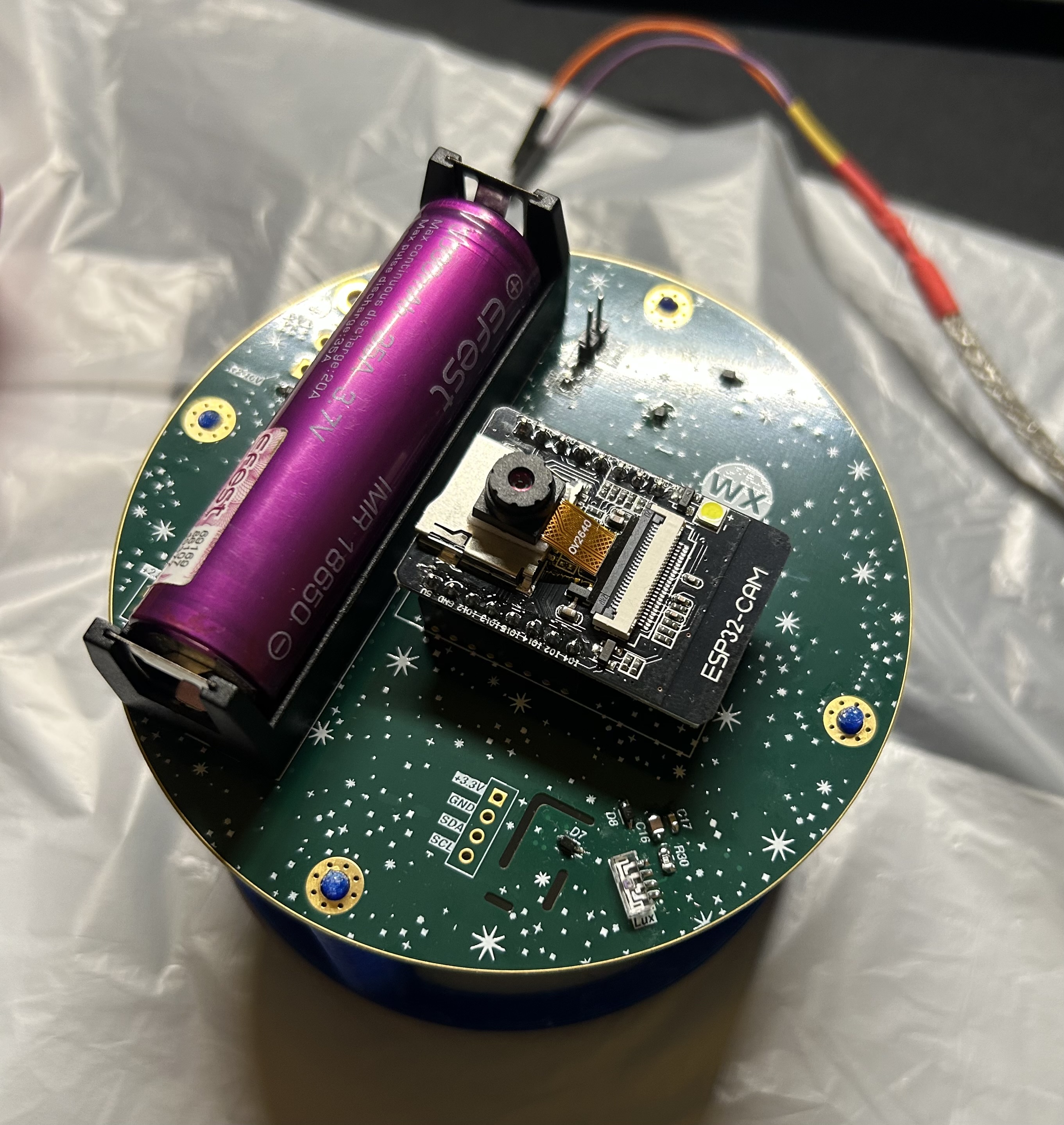
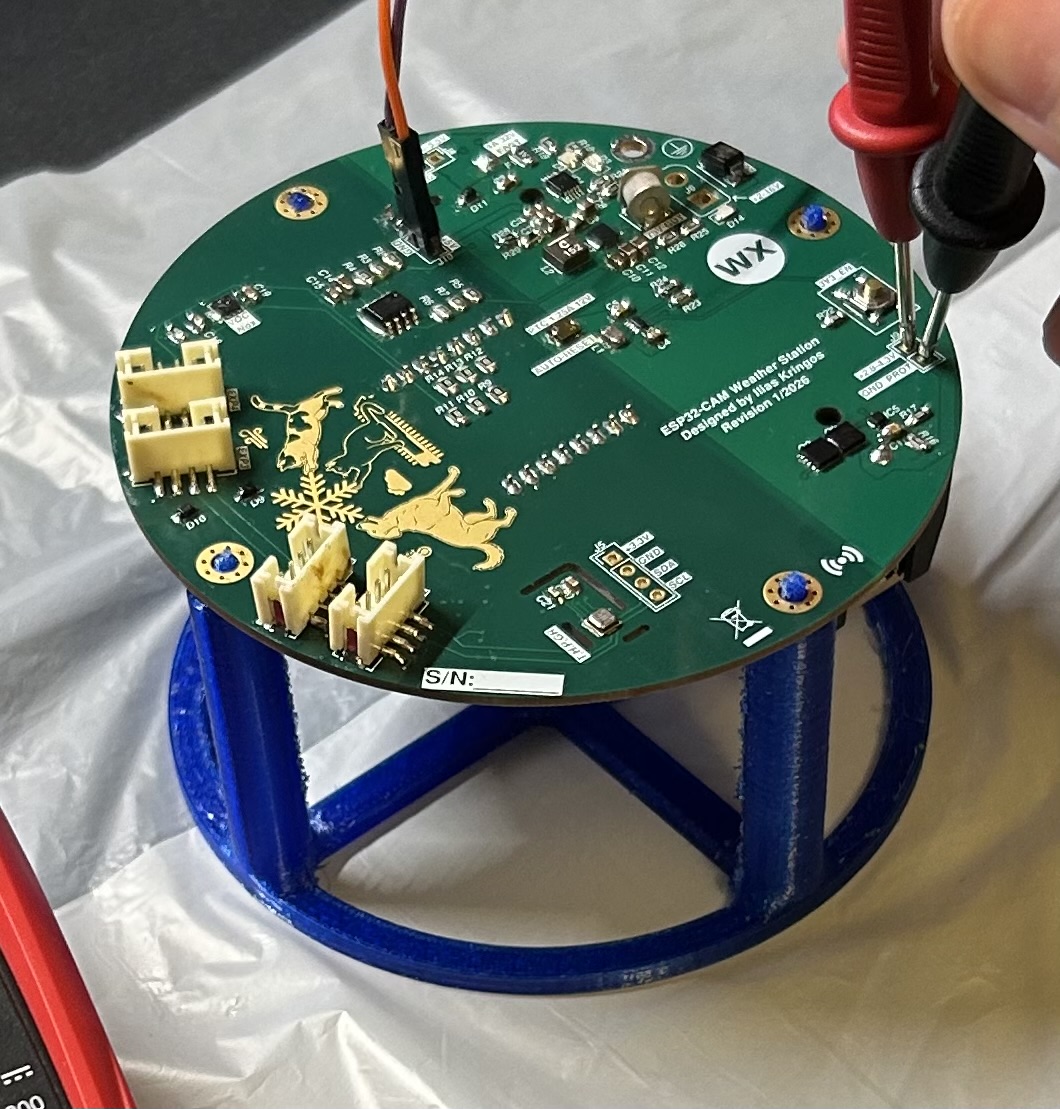
Photos below are from testing / bring-up and may show temporary wiring or rework.
PCB front (testing photo)
PCB back (testing photo)
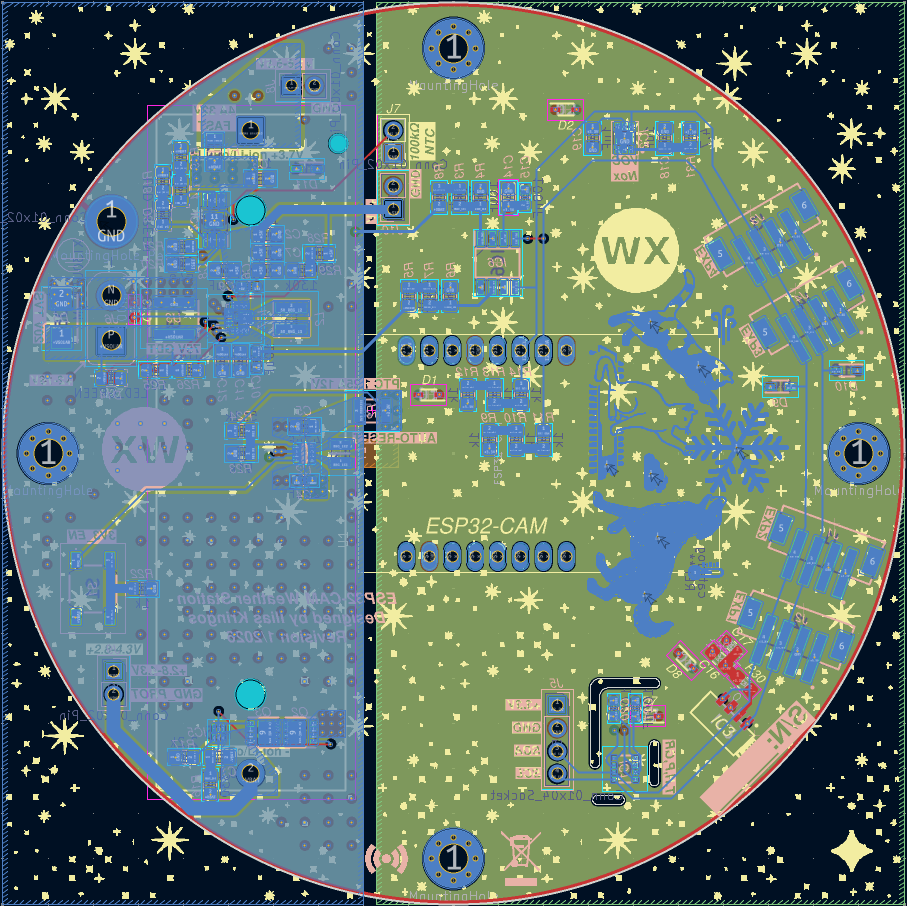
KiCad PCB layout (screenshot)
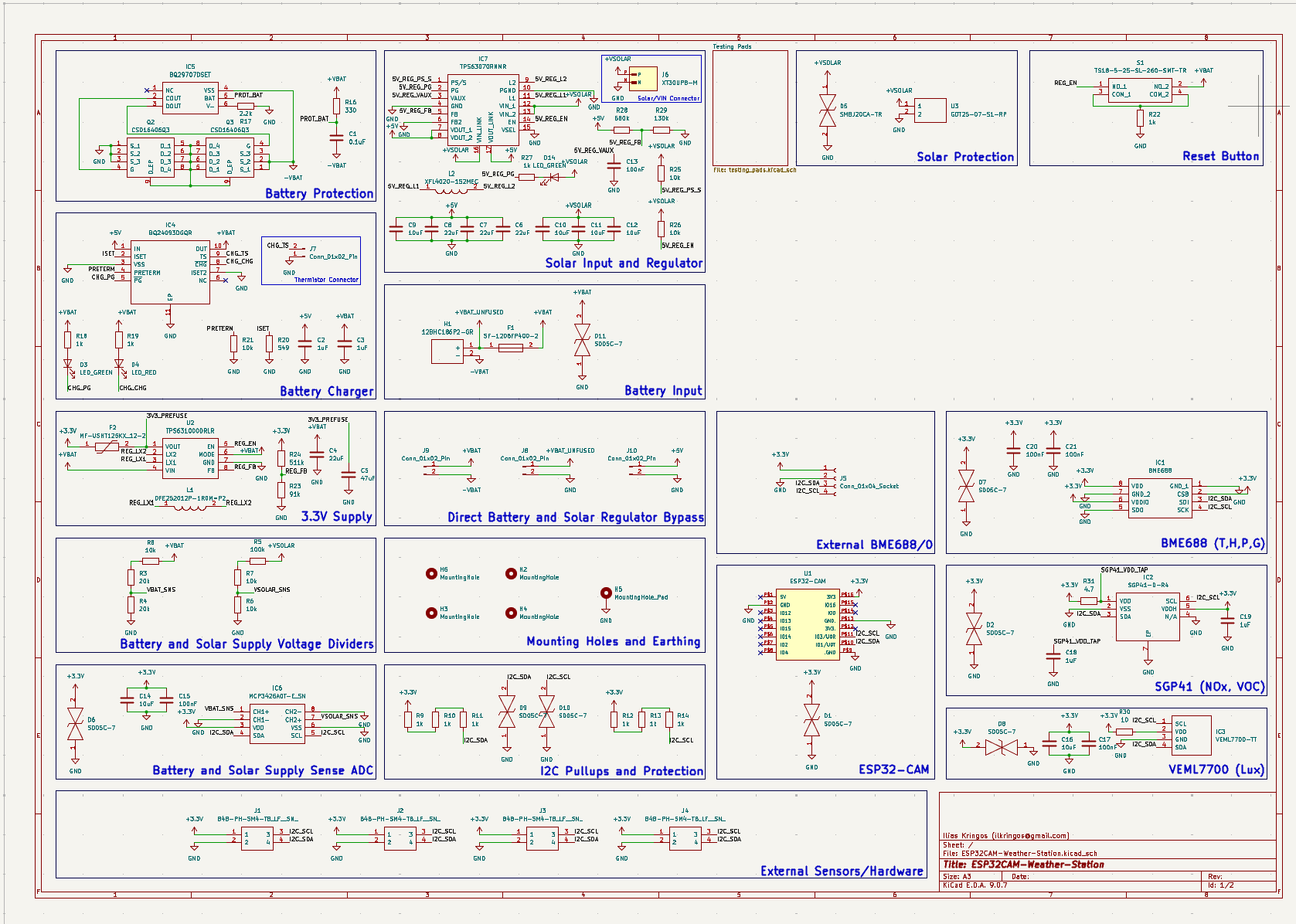
Schematic (export image)
This project consists of:
Security note: This design does not encrypt the data in transit (it is HTTP). It does prevent unauthorized clients from successfully sending data (and helps prevent trivial overload). If you need confidentiality, use HTTPS.
src/measurement_post_requests.cpp (or src/main.cpp) — client codeinclude/client_config.h — user-created (not committed)include/wificredentials.h — user-created (not committed)server/server_config.pyserver/server_http_hmac.pyNo pip packages required.
Create a directory (example):
server/
  server_http_hmac.py
server_config.pyserver_config.pyKey options:
HOST, PORT, INGEST_PATHAUTH_TOKENS, ALLOW_BEARER_HEADERREQUIRE_HMAC, REQUIRE_TIMESTAMP, RATE_LIMIT_*, MAX_BODY_BYTES, MAX_CONCURRENT_REQUESTSCSV_PATH_1, CSV_PATH_2, CSV_HEADERIf you are not setting time on the Pico (no NTP), set
REQUIRE_TIMESTAMP = False.
From the server/ directory:
python3 server_http_hmac.pycurl http://<server-ip>:<port>/healthCreate these two files under the PlatformIO include directory:
include/client_config.hinclude/wificredentials.hThese should not be committed (they contain secrets).
include/wificredentials.h#pragma once
#define WIFI_SSID "YOUR_WIFI_SSID"
#define WIFI_PASS "YOUR_WIFI_PASSWORD"
#define USE_STATIC_IP 1
#if USE_STATIC_IP
#define WIFI_LOCAL_IP IPAddress(192,168,2,55)
#define WIFI_DNS_IP IPAddress(1,1,1,1)
#define WIFI_GATEWAY_IP IPAddress(192,168,2,1)
#define WIFI_SUBNET_IP IPAddress(255,255,255,0)
#endifinclude/client_config.h#pragma once
#define DEVICE_ID "pico2w-01"
#define SERVER_URL "http://192.168.2.8:8080/ingest"
// Token secret: must exist in server_config.AUTH_TOKENS
#define AUTH_TOKEN "CHANGE_ME_TO_A_LONG_RANDOM_SECRET"
#define POST_INTERVAL_MS 1000
#define HTTP_TIMEOUT_MS 5000| Qty | Value | Footprint | References |
|---|---|---|---|
| 10 | 1k | Resistor_SMD:R_0805_2012Metric_Pad1.20x1.40mm_HandSolder | R9, R10, R11, R12, R13, R14, R18, R19, R22, R27 |
| 8 | SD05C-7 | SD05C-7:SOD2513X120N | D1, D2, D6, D7, D8, D9, D10, D11 |
| 6 | 10k | Resistor_SMD:R_0805_2012Metric_Pad1.20x1.40mm_HandSolder | R6, R7, R8, R21, R25, R26 |
| 5 | 100nF | Capacitor_SMD:C_0603_1608Metric_Pad1.08x0.95mm_HandSolder | C13, C15, C17, C20, C21 |
| 4 | 10uF | Capacitor_SMD:C_0805_2012Metric_Pad1.18x1.45mm_HandSolder | C11, C12, C14, C16 |
| 4 | 1uF | Capacitor_SMD:C_0805_2012Metric_Pad1.18x1.45mm_HandSolder | C2, C3, C18, C19 |
| 4 | B4B-PH-SM4-TB_LF__SN_ | B4B-PH-SM4-TB_LF__SN_:B4B-PH-SM4_1 | J1, J2, J3, J4 |
| 4 | Conn_01x02_Pin | Connector_PinHeader_2.54mm:PinHeader_1x02_P2.54mm_Vertical | J7, J8, J9, J10 |
| 4 | MountingHole | MountingHole:MountingHole_3.2mm_M3_Pad_Via | H2, H3, H4, H6 |
| 3 | 22uF | Capacitor_SMD:C_0805_2012Metric_Pad1.18x1.45mm_HandSolder | C6, C7, C8 |
| 2 | 10uF | Capacitor_SMD:C_0603_1608Metric_Pad1.08x0.95mm_HandSolder | C9, C10 |
| 2 | 20k | Resistor_SMD:R_0805_2012Metric_Pad1.20x1.40mm_HandSolder | R3, R4 |
| 2 | CSD16406Q3 | CSD16406Q3:DQG_VSON-CLIP | Q2, Q3 |
| 2 | LED_GREEN | LED_SMD:LED_0805_2012Metric_Pad1.15x1.40mm_HandSolder | D3, D14 |
| 1 | 0.1uF | Capacitor_SMD:C_0805_2012Metric_Pad1.18x1.45mm_HandSolder | C1 |
| 1 | 10 | Resistor_SMD:R_0805_2012Metric_Pad1.20x1.40mm_HandSolder | R30 |
| 1 | 100k | Resistor_SMD:R_0805_2012Metric_Pad1.20x1.40mm_HandSolder | R5 |
| 1 | 12BHC186P2-GR | 12BHC186P2-GR:12BHC186P2GR | H1 |
| 1 | 130k | Resistor_SMD:R_0805_2012Metric_Pad1.20x1.40mm_HandSolder | R29 |
| 1 | 2.2k | Resistor_SMD:R_0805_2012Metric_Pad1.20x1.40mm_HandSolder | R17 |
| 1 | 22uF | Capacitor_SMD:C_0603_1608Metric_Pad1.08x0.95mm_HandSolder | C4 |
| 1 | 330 | Resistor_SMD:R_0805_2012Metric_Pad1.20x1.40mm_HandSolder | R16 |
| 1 | 4.7 | Resistor_SMD:R_0805_2012Metric_Pad1.20x1.40mm_HandSolder | R31 |
| 1 | 47uF | Capacitor_SMD:C_0805_2012Metric_Pad1.18x1.45mm_HandSolder | C5 |
| 1 | 511k | Resistor_SMD:R_0805_2012Metric_Pad1.20x1.40mm_HandSolder | R24 |
| 1 | 549 | Resistor_SMD:R_0805_2012Metric_Pad1.20x1.40mm_HandSolder | R20 |
| 1 | 680k | Resistor_SMD:R_0805_2012Metric_Pad1.20x1.40mm_HandSolder | R28 |
| 1 | 91k | Resistor_SMD:R_0805_2012Metric_Pad1.20x1.40mm_HandSolder | R23 |
| 1 | BME688 | BME688:BME688 | IC1 |
| 1 | BQ24093DGQR | BQ24093DGQR:SOP50P490X110-11N | IC4 |
| 1 | BQ29707DSET | BQ29707DSET:TPS610985DSET | IC5 |
| 1 | Conn_01x04_Socket | Connector_PinHeader_2.54mm:PinHeader_1x04_P2.54mm_Vertical | J5 |
| 1 | DFE252012P-1R0M=P2 | DFE252012P-1R0M=P2:DFE2HCAH1R0MJ0L | L1 |
| 1 | ESP32-CAM | ESP32-CAM:ESP32-CAM | U1 |
| 1 | GDT25-07-S1-RP | GDT25-07-S1-RP:GDT2507S1RP | U3 |
| 1 | LED_RED | LED_SMD:LED_0805_2012Metric_Pad1.15x1.40mm_HandSolder | D4 |
| 1 | MCP3426A0T-E_SN | MCP3426A0T-E_SN:SOIC127P600X175-8N | IC6 |
| 1 | MF-USHT125KX_12-2 | MF-USHT125KX_12-2:MFUSHT125KX122 | F2 |
| 1 | MountingHole_Pad | MountingHole:MountingHole_3.2mm_M3_DIN965_Pad | H5 |
| 1 | SF-1206FP400-2 | SF-1206FP400-2:FUSC3116X70N | F1 |
| 1 | SGP41-D-R4 | SGP41-D-R4:SON80P244X244X95-7N | IC2 |
| 1 | SMBJ20CA-TR | SMBJ20CA-TR:DIONM5436X265N | D5 |
| 1 | TPS63070RNMR | TPS63070RNMR:TPS630701RNMR | IC7 |
| 1 | TPS631000DRLR | TPS631000DRLR:SOTFL50P160X60-8N | U2 |
| 1 | TS18-5-25-SL-260-SMT-TR | TS18-5-25-SL-260-SMT-TR:TS18525SL260SMTTR | S1 |
| 1 | VEML7700-TT | VEML7700-TT:VEML7700 | IC3 |
| 1 | XFL4020-152MEC | XFL4020-152MEC:XFL4020152MEC | L2 |
| 1 | XT30UPB-M | XT30UPB-M:AMASS_XT30UPB-M | J6 |
The 94 most common of 96 parts.
EliaKr/ESP32CAM-Weather-Station
[WIP] This repo includes electronics (schematics/PCBs), 3D-printable mechanical parts, and software for a custom ESP32-CAM weather station.


Sai-Santosh09/Flight-Controller
Flight Controller is a compact STM32F722-based flight controller designed for drones and other unmanned aerial systems.

Acidicts/FlightController
PCB BOM UNSELECTED - Most due to not being in stock or I couldn't find them on lcsc


eshelton328/forge
Hardware design monorepo with software-grade CI/CD. KiCad PCB projects with automated ERC/DRC, multi-fab rule validation, schematic & BOM checks, and auto-generated board documentation.


Markvsid/Piezo_sensing
Exploratory project using piezoelectric contact sensor to attempt to extract footstep count, breathing, and heartbeat. 4 layer stm32H7 PCB with analog charge amplifier front end.
It measures 50 × 38.9 mm and has 4 copper layers, 1.58 mm thick.
96 parts, built around the ESP32-CAM, BME688, SGP41-D-R4 and TPS63070RNMR. The full list of its parts is on this page, with links to each part's symbol and footprint where PCBKit's library has them.
From the EliaKr/ESP32CAM-Weather-Station repository on GitHub, at the commit this page was made from: the board is electronics/ESP32CAM-Weather-Station/ESP32CAM-Weather-Station.kicad_pcb and its schematic electronics/ESP32CAM-Weather-Station/ESP32CAM-Weather-Station-backups/ESP32CAM-Weather-Station-2026-01-18_001710/ESP32CAM-Weather-Station.kicad_sch. PCBKit opens the board in the browser, with nothing to install.
Its repository publishes it under the GPL-3.0 licence: you may reuse it on that licence's terms (keep the author's notice, and for a copyleft licence share your changes alike).