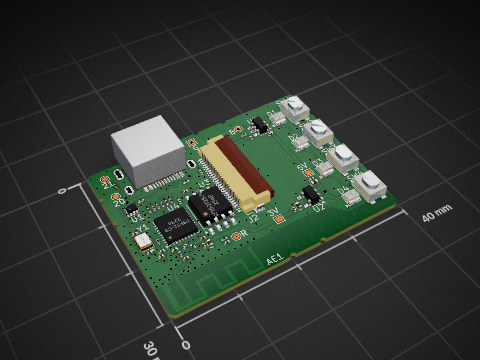
4 layers85 × 56 mm
Espressif SystemsExtended
12bit 160MHz 22 3V~3.6V Others QFN-32-EP(5x5) Microcontrollers (MCU/MPU/SOC) ROHS
The ESP32-C3 is a microcontroller made by Espressif Systems in a QFN-32-EP(5x5) package with 33 pins. 12bit 160MHz 22 3V~3.6V Others QFN-32-EP(5x5) Microcontrollers (MCU/MPU/SOC) ROHS.
PCBKit's library has its KiCad symbol (Espressif:ESP32-C3, from Espressif) and its footprint (Package_DFN_QFN:QFN-32-1EP_5x5mm_P0.5mm_EP3.7x3.7mm, from KiCad's library), ready for a KiCad board. 6,638 are in stock at JLCPCB (part C2838500). 128 open-source boards in 103 repositories on GitHub use it.
| Parameter | Conditions | As printed | Page |
|---|---|---|---|
| Allowed input voltage Input power pins | min -0.3 · max 3.6 V | 43 | |
| Cumulative IO output current Ioutput | max 1000 mA | 43 | |
| Storage temperature TST ORE | min -40 · max 150 °C | 43 | |
| Recommended input voltage VDDA, VDD3P3, VDD3P3_RTC | min 3 · typ 3.3 · max 3.6 V | 43 | |
| Recommended input voltage VDD3P3_CPU | min 3 · typ 3.3 · max 3.6 V | 43 | |
| VDD_SPI (as input) VDD_SPI | as input | min 3 · typ 3.3 · max 3.6 V | 43 |
| Cumulative input current IV DD | min 0.5 A | 43 | |
| VDD_SPI powered by VDD3P3_CPU via RSP I for 3.3 V flash_CPU RSP I | VDD_SPI powered by VDD3P3_CPU | typ 7.5 Ω | 44 |
| Pin capacitance CIN | 3.3 V, 25 °C | typ 2 pF | 44 |
| Low-level input voltage VIL | 3.3 V, 25 °C; VDD is the supply of the respective power domain | min -0.3 V | 44 |
| High-level input current IIH | 3.3 V, 25 °C | max 50 nA | 44 |
| Low-level input current IIL | 3.3 V, 25 °C | max 50 nA | 44 |
| High-level source current IOH | VDD = 3.3 V, VOH >= 2.64 V, PAD_DRIVER = 3; 25 °C | typ 40 mA | 44 |
| Low-level sink current IOL | VDD = 3.3 V, VOL = 0.495 V, PAD_DRIVER = 3; 25 °C | typ 28 mA | 44 |
| Internal weak pull-up resistor RP U | 3.3 V, 25 °C | typ 45 kΩ | 44 |
| Internal weak pull-down resistor RP D | 3.3 V, 25 °C | typ 45 kΩ | 44 |
| Chip reset voltage VIL_nRST | CHIP_EN voltage within specified range; 3.3 V, 25 °C | min -0.3 V | 44 |
| Differential nonlinearity DNL | ADC connected to an external 100 nF capacitor; DC signal input; ambient temperature 25 °C; Wi-Fi off | min -7 · max 7 LSB | 45 |
| Integral nonlinearity INL | ADC connected to an external 100 nF capacitor; DC signal input; ambient temperature 25 °C; Wi-Fi off | min -12 · max 12 LSB | 45 |
| Sampling rate | max 100 kSPS | 45 | |
| Total error | ATTEN0, effective measurement range of 0 ~ 750 | min -10 · max 10 mV | 45 |
| Total error | ATTEN1, effective measurement range of 0 ~ 1050 | min -10 · max 10 mV | 45 |
| Total error | ATTEN2, effective measurement range of 0 ~ 1300 | min -10 · max 10 mV | 45 |
| Total error | ATTEN3, effective measurement range of 0 ~ 2500 | min -35 · max 35 mV | 45 |
| Active (RF working) | TX; 802.11b, 1 Mbps, @21 dBm; 3.3 V, 25 °C; 100% duty cycle; peak | max 335 mA | 45 |
| Active (RF working) | TX; 802.11g, 54 Mbps, @19 dBm; 3.3 V, 25 °C; 100% duty cycle; peak | max 285 mA | 45 |
| Active (RF working) | TX; 802.11n, HT20, MCS7, @18.5 dBm; 3.3 V, 25 °C; 100% duty cycle; peak | max 276 mA | 45 |
| Active (RF working) | TX; 802.11n, HT40, MCS7, @18.5 dBm; 3.3 V, 25 °C; 100% duty cycle; peak | max 278 mA | 45 |
| Active (RF working) | RX; 802.11b/g/n, HT20; 3.3 V, 25 °C; peak | max 84 mA | 45 |
| Active (RF working) | RX; 802.11n, HT40; 3.3 V, 25 °C; peak | max 87 mA | 45 |
| Modem-sleep | 160 MHz; CPU is running; all peripherals clocks disabled | typ 23 mA | 46 |
| Modem-sleep | 160 MHz; CPU is running; all peripherals clocks enabled | typ 28 mA | 46 |
| Modem-sleep | 160 MHz; CPU is idle; all peripherals clocks disabled | typ 16 mA | 46 |
| Modem-sleep | 160 MHz; CPU is idle; all peripherals clocks enabled | typ 21 mA | 46 |
| Modem-sleep | 80 MHz; CPU is running; all peripherals clocks disabled | typ 17 mA | 46 |
| Modem-sleep | 80 MHz; CPU is running; all peripherals clocks enabled | typ 22 mA | 46 |
| Modem-sleep | 80 MHz; CPU is idle; all peripherals clocks disabled | typ 13 mA | 46 |
| Modem-sleep | 80 MHz; CPU is idle; all peripherals clocks enabled | typ 18 mA | 46 |
| Light-sleep | VDD_SPI and Wi-Fi are powered down, and all GPIOs are high-impedance | typ 130 uA | 46 |
| Deep-sleep | RTC timer + RTC memory | typ 5 uA | 46 |
| Power off | CHIP_EN is set to low level, the chip is powered off | typ 1 uA | 46 |
| ESD (Electro-Static Discharge Sensitivity) | HBM (Human Body Mode); JS-001 | min -2000 · max 2000 V | 46 |
| ESD (Electro-Static Discharge Sensitivity) | CDM (Charge Device Mode); JS-002 | min -1000 · max 1000 V | 46 |
| VDD_SPI (as input) VDD_SPI | min 3 · typ 3.3 · max 3.6 V | 43 | |
| VDD_SPI powered by VDD3P3_CPU via RSP I for 3.3 V flash_CPU RSP I | typ 7.5 Ω | 44 | |
| Low-level input voltage VIL | 3.3 V, 25 °C; max 0.25 × VDD | min -0.3 V | 44 |
| Chip reset voltage VIL_nRST | CHIP_EN voltage is within the specified range; max 0.25 × VDD | min -0.3 V | 44 |
| Differential nonlinearity DNL | ADC connected to an external 100 nF capacitor; DC signal input; ambient temperature at 25 °C; Wi-Fi off | min -7 · max 7 LSB | 45 |
| Integral nonlinearity INL | ADC connected to an external 100 nF capacitor; DC signal input; ambient temperature at 25 °C; Wi-Fi off | min -12 · max 12 LSB | 45 |
| Total error | ATTEN0, effective measurement range of 0 ~ 750; hardware and software calibration | min -10 · max 10 mV | 45 |
| Total error | ATTEN1, effective measurement range of 0 ~ 1050; hardware and software calibration | min -10 · max 10 mV | 45 |
| Total error | ATTEN2, effective measurement range of 0 ~ 1300; hardware and software calibration | min -10 · max 10 mV | 45 |
| Total error | ATTEN3, effective measurement range of 0 ~ 2500; hardware and software calibration | min -35 · max 35 mV | 45 |
| Active (RF working) | TX; 802.11b, 1 Mbps, @21 dBm; 3.3 V, 25 °C, 100% duty cycle; peak | max 335 mA | 45 |
| Active (RF working) | TX; 802.11g, 54 Mbps, @19 dBm; 3.3 V, 25 °C, 100% duty cycle; peak | max 285 mA | 45 |
| Active (RF working) | TX; 802.11n, HT20, MCS7, @18.5 dBm; 3.3 V, 25 °C, 100% duty cycle; peak | max 276 mA | 45 |
| Active (RF working) | TX; 802.11n, HT40, MCS7, @18.5 dBm; 3.3 V, 25 °C, 100% duty cycle; peak | max 278 mA | 45 |
| ESD (Electro-Static Discharge Sensitivity) | HBM (Human Body Mode); JS-001; ±2000 V | min -2000 · max 2000 V | 46 |
| ESD (Electro-Static Discharge Sensitivity) | CDM (Charge Device Mode); JS-002; ±1000 V | min -1000 · max 1000 V | 46 |
| Latch up | Current trigger ± 200 mA; JESD78 | min -200 · max 200 mA | 46 |
| Center frequency of operating channel | min 2412 · max 2484 MHz | 47 | |
| 802.11b, 1 Mbps | typ 21 dBm | 47 | |
| 802.11b, 11 Mbps | typ 21 dBm | 47 | |
| 802.11g, 6 Mbps | typ 21 dBm | 47 | |
| 802.11g, 54 Mbps | typ 19 dBm | 47 | |
| 802.11n, HT20, MCS0 | typ 20 dBm | 47 | |
| 802.11n, HT20, MCS7 | typ 18.5 dBm | 47 | |
| 802.11n, HT40, MCS0 | typ 20 dBm | 47 | |
| 802.11n, HT40, MCS7 | typ 18.5 dBm | 47 | |
| 802.11b, 1 Mbps, @21 dBm | SL (standard limit) = –10 dB | typ -24.5 · max -10 dB | 47 |
| 802.11b, 11 Mbps, @21 dBm | SL (standard limit) = –10 dB | typ -25 · max -10 dB | 47 |
| 802.11g, 6 Mbps, @21 dBm | SL (standard limit) = –5 dB | typ -23 · max -5 dB | 47 |
| 802.11g, 54 Mbps, @19 dBm | SL (standard limit) = –25 dB | typ -27.5 · max -25 dB | 47 |
| 802.11n, HT20, MCS0, @20 dBm | SL (standard limit) = –5 dB | typ -22.5 · max -5 dB | 47 |
| 802.11n, HT20, MCS7, @18.5 dBm | SL (standard limit) = –27 dB | typ -29 · max -27 dB | 47 |
| 802.11n, HT40, MCS0, @20 dBm | SL (standard limit) = –5 dB | typ -22.5 · max -5 dB | 47 |
| 802.11n, HT40, MCS7, @18.5 dBm | SL (standard limit) = –27 dB | typ -28 · max -27 dB | 47 |
| 802.11b, 1 Mbps | typ -98.4 dBm | 48 | |
| 802.11b, 2 Mbps | typ -96 dBm | 48 | |
| 802.11b, 5.5 Mbps | typ -93 dBm | 48 | |
| 802.11b, 11 Mbps | typ -88.6 dBm | 48 | |
| 802.11g, 6 Mbps | typ -93.8 dBm | 48 | |
| 802.11g, 9 Mbps | typ -92.2 dBm | 48 | |
| 802.11g, 12 Mbps | typ -91 dBm | 48 | |
| 802.11g, 18 Mbps | typ -88.4 dBm | 48 | |
| 802.11g, 24 Mbps | typ -85.8 dBm | 48 | |
| 802.11g, 36 Mbps | typ -82 dBm | 48 | |
| 802.11g, 48 Mbps | typ -78 dBm | 48 | |
| 802.11g, 54 Mbps | typ -76.6 dBm | 48 | |
| 802.11n, HT20, MCS0 | typ -93.6 dBm | 48 | |
| 802.11n, HT20, MCS1 | typ -90.8 dBm | 48 | |
| 802.11n, HT20, MCS2 | typ -88.4 dBm | 48 | |
| 802.11n, HT20, MCS3 | typ -85 dBm | 48 | |
| 802.11n, HT20, MCS4 | typ -81.8 dBm | 48 | |
| 802.11n, HT20, MCS5 | typ -77.8 dBm | 48 | |
| 802.11n, HT20, MCS6 | typ -76 dBm | 48 | |
| 802.11n, HT20, MCS7 | typ -74.8 dBm | 48 | |
| 802.11n, HT40, MCS0 | typ -90 dBm | 48 | |
| 802.11n, HT40, MCS1 | typ -88 dBm | 48 | |
| 802.11n, HT40, MCS2 | typ -85.2 dBm | 48 | |
| 802.11n, HT40, MCS3 | typ -82 dBm | 48 | |
| 802.11n, HT40, MCS4 | typ -78.8 dBm | 48 | |
| 802.11n, HT40, MCS5 | typ -74.6 dBm | 48 | |
| 802.11n, HT40, MCS6 | typ -73 dBm | 48 | |
| 802.11n, HT40, MCS7 | typ -71.4 dBm | 48 | |
| 802.11b, 1 Mbps | typ 5 dBm | 48 | |
| 802.11b, 11 Mbps | typ 5 dBm | 48 | |
| 802.11g, 6 Mbps | typ 5 dBm | 48 | |
| 802.11g, 54 Mbps | typ 0 dBm | 48 | |
| 802.11n, HT20, MCS0 | typ 5 dBm | 48 | |
| 802.11n, HT20, MCS7 | typ 0 dBm | 49 | |
| 802.11n, HT40, MCS0 | typ 5 dBm | 49 | |
| 802.11n, HT40, MCS7 | typ 0 dBm | 49 | |
| 802.11b, 1 Mbps | typ 35 dB | 49 | |
| 802.11b, 11 Mbps | typ 35 dB | 49 | |
| 802.11g, 6 Mbps | typ 31 dB | 49 | |
| 802.11g, 54 Mbps | typ 20 dB | 49 | |
| 802.11n, HT20, MCS0 | typ 31 dB | 49 | |
| 802.11n, HT20, MCS7 | typ 16 dB | 49 | |
| 802.11n, HT40, MCS0 | typ 25 dB | 49 | |
| 802.11n, HT40, MCS7 | typ 11 dB | 49 | |
| Center frequency of operating channel | min 2402 · max 2480 MHz | 49 | |
| RF transmit power | RF power control range | min -24 · typ 0 · max 20 dBm | 49 |
| RF transmit power | Gain control step | typ 3 dB | 49 |
| Carrier frequency offset and drift | Max |fn |n=0, 1, 2, k | typ 17 kHz | 49 |
| Carrier frequency offset and drift | Max |f0 − fn | | typ 1.75 kHz | 49 |
| Carrier frequency offset and drift | Max |fn − fn−5 | | typ 1.46 kHz | 49 |
| Carrier frequency offset and drift | |f1 − f0 | | typ 0.8 kHz | 49 |
| Modulation characteristics | ∆ f 1avg | typ 250 kHz | 49 |
| Modulation characteristics | Min ∆ f 2max (for at least 99.9% of all ∆ f 2max) | typ 190 kHz | 49 |
| Modulation characteristics | ∆ f 2avg /∆ f 1avg | typ 0.83 — | 49 |
| In-band spurious emissions | ± 2 MHz offset | typ -37.62 dBm | 50 |
| In-band spurious emissions | ± 3 MHz offset | typ -41.95 dBm | 50 |
| In-band spurious emissions | > ± 3 MHz offset | typ -44.48 dBm | 50 |
| Carrier frequency offset and drift | Max |fn |n=0, 1, 2, k | typ 20.8 kHz | 50 |
| Carrier frequency offset and drift | Max |f0 − fn | | typ 1.3 kHz | 50 |
| Carrier frequency offset and drift | Max |fn − fn−5 | | typ 1.33 kHz | 50 |
| Carrier frequency offset and drift | |f1 − f0 | | typ 0.7 kHz | 50 |
| Modulation characteristics | ∆ f 1avg | typ 498 kHz | 50 |
| Modulation characteristics | Min ∆ f 2max (for at least 99.9% of all ∆ f 2max) | typ 430 kHz | 50 |
| Modulation characteristics | ∆ f 2avg /∆ f 1avg | typ 0.93 — | 50 |
| In-band spurious emissions | ± 4 MHz offset | typ -43.55 dBm | 50 |
| In-band spurious emissions | ± 5 MHz offset | typ -45.26 dBm | 50 |
| In-band spurious emissions | > ± 5 MHz offset | typ -45.26 dBm | 50 |
| Carrier frequency offset and drift | Max |fn |n=0, 1, 2, k | typ 17.5 kHz | 50 |
| Carrier frequency offset and drift | Max |f0 − fn | | typ 0.45 kHz | 50 |
| Carrier frequency offset and drift | |fn − fn−3 | | typ 0.7 kHz | 50 |
| Carrier frequency offset and drift | |f0 − f3 | | typ 0.3 kHz | 50 |
| Modulation characteristics | Min ∆ f 1max (for at least 99.9% of all∆ f 2max) | typ 235 kHz | 50 |
| In-band spurious emissions | ± 2 MHz offset | typ -37.9 dBm | 50 |
| In-band spurious emissions | ± 3 MHz offset | typ -41 dBm | 50 |
| In-band spurious emissions | > ± 3 MHz offset | typ -42.5 dBm | 50 |
| Carrier frequency offset and drift | Max |f0 − fn | | typ 0.88 kHz | 51 |
| Carrier frequency offset and drift | |fn − fn−3 | | typ 1 kHz | 51 |
| Carrier frequency offset and drift | |f0 − f3 | | typ 0.2 kHz | 51 |
| Modulation characteristics | ∆ f 2avg | typ 208 kHz | 51 |
| Modulation characteristics | Min ∆ f 2max (for at least 99.9% of all ∆ f 2max) | typ 190 kHz | 51 |
| In-band spurious emissions | ± 3 MHz offset | typ -41.3 dBm | 51 |
| In-band spurious emissions | > ± 3 MHz offset | typ -42.8 dBm | 51 |
| Sensitivity @30.8% PER | typ -97 dBm | 51 | |
| Maximum received signal @30.8% PER | typ 5 dBm | 51 | |
| Co-channel C/I | typ 8 dB | 51 | |
| Adjacent channel selectivity C/I | F = F0 + 1 MHz | typ -3 dB | 51 |
| Adjacent channel selectivity C/I | F = F0 – 1 MHz | typ -4 dB | 51 |
| Adjacent channel selectivity C/I | F = F0 + 2 MHz | typ -29 dB | 51 |
| Adjacent channel selectivity C/I | F = F0 – 2 MHz | typ -31 dB | 51 |
| Adjacent channel selectivity C/I | F = F0 + 3 MHz | typ -33 dB | 51 |
| Adjacent channel selectivity C/I | F = F0 – 3 MHz | typ -27 dB | 51 |
| Adjacent channel selectivity C/I | F ≥ F0 + 4 MHz | typ -29 dB | 51 |
| Adjacent channel selectivity C/I | F ≤ F0 – 4 MHz | typ -38 dB | 51 |
| Image frequency | typ -29 dB | 51 | |
| Adjacent channel to image frequency | F = Fimage + 1 MHz | typ -41 dB | 51 |
| Adjacent channel to image frequency | F = Fimage – 1 MHz | typ -33 dB | 51 |
| Out-of-band blocking performance | 30 MHz ~ 2000 MHz | typ -5 dBm | 51 |
| Out-of-band blocking performance | 2003 MHz ~ 2399 MHz | typ -18 dBm | 51 |
| Out-of-band blocking performance | 2484 MHz ~ 2997 MHz | typ -15 dBm | 51 |
| Out-of-band blocking performance | 3000 MHz ~ 12.75 GHz | typ -5 dBm | 51 |
| Intermodulation | typ -30 dBm | 51 | |
| Sensitivity @30.8% PER | typ -93 dBm | 51 | |
| Maximum received signal @30.8% PER | typ 3 dBm | 51 | |
| Co-channel C/I | typ 10 dB | 51 | |
| Adjacent channel selectivity C/I | F = F0 + 2 MHz | typ -7 dB | 52 |
| Adjacent channel selectivity C/I | F = F0 – 2 MHz | typ -7 dB | 52 |
| Adjacent channel selectivity C/I | F = F0 + 4 MHz | typ -28 dB | 52 |
| Adjacent channel selectivity C/I | F = F0 – 4 MHz | typ -26 dB | 52 |
| Adjacent channel selectivity C/I | F = F0 + 6 MHz | typ -26 dB | 52 |
| Adjacent channel selectivity C/I | F = F0 – 6 MHz | typ -27 dB | 52 |
| Adjacent channel selectivity C/I | F ≥ F0 + 8 MHz | typ -29 dB | 52 |
| Adjacent channel selectivity C/I | F ≤ F0 – 8 MHz | typ -28 dB | 52 |
| Image frequency | typ -28 dB | 52 | |
| Adjacent channel to image frequency | F = Fimage + 2 MHz | typ -26 dB | 52 |
| Adjacent channel to image frequency | F = Fimage – 2 MHz | typ -7 dB | 52 |
| Out-of-band blocking performance | 2003 MHz ~ 2399 MHz | typ -19 dBm | 52 |
| Out-of-band blocking performance | 2484 MHz ~ 2997 MHz | typ -16 dBm | 52 |
| Intermodulation | typ -29 dBm | 52 | |
| Sensitivity @30.8% PER | typ -105 dBm | 52 | |
| Co-channel C/I | typ 3 dB | 52 | |
| Adjacent channel selectivity C/I | F = F0 + 1 MHz | typ -6 dB | 52 |
| Adjacent channel selectivity C/I | F = F0 – 1 MHz | typ -6 dB | 52 |
| Adjacent channel selectivity C/I | F = F0 + 2 MHz | typ -33 dB | 52 |
| Adjacent channel selectivity C/I | F = F0 – 2 MHz | typ -43 dB | 52 |
| Adjacent channel selectivity C/I | F = F0 + 3 MHz | typ -37 dB | 52 |
| Adjacent channel selectivity C/I | F = F0 – 3 MHz | typ -47 dB | 52 |
| Adjacent channel selectivity C/I | F ≥ F0 + 4 MHz | typ -40 dB | 52 |
| Adjacent channel selectivity C/I | F ≤ F0 – 4 MHz | typ -50 dB | 52 |
| Image frequency | typ -40 dB | 52 | |
| Adjacent channel to image frequency | F = Fimage + 1 MHz | typ -50 dB | 52 |
| Adjacent channel to image frequency | F = Fimage – 1 MHz | typ -37 dB | 52 |
| Sensitivity @30.8% PER | typ -100 dBm | 52 | |
| Adjacent channel selectivity C/I | F = F0 + 1 MHz | typ -2 dB | 52 |

G-Pereira/greenmobi-bms
A VESC compatible battery management system

OpenDrone-hw/OpenAIO
Open-source AIO for 2-6S toothpick quads: flight controller, 4-in-1 AM32 ESC and ExpressLRS receiver, 25.5x25.5 mm.


Yes. The symbol is Espressif:ESP32-C3 and the footprint Package_DFN_QFN:QFN-32-1EP_5x5mm_P0.5mm_EP3.7x3.7mm, both drawn on this page. PCBKit places them on a board for you when you design with it.
QFN-32-EP(5x5), with 33 pins. Its footprint is drawn on this page.
Espressif Systems publishes it: the Datasheet link on this page opens it.
JLCPCB lists it as part C2838500, with 6,638 in stock; the sellers' links on this page open their listings.
Parts like it in the library: the ESP32-C3FH4 by Espressif Systems, the ESP32-C3FN4 by Espressif Systems and the ESP32-C3FH4X by Espressif Systems. Check their datasheets: a part that fits the footprint may still differ in its ratings.
128 boards in 103 repositories on GitHub; the most starred are listed on this page, with their KiCad files.